The CPU cooling market shifted further in early 2026. Arctic’s Liquid Freezer III Pro — named the cooler to beat by both Tom’s Hardware and Tech4Gamers — has displaced the original Freezer III as the 360mm AIO benchmark, delivering up to 10°C better thermals on Intel and running 19% quieter at the same speeds. Meanwhile, the Noctua NH-D15 G2 has climbed from its $150 launch price to around $180, narrowing its value case against performance AIOs. The honest answer to “air or liquid?” is more nuanced than ever.
| Spec | Noctua NH-D15 G2 9.2/10 | DeepCool AK620 Digital Unavailable 9/10 | be quiet! Dark Rock Pro 5 8.8/10 | Arctic Liquid Freezer III Pro 360 9.5/10 | Thermalright Aqua Elite 360 V3 8.5/10 |
|---|---|---|---|---|---|
| type | Dual-tower air | Dual-tower air | Dual-tower air | 360mm AIO | 360mm AIO |
| fans | 2x 140mm NF-A14x25r G2 PWM | 2x 120mm FK120 PWM | 2x 135mm Silent Wings 4 PWM | 3x 120mm P12 Pro PWM (200-1800 RPM, 7-blade) | 3x 120mm ARGB PWM (800-2000 RPM) |
| tdp | 240W rated | 260W rated | 270W rated | — | — |
| height | 168mm | 160mm | 168mm | — | — |
| noise | 24.6 dBA max | 28.0 dBA max | 24.3 dBA max | — | — |
| socket | AM5/AM4, LGA1700/LGA1851 | AM5/AM4, LGA1700/LGA1851 | AM5/AM4, LGA1700/LGA1851 | AM5/AM4, LGA1700/LGA1851 | AM5/AM4, LGA1700/LGA1851 |
| Rating | 9.2/10 | 9/10 | 8.8/10 | 9.5/10 | 8.5/10 |
Prices change daily — tap Check Price for the current Amazon price.
Prices change daily — tap Check Price for the current Amazon price.
Quick Verdict
Pick air cooling if your CPU is a mid-range or mainstream chip (Ryzen 7 9700X, Core Ultra 5 245, or lower), your case has 170mm+ clearance, and you value zero-maintenance reliability. An $83 DeepCool AK620 Digital handles those loads with no moving parts that can fail.
Pick liquid cooling if you’re running a high-TDP chip (Ryzen 9 9950X, Core Ultra 9 285K), pushing sustained all-core loads like rendering or compiling, or if RAM clearance and aesthetics drive the decision. The Arctic Liquid Freezer III Pro 360 at $95 handles 300W+ loads and runs quieter than any comparably-priced air cooler under heavy use.
The crossover point sits at roughly 200W sustained thermal output. Below that, premium air coolers match or beat AIOs on noise-normalized performance. Above it — especially above 250W — liquid cooling pulls decisively ahead.
How They Compare: Cooling Method Fundamentals
Air coolers transfer heat from the CPU IHS through copper heatpipes into aluminum fins, where case airflow carries it away. The entire cooling chain relies on thermal conductivity — no consumable parts, nothing that can leak or fail mechanically.
Liquid coolers circulate coolant from a cold plate to a radiator mounted at the case intake or exhaust. The larger radiator surface area lets fans spin slower for the same heat dissipation — that’s the core acoustic advantage. The trade-off is mechanical complexity: a pump with a rated lifespan (typically 50,000 hours MTBF), tubing that can potentially leak, and a cold plate requiring correct mounting pressure.
| Factor | Premium Air (NH-D15 G2) | Budget Air (AK620) | 360mm AIO (Freezer III Pro) | Budget AIO (Aqua Elite) |
|---|---|---|---|---|
| Avg temp (200W load) | 68°C | 70°C | 60°C | 67°C |
| Noise at 200W | 32 dBA | 35 dBA | 27 dBA | 33 dBA |
| Noise at 300W | Not rated | Not rated | 32 dBA | 38 dBA |
| RAM clearance | Poor (168mm) | Poor (160mm) | Full | Full |
| Case height req. | 180mm+ | 175mm+ | 120mm rad. space | 120mm rad. space |
| Failure modes | None | None | Pump, tubing | Pump, bearing |
| Typical lifespan | 7-10+ years | 5-7 years | 5-7 years (sealed) | 3-5 years |
| Price | $180 | $83 | $95 | $55 |
Approximate values based on published review data. Actual results vary by CPU, case, and ambient temperature.
When Air Cooling Wins
For mainstream gaming builds running the Ryzen 7 9700X (65W TDP, spikes to ~120W all-core) or Core Ultra 5 245, a quality dual-tower air cooler never approaches its thermal limit. Under gaming loads — bursty rather than sustained — the AK620 Digital keeps temps in the 65-72°C range with fans barely audible at 900-1,000 RPM.
Air cooling also wins on long-term value. Sealed AIO pumps carry a rated MTBF of ~50,000 hours — about 5.7 years of continuous operation. Failed pumps are the number one AIO failure mode in reliability data, a risk that simply doesn’t exist with air. A Noctua or DeepCool air cooler will likely outlive your next two or three CPU upgrades.
Cases with limited clearance — ITX builds, compact mATX — also favor air cooling, as long as the cooler height fits. A 120mm single-tower like the Noctua NH-U12S fits ITX cases where a 240mm AIO would require top-mount routing.
When Liquid Cooling Wins
The Core Ultra 9 285K and Ryzen 9 9950X both push past 250W under sustained all-core loads. At that power level, even the best dual-tower air coolers hit their thermal ceiling — CPU temperatures above 90°C trigger throttling and shorten boost durations. A 360mm AIO handles these loads with headroom to spare.
Noise-normalized performance is the other major AIO advantage. A 360mm radiator has roughly 1.5× the fin surface area of a dual-tower air cooler. Extra surface lets fans spin at 600-800 RPM for the same heat dissipation, versus 1,000-1,200 RPM on a dual-tower. The gap is audible in a quiet room.
Liquid cooling also eliminates the RAM clearance issues that large air coolers create. Running tall DDR5 kits — Corsair Vengeance, G.Skill Trident Z5, anything with heatspreaders over 40mm — an AIO removes the compatibility question entirely.
Air Cooler Deep Dives
Noctua NH-D15 G2
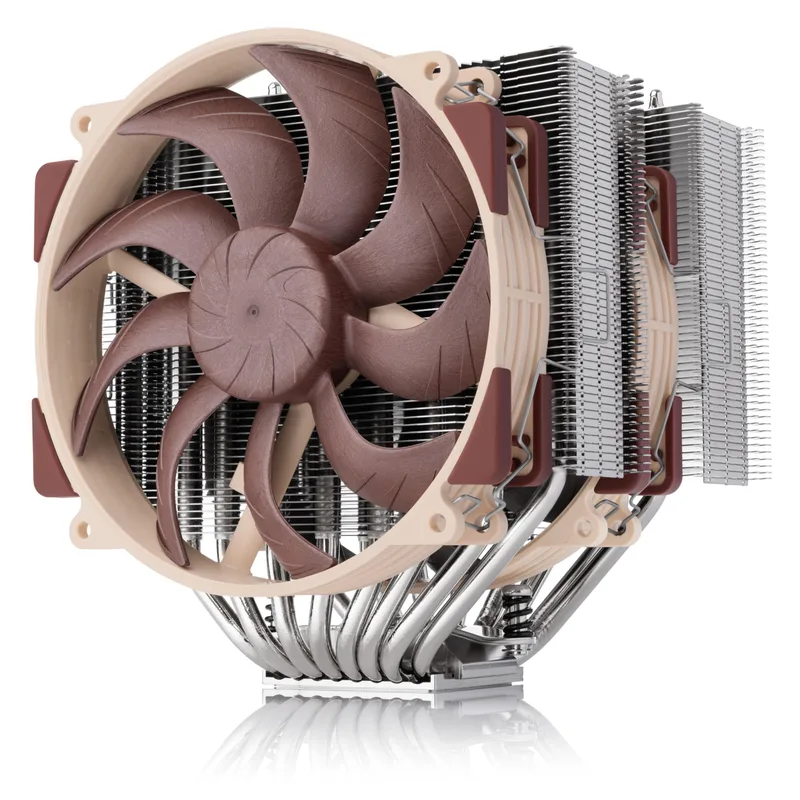
The NH-D15 G2 is Noctua’s biggest revision of their flagship since the original NH-D15 launched in 2014. Eight heatpipes replace the original five, fin spacing tightens from 1.9mm to 1.6mm adding 23 fins per tower, and total fin surface area increases 20%. The result: a measured 3°C improvement over the original under i9-14900K all-core load in Noctua’s own comparison data.
Three variants exist, differing only in cold plate geometry: standard, HBC (optimized for Intel LGA1700/1851 IHS contact), and LBC (optimized for AMD AM5). If you know your target CPU, pick the matching variant — the thermal difference is measurable, up to 2-3°C advantage according to Noctua’s data.
The NF-A14x25r G2 fans top out at 24.6 dBA — quieter than most AIO fans at equivalent cooling loads up to around 180W. Above 200W sustained, the fans spin up noticeably. At $180, the NH-D15 G2 now costs nearly double what a comparable 360mm AIO runs — and that AIO handles higher TDPs more gracefully. If your build stays reliably under 200W all-core, this remains the best air cooler available.
DeepCool AK620 Digital
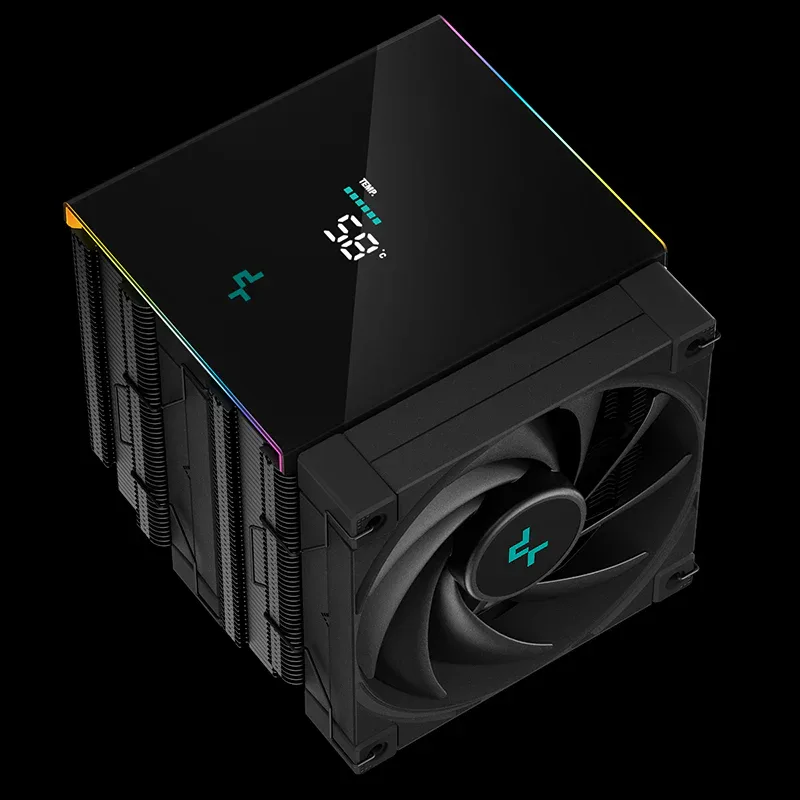
DeepCool AK620 Digital
The AK620 Digital’s performance case is simple: it lands within 2-3°C of the NH-D15 G2 across published benchmarks, at less than half the price. Six heatpipes feed a dual-tower aluminum stack cooled by 120mm FK120 fans. The 260W TDP rating gives clearance for Ryzen 9 9900X and Core Ultra 7 265K under sustained workloads.
The standout feature is the front-panel status display — a small magnetic screen connecting to a USB 2.0 header that shows live CPU temperature and utilization without any software. For a build-and-forget workstation or gaming rig, seeing CPU temp without opening HWiNFO is a genuine quality-of-life improvement.
At $83, the AK620 Digital is the strongest value proposition in air cooling. The only reason to spend more on air is if you need the absolute best noise-normalized performance (NH-D15 G2) or want all-black aesthetics (Dark Rock Pro 5).
be quiet! Dark Rock Pro 5
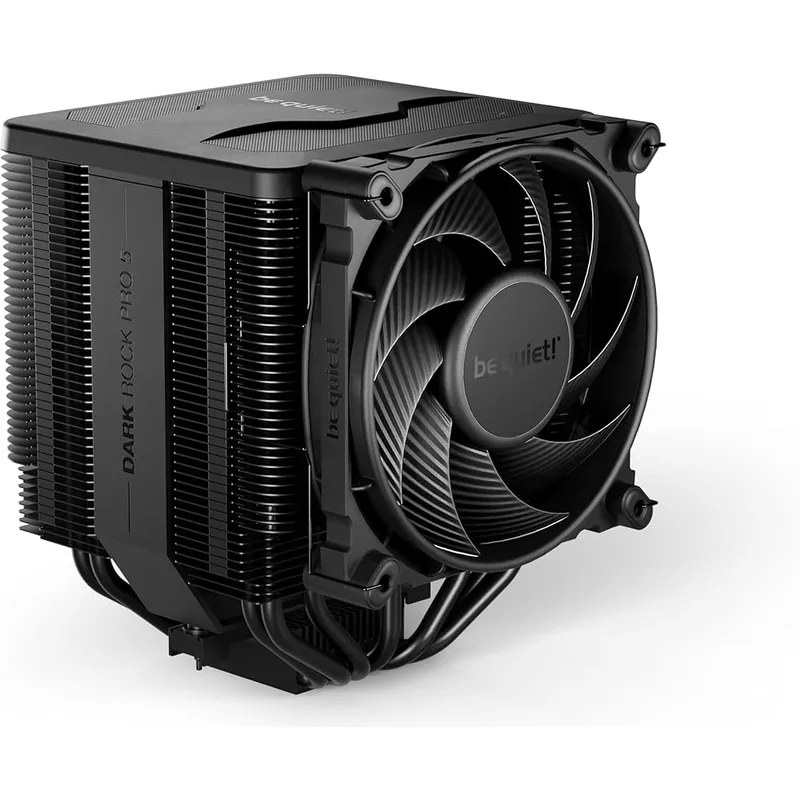
be quiet! Dark Rock Pro 5
The Dark Rock Pro 5 spec sheet closely tracks the NH-D15 G2: 270W TDP rating, 168mm height, dual 135mm Silent Wings 4 fans, fully blacked-out finish. In published thermal comparisons, the two coolers swap positions within the margin of test variance — neither consistently leads. The Dark Rock Pro 5’s advantages are aesthetic (entirely black, no brown fans) and acoustic via a physical speed switch that drops both fans to a low-noise preset without software.
For builders who want a premium air cooler that matches any black case interior, the Dark Rock Pro 5 is the natural alternative to the Noctua. For pure performance-per-dollar, the NH-D15 G2 is equivalent and the AK620 Digital undercuts it by $7 for nearly identical cooling — making the Dark Rock Pro 5 the middle option that serves aesthetics over strict value.
AIO Liquid Cooler Deep Dives
Arctic Liquid Freezer III Pro 360
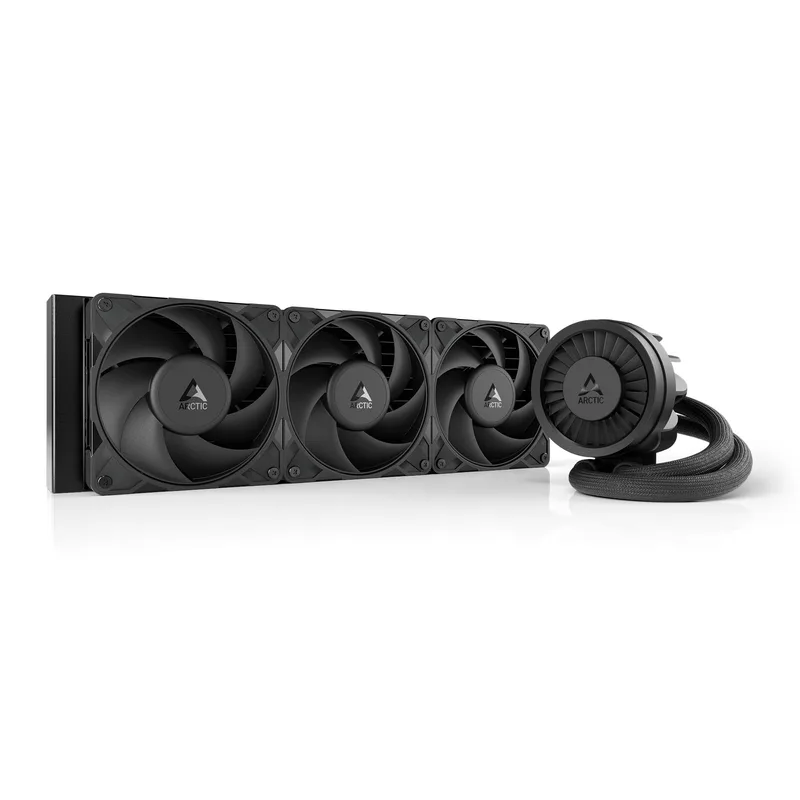
The Liquid Freezer III Pro 360 builds on what made the original a top GamersNexus and Tom’s Hardware pick for multiple years, then improves both thermals and acoustics. The new P12 Pro fans feature seven blades instead of five — a redesign that delivers up to 10°C better performance on Intel under noise-normalized conditions (2°C on AMD) and runs 19% quieter at 1,200 RPM than the previous generation. Multiple 2026 reviews, including Tech4Gamers and PC Gamer, name it the AIO to beat at its price point.
The 38mm thick radiator remains — significantly thicker than the 27mm standard on most budget AIOs — along with the integrated 40mm VRM fan that actively cools motherboard power delivery under sustained loads. On boards with dense power delivery (Z890, X870E), that secondary fan is a measurable thermal benefit.
Priced at $95, the Liquid Freezer III Pro 360 undercuts comparable performance AIOs by a wide margin. The standard version lacks ARGB; the A-RGB variant costs slightly more. Intel users should verify the LGA1700/1851 contact frame is included — installation takes more effort than average but delivers rock-solid mounting pressure.
Thermalright Aqua Elite 360 V3
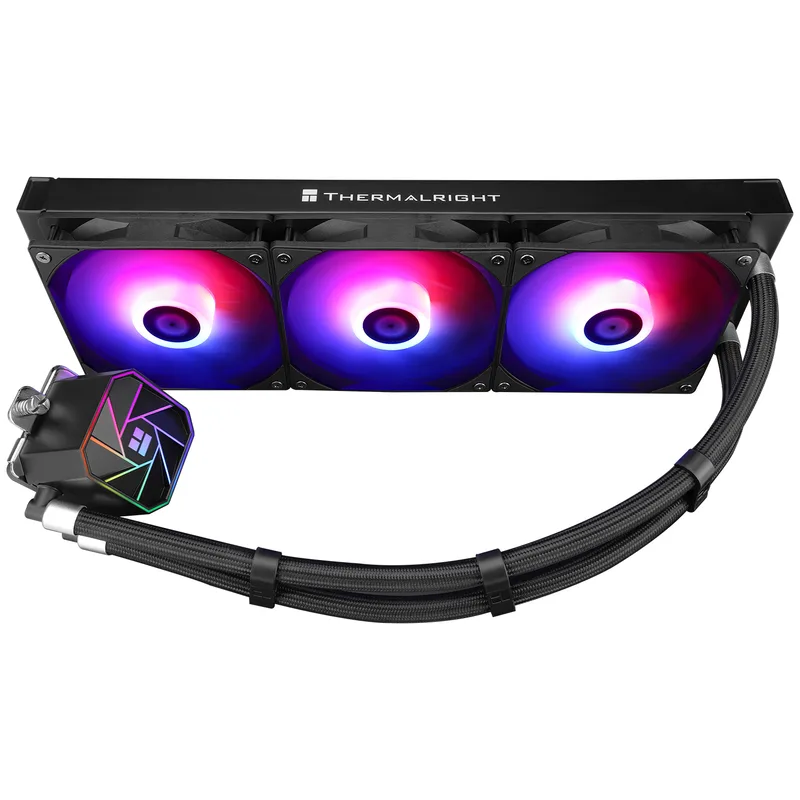
At $55, the Aqua Elite 360 V3 is the cheapest 360mm AIO that outperforms 240mm counterparts in published thermal comparisons. Thermalright uses S-FDB (Sleeve Fluid Dynamic Bearing) fans operating between 800-2000 RPM. The 3× ARGB fans use standard 5V A-RGB headers — no hub or extra software required.
The 27mm radiator is thinner than the 38mm found on premium AIOs, which limits peak cooling capacity. In published noise-normalized results, the Aqua Elite runs roughly 4-5°C warmer than the premium option above under equivalent conditions. For Ryzen 7 9700X or Core i7-14700K loads staying under 180W, that gap is irrelevant. For a Ryzen 9 9950X running 200W+ sustained, the Pro 360 is the better call.
What the Aqua Elite delivers: genuine 360mm AIO performance at a price point where most alternatives are 240mm. For mid-tier builders who want RAM clearance and liquid aesthetics without the AIO premium, this is the entry point.
FAQ
Does liquid cooling require maintenance?
Sealed AIOs — including every option above — are maintenance-free. The coolant is factory-filled and sealed; you don’t top it off or replace it. Custom open-loop cooling requires annual coolant changes and leak checks, but none of these units are open loop.
Will a 240mm AIO beat the NH-D15 G2?
Usually not on noise-normalized results. Published comparisons from GamersNexus consistently show the NH-D15 G2 matching or beating 240mm AIOs at equivalent noise levels. The radiator surface area difference between a 240mm (288 cm²) and a dual-tower heatsink (~300-320 cm² total fin area) is smaller than the size implies. A 360mm AIO pulls ahead clearly; a 240mm is roughly a wash.
What happens if an AIO pump fails?
The CPU throttles immediately and may shut down to prevent damage. Sealed AIOs typically carry 3-5 year warranties from brands like Arctic and Thermalright. A failed pump on an air cooler is mechanically impossible — the trade-off for that zero-failure guarantee is lower peak cooling capacity above 250W.
Does case airflow matter with an AIO?
Yes. AIOs heat the air inside the case via the radiator. If that hot air has nowhere to go — poor case exhaust — GPU and motherboard temps rise. Standard approach: front intake (coolest incoming air hits the radiator first) or top exhaust (hot air exits directly). Bottom intake for a 360mm is generally not recommended.
Can a 360mm AIO fit in a mid-tower case?
Most modern mid-towers (NZXT H5 Flow, Fractal Pop Air, Lian Li Lancool III) support 360mm top or front mounts. Check your case spec sheet — a case listed as 360mm front-compatible has at least 420mm of internal length. Compact mATX cases typically max out at 240mm.
The Bottom Line
For mainstream gaming builds under 200W sustained — most Ryzen 7 and Core Ultra 7 systems — the DeepCool AK620 Digital at $83 is the rational choice. It matches premium air coolers within 2-3°C, includes a useful built-in display, and will outlast the build with zero maintenance. The Noctua NH-D15 G2 remains the best air cooler available but at $180 it’s a harder sell unless noise-per-degree and a long warranty are non-negotiable.
For high-TDP builds above 200W, or any build where RAM clearance and aesthetics drive the decision, the Arctic Liquid Freezer III Pro 360 at $95 is the clear recommendation — it beats 360mm AIO competition on both thermals and acoustics while costing less than most comparable units.
Budget-constrained builders who want 360mm liquid cooling should consider the Thermalright Aqua Elite 360 V3, which provides a genuine upgrade over 240mm performance without the full AIO price premium.