The AMD Ryzen 7 9700X had a rough debut in August 2024. Initial reviews — including GamersNexus’s famously titled “Wasted Opportunity” write-up — noted that the 9700X delivered only 3–6% gaming improvements over the 7700X at a $359 asking price that was hard to justify. By May 2026, two things have changed: the street price has fallen to $269, and AMD’s firmware updates have extracted more consistent single-core boost performance from the chip. At $90 off launch MSRP, the 9700X’s calculus looks different.
The question isn’t whether the 9700X is a good CPU in 2026 — it clearly is. The question is where it fits between the $179 Ryzen 5 9600X and the $448 Ryzen 7 9800X3D, and whether the middle ground is worth occupying.
| Spec | AMD Ryzen 7 9700X 8.2/10 | AMD Ryzen 5 9600X 8.5/10 | AMD Ryzen 7 9800X3D 9.5/10 |
|---|---|---|---|
| architecture | Zen 5, 4nm N4P (TSMC) | Zen 5, 4nm N4P (TSMC) | Zen 5, 4nm N4P + 3D V-Cache |
| cores_threads | 8 cores / 16 threads | 6 cores / 12 threads | 8 cores / 16 threads |
| clocks | 3.8 GHz base / 5.5 GHz boost | 3.9 GHz base / 5.4 GHz boost | 4.7 GHz base / 5.2 GHz boost |
| cache | 32 MB L3 + 8 MB L2 | 32 MB L3 + 6 MB L2 | 96 MB L3 (64 MB 3D V-Cache) + 8 MB L2 |
| tdp | 65W (105W with PBO enabled) | 65W (88W with PBO) | 120W |
| socket | AM5 (LGA1718) | AM5 (LGA1718) | AM5 (LGA1718) |
| Rating | 8.2/10 | 8.5/10 | 9.5/10 |
Prices change daily — tap Check Price for the current Amazon price.
Prices change daily — tap Check Price for the current Amazon price.
Specifications
| Spec | Ryzen 7 9700X | Ryzen 5 9600X | Ryzen 7 9800X3D |
|---|---|---|---|
| Architecture | Zen 5 | Zen 5 | Zen 5 + 3D V-Cache |
| Cores / Threads | 8 / 16 | 6 / 12 | 8 / 16 |
| Base / Boost | 3.8 / 5.5 GHz | 3.9 / 5.4 GHz | 4.7 / 5.2 GHz |
| L3 Cache | 32 MB | 32 MB | 96 MB |
| TDP (base) | 65W | 65W | 120W |
| Socket | AM5 | AM5 | AM5 |
| Street Price (May 2026) | ~$269 | ~$179 | ~$448 |
The core specs illustrate the 9700X’s positioning clearly. Against the 9600X, it adds two cores and four threads at the same 65W TDP — identical socket, same cache size, essentially the same boost ceiling (5.5 GHz vs 5.4 GHz). Against the 9800X3D, the 9700X runs at a lower TDP with a higher boost clock (5.5 vs 5.2 GHz), but the 9800X3D’s 96 MB L3 cache dwarfs the 9700X’s 32 MB — and that cache is the entire story in gaming benchmarks.
Gaming Performance
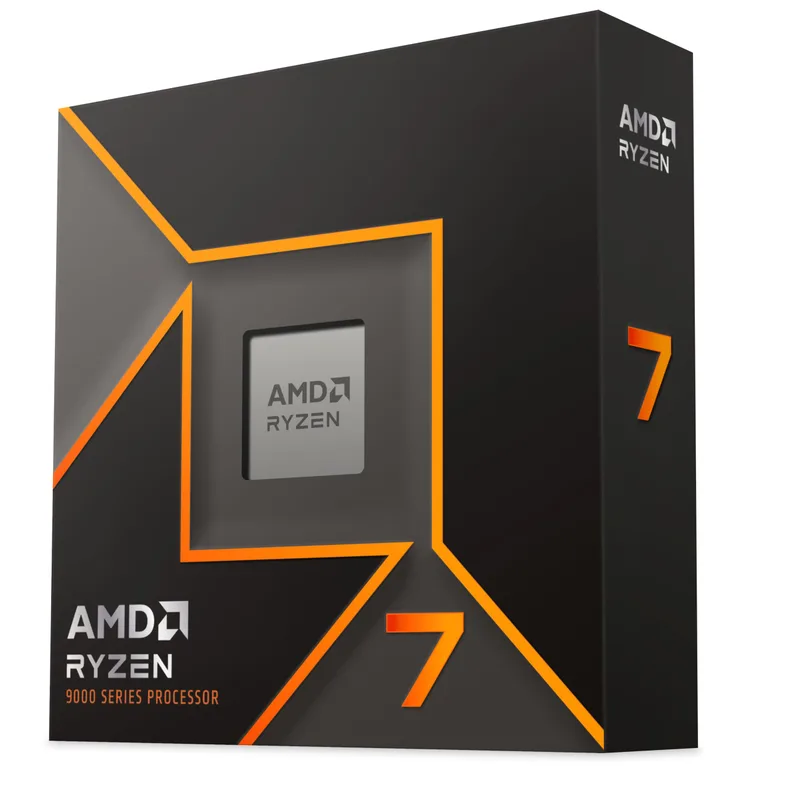
The Zen 5 IPC uplift is real. AMD measured a 16% average IPC improvement over Zen 4, driven largely by a 512-bit FPU (double the Zen 4 width) and improved branch prediction. In practice, per-game gaming benchmarks from multiple review outlets show:
1080p Gaming (CPU-Bound, High Refresh)
| Game | Ryzen 7 9700X | Ryzen 5 9600X | Ryzen 7 9800X3D |
|---|---|---|---|
| Cyberpunk 2077 (Ultra, No RT) | ~165 FPS | ~158 FPS | ~200 FPS |
| Starfield | ~97 FPS | ~83 FPS | ~115 FPS |
| Horizon Forbidden West | ~174 FPS | ~165 FPS | ~200 FPS |
| Final Fantasy XIV (Max) | ~330 FPS | ~312 FPS | ~358 FPS |
| Total War: Warhammer III | ~112 FPS | ~106 FPS | ~138 FPS |
The 9700X vs 9600X delta averages roughly 6% across these titles, matching what Tom’s Hardware and Club386 found at launch and confirmed in subsequent testing. Starfield is the outlier — it’s consistently 14–17% faster on the 9700X, likely due to its heavy multithreaded scene streaming. In most other games, the two extra cores matter less than you’d expect in 2026.
The 9800X3D tells a different story. In cache-sensitive titles like Cyberpunk 2077, Total War, and Starfield, the 9800X3D leads the 9700X by 15–25% at 1080p. That gap narrows considerably at 1440p and 4K, where the GPU becomes the primary limiter. For 1080p/360 Hz competitive gaming or the highest-refresh 1440p setups, the 9800X3D’s lead is meaningful and persistent.
At 1440p and 4K with a GPU like the RTX 5070 or RX 9070 XT, the difference between the 9700X and 9800X3D compresses to 5–10% in most titles — because the GPU is limiting before the CPU becomes the bottleneck. If you’re gaming at 1440p or above, the $179 9700X-to-9800X3D premium buys minimal real-world improvement most of the time.
Multithreaded and Productivity Performance
This is where the 9700X’s 8-core, 16-thread configuration earns its keep over the 9600X.
According to benchmark data from PassMark and Cinebench R24, the 9700X’s multi-threaded score exceeds the 9600X by approximately 30% — reflecting the two-core advantage in workloads that scale with core count. In content creation tasks:
- Video encoding (HandBrake H.265): The 9700X encodes roughly 25–30% faster than the 9600X on the same settings, because HandBrake saturates all available threads. At 16 threads vs 12, the throughput gap is real.
- 3D rendering (Blender): AMD’s own data shows Zen 5 delivering strong Blender performance, and the 9700X’s 30%+ multi-core lead over the 9600X scales directly into shorter render times.
- Live streaming: Using OBS x264 encoding at a medium preset while gaming, the 9700X maintains frame delivery without the stutters that 6-core chips begin showing in CPU-bound scenes. The 9600X handles moderate streaming loads well, but the 9700X’s overhead is noticeably larger under simultaneous heavy workloads.
For pure gaming, this productivity lead is irrelevant. For a PC that does double duty as a gaming rig and a workstation — video editing, CAD, software development, Blender renders — the 9700X’s extra threads are meaningfully useful.
Power Efficiency
The 9700X’s 65W TDP is one of its most underrated characteristics. At 65W base, it draws roughly 40W less under load than the 7700X it replaced (105W TDP), while matching or exceeding its performance thanks to Zen 5’s improved IPC and the 4nm N4P process node efficiency gains.
In sustained Cinebench workloads, the 9700X stabilizes around 65–75W package power at stock settings. Enable PBO (Precision Boost Overdrive) and the power limit rises to approximately 105W, with clock speeds improving 3–7% depending on the workload. PBO is free performance that comes at the cost of higher temperatures — on a quality air cooler, temperatures remain manageable even at 105W.
The 9800X3D draws a rated 120W — roughly double the 9700X’s base TDP. For efficiency-focused builds (compact mATX cases, smaller PSUs, quiet cooling requirements), the 9700X’s 65W ceiling is a practical advantage the 9800X3D doesn’t offer.
The Budget Pick
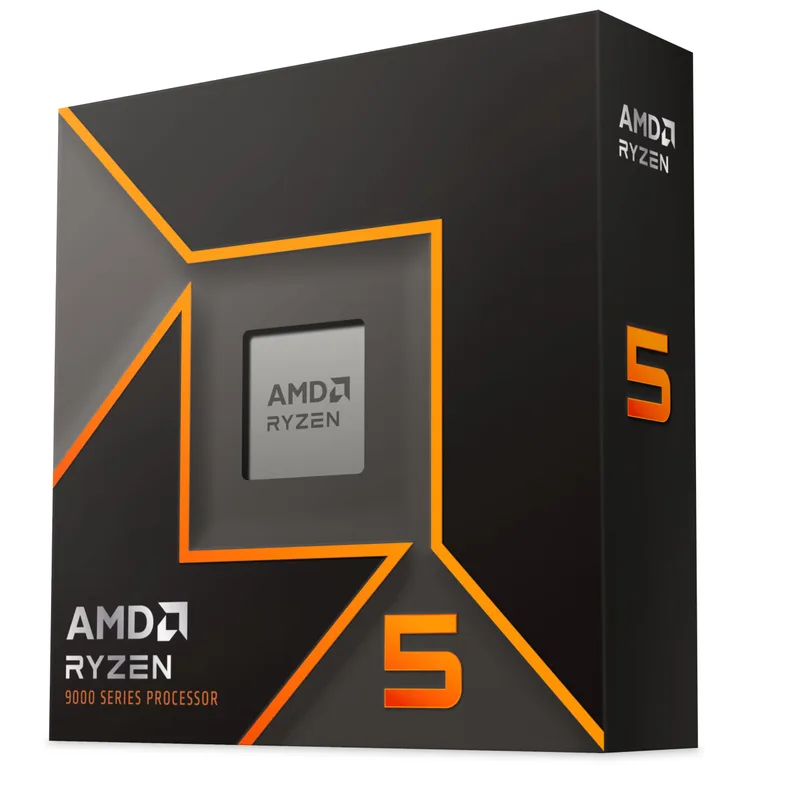
The AMD Ryzen 5 9600X remains one of the most straightforward CPU recommendations for pure gaming in 2026. At $179, it leverages the full Zen 5 IPC advantage in a 6-core package that’s sufficient for current games — most titles still run their primary rendering loops on 4–6 threads, and the 9600X’s 5.4 GHz boost means it’s rarely the bottleneck at 1440p and above.
Compared with the 9700X, the 9600X gives up:
- ~6% average gaming performance (with specific titles like Starfield showing up to 17% gaps)
- ~30% multi-core throughput in productivity workloads
- 2 cores and 4 threads for streaming, rendering, and heavy multitasking
In exchange, you get $90 back to put toward your GPU, storage, or cooling. For a builder spending $700–$900 total on a gaming rig, that $90 redirected to a GPU tier upgrade (say, from an RTX 5060 Ti to an RX 9070) produces more measurable gaming improvement than the 9700X premium would.
The 9600X is the better pick if gaming is your primary (or only) use case and you’re budget-constrained. The 9700X is the better pick if your PC will see any meaningful multitasking or productivity load.
The Gaming Maximum
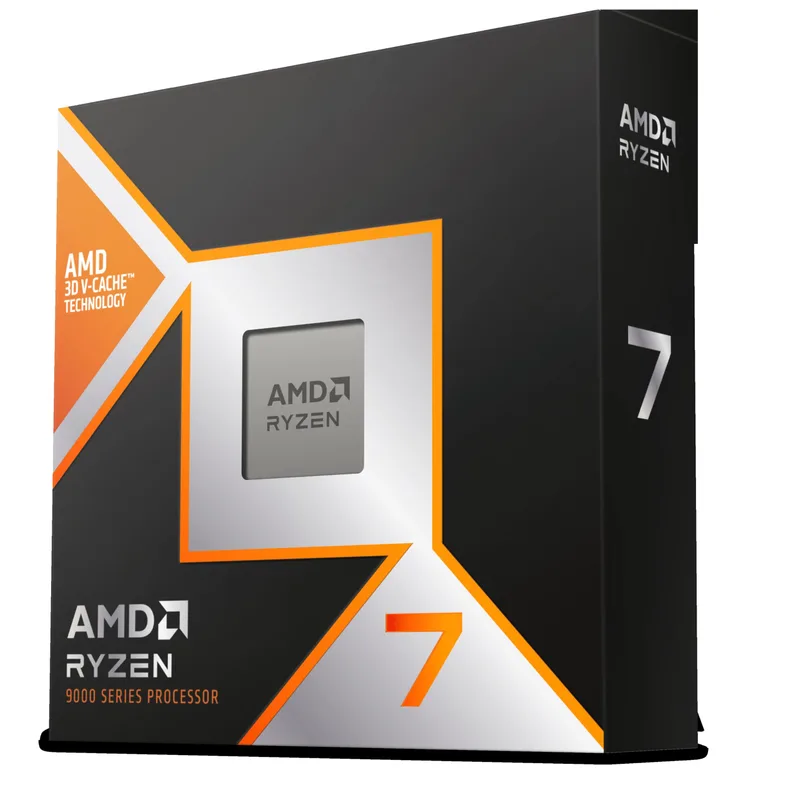
The AMD Ryzen 7 9800X3D operates in a different tier. Its 96 MB L3 cache (64 MB 3D V-Cache stacked on the standard 32 MB) reduces CPU-side game latency by keeping more of the game’s working set in on-die cache, reducing round-trips to slower DRAM. The result is a consistent 15–25% gaming advantage over the 9700X in cache-sensitive titles at 1080p.
That lead compresses at higher resolutions. A benchmark that shows a 200 FPS 9800X3D versus 165 FPS on the 9700X at 1080p will show something closer to 120 FPS vs 110 FPS at 1440p with an RTX 5070 — because the GPU becomes the limiter, and the CPU advantage becomes invisible.
The 9800X3D’s $448 price is $179 above the 9700X. At 1080p with a fast GPU like the RX 9070 XT or RTX 5070, that premium buys real, consistent frame rate improvements across essentially every title. At 1440p with mid-range GPUs, the premium buys improvements that only materialize in the most CPU-bound scenarios. At 4K, the premium is nearly invisible.
The straightforward guidance: If you’re building a dedicated 1080p high-refresh gaming rig with a fast GPU and no interest in productivity workloads, the 9800X3D is worth the premium. If you’re gaming at 1440p or above, or if your budget doesn’t comfortably stretch to $448 without compromising GPU selection, the 9700X performs the same job with far less penalty.
Platform Compatibility
All three chips use the AM5 socket (LGA1718) and are compatible with:
- B650 motherboards (PCIe 5.0 on GPU slot, PCIe 4.0 on M.2)
- X670/X670E motherboards (PCIe 5.0 on GPU + M.2)
- B850 motherboards (PCIe 5.0 on GPU slot and M.2 — current mainstream sweet spot)
- X870/X870E motherboards (PCIe 5.0 everywhere, USB 4 standard)
A B850 board in the $160–$210 range is the natural pairing for the 9700X — enough features to support PCIe 5.0 storage, DDR5-6000, and future CPU swaps, without overspending for a mid-range processor. AMD’s AM5 socket is supported through at least 2027 per AMD’s roadmap, meaning a 9700X owner can upgrade to a future AM5 chip (Ryzen 9000 successor, Zen 6) without changing motherboards or RAM.
The 9700X ships without a cooler. A 240mm AIO or a tower cooler like the Noctua NH-D15 G2 ($149) or be quiet! Dark Rock 4 (~$75) handles the 65W base TDP with comfortable headroom. For PBO-enabled builds, a 240mm AIO is the practical choice to stay under 80°C during sustained Cinebench or rendering loads.
DDR5 Compatibility
The 9700X supports DDR5-5600 natively (JEDEC) and DDR5-6000+ with AMD EXPO profiles. DDR5-6000 CL30 is the recommended operating point — it maximizes the memory controller’s bandwidth without requiring exotic voltage tuning.
Current DDR5-6000 32 GB kit pricing has risen significantly through 2026 due to AI-driven DRAM demand. As of May 2026, DDR5-6000 32 GB kits run $390–$530 for quality options — a significant increase from 2025 lows. Factor that into build budgets accordingly, particularly if upgrading from a DDR4 platform where RAM can’t transfer.
The 9600X and 9700X use identical memory controllers, so DDR5 compatibility is identical between them. The 9800X3D’s 3D V-Cache partially offsets memory latency, meaning the 9800X3D is slightly less sensitive to RAM speed than the 9700X — though DDR5-6000 CL30 is still the recommended profile for all three.
Who Should Buy the Ryzen 7 9700X
Buy the 9700X if:
- You’re building a PC that handles both gaming and regular workloads — streaming, video editing, content creation, or heavy multitasking
- You’re on an AM5 board and want a long-term platform investment with upgrade headroom to 9800X3D later
- You want 65W efficiency with a compact cooling solution and solid gaming performance
- Your gaming resolution is 1440p or 4K, where the 9800X3D premium delivers minimal return
Buy the 9600X instead if:
- Gaming is your only workload and you won’t run simultaneous heavy multitasking loads
- You need to reallocate the $90 toward a better GPU — that’s almost always the higher-impact upgrade at the same total budget
- Your build is budget-constrained at the $600–$800 total range
Buy the 9800X3D instead if:
- You’re building a dedicated 1080p high-refresh gaming rig with a fast GPU (RX 9070 XT, RTX 5070, or better)
- You want the top gaming CPU available without qualification or compromise
- Competitive multiplayer at the highest achievable framerates is the primary use case
FAQ
Is the Ryzen 7 9700X worth it over the 9600X for gaming? For pure gaming, the 9700X is only about 6% faster on average than the 9600X — a margin that’s real but won’t be felt in most gameplay. Starfield is the notable exception, where the 9700X runs 14–17% faster due to its heavier multithreaded scene streaming. If your games include simulation titles, open-world games, or you simultaneously stream while gaming, the 9700X’s extra cores make a practical difference. For competitive multiplayer gaming only, the 9600X saves $90 at minimal cost.
How does the Ryzen 7 9700X compare to Intel’s Core Ultra 5 245K? The Core Ultra 5 245K ($249) runs at a much higher TDP (125W) and requires a more expensive Z890 or B860 motherboard to unlock overclocking. In gaming, the two processors are within 5–8% of each other, with the 9700X generally leading in lightly-threaded scenarios thanks to Zen 5’s higher IPC, while the 245K’s higher thread count helps in massively parallel workloads. The 9700X’s AM5 platform longevity, lower power draw, and current pricing make it the more practical choice for most builds.
Does the Ryzen 7 9700X come with a cooler? No. AMD removed the bundled Wraith cooler from the 9000-series X-class processors. A quality aftermarket cooler is required — budget at least $30–$50 for a tower cooler that can handle the 65W base TDP. At PBO-enabled 105W, a $50–$75 dual-tower cooler or a 240mm AIO is the appropriate choice.
What motherboard should I pair with the Ryzen 7 9700X?
A B850 board in the $160–$210 range is the best value pairing — it supports PCIe 5.0 on the GPU slot and M.2, DDR5-6000 EXPO, and future AM5 CPU upgrades. The ASUS TUF Gaming B850-PLUS WiFi ($200) and MSI MAG B850 Tomahawk MAX WiFi ($229) are strong choices. Step up to X870 only if you need USB 4, additional PCIe 5.0 M.2 slots, or advanced overclocking headroom for extreme DDR5 profiles. For a full breakdown of the top boards at each price point, see our best motherboards for the Ryzen 7 9700X guide.
Is it worth upgrading from Ryzen 7 7700X to the 9700X? The Zen 5 IPC advantage over Zen 4 is about 16% in heavily IPC-bound workloads, but typical gaming scenarios show 8–12% improvements over the 7700X at the same clock speed. At $269 vs the cost of a used 7700X, the 9700X is meaningfully faster — but the upgrade math depends on what else that $269 could accomplish in your build. For a structured framework for weighing this decision, see our upgrade vs. build new decision guide. If you’re on a 7800X3D and considering the 9700X, skip it entirely: the 7800X3D still beats the 9700X in gaming due to its 96 MB V-Cache advantage.
The Bottom Line
The AMD Ryzen 7 9700X has become a significantly better buy in 2026 than it was at its $359 launch. At $269, it sits at a price where its core value proposition — 8 Zen 5 cores at 65W, combining comfortable gaming performance with real multithreaded throughput — becomes hard to argue against for a general-purpose build.
It isn’t the right choice for pure gaming on a tight budget (the Ryzen 5 9600X at $179 remains the smarter move there) and it isn’t the right choice for absolute gaming performance (the Ryzen 7 9800X3D at $448 leads every game by a meaningful margin at 1080p). But for builders who need a platform that handles both gaming and everything else a modern PC does, the 9700X at $269 is the Zen 5 sweet spot — efficient, capable, and sitting on AMD’s AM5 platform with years of upgrade runway ahead of it.