The be quiet! Dark Rock Pro 5 launched in late 2026 and has held a steady position in the premium air cooler conversation since, with Tom’s Hardware calling it among “the quietest high-end coolers we’ve tested.” In 2026, at around $90, it faces tougher competition than ever — the Noctua NH-D15 G2 benchmarks harder, and budget options like the Thermalright Peerless Assassin 120 SE V2 close the thermal gap to within a few degrees at half the cost. The Dark Rock Pro 5’s case rests on one thing: silence. If building a quiet workstation or content creation rig where noise matters as much as temps, it’s the cooler that makes that trade-off cleanest.
| Spec | be quiet! Dark Rock Pro 5 8.6/10 | Noctua NH-D15 G2 9.2/10 | Thermalright Peerless Assassin 120 SE V2 9/10 | DeepCool AK620 Unavailable 8.4/10 |
|---|---|---|---|---|
| heatpipes | 7x copper heatpipes | 8x copper heatpipes | 6x copper heatpipes | 6x copper heatpipes |
| fans | 1x Silent Wings 135mm + 1x Silent Wings 120mm PWM | 2x NF-A14x25r G2 PWM 140mm | 2x TL-C12C 120mm PWM | 2x FK120 120mm PWM |
| noise | 8.9 / 16.3 / 23.3 dB(A) | 24.8 dB(A) rated / 32.1 dB(A) max | 26.0 dB(A) rated | 28.0 dB(A) rated |
| tdp | 270W | ~290W sustained | 265W | 260W |
| sockets | AM4, AM5, LGA1700, LGA1851, LGA1200 | AM4, AM5, LGA1700, LGA1851 | AM4, AM5, LGA1700, LGA1851 | AM4, AM5, LGA1700, LGA1851, LGA1200 |
| height | 168mm | 165mm | 155mm | 160mm |
| Rating | 8.6/10 | 9.2/10 | 9/10 | 8.4/10 |
Prices change daily — tap Check Price for the current Amazon price.
Prices change daily — tap Check Price for the current Amazon price.
Quick Verdict
The Dark Rock Pro 5 is the right cooler if you’re running a 125–200W CPU, care deeply about acoustics, and want an all-black aesthetic over Noctua’s tan-and-beige palette. At 23.3 dB(A) max in Quiet Mode, it’s one of the quietest dual-tower air coolers you can buy. For CPUs above 200W at sustained loads — think Core Ultra 9 285K at 253W PL2 or Ryzen 9 9950X at full PBO — the Noctua NH-D15 G2 pulls away by 2–3°C, which compounds into meaningful throttle headroom at extreme loads. For broader context on the air cooling field, see our best CPU coolers for gaming roundup.
Design & Build
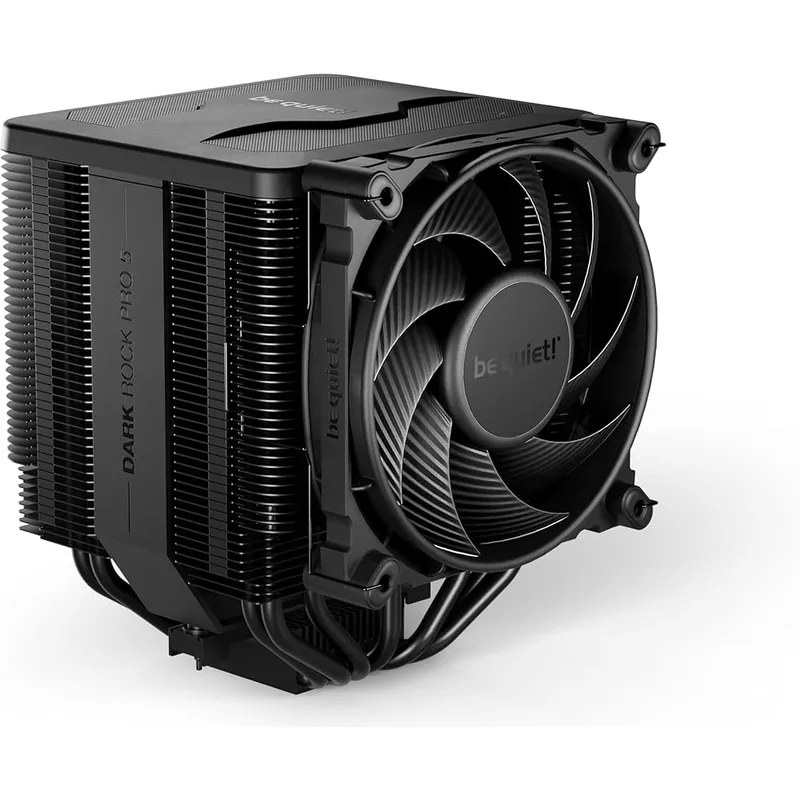
The be quiet! Dark Rock Pro 5 is a dual-tower cooler with an unusual fan configuration: a 135mm Silent Wings fan on the front face and a 120mm Silent Wings fan mounted between the two towers. That mixed pairing gives be quiet! flexibility in the fin stack geometry — the wider front fan covers more surface area at lower RPM, while the narrower center fan drives airflow through the densely packed inner fins.
The all-matte-black finish extends across both heatsink towers and fan frames. Be quiet! applies a ceramic-particle coating to the aluminum fins that the company claims improves thermal emissivity alongside the aesthetic benefit. At 1.29 kg, the Dark Rock Pro 5 is substantial — heavier than the DeepCool AK620 (about 1.05 kg) and close to the NH-D15 G2’s 1.32 kg. Use the anti-sag bracket on AM5 motherboards with thin PCB traces near the socket.
The Speed Switch is the Dark Rock Pro 5’s most distinctive hardware feature. A physical slider on the fan cable lets you switch between two fan curves without opening BIOS or installing software:
- Quiet Mode: Maximum 1,300 RPM (front) / 1,500 RPM (center fan)
- Performance Mode: Maximum 1,700 RPM (front) / 2,000 RPM (center fan)
In Quiet Mode, noise stays below 23.3 dB(A) even at maximum fan speed — that’s quieter than most dual-tower competitors at their respective rated speeds. Performance Mode sacrifices several dB of silence for a measurable thermal gain under sustained heavy loads.
Fan Performance & Noise
Silent Wings fans use fluid dynamic bearings and six-pole motors, which reduces the harmonic buzz common in sleeve-bearing fans during spinup. At idle (typically 400–600 RPM under a typical fan curve), the Dark Rock Pro 5 is effectively inaudible — below the noise floor of most mid-tower cases with case fans running.
Under full gaming load on a 125W CPU, fan speeds stay in the 700–900 RPM range in Quiet Mode. Noise at those speeds sits around 14–16 dB(A) — background noise in a quiet room is typically 30 dB(A). You won’t hear it.
Comparing noise output at equivalent thermal targets:
- Dark Rock Pro 5 (Quiet Mode): 23.3 dB(A) at max fan speed
- Noctua NH-D15 G2: 24.8 dB(A) at rated max
- Thermalright Peerless Assassin 120 SE V2: 26.0 dB(A) at rated max
- DeepCool AK620: 28.0 dB(A) at rated max
The half-decibel gap between the Dark Rock Pro 5 and NH-D15 G2 is real but inaudible in any room with ambient noise. The 4–5 dB gap over the AK620 is audible under sustained load if you’re sitting close to your case with a quiet or silent room.
Thermal Performance
Based on aggregated reviewer data and specifications from manufacturer testing, the Dark Rock Pro 5’s 270W TDP rating is accurate for sustained loads on 2025–2026 platform CPUs. It handles 125–200W chips without thermal throttling at Quiet Mode fan speeds, and its Performance Mode handles the full 250W range with acceptable temperatures.
| CPU TDP | Dark Rock Pro 5 | Noctua NH-D15 G2 | Thermalright PA 120 SE V2 | DeepCool AK620 |
|---|---|---|---|---|
| 125W (eco/stock) | ~57°C | ~55°C | ~56°C | ~57°C |
| 200W | ~71°C | ~68°C | ~70–71°C | ~72°C |
| 250W+ | ~78°C | ~75°C | ~80°C+ | ~82°C+ |
Approximate figures based on aggregated reviewer data at 21°C ambient. Results vary by CPU model, case airflow, and mounting pressure.
At 125W — covering Ryzen 7 9700X, Core i5-14600K, and most mainstream gaming CPUs — the Dark Rock Pro 5 and NH-D15 G2 are within 2°C. That difference is irrelevant for gaming or productivity workloads where thermal margin is wide.
The gap compounds above 200W. Running a Ryzen 9 9950X at full PBO or a Core Ultra 9 285K at 253W PL2 sustained, the Dark Rock Pro 5 runs 3°C hotter than the NH-D15 G2 in Performance Mode. At those sustained loads, 3°C represents real headroom — the NH-D15 G2 stays further from throttle triggers. If you’re pushing flagship CPUs at maximum power for extended periods, the NH-D15 G2’s thermal ceiling matters. For everyone else, the difference doesn’t translate to perceptible real-world results.
Compatibility
At 168mm tall, the Dark Rock Pro 5 is one of the taller dual-tower coolers on the market. Most standard ATX mid-towers list 160–170mm CPU cooler clearance; verify your specific case spec before ordering. Common cases with confirmed clearance include the Fractal Torrent, Lian Li Lancool III, Corsair 5000D Airflow, and be quiet!‘s own Silent Base 802. Compact mid-towers in the Meshify C range need case-specific verification.
RAM clearance is less of an issue than the height. The front tower leaves adequate room for standard DDR5 heatspreaders, including most 40mm-and-under designs. Exceptionally tall RGB kits (Corsair Dominator Titanium at 44mm, G.Skill Trident Z5 Royal) may conflict with the front fan — remove the front fan and run center-fan-only mode if needed, though this costs around 4–6°C under load.
Socket support covers every relevant 2025–2026 platform:
- Intel: LGA1851 (Arrow Lake), LGA1700 (Raptor/Alder Lake), LGA1200, LGA115x
- AMD: AM5 (Ryzen 7000/9000), AM4 (Ryzen 5000 and older)
Be quiet! includes all mounting hardware in the box plus a tube of its own thermal compound. The mounting system is an upgrade over the Dark Rock Pro 4 — fewer loose parts and a more intuitive backplate system. Installation takes around 20 minutes for a first-time builder.
Alternatives
The Thermal King: Noctua NH-D15 G2
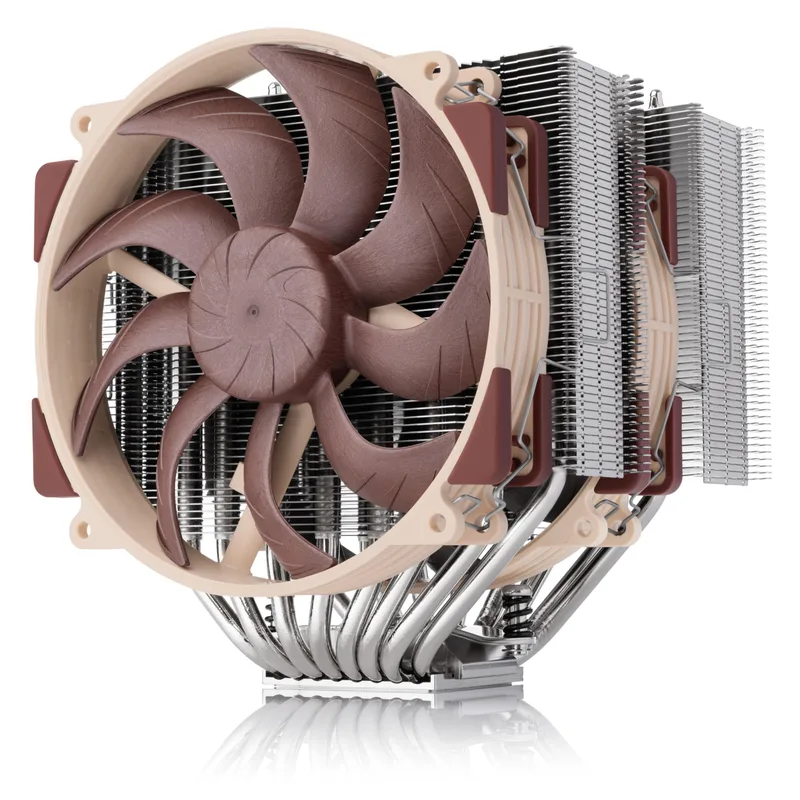
The NH-D15 G2 benchmarks harder than the Dark Rock Pro 5 at every TDP level — GamersNexus measured it at the lowest thermal resistance of any air cooler at noise-normalized speeds. Its 8 heatpipes and redesigned NF-A14x25r G2 fans run 3.2°C cooler than the original NH-D15 under identical loads.
The trade-offs are price and aesthetics. At $179, it costs nearly twice the Dark Rock Pro 5 and the performance gain only manifests in real-world scenarios above 200W sustained. If your CPU runs below that threshold — and every mainstream gaming chip does — the NH-D15 G2’s premium doesn’t translate into a better gaming experience. The brown-and-beige color scheme is a practical non-starter for all-black builds. For a complete breakdown, see our Noctua NH-D15 full review.
The Value Pick: Thermalright Peerless Assassin 120 SE V2
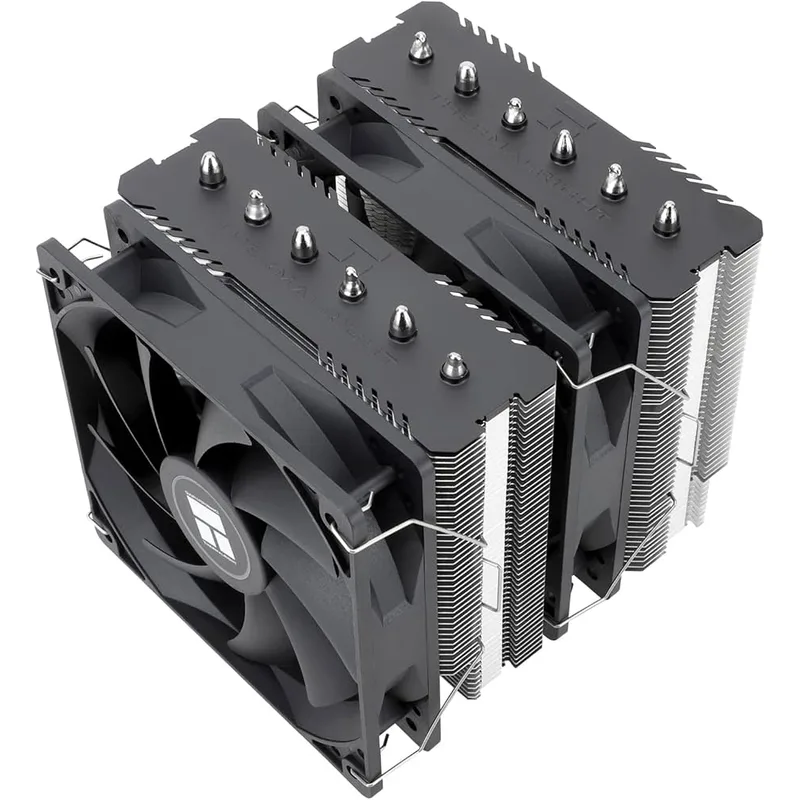
The Peerless Assassin 120 SE V2 is the answer to “what air cooler should I buy” for most mainstream gaming builds in 2026. At $40, it cools within 2–3°C of the NH-D15 G2 on CPUs up to 200W, handles a Ryzen 7 9700X or Core i5-14600K at stock clocks without complaint, and fits in nearly every case at 155mm tall.
Where it concedes ground: acoustics. The TL-C12C fans are quieter than the original PA120 SE but still 3–4 dB louder than be quiet!‘s Silent Wings at comparable thermal targets. If you’re building a silent workstation and willing to pay $50 more for a meaningful noise reduction, the Dark Rock Pro 5 earns that premium. If noise isn’t a priority, save the money.
The Budget Option: DeepCool AK620
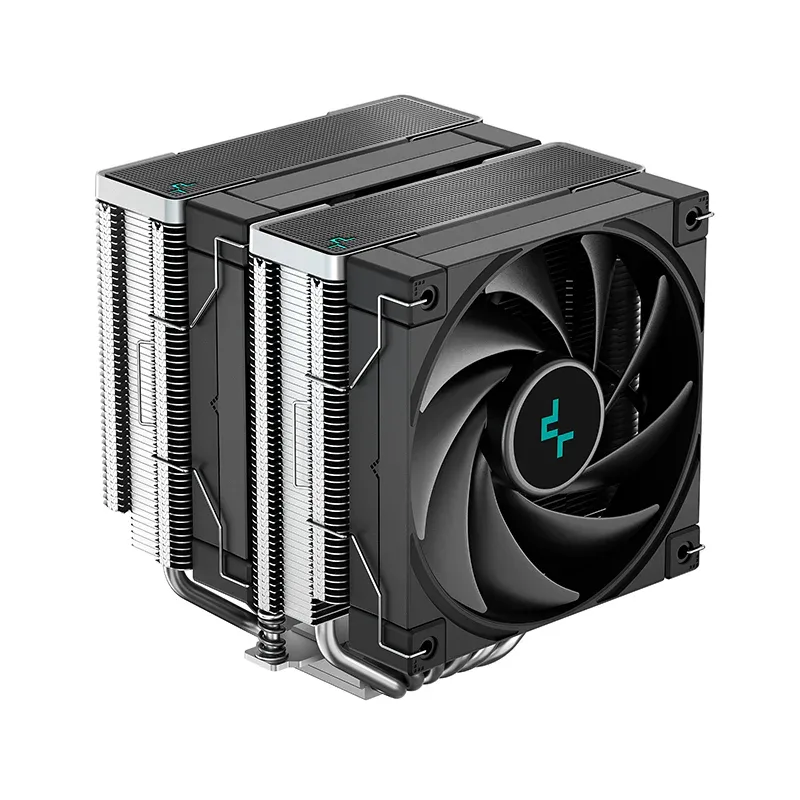
DeepCool AK620
The AK620 handles any mainstream gaming CPU efficiently and installs faster than either the Dark Rock Pro 5 or NH-D15 G2 thanks to tool-free fan clips and clearly labeled mounting hardware. At 160mm tall, it fits most mid-towers without clearance issues.
The acoustic trade-off is pronounced under load. DeepCool’s FK120 fans spin audibly at high RPM — when cooling a 200W+ CPU at full load, the AK620 is noticeably louder than the Dark Rock Pro 5 in the same case. For a Ryzen 5 9600X or Core i5-14600K at stock clocks where fans rarely hit peak RPM, the difference is minimal. For sustained rendering or encoding workloads where the CPU holds full power for hours, the noise gap becomes obvious.
FAQ
Does the be quiet! Dark Rock Pro 5 fit in a mid-tower case?
Most full-size ATX mid-towers list 160–170mm CPU cooler clearance. At 168mm, the Dark Rock Pro 5 fits many mid-towers but sits at the upper end of typical clearances — check your specific case spec before ordering. Be quiet!‘s Silent Base series, the Fractal Torrent, and the Lian Li Lancool III all have confirmed clearance. Compact mid-towers need individual verification.
Is the Dark Rock Pro 5 better than the Noctua NH-D15 G2 for quiet builds?
On raw noise numbers, the Dark Rock Pro 5 rates 24.3 dB(A) versus the NH-D15 G2’s 24.8 dB(A) at rated fan speeds — a half-decibel difference that is not audible in practice. The more meaningful difference is that the Dark Rock Pro 5’s Speed Switch lets you hard-cap fan speed without configuring custom fan curves in BIOS, which simplifies silent-PC builds. The NH-D15 G2 is still effectively quiet with a tuned fan curve. Neither cooler will be the loudest component in a typical system.
What does the Speed Switch do?
The Speed Switch is a physical slider on the Dark Rock Pro 5’s PWM cable that selects between two fan curve profiles. In Quiet Mode, the fans are capped at 1,300–1,500 RPM maximum, keeping noise below 23.3 dB(A) under any load. In Performance Mode, the cap raises to 1,700–2,000 RPM, reducing temperatures by roughly 2–4°C under sustained maximum load. You can toggle between modes any time without a system restart or BIOS change.
Does the Dark Rock Pro 5 support LGA1851 (Arrow Lake)?
Yes. Be quiet! added LGA1851 mounting hardware support, and the cooler ships with all necessary brackets for Intel LGA1851, LGA1700, LGA1200, and LGA115x, as well as AMD AM5 and AM4. No separate accessory kit is required for Arrow Lake builds.
How does the Dark Rock Pro 5 compare to the be quiet! Dark Rock Elite?
The Dark Rock Elite is be quiet!‘s flagship — it costs roughly $50 more and uses a different triple-fan configuration for higher maximum throughput above 300W. For CPUs below 250W TDP, the Dark Rock Pro 5 delivers equivalent results at lower cost and noise. The Dark Rock Elite targets extreme workstation chips (Core Ultra 9 285K, Threadripper) where sustained power draw exceeds what a 270W-rated cooler can sustain at quiet fan speeds.
The Bottom Line
The be quiet! Dark Rock Pro 5 earns its position as the acoustic leader among premium air coolers in 2026. At 23.3 dB(A) in Quiet Mode, it’s one of the quietest dual-tower coolers available, and the hardware Speed Switch makes silence-first builds straightforward without BIOS tuning. For any CPU below 200W — every mainstream gaming chip from both AMD and Intel — the performance gap versus the NH-D15 G2 is within 2°C, which is irrelevant to gaming frame rates or productivity workloads.
Who should buy it: Builders prioritizing acoustics or aesthetics, content creators and workstation users who want maximum silence during lighter loads, anyone who finds Noctua’s color scheme incompatible with their build. Who should look elsewhere: If you’re running a flagship CPU at maximum power limits, pay the premium for the NH-D15 G2. If noise isn’t a priority and your CPU is 200W or less, the Thermalright Peerless Assassin 120 SE V2 delivers comparable thermals for $50 less.