Affiliate disclosure: PCBuildRanked earns a commission on qualifying Amazon purchases at no extra cost to you.
The 1440p sweet spot has shifted dramatically in 2026. OLED panels now dominate the upper tier, with 480Hz monitors pushing into mainstream price territory. The LG 27GX790A-B has dropped to $699, making 480Hz OLED accessible to buyers who previously couldn’t justify the entry price. At the budget end, the AOC Q27G3XMN delivers DisplayHDR 1000 under $300 via mini-LED — proving you don’t need OLED to get HDR worth enabling.
| Spec | ASUS ROG Swift PG27AQDP 9.5/10 | LG 27GX790A-B UltraGear Unavailable 9.3/10 | ASUS ROG Strix XG27AQDMG 9/10 | MSI MAG 271QPX QD-OLED E2 8.7/10 | AOC Q27G3XMN 8.2/10 |
|---|---|---|---|---|---|
| panel | 27" WOLED | 27" OLED | 27" WOLED (Glossy) | 27" QD-OLED (2nd Gen) | 27" Mini-LED (VA) |
| resolution | 2560x1440 (QHD) | 2560x1440 (QHD) | 2560x1440 (QHD) | 2560x1440 (QHD) | 2560x1440 (QHD) |
| refresh_rate | 480Hz | 480Hz | 240Hz | 240Hz | 180Hz |
| response_time | 0.03ms GtG | 0.03ms GtG | 0.03ms GtG | 0.03ms GtG | 1ms GtG |
| hdr | DisplayHDR True Black 400 | DisplayHDR True Black 400 | DisplayHDR True Black 400 | True Black HDR 400 | DisplayHDR 1000 |
| color | 99% DCI-P3, True 10-bit | — | 99% DCI-P3 | — | sRGB 137.5% |
| Rating | 9.5/10 | 9.3/10 | 9/10 | 8.7/10 | 8.2/10 |
Prices change daily — tap Check Price for the current Amazon price.
Prices change daily — tap Check Price for the current Amazon price.
Quick Picks
- Best Overall: ASUS ROG Swift PG27AQDP — 480Hz WOLED with hardware heatsink, 99% DCI-P3, and True 10-bit color at $799
- Best for eSports: LG 27GX790A-B UltraGear — 480Hz OLED with DisplayPort 2.1 (uncompressed bandwidth), now at $699
- Best Value OLED: MSI MAG 271QPX QD-OLED E2 — second-gen QD-OLED at $629, the most accessible OLED gaming monitor worth buying
- Best Budget: AOC Q27G3XMN — mini-LED DisplayHDR 1000 at $299, best non-OLED value at 1440p
Buying Guide
Panel Technology in 2026: OLED vs. Mini-LED
The monitor market has split into two tiers. OLED (WOLED and QD-OLED) delivers true pixel-level blacks, sub-0.1ms response times, and contrast ratios that LCD cannot match. Mini-LED with local dimming narrows the gap on brightness and HDR, but halos remain visible in mixed content.
WOLED (LG’s White OLED) powers the ASUS PG27AQDP and ROG Strix XG27AQDMG. It has a slightly lower peak brightness ceiling than QD-OLED but offers wider viewing angles. ASUS’s custom heatsink on the PG27AQDP addresses sustained brightness throttling that plagued earlier WOLED designs — a real engineering improvement, not a spec-sheet feature.
QD-OLED (Samsung’s Quantum Dot OLED) powers the MSI MAG 271QPX E2. Second-gen QD-OLED improved SDR brightness by roughly 30% over the first generation, making it genuinely usable in office lighting rather than exclusively for dark-room gaming.
Mini-LED VA (AOC Q27G3XMN) trades OLED’s perfect blacks for far greater peak brightness — DisplayHDR 1000 here — at under $300.
Refresh Rate: How Much Do You Need?
Three tiers at 1440p in 2026:
- 180Hz — sufficient for most single-player and casual competitive players. The AOC Q27G3XMN sits here.
- 240Hz — the competitive standard. All OLED options except the 480Hz flagships hit this tier.
- 480Hz — meaningful only if your GPU and game engine sustain above 360 FPS consistently. At 1440p, that requires an RTX 5090 or RX 9900 XTX in esports titles at low settings.
For reference: the LG 27GX790B-B — successor to the 27GX790A-B — launched with a 540Hz native QHD mode (720Hz in dual reduced-resolution mode) at $799 using 4th-gen Tandem OLED. That’s the new ceiling in the 27-inch 1440p competitive stack if you’re shopping at the top tier.
GPU Requirements
1440p at high refresh rates demands current-gen hardware:
- For 180Hz casual gaming: RTX 4070 / RX 7800 XT
- For consistent 240Hz in competitive titles: RTX 5070 Ti / RX 9800 XT
- For 480Hz at low settings in CS2/Valorant: RTX 5090 / RX 9900 XTX
DisplayPort 2.1 and Bandwidth
The LG 27GX790A-B is the only 480Hz monitor in this roundup with DisplayPort 2.1. At 480Hz and 1440p with HDR, DP 1.4 requires DSC (Display Stream Compression). DP 2.1 eliminates the compression. Most reviewers find DSC at this resolution transparent to the eye, so this distinction matters mainly to purists chasing zero-compromise signal integrity.
Detailed Reviews
1. ASUS ROG Swift PG27AQDP — Best Overall
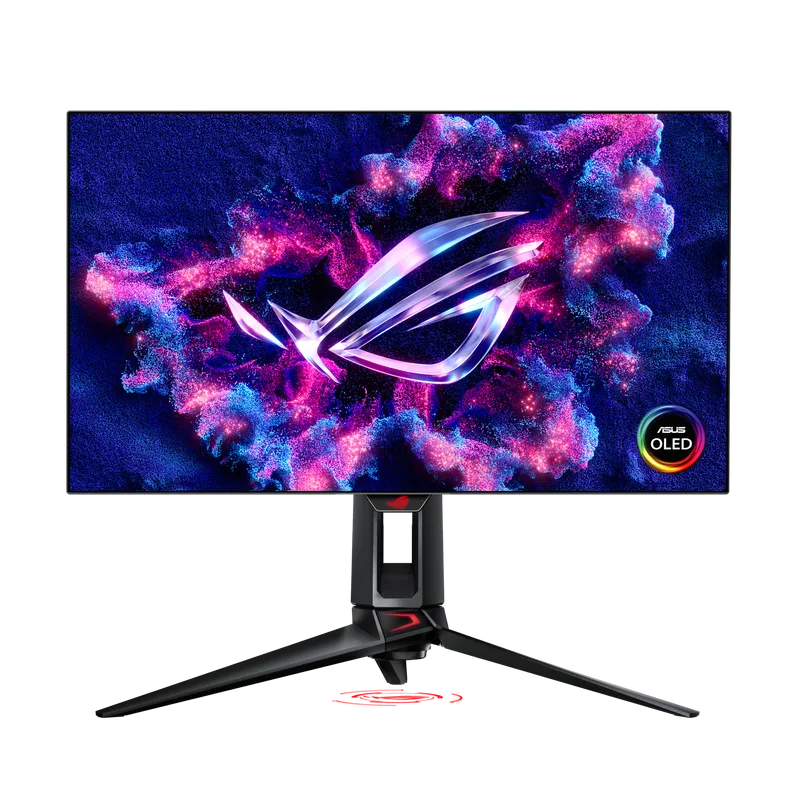
The ASUS ROG Swift PG27AQDP is the fastest 1440p gaming monitor on a WOLED panel. Its 480Hz refresh rate combined with 0.03ms gray-to-gray response eliminates motion blur at any frame rate a GPU can realistically produce at this resolution. The custom heatsink ASUS added to the back of the panel is a genuine engineering solution — where earlier OLED monitors throttled brightness during extended sessions, the PG27AQDP maintains consistent output.
Color accuracy is legitimately dual-purpose. The 99% DCI-P3 and True 10-bit processing make it a credible creative monitor for video editing and photography, not just a gaming accessory. DisplayHDR True Black 400 certification means HDR content is fully realized — you see black when the pixel is off, not a dim backlight glow.
The DP 1.4 limitation: 480Hz at 1440p requires DSC on this connection. Most users won’t detect the compression, but if you’re running high-end video work and gaming on the same display, the LG 27GX790A-B’s DP 2.1 is the cleaner technical choice.
The AI Assistant feature — game-specific display presets via an app — adds to the MSRP without meaningful benefit for most buyers. Skip it in practice. You’re still buying one of the best 1440p gaming monitors available.
2. LG 27GX790A-B UltraGear — Best for eSports
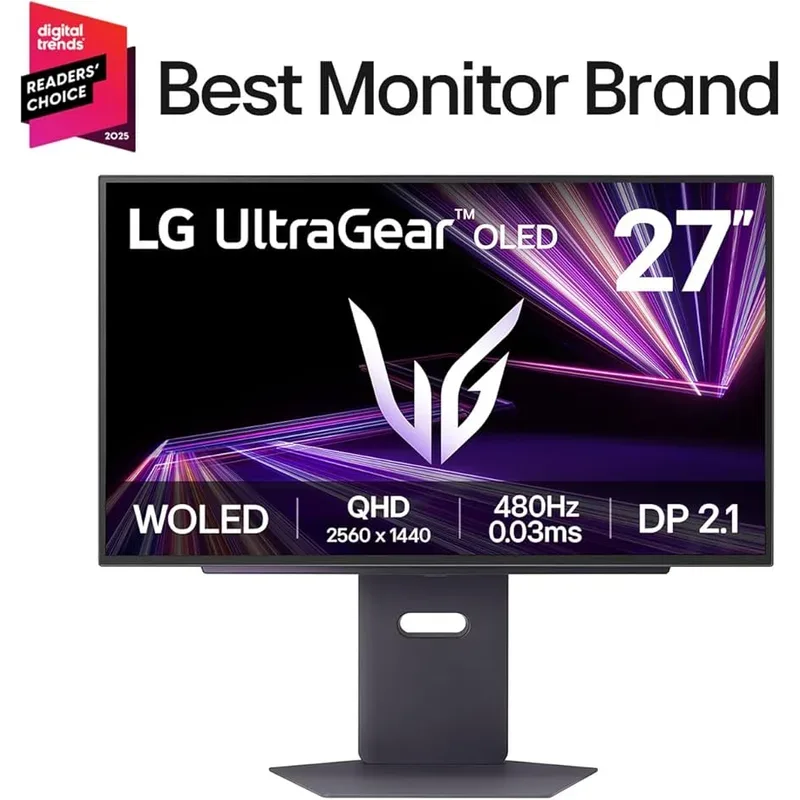
LG 27GX790A-B UltraGear
The LG 27GX790A-B launched well above its current $699 street price — a substantial discount that makes it the strongest value among 480Hz OLED monitors right now. It matches the ASUS PG27AQDP on refresh rate and response time while adding DisplayPort 2.1, which delivers uncompressed signal bandwidth where the ASUS requires DSC.
For competitive players who eliminate every possible variable — signal compression, added latency, image artifacts under DSC edge cases — the LG’s DP 2.1 is the cleaner specification at a lower price than the ASUS.
Dual HDMI 2.1 ports add practical flexibility: connect a PS5 or Xbox Series X alongside your PC without a KVM switch, switching between console gaming at 4K/120Hz and PC gaming at 480Hz/1440p from the same display.
LG’s OLED panel reaches 1,300 nits peak brightness with 98.5% DCI-P3 coverage — marginally below the ASUS’s 99% DCI-P3, but the difference is invisible in normal use. The stand covers tilt, height, swivel, and pivot adjustment.
Where the LG trails the ASUS is thermal management. The PG27AQDP includes a dedicated hardware heatsink and ASUS OLED Care+ software. LG includes OLED Care features but without the physical thermal solution for sustained professional workloads.
If 540Hz matters to you: LG’s 27GX790B-B is now available at $799 with a 4th-gen Tandem OLED panel and 540Hz native at 1440p. At $699, the 27GX790A-B remains the better value for competitive gaming.
3. ASUS ROG Strix XG27AQDMG — Best Glossy OLED
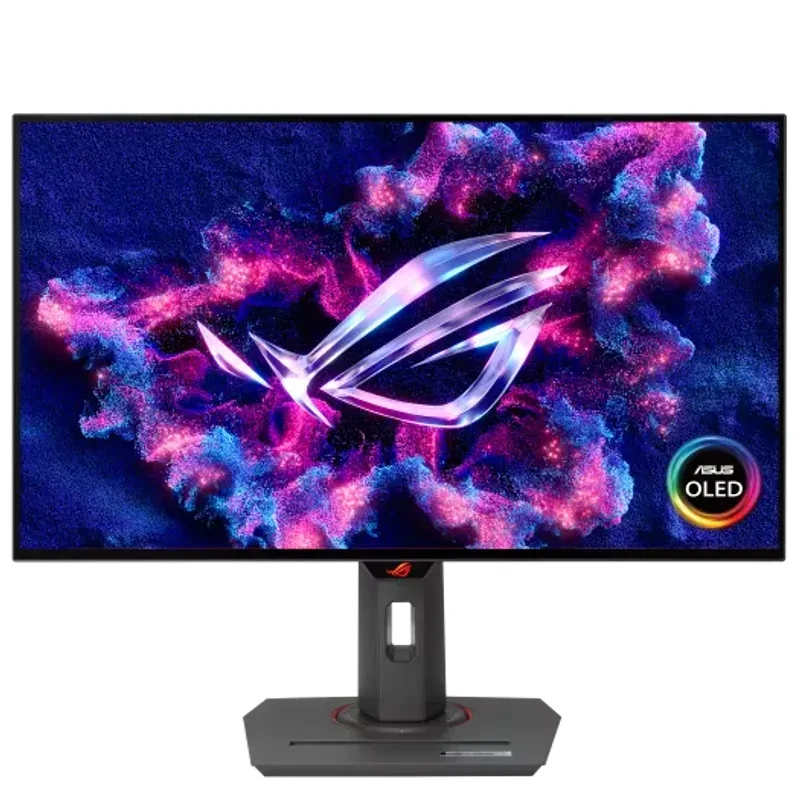
The ASUS ROG Strix XG27AQDMG targets buyers who want OLED image quality at 240Hz without paying a premium for frame rates their GPU can’t sustain. Priced below the 480Hz flagships, it delivers the same WOLED panel quality with a unique differentiator: a glossy anti-reflective coating.
The glossy coating divides users. In a dark room or controlled lighting, it makes OLED’s already excellent blacks appear even deeper, with colors looking more saturated and vivid compared to matte panels. In a bright office with windows behind the monitor, reflections are noticeable. This is a room-setup choice, not an objective upgrade.
ASUS includes a 3-year warranty with OLED Care protection covering pixel uniformity and burn-in under normal usage. At this price tier, long-term protection matters — it’s the kind of coverage that justifies this panel over cheaper third-party OLED options.
The 240Hz ceiling won’t satisfy players running RTX 5090 builds at maximum frame rates. For the vast majority of competitive gaming scenarios — esports titles at competitive settings, AAA gaming at high refresh — 240Hz covers the practical range.
4. MSI MAG 271QPX QD-OLED E2 — Best Value OLED
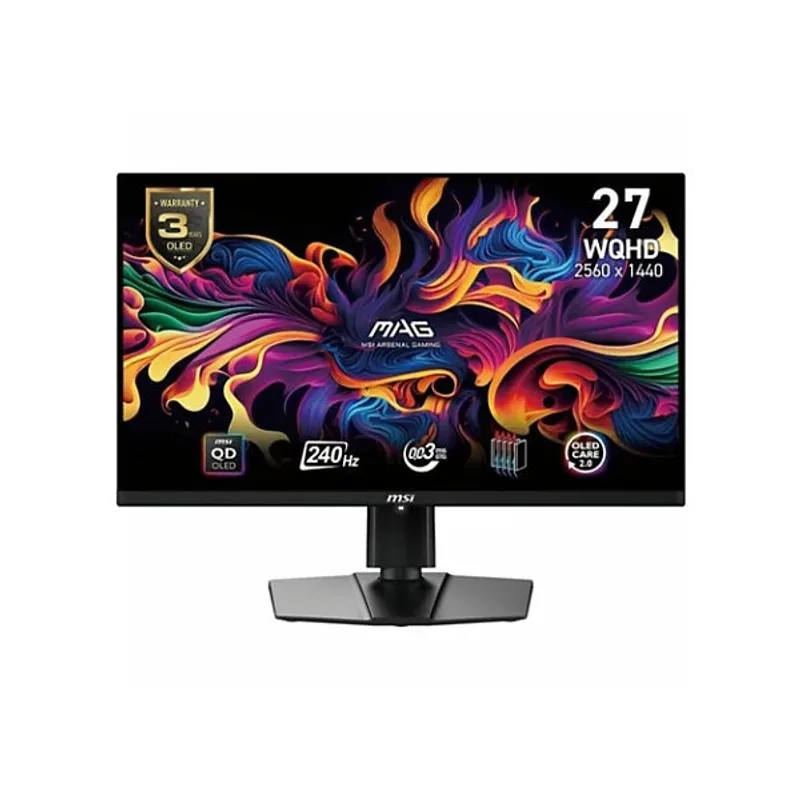
The MSI MAG 271QPX QD-OLED E2 is the most accessible route to genuine OLED gaming at 1440p at $629. It uses Samsung’s second-generation QD-OLED panel — the same core technology driving the more expensive monitors in this list — with improved SDR brightness over first-gen that resolves the main criticism of QD-OLED in office lighting.
Second-gen QD-OLED reaches approximately 250 nits in SDR mode, roughly 30% higher than first-gen panels. That makes the monitor genuinely usable for daytime work rather than exclusively for dark-room gaming — a real-world improvement that first-gen QD-OLED buyers requested.
At $629, this is the entry point for OLED gaming. The 0.03ms response time, infinite contrast ratio, and QD-OLED color gamut all transfer from the more expensive options in this roundup. You’re not getting a watered-down OLED experience — you’re getting 240Hz instead of 480Hz and a slightly simpler accessory package.
The frameless design skips built-in speakers entirely. Factor in a headset or desktop speakers before purchase.
5. AOC Q27G3XMN — Best Budget
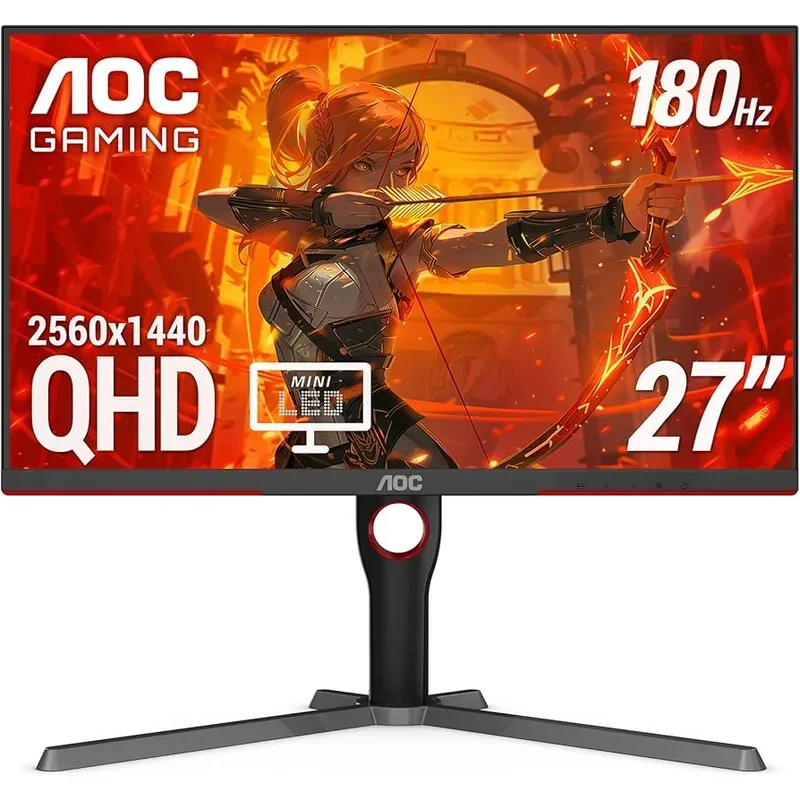
The AOC Q27G3XMN is the best 1440p monitor under $300 — and it’s not particularly close. A mini-LED backlight system with local dimming zones achieves DisplayHDR 1000 certification — 1,000 nits peak brightness in HDR mode — which outperforms many monitors priced $200 higher. Its sRGB 137.5% coverage produces colors well beyond standard gamut LCD panels.
Pricing context: the Q27G3XMN now runs around $299 after spending time below $250. The “sub-$250” framing from earlier coverage no longer reflects current pricing, but at $299 it remains an outstanding value relative to what it delivers.
The OLED trade-offs are real. VA panels produce deeper blacks than IPS but with slower pixel response, and mini-LED local dimming creates halos around bright objects against dark backgrounds. Both appear in dark scenes with bright UI elements — space games, horror titles, anything with high contrast in a single frame.
The 180Hz refresh rate falls short for competitive play. Players who need 240Hz+ in CS2 or Valorant should look at the MSI MAG 271QPX instead. For single-player games, RPGs, strategy titles, and casual multiplayer, 180Hz at 1440p is more than sufficient.
AOC’s 3-year zero-bright-dot warranty covers bright stuck pixels from day one — meaningful quality assurance for VA panels where uniformity shows more variance than OLED.
FAQ
Is 1440p still worth it in 2026 with 4K monitors falling in price?
Yes. At 27 inches, 1440p hits 109 PPI — enough sharpness that most users can’t distinguish it from 4K without their face close to the screen. More importantly, 1440p delivers roughly twice the frame rates of 4K at the same GPU power, which translates directly to lower response times and smoother motion in competitive games.
Do I need an OLED monitor for 1440p gaming?
Not necessarily. The AOC Q27G3XMN proves mini-LED can deliver serious HDR and wide color gamut under $300. OLED is worth the premium if you play dark atmosphere games (Elden Ring, horror titles, space games) where true blacks matter, or if competitive play is your focus and sub-1ms response is the priority. For casual gaming and mixed-use setups, mini-LED is genuinely competitive.
Will a 480Hz monitor make me better at gaming?
The incremental benefit over 240Hz is real but narrow. The jump from 60Hz to 120Hz is dramatic, 120Hz to 240Hz is meaningful, and 240Hz to 480Hz is a smaller perceptual improvement that most players need controlled conditions to confirm. The primary argument for 480Hz is lower average system latency — at 480Hz your display adds roughly 2ms of frame time versus 4ms at 240Hz. For high-level competitive play, that difference matters. For everyone else, 240Hz is the practical ceiling.
What GPU do I need for 1440p 240Hz gaming?
For consistent 240Hz across competitive and AAA titles, the RTX 5070 Ti or AMD RX 9800 XT are the current baseline. For esports titles (CS2, Valorant, Apex Legends) at competitive-grade settings, the RTX 5070 sustains 240+ FPS in most scenarios.
Should I consider the LG 27GX790B-B over the 27GX790A-B?
If you’re buying new at the $799 tier and want the absolute fastest panel, yes — the 27GX790B-B uses 4th-gen Tandem OLED at 540Hz native (720Hz in dual reduced-resolution mode). For most buyers, the 27GX790A-B at its current $699 street price remains the better value since 480Hz already exceeds what any current GPU can sustain in demanding titles.
Curved or flat at 27 inches?
Flat. At 27 inches, curvature provides minimal immersion benefit and can introduce geometric distortion close to the screen. Every panel in this roundup is flat — that’s the right call at this screen size. For immersive curved gaming at 1440p, look at 34-inch ultrawide options instead.
The Bottom Line
ASUS ROG Swift PG27AQDP is the best 1440p gaming monitor in 2026 — 480Hz WOLED with a hardware heatsink and professional-grade color accuracy at $799.
LG 27GX790A-B is the stronger eSports pick at $699, adding DisplayPort 2.1 uncompressed bandwidth at a lower price than the ASUS.
MSI MAG 271QPX QD-OLED E2 at $629 is the entry point for OLED gaming — second-gen QD-OLED performance without compromise.
AOC Q27G3XMN at $299 is the smartest non-OLED purchase at 1440p — DisplayHDR 1000 and 180Hz without paying the OLED premium.