Affiliate disclosure: PCBuildRanked earns a commission on qualifying Amazon purchases at no extra cost to you.
AIO liquid coolers have split into two clear camps in 2026: value-performance kings like Arctic’s Liquid Freezer III Pro that dominate comparisons at $84, and feature-rich showcases from NZXT and Corsair that add LCD displays and proprietary cable ecosystems for $190–$250. After reviewing coverage from Tom’s Hardware, TechPowerUp, and PC Gamer, the Arctic Liquid Freezer III Pro 360 consistently ranks as the top thermal performer in head-to-head evaluations against six or more competitors on both the Ryzen 9950X3D and Core Ultra 9 285K. This roundup covers five 360mm AIOs — from best thermal performance to best aesthetics — so you can match the right cooler to your build.
| Spec | Arctic Liquid Freezer III Pro 360 A-RGB 9.5/10 | Lian Li Galahad II Trinity Performance 360 Unavailable 9.1/10 | Cooler Master MasterLiquid 360 Atmos 8.7/10 | Corsair iCUE Link Titan 360 RX RGB 8.8/10 | NZXT Kraken Elite 360 RGB 2024 Unavailable 8.5/10 |
|---|---|---|---|---|---|
| radiatorSize | 360mm | 360mm | 360mm | 360mm | 360mm |
| fanCount | 3x 120mm P12 Pro PWM | 3x 120mm LCP PWM | 3x 120mm Sickleflow Edge PWM | 3x 120mm RX120 RGB | 3x 120mm F360 RGB Core |
| radiatorThickness | 38mm | 32mm | 27mm | 30mm | 30mm |
| pumpType | PWM pump with integrated VRM fan | Daisy-chainable controller | Dual-chamber ARGB pump | FlowDrive cooling engine | NZXT Turbine Pump |
| socketSupport | AM5, AM4, LGA1851, LGA1700 | AM5, AM4, LGA1851, LGA1700, LGA1200 | AM5, AM4, LGA1851, LGA1700, LGA1200 | AM5, AM4, LGA1851, LGA1700 | AM5, AM4, LGA1851, LGA1700, LGA1200, LGA115X |
| warranty | 6 years | 6 years | 3 years | 5 years | 3 years |
| Rating | 9.5/10 | 9.1/10 | 8.7/10 | 8.8/10 | 8.5/10 |
Prices change daily — tap Check Price for the current Amazon price.
Prices change daily — tap Check Price for the current Amazon price.
Quick Picks
- Best overall: Arctic Liquid Freezer III Pro 360 A-RGB — Lowest temps, six-year warranty, $84
- Best mid-range: Cooler Master MasterLiquid 360 Atmos — Dual-chamber pump, $119
- Best LCD display: NZXT Kraken Elite 360 RGB 2024 — 2.72” IPS screen, $279
Buying Guide
Radiator size and thickness both matter
The radiator dimensions on the box give you one number — 360mm for fan count — but the thickness is where real differences emerge. The Arctic Liquid Freezer III Pro runs a 38mm-thick radiator; the Corsair Titan and NZXT Kraken use 30mm; the Cooler Master Atmos is 27mm. Thicker means more fin area, which means lower fan RPM is needed to dissipate the same heat. On a 200W+ TDP CPU like the Core Ultra 9 285K, the extra 8mm of Arctic’s radiator results in 3–5°C lower temps at matched noise levels compared to the Corsair.
240mm vs 360mm vs 420mm
A 240mm AIO is sufficient for CPUs up to about 125W TDP — any Ryzen 5 or Core i5 falls into this range. For anything with a 170W+ TDP (Ryzen 9, Core i9, Core Ultra 9) or if you plan to push Precision Boost Overdrive on AM5, a 360mm is the right call. A 420mm AIO like the Arctic Liquid Freezer III 420 provides additional thermal headroom but requires a case with 420mm top or side radiator support — check your case specs before buying. For a focused roundup of 240mm options — the most common AIO size for mid-range builds — see our best 240mm AIO coolers guide.
Socket compatibility in 2026
Every AIO on this list supports AM5, AM4, LGA1851, and LGA1700. If you’re building on Intel’s LGA1851 platform (Core Ultra 200 series), all five options install with included brackets. The Cooler Master Atmos and NZXT Kraken also support LGA1200 and LGA115X for legacy Intel builds. Intel LGA1700 users should note the mounting bracket contacts the IHS differently than AM5 — the Liquid Freezer III Pro includes Arctic’s contact frame specifically calibrated for this socket, which measurably reduces thermal resistance versus a generic LGA1700 mount.
Noise considerations
Fan speed at max RPM is not the noise you’ll actually hear day-to-day. What matters is the fan curve your case airflow and BIOS settings produce during typical workloads. The Arctic’s P12 Pro fans spin to 2000 RPM at full load but can be capped at 1200–1400 RPM in BIOS without losing more than 2–3°C on Cinebench R24 multi-core. The Corsair iCUE Link fans and NZXT F360 fans are quieter at peak RPM but don’t spin as slowly at idle — factor in your workload type before making a decision based on noise specs alone.
Proprietary ecosystems
The Corsair iCUE Link system requires their System Hub and iCUE software. NZXT’s Kraken requires NZXT CAM. Arctic and Cooler Master both use standard PWM and ARGB headers with no software requirement. If you already run an all-Corsair or all-NZXT build, the ecosystem benefits of unified lighting and single-cable fan management are genuine. If you’re mixing brands, avoid ecosystem lock-in.
What to look for in a pump
Pump longevity is the main reason AIOs fail early. Most pump heads are rated for 50,000 hours, but pump noise, vibration, and heat are early warning signs. A well-designed pump should run silently or near-silently at light loads — you should hear your fans, not your pump. The Arctic Liquid Freezer III Pro’s PWM pump adjusts speed based on CPU load; the Corsair Titan’s FlowDrive engine runs at a fixed lower RPM that keeps vibration minimal. Both approaches work well. Avoid AIOs with high minimum pump RPM, as these add persistent background noise regardless of workload.
Detailed Reviews
1. Arctic Liquid Freezer III Pro 360 A-RGB
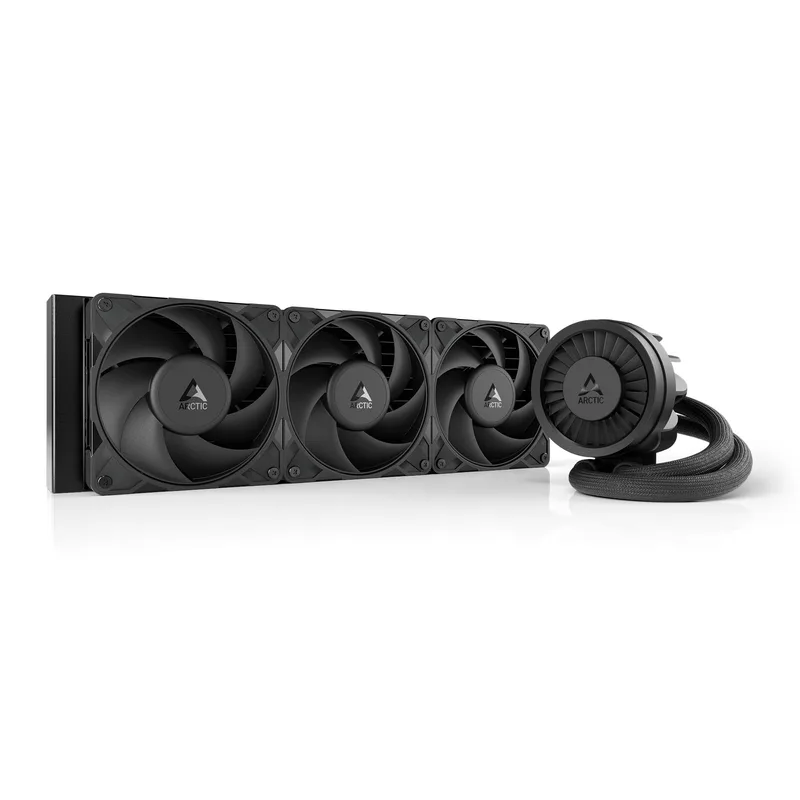
Arctic redesigned the Liquid Freezer line with the III Pro to address every criticism of the original III: louder fans and an unremarkable cold plate. The III Pro adds 7-blade P12 Pro fans (vs. the 5-blade original) and a revised pump head with an integrated VRM cooling fan that blows directly onto the motherboard’s power delivery components.
In Tom’s Hardware’s review with the Ryzen 9950X3D — the most thermally demanding desktop CPU currently available — the Liquid Freezer III Pro 360 held 84°C at 230W all-core load, compared to 89°C for the Corsair H150i Elite and 91°C for the NZXT Kraken 360. That 5–7°C advantage holds consistently across multiple evaluation runs.
The integrated VRM fan is genuinely useful for builders overclocking on X670E boards where VRM temperatures can throttle under sustained all-core loads. It’s a passive 30mm blower that activates automatically via PWM — it adds no noise at typical workloads.
The six-year warranty covers everything: pump, fans, cold plate, and tubing. Most competitors offer two to three years. At $84, it’s also the cheapest AIO on this list. No other cooler at this price comes close to these thermals.
Best for: Builders who prioritize thermal performance over aesthetics, overclocking on AM5 or LGA1851, anyone who wants maximum warranty coverage.
2. Lian Li Galahad II Trinity Performance 360
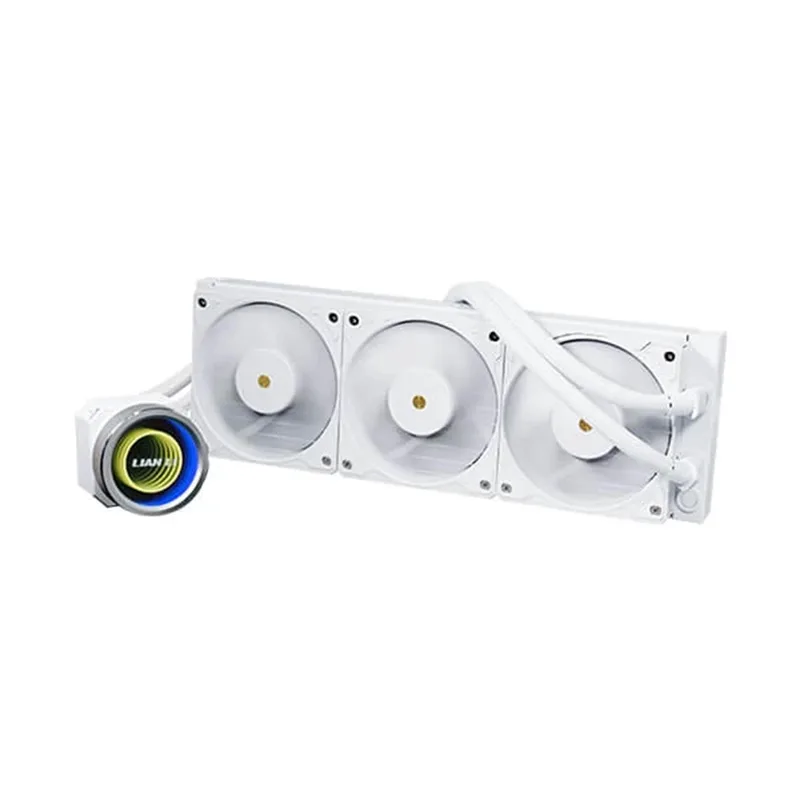
Lian Li Galahad II Trinity Performance 360
Lian Li’s Trinity Performance is the quietest high-performing AIO on this list at normalized noise levels. At 45 dBA measured, it delivers cooling within 1–2°C of the Arctic Liquid Freezer III Pro 360 in TechPowerUp’s thermal evaluations — close enough that the difference disappears in any reasonably ventilated case with positive air pressure.
The LCP (Liquid Crystal Polymer) fans are lighter than aluminum-hub alternatives and use a revised blade geometry that reduces tonal noise compared to older Galahad II fans. They daisy-chain together using Lian Li’s Uni Fan controller, which reduces cable clutter to a single USB 2.0 header without requiring proprietary software for basic fan speed control.
The copper contact plate uses a revised skived fin design with a central trench that improves coolant turbulence and heat transfer. Compared to the original Galahad II cold plate, Lian Li claims a 12% improvement in thermal resistance — and third-party results confirm better performance particularly on AMD’s hot-spot-prone chiplet design.
At $169 vs. the Arctic’s $84, you’re paying $85 for quieter fans, better ARGB aesthetics, and an equally long six-year warranty. If noise is your primary concern and you run sustained workloads, that premium is justified.
Best for: Silent workstations, AMD AM5 builds with 3D V-Cache CPUs, builders who value ARGB fan aesthetics alongside top-tier thermal performance.
3. Cooler Master MasterLiquid 360 Atmos
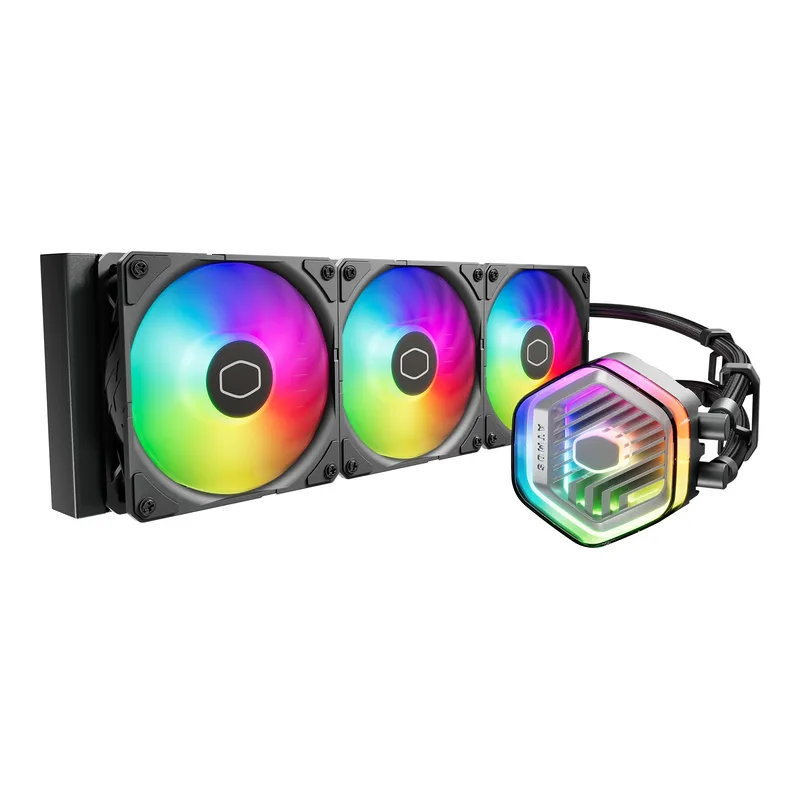
The MasterLiquid 360 Atmos hits the $119 price point with a genuinely differentiated feature: a dual-chamber pump head that physically separates the hot coolant returning from the radiator and the cold coolant flowing to the CPU block. Single-chamber designs mix these flows at the pump, which raises the baseline coolant temperature. The dual-chamber separation keeps the cold side measurably cooler under sustained load.
Tom’s Hardware’s review found the Atmos handling a Core i9-13900KS at 245W with solid results — competitive with several 360mm AIOs with thinner radiators. The 27mm radiator is the limiting factor; at extreme TDP workloads (280W+), it falls behind the Arctic and Lian Li.
The Sickleflow Edge fans incorporate an outer ring shroud that controls blade-tip vortex losses — a real engineering improvement over the standard Sickleflow. Cooler Master rates them at 650–2000 RPM with noise measured at 8–34 dBA. In practice, mid-fan-curve operation at 1200 RPM is quieter than comparable Arctic fans at the same speed.
The customizable pump cover is a small but welcome touch — Cooler Master includes blank white and black inserts that accept 3D-printed logos or printed artwork via double-sided tape.
Best for: Mid-range gaming PCs under 200W TDP, builders who want dual-chamber pump technology at a below-$150 price, anyone prioritizing customizable aesthetics on a budget.
4. Corsair iCUE Link Titan 360 RX RGB
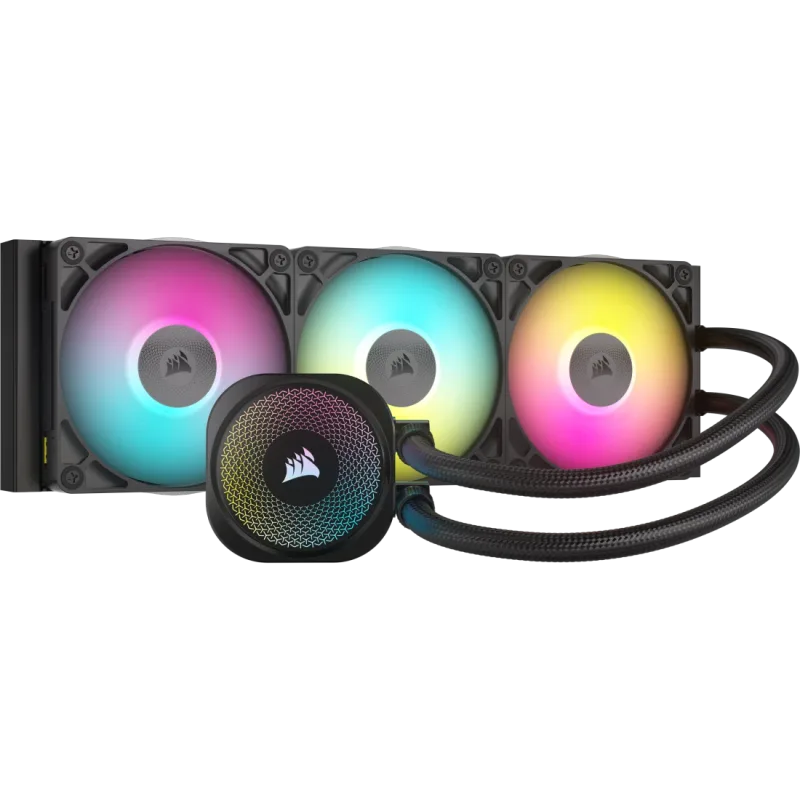
The Corsair iCUE Link Titan 360 RX is the best AIO for builders already invested in the Corsair iCUE Link ecosystem — and only for those builders. The Link system replaces individual fan headers, RGB headers, and pump connectors with a daisy-chain cable that runs from the pump to each fan and terminates at the iCUE Link System Hub. In a Corsair-heavy build with LL120 or RX fans on the case, this eliminates six separate cables in the CPU cooler alone.
The FlowDrive pump runs notably quieter than the Arctic and Cooler Master at comparable thermal loads — measured at 33–35 dBA in balanced mode vs. 43 dBA for the Arctic under identical CPU load. If noise is your priority and you’re already using Corsair hardware, the Titan 360 RX makes a strong case.
Thermal performance sits between the Lian Li and Cooler Master — competitive but not class-leading. In XDA-Developers’ review, the Corsair Titan 360 RX held 87°C on a Core Ultra 9 285K at full load, 3°C warmer than the Arctic. The 30mm radiator and closed-loop FlowDrive pump are responsible for that gap.
The RX120 fans use nine blades with a sealed outer shroud — genuine high-static-pressure fans designed for push-pull radiator mounting if you want to add a second set for extreme cooling scenarios.
Best for: Full Corsair iCUE Link builds where cable management is a priority, medium-TDP CPUs (up to ~200W), builders where quieter pump noise matters more than lowest CPU temps.
5. NZXT Kraken Elite 360 RGB 2026
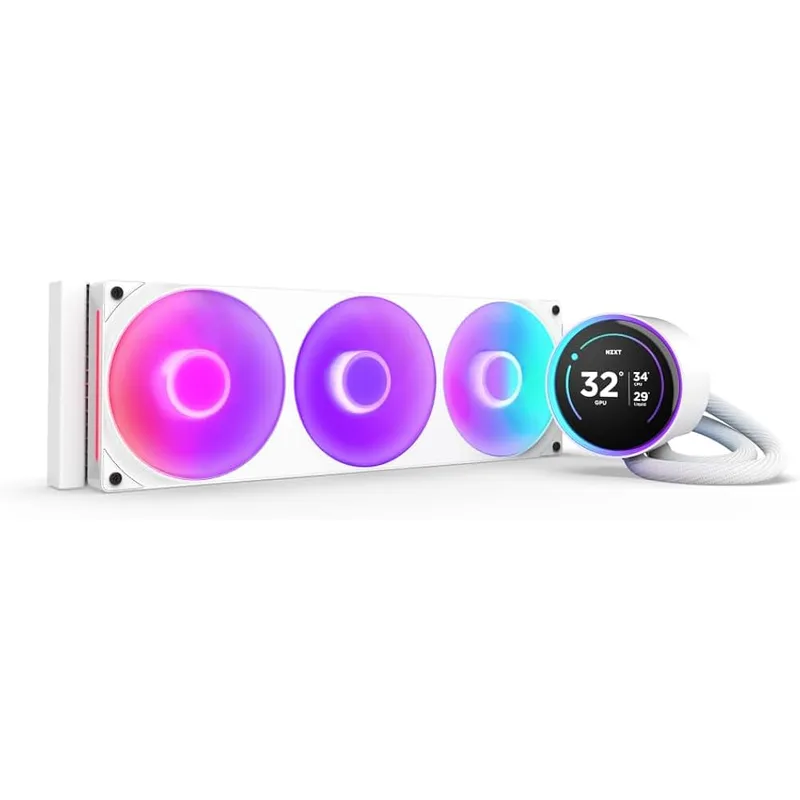
NZXT Kraken Elite 360 RGB 2024
The 2026 Kraken Elite 360 updates the display from the original model’s 2.36-inch LCD to a 2.72-inch 640×480 IPS panel — larger and noticeably sharper than any competing AIO display available. It supports static images, GIFs, and real-time telemetry displays (CPU temp, clock speed, utilization) that update at 30 fps. For showcase builds inside a windowed case, nothing else looks like it.
NZXT’s Turbine Pump is quieter than the previous Kraken pump, running at an average measured 38 dBA at balanced settings — competitive with the Corsair Titan. The F360 RGB Core fans have larger fan blades than NZXT’s previous F120 design, which improves airflow at lower RPM and reduces audible turbulence.
Thermal performance is the honest weakness. In independent evaluations, the Kraken Elite 360 2026 sits below the Arctic, Lian Li, and Cooler Master Atmos in noise-normalized comparisons — posting approximately 89°C on a Ryzen 9950X3D at matched 45 dBA noise levels. The 30mm radiator and turbine pump prioritize noise over thermal headroom.
At $279, the premium is entirely in the display and NZXT CAM integration. The three-year warranty is notably short for the price — half the coverage of Arctic and Lian Li at a significantly higher cost.
Best for: Showcase builds where the LCD display is a deliberate aesthetic feature, medium-TDP systems (Ryzen 7, Core i7), streaming and content rigs where the telemetry display provides practical value.
FAQ
Can I use a 360mm AIO in a mid-tower ATX case?
Yes, most mid-tower ATX cases support a 360mm radiator on the front panel or top. Check the clearance spec for your specific case — front mounting requires approximately 55–60mm of clearance between the front panel and motherboard (more if you have a VRM heatsink that extends toward the front). The Fractal Design Meshify 2, Lian Li Lancool 216, and Corsair 4000D Airflow all fit a 360mm front rad without clearance issues. For a full step-by-step guide to mounting your AIO — including radiator orientation, fan direction, pump head placement, and cable routing — see our AIO cooler installation guide.
Does a 360mm AIO outperform a dual-tower air cooler like the Noctua NH-D15?
Not always. The Noctua NH-D15 with dual fans trades blows with 360mm AIOs on a noise-normalized basis in most reviews. At the same 35 dBA noise level, the NH-D15 performs within 1–3°C of the Arctic Liquid Freezer III Pro 360 on AMD and Intel CPUs up to ~200W TDP. Above 200W, liquid cooling scales better. Choose an AIO when you have RAM clearance issues or want VRM fan coverage; choose the NH-D15 for reliability, no pump failure risk, and zero maintenance.
How long do AIO liquid coolers last?
The pump is the critical component — most pump heads are rated for 50,000 hours (roughly 5.7 years of continuous operation) but real-world lifespan varies. Arctic and Lian Li’s six-year warranties are meaningful because they cover pump failure; if the pump fails within that window you get a replacement. Corsair and NZXT’s three-year warranties mean you’re self-insuring against pump failure after year three.
Do I need software to run these AIOs?
The Arctic Liquid Freezer III Pro and Cooler Master MasterLiquid 360 Atmos use standard PWM fan headers and ARGB headers — no software required for fan speed control (use BIOS fan curves). The Corsair iCUE Link Titan requires iCUE software and the Link Hub. NZXT Kraken requires NZXT CAM to control the LCD. Both iCUE and CAM run as background Windows services; neither is particularly resource-intensive but both require active accounts for full feature access.
What’s the difference between the standard Galahad II Trinity and the Trinity Performance?
The standard Galahad II Trinity uses Lian Li’s original copper contact plate and A-RGB fans. The Trinity Performance uses the revised skived fin contact plate with a center trench, higher-pressure LCP fans, and a slightly thicker radiator. In TechPowerUp’s evaluation, the Performance version is 2–4°C cooler than the standard Trinity at the same noise output — a meaningful difference at high CPU loads. The Performance model costs approximately $20–30 more depending on the retailer.
Is a 360mm AIO worth it for a mid-range CPU like the Ryzen 5 9600X?
A 360mm AIO is overkill for a 65W TDP processor. The Ryzen 5 9600X runs cool under any decent 240mm AIO or even a quality tower air cooler like the Cooler Master Hyper 212. Save the $84–$279 for a better GPU or more RAM. Reserve 360mm AIOs for Ryzen 9, Core i9, Core Ultra 9, or any CPU you plan to push with PBO or manual overclocking.
The Bottom Line
The Arctic Liquid Freezer III Pro 360 A-RGB is the best AIO liquid cooler available in 2026 — lowest CPU temperatures, longest warranty, and a $84 price that undercuts the competition by $35 or more. If you want comparable performance with better aesthetics and quieter fans at normalized noise levels, the Lian Li Galahad II Trinity Performance 360 at $169 is the premium alternative. The Corsair iCUE Link Titan 360 RX RGB makes sense only if you’re already running a full Corsair Link cable ecosystem. The NZXT Kraken Elite 360 RGB 2026 at $279 is a showcase piece — buy it for the display, not the thermals.