The sub-$75 gaming headset market got more competitive in early 2026. The Logitech G435 — a wireless headset that normally retails at $79.99 — dropped to $39.99 on Amazon in late March 2026, making it one of the most compelling wireless buys under $75 right now. Meanwhile, established wired picks like the SteelSeries Arctis Nova 1 and HyperX Cloud Stinger 2 have settled into stable pricing that makes them easy, low-risk recommendations. These five headsets cover every meaningful use case from competitive FPS to casual multi-platform gaming without pushing past the $75 ceiling. For picks at all price points, see our best gaming headsets roundup.
| Spec | SteelSeries Arctis Nova 1 Unavailable 8.4/10 | HyperX Cloud Stinger 2 8.2/10 | Razer BlackShark V2 X Unavailable 8/10 | Logitech G435 Unavailable 8.1/10 | Corsair HS35 v2 7.8/10 |
|---|---|---|---|---|---|
| drivers | 40mm Hi-Fi | 50mm | 50mm Razer TriForce | 40mm | 50mm neodymium |
| weight | 235g | 275g | 240g | 165g | — |
| frequency | 20Hz–22kHz | 10Hz–28kHz | 12Hz–28kHz | — | — |
| connection | 3.5mm universal | 3.5mm + USB-A | 3.5mm analog | LIGHTSPEED + Bluetooth | 3.5mm + USB-A |
| platforms | PC, PS5, Xbox, Switch | PC (Windows) | PC, PS4/5, Xbox, Switch | PC, PS4/5, Switch, Mobile | PC, Mac, PS5, PS4, Xbox, Switch, Mobile |
| mic | Retractable noise-cancelling | Swivel-to-mute, noise-cancelling | HyperClear Cardioid | Dual beamforming built-in | Flexible omni-directional boom |
| Rating | 8.4/10 | 8.2/10 | 8/10 | 8.1/10 | 7.8/10 |
Prices change daily — tap Check Price for the current Amazon price.
Prices change daily — tap Check Price for the current Amazon price.
Quick Picks
- Best Overall: SteelSeries Arctis Nova 1 — Lightweight, works on everything via 3.5mm, AirWeave foam keeps it cool.
- Best Wireless Under $75: Logitech G435 — 165g, LIGHTSPEED wireless, currently $39.99 — the easiest recommendation on this list at that price.
- Best for Competitive FPS: Razer BlackShark V2 X — TriForce 50mm drivers deliver clean directional audio tuned for footstep detection.
Buying Guide
Wired vs. Wireless at This Price
Wireless gaming headsets under $75 used to mean compromised audio or a dead battery mid-session. The G435 has changed that calculus — 18 hours of LIGHTSPEED battery life and sub-2ms latency on PC/PS5 are genuinely competitive numbers. But for pure audio quality per dollar, wired still wins. The Arctis Nova 1 and BlackShark V2 X deliver more driver quality for the same money because none of the budget goes toward wireless hardware.
If you play primarily at a desk and don’t mind a cable, go wired. If you game from a couch or move between devices frequently, the G435 at its current sale price is difficult to argue against. For a full roundup of wireless gaming headsets at every budget, see our best wireless gaming headsets guide.
40mm vs. 50mm Drivers
Three headsets here use 50mm drivers (Stinger 2, BlackShark V2 X, HS35 v2) and two use 40mm (Arctis Nova 1, G435). Larger drivers don’t automatically mean better sound — the Arctis Nova 1’s 40mm units measure better than many budget 50mm designs. What 50mm drivers do provide is more physical surface area for low-frequency reproduction, which translates to stronger bass impact in action games.
The practical difference: if you play games where footstep audio matters (CS2, Valorant, Tarkov), a well-tuned 50mm like the TriForce on the BlackShark V2 X has an edge. For general gaming and music listening, driver size matters less than tuning quality.
Platform Compatibility
All five headsets here work on multiple platforms, but in different ways:
- SteelSeries Arctis Nova 1 and Corsair HS35 v2: Universal 3.5mm — plug into any controller, headphone jack, or 3.5mm audio out on any system
- Razer BlackShark V2 X: 3.5mm only — same universal compatibility, but Razer software features are PC-exclusive
- HyperX Cloud Stinger 2: Dual 3.5mm/USB-A — USB gives access to DTS Headphone:X on Windows only; 3.5mm works everywhere else
- Logitech G435: LIGHTSPEED (PC/PS4/PS5/Switch) or Bluetooth (mobile/Switch) — no Xbox LIGHTSPEED support, though Bluetooth connects to Xbox via mobile
If you primarily game on Xbox, the Arctis Nova 1 or HS35 v2 offer the cleanest experience via 3.5mm controller input.
Microphone Types
Four of these headsets use physical boom arms; the G435 uses dual beamforming mics built into the earcups. For Discord voice calls and casual gaming, beamforming performs adequately. For streaming, content creation, or situations where voice clarity matters significantly, a dedicated boom mic is more reliable — especially the BlackShark V2 X’s cardioid design, which isolates voice pickup more effectively than the HS35 v2’s omni-directional unit.
Detailed Reviews
SteelSeries Arctis Nova 1 — Best Overall
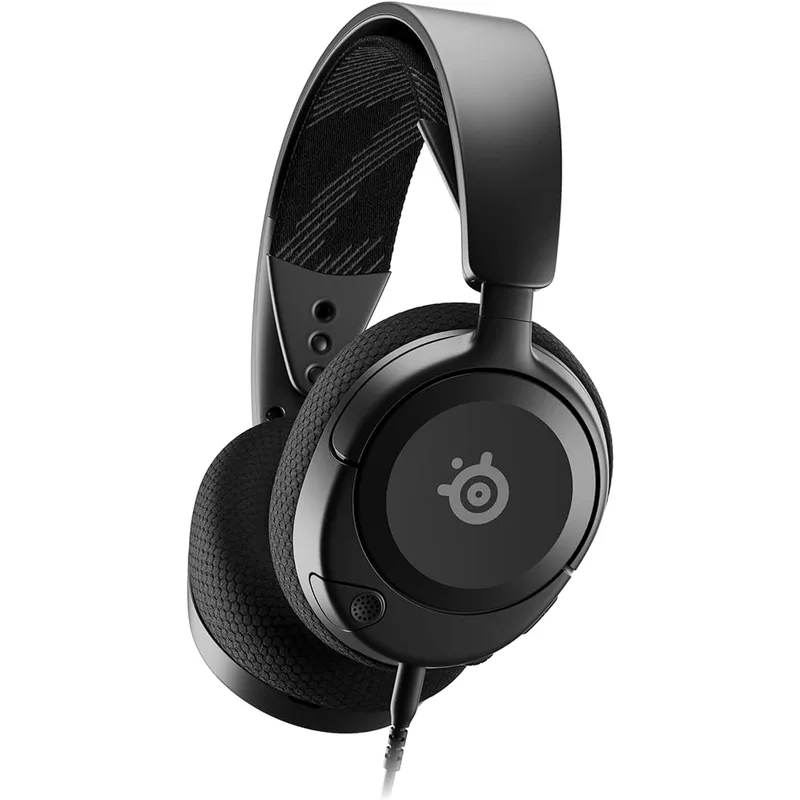
SteelSeries Arctis Nova 1
The Arctis Nova 1 earns the top spot through consistency: it does nothing exceptionally wrong, and its lightweight frame (235g) eliminates the neck fatigue that plagues heavier headsets during 4-6 hour sessions. The 40mm Hi-Fi drivers tune at 20Hz–22kHz with a 93dBSPL sensitivity rating — conservative specs that translate to a balanced sound signature without boosted bass that muddies competitive audio.
Cross-platform use is genuinely seamless. The single 3.5mm cable with a standard 4-pole TRRS plug works with PlayStation controllers, Xbox controllers, Switch in handheld mode, and PC headphone jacks. SteelSeries doesn’t lock Nova 1 features behind software — everything you get from this headset works regardless of platform.
The retractable microphone is functional rather than outstanding. It rates at -38dBV/Pa sensitivity across 100–10,000Hz — acceptable for gaming communication, but not for anyone who streams or records content. The lack of inline volume control is a legitimate frustration; SteelSeries saved cost there, and you feel it. Still, at $49 with multiplatform compatibility and that 235g frame, the Nova 1 offers the most all-around value on this list.
HyperX Cloud Stinger 2 — Best for PC
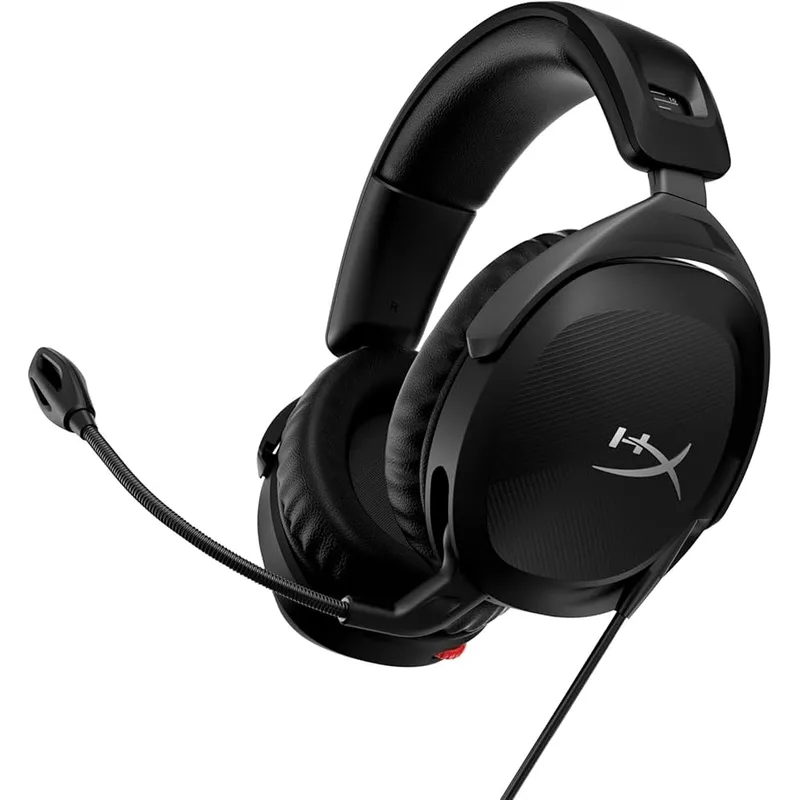
The Cloud Stinger 2 is what you buy when you’re on PC exclusively and want the most audio performance per dollar without going wireless. The 50mm drivers cover 10Hz–28kHz — that lower 10Hz floor means you feel bass extension from explosions and engine sounds that the Arctis Nova 1’s 20Hz floor clips. The difference isn’t dramatic in practice, but it’s measurable.
DTS Headphone:X spatial audio is the Stinger 2’s headline feature on PC. It processes positional cues into virtual 7.1 surround, which helps with audio localization in FPS games — not a replacement for a discrete soundcard, but a meaningful upgrade over stereo at zero additional cost. This only activates via the USB-A connection; the 3.5mm jack bypasses it entirely.
The swivel-to-mute mic is the most practical mic design on this list. Rotating the mic arm upward physically disconnects it — visible, tactile, impossible to forget. For home office and gaming use where you toggle mic-on frequently, that matters.
Build quality has been a historical weakness in the Cloud Stinger line. The Stinger 2 uses an all-plastic construction that flexes more than the HS35 v2 or Arctis Nova 1. It won’t snap under normal use, but it doesn’t inspire confidence under pressure. If you carry your headset frequently, that’s worth noting.
Razer BlackShark V2 X — Best for Competitive Play
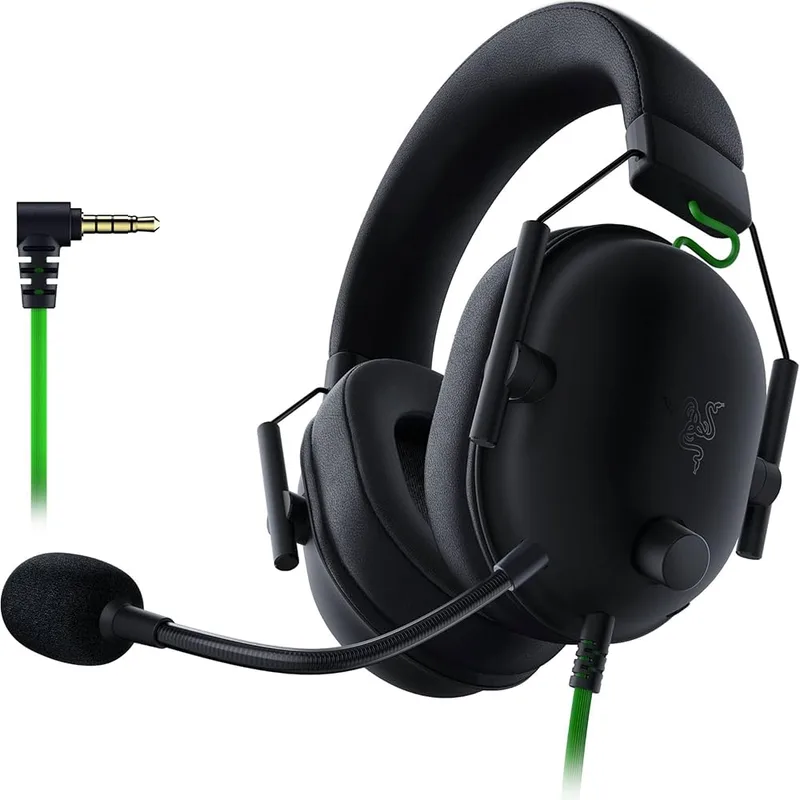
Razer BlackShark V2 X
The BlackShark V2 X exists specifically to serve competitive gaming, and Razer’s spec choices reflect that. The TriForce 50mm drivers split the driver into three distinct zones for bass, mid, and treble reproduction rather than relying on a single diaphragm for the full frequency range. The practical result is cleaner separation of high-frequency sounds — footsteps at 1–4kHz register more distinctly against lower-frequency environmental noise.
At 12Hz–28kHz frequency response with 32Ω impedance and 100dBSPL/mW sensitivity, the V2 X is one of the more technically specified budget headsets available. The 32Ω impedance means it draws adequate volume from any 3.5mm source including phone outputs and integrated laptop audio — you won’t need to crank the volume uncomfortably high to reach listening level.
The HyperClear cardioid microphone uses directional pickup to reject sound from outside the front-facing cone. In practice, keyboard noise and HVAC hum appear significantly less in recordings compared to the omni-directional designs on the HS35 v2. For anyone who plays in a noisy environment and cares how their voice sounds to teammates, this mic is the best on this list.
The short 1.3m cable is a genuine limitation for desktop tower setups. If your PC sits on the floor, plan on purchasing a 3.5mm extension cable.
Logitech G435 — Best Wireless Value
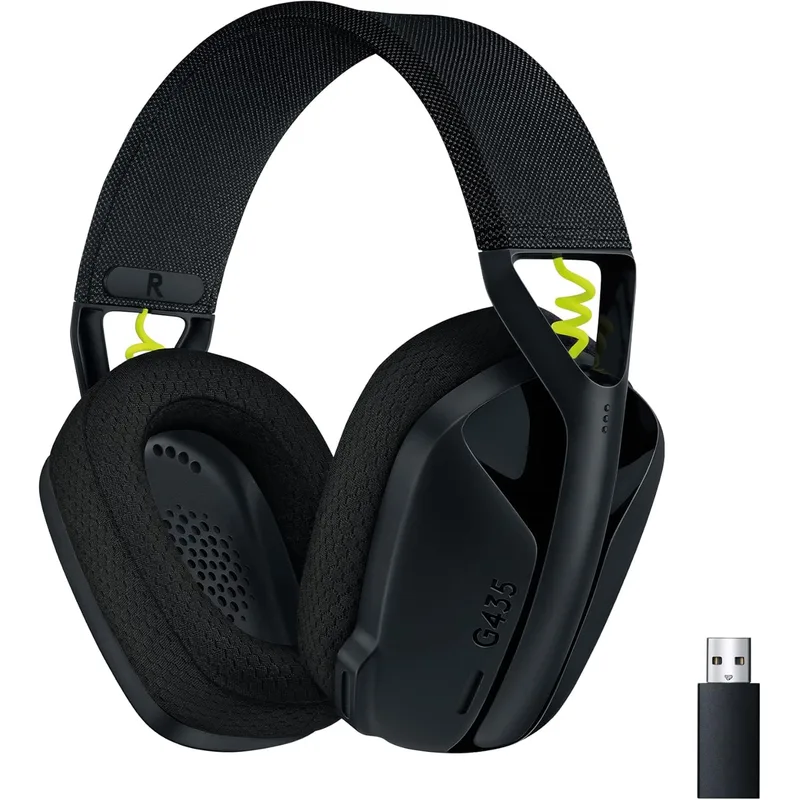
Logitech G435
The G435 normally retails at $79.99, but it routinely sells below $75 and hit $39.99 on Amazon in late March 2026 — the most dramatic discount of any headset here. At $40, the wireless value is exceptional; even at $60, it’s the only entry on this list that eliminates a cable entirely.
The 165g frame is the lightest headset in this comparison by 70g. The Arctis Nova 1 is already considered lightweight at 235g; the G435 feels nearly invisible by comparison. For marathon gaming sessions where fatigue accumulates, that 70g difference is meaningfully felt over 6+ hours.
LIGHTSPEED wireless on the G435 delivers 1ms connection latency when used via the USB dongle on PC or PS4/PS5. Bluetooth handles mobile devices and Switch Lite simultaneously. The dual-connectivity allows connection switching without manual re-pairing. The 18-hour battery life covers roughly 2–3 days of moderate gaming before needing a charge via USB-C.
The limitations are specific. The built-in beamforming mics perform adequately for gaming communication but produce a thinner vocal quality than the boom arm options here. Bass extension is subdued compared to 50mm drivers — explosions and cinematic rumble are noticeably less present. And Xbox LIGHTSPEED support is absent; Xbox users would connect via Bluetooth only.
Those limitations are real but not disqualifying at $40. As a wireless headset under $75, the G435 has no serious competition on this list.
Corsair HS35 v2 — Best No-Frills Pick
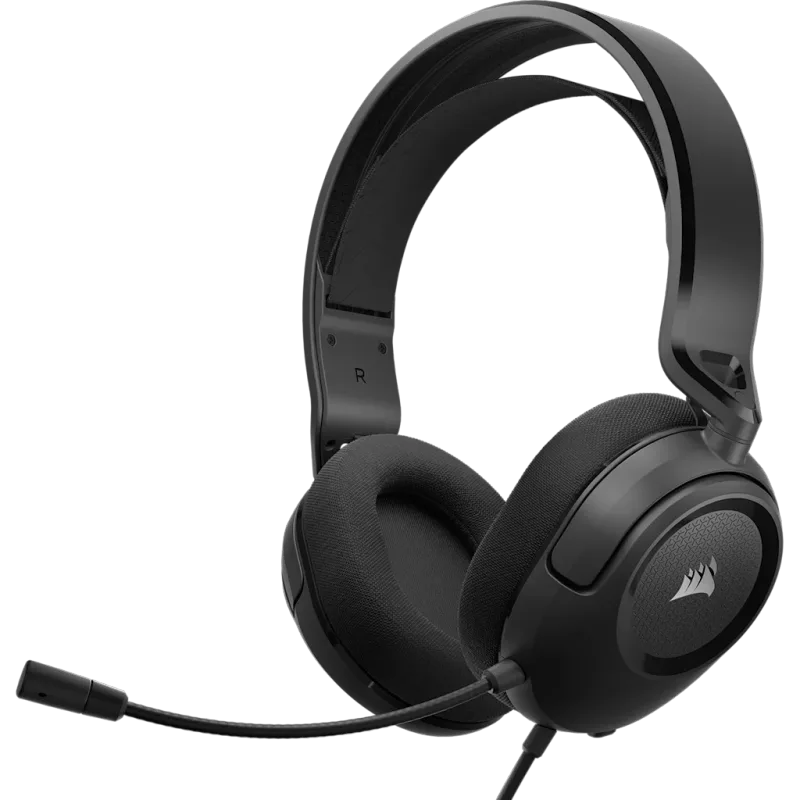
Corsair HS35 v2
The HS35 v2 is Corsair’s update to the original HS35, one of the most consistently recommended entry-level headsets of the past five years. The v2 improves the microphone design — moving from a detachable boom to a flexible omni-directional arm — and upgrades connection to include USB-A alongside 3.5mm for Windows 10/11 compatibility without a dedicated soundcard.
The 50mm neodymium drivers deliver broad sound output with emphasis on bass presence, which suits casual gaming and music listening well. The 1.8m cable is the longest on this list and the right call for a desktop-focused headset — floor-mounted PC towers no longer require an extension cable. Build quality follows Corsair’s budget philosophy: heavy-use plastic construction that withstands daily abuse better than lighter alternatives, but not as premium-feeling as the Arctis Nova 1’s frame.
Where the HS35 v2 falls short is microphone directionality. The omni-directional design picks up the full room, not just your voice. In a dedicated gaming setup with ambient noise control, that’s fine. If your desk is near an air conditioner, other people talking, or a mechanical keyboard, your teammates will hear it. The BlackShark V2 X’s cardioid mic is a better choice for those environments.
The HS35 v2 is the right pick if you want a reliable, cable-connected headset across all platforms — including Mac and Nintendo Switch — and don’t need advanced audio processing or standout mic performance.
FAQ
Do I need a soundcard or DAC to get good audio from these headsets?
No. All five headsets here are designed to work with onboard audio. The BlackShark V2 X at 32Ω and 100dBSPL sensitivity specifically targets integrated audio output. A discrete DAC will improve audio quality, but these headsets are voiced to deliver their intended sound profile through standard audio jacks.
Is the Logitech G435 actually worth it if it sometimes costs more than $75?
At $39.99–$60 (the price range it realistically sells at), yes. At $79.99 MSRP, the audio quality-per-dollar isn’t competitive with the wired options here. Set a price alert and buy it on sale — it discounts frequently enough that paying full price is avoidable.
What’s the difference between a cardioid and omni-directional gaming mic?
A cardioid mic captures sound in a focused front-facing cone, rejecting sound from the sides and rear. An omni-directional mic captures sound from all directions. For gaming, cardioid (Razer BlackShark V2 X) keeps background noise out of your voice channel; omni-directional (Corsair HS35 v2) picks up more room context. Cardioid is better for most gaming environments.
Can I use these headsets on both PC and PlayStation?
Yes, with caveats. The Arctis Nova 1, BlackShark V2 X, and HS35 v2 connect via universal 3.5mm and work natively on both platforms. The Cloud Stinger 2 works on both via 3.5mm but loses DTS Headphone:X on PlayStation. The G435 supports PlayStation via LIGHTSPEED and PC via LIGHTSPEED or Bluetooth, but has no LIGHTSPEED support for Xbox.
Should I spend $75 on a headset or put that money toward a dedicated microphone instead?
If voice communication quality is your priority — streaming, content creation, professional calls — a $50 headset plus a $30 desk mic (like the Fifine AM8) often beats a $75 gaming headset with a built-in mic. If gaming audio quality and communication are equally important, a single headset in this price range is the more practical choice.
The Bottom Line
The SteelSeries Arctis Nova 1 is the most balanced pick for most people — lightweight, platform-agnostic, and competently built at $49. If you game primarily on PC and want better positional audio, the HyperX Cloud Stinger 2’s DTS Headphone:X integration is worth the same price. For wireless without paying a wireless premium, the Logitech G435 at its current $39.99 sale price is the obvious choice — just don’t pay $79 for it.