The NVMe SSD market in early 2026 looks nothing like it did a year ago. NAND flash prices have surged due to AI data center demand consuming a disproportionate share of global production — the Phison CEO confirmed all 2026 NAND capacity was sold out before January, and some 1TB drives that cost $66 in October 2025 now sell for over $100. Finding a capable Gen4 NVMe SSD under $60 still requires knowing exactly where to look, but the deals exist if you act fast.
| Spec | TeamGroup MP44L 1TB 8.5/10 | Kingston NV3 1TB 8.7/10 | Crucial P3 Plus 1TB 8.2/10 | WD Blue SN5000 1TB 8.9/10 | WD Black SN7100 500GB 8.6/10 |
|---|---|---|---|---|---|
| interface | PCIe Gen4 x4 NVMe 1.4 | PCIe Gen4 x4 | PCIe Gen4 x4 | PCIe Gen4 x4 | PCIe Gen4 x4 |
| formFactor | M.2 2280 | M.2 2280 | M.2 2280 | M.2 2280 | M.2 2280 |
| sequentialRead | 5,000 MB/s | 6,000 MB/s | 5,000 MB/s | 5,150 MB/s | 6,800 MB/s |
| sequentialWrite | 4,500 MB/s | 5,000 MB/s | 4,200 MB/s | 4,850 MB/s | 5,000 MB/s |
| endurance | 600 TBW | 600 TBW | 440 TBW | 600 TBW | 300 TBW |
| warranty | 5-year | 5-year | 5-year | 5-year | 5-year |
| Rating | 8.5/10 | 8.7/10 | 8.2/10 | 8.9/10 | 8.6/10 |
Prices change daily — tap Check Price for the current Amazon price.
Prices change daily — tap Check Price for the current Amazon price.
Quick Picks
- Best overall value: TeamGroup MP44L 1TB — 5,000/4,500 MB/s Gen4 at ~$43 is the lowest cost-per-GB in the segment
- Best performance under $60: Kingston NV3 1TB — 6,000/5,000 MB/s leads the sub-$60 roundup at ~$52
- Best if you need raw speed over capacity: WD Black SN7100 500GB — 6,800 MB/s reads, the fastest sequential throughput at any price in this range
Buying Guide: What Matters Under $60
PCIe Gen3 vs Gen4 — No Reason to Go Backward
Every drive in this roundup uses PCIe Gen4. At the under-$60 price tier in 2026, remaining Gen3 options have largely disappeared or offer no price advantage. A Gen4 drive like the Kingston NV3 runs 6,000 MB/s sequential reads versus a Gen3 SATA SSD’s 550 MB/s ceiling. Even if your current motherboard only supports Gen3, these drives are backward-compatible and ready for your next upgrade.
DRAM vs DRAM-less vs HMB
None of these budget drives include a dedicated DRAM cache chip — at this price point, that’s expected and not a meaningful concern for most users. Two strategies exist among DRAM-less drives:
- SLC cache + no HMB (TeamGroup MP44L, Crucial P3 Plus, Kingston NV3): The controller mimics faster TLC blocks as SLC for bursting writes. Once the cache is saturated on large transfers (typically around 30-40GB), write speeds drop.
- HMB (Host Memory Bridge) (WD Blue SN5000, WD Black SN7100): Uses a small portion of your system RAM as a mapping cache. Real-world random read performance is noticeably tighter, and the drives handle large writes more consistently.
For gaming and OS use — loading games, booting Windows, application launches — the difference is negligible. If you regularly move 50GB+ files, the WD Blue SN5000’s HMB implementation is worth the extra ~$8.
Capacity: 500GB vs 1TB in 2026
Modern games routinely exceed 50GB. A 500GB drive nets you roughly 460GB usable after formatting. With Windows consuming 50GB and a few games installed, that fills quickly. The 1TB options in this roundup are the better long-term buy for most desktop builds. The WD Black SN7100 500GB earns its place here specifically for laptop upgrades and second-drive scenarios where 500GB is sufficient.
Endurance Ratings (TBW)
For a gaming and everyday-use SSD, any drive with 400+ TBW at 1TB will outlast its warranty by a wide margin under typical home use. Most users write 10-30GB per day — at that rate, a 440 TBW drive lasts over 40 years before hitting the rated limit. Don’t let a lower TBW spec be the deciding factor at this price tier.
Detailed Reviews
1. TeamGroup MP44L 1TB — Best Value
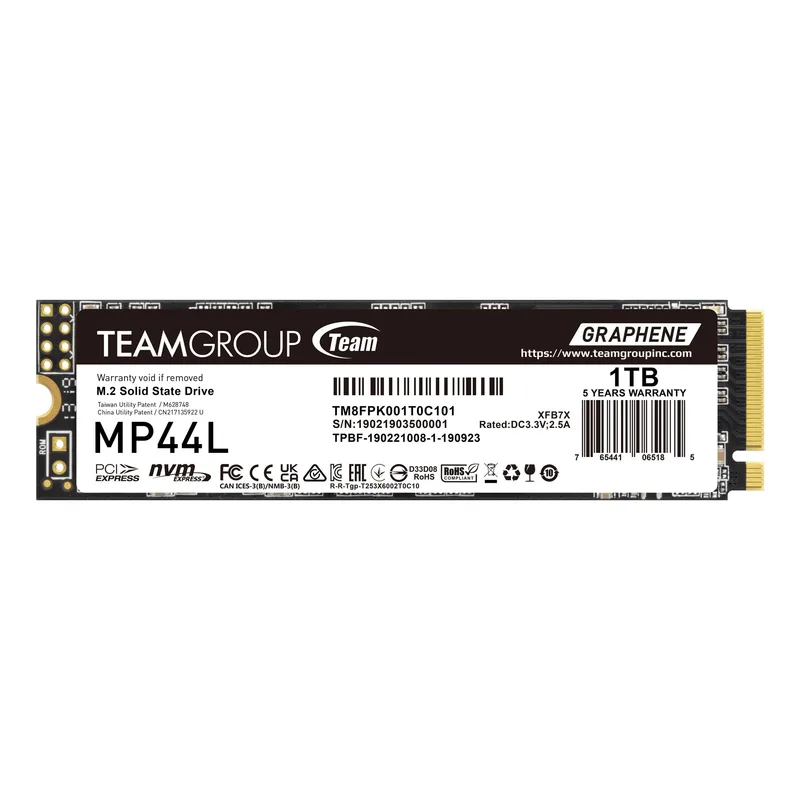
The TeamGroup MP44L 1TB is the drive to buy when the budget ceiling is firm. At roughly $43 on Amazon, it delivers 5,000 MB/s sequential reads and 4,500 MB/s writes — Gen4 speeds that would have cost $150+ just three years ago. TeamGroup’s own SLC cache implementation keeps burst write performance competitive with drives costing 20% more.
In Tom’s Hardware’s review, the MP44L traded blows with the Crucial P3 Plus in synthetic benchmarks while undercutting it in price. Real-world game load times on the MP44L are within 1-2 seconds of every other drive in this roundup — the speed floor for Gen4 NVMe is high enough that budget options barely differ in practice.
The 600 TBW endurance rating is genuinely impressive for the price. TeamGroup backs it with a full 5-year warranty, which is standard for premium-tier drives but uncommon at this cost level.
2. Kingston NV3 1TB — Editor’s Pick
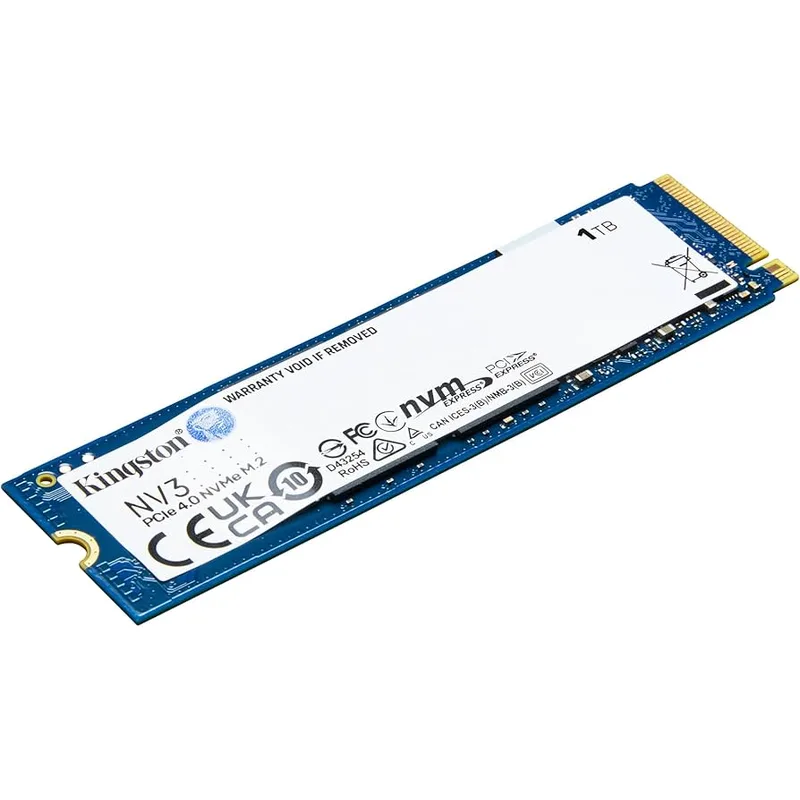
The Kingston NV3 1TB (PCIe Gen4 x4) delivers 6,000 MB/s sequential reads and 5,000 MB/s writes — meaningfully faster peak specs than the TeamGroup MP44L for about $9 more. In Tom’s Hardware’s review, the NV3 performed above expectations for a QLC-based budget drive, particularly in the 450GB sequential transfer test where it held pace better than competing budget options.
Kingston used PCIe Gen4 x4 here while some competitors cut corners with Gen4 x2 configurations. The full x4 connection ensures you’re not leaving bandwidth on the table in future builds.
The NV3 1TB hit $52.99 at its Amazon low point — an exceptional deal for 6,000 MB/s Gen4 with 600 TBW. Prices fluctuate given current NAND market conditions, but it reliably sits in the $52-60 range. If you see it under $55, buy it immediately.
3. Crucial P3 Plus 1TB
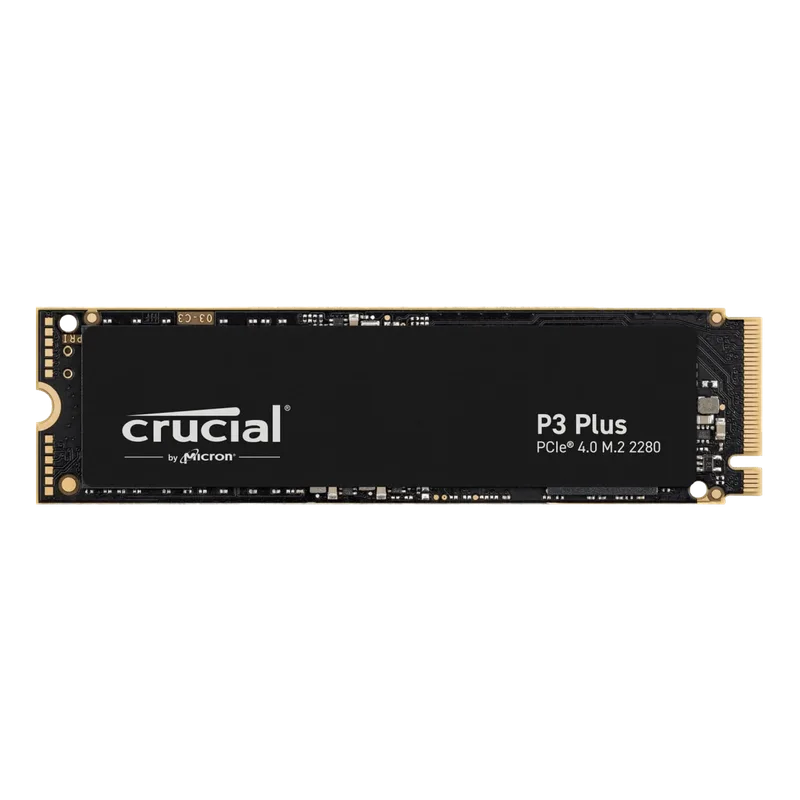
Crucial P3 Plus 1TB
The Crucial P3 Plus is the safest choice in this roundup if you prioritize brand familiarity and consistency. Crucial uses Micron’s own NAND — the parent company manufactures the memory that goes into these drives, so there’s no NAND lottery problem where early batches use one chip and later production switches to a slower one. What you read in a review is what you get.
Sequential specs of 5,000/4,200 MB/s trail the Kingston NV3’s 6,000/5,000 MB/s, and the 440 TBW endurance rating is lower. But in practical use, the P3 Plus boots Windows and loads games identically to the other Gen4 drives in this roundup. The included Acronis True Image license (full version, not a limited trial) adds real value if you’re migrating from an existing drive — that software sells for $50 standalone.
Watch for sale pricing. The P3 Plus 1TB has routinely dropped to $43-48 at Amazon and Newegg, making it the cheapest Gen4 drive you can buy on a good day.
4. WD Blue SN5000 1TB — Best Performance Under $60
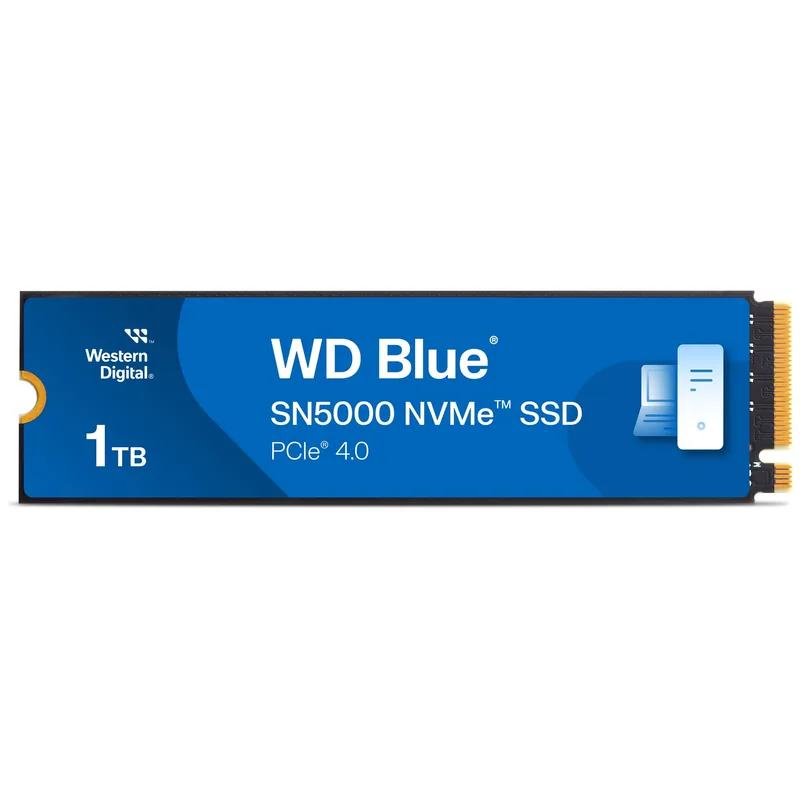
The WD Blue SN5000 is the top performer among budget drives, using Western Digital’s nCache 4.0 HMB implementation. Unlike pure SLC-cache designs, the SN5000 uses a portion of your system RAM (typically 32-64MB) as a persistent mapping table, which translates to lower random-access latency and more consistent write speeds once the SLC cache drains.
At 5,150/4,850 MB/s sequential, the SN5000’s peak specs don’t lead the roundup — the Kingston NV3 is faster in sequential reads. But in the 4K random read and write tests that matter most for OS responsiveness and database workloads, the SN5000’s HMB advantage shows up clearly. PCWorld found it ranked among the fastest HMB drives tested in 2026 across the full range of SSD benchmarks.
The SN5000 sits at the upper edge of the $60 ceiling, typically trading between $55-66 depending on retailer and timing. Set a price alert for $58 or below — at that price it’s the best budget NVMe drive money can buy.
5. WD Black SN7100 500GB — Fastest Budget NVMe Available
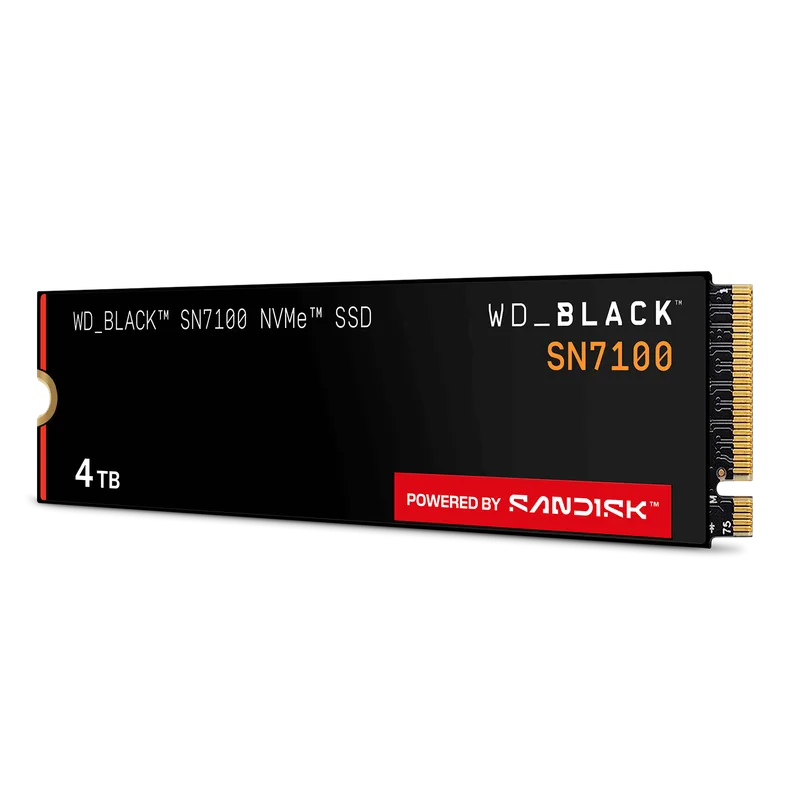
WD Black SN7100 500GB
The WD Black SN7100 500GB exists in a specific use case: you need the fastest possible sequential throughput under $60 and don’t need more than 500GB. At 6,800 MB/s sequential reads and 5,000 MB/s writes, these are numbers that rival drives costing $100+ just a year ago. PCWorld’s review called it a “record-breaking SSD” and a gaming champion for its class.
The SN7100 uses next-generation TLC 3D NAND, which sustains writes better than the QLC alternatives in this roundup once the SLC cache window is exceeded. For a 500GB drive you’re using as a game drive or laptop upgrade, you likely won’t hit that ceiling anyway.
The trade-offs are real: 300 TBW is the lowest endurance rating here, and 500GB fills up faster than you’d like on a primary desktop drive. As a secondary game storage drive alongside a 1TB system SSD, the SN7100 500GB is a compelling option. As a solo drive for a full build, the 1TB picks above make more sense.
FAQ
Do I need PCIe Gen5 instead of Gen4 for gaming?
No. PCIe Gen5 NVMe drives hit 10,000-14,000 MB/s sequential reads but cost $150-300+ in the 1TB range. Gaming performance differences between Gen4 and Gen5 are statistically zero — games don’t saturate Gen4 bandwidth. Spend the $60 here and put the savings toward GPU or RAM.
Will these drives work in a laptop?
Yes, if your laptop has an M.2 2280 slot (the standard size). All five drives use the M.2 2280 form factor and are backward-compatible with PCIe Gen3 slots. Verify your laptop’s M.2 slot dimensions before buying — some ultrabooks use the shorter 2242 or 2230 form factor instead.
Are DRAM-less SSDs reliable for a primary OS drive?
Yes, with context. DRAM-less drives have improved dramatically as HMB and SLC cache implementations matured. For OS and gaming use — typical write loads of 10-30GB per day — any drive in this roundup will outlast its 5-year warranty. DRAM-less drives show weaknesses primarily in sustained large sequential writes (video editing scratch disks, large file moves), not in typical daily use.
Will NVMe SSD prices keep rising in 2026?
The Phison CEO confirmed in early 2026 that NAND prices have more than doubled from mid-2025 levels, and all production capacity through the year is already committed to AI data center contracts. Price increases are expected to continue into 2027. If you’re buying a budget NVMe SSD, acting sooner rather than later is advisable.
Is 500GB enough for a gaming PC in 2026?
Technically possible, but uncomfortable. Windows 11 consumes 40-50GB. Add a few modern titles (Hogwarts Legacy: 76GB, Call of Duty: 90GB+, Cyberpunk 2077: 70GB) and a 500GB drive fills within weeks. Stick to 1TB as your minimum for a gaming build in 2026.
The Bottom Line
For most builders, the TeamGroup MP44L 1TB is the smartest buy — $43 for Gen4 speeds and a 600 TBW endurance rating is genuinely hard to argue with. If you can stretch to $52, the Kingston NV3 1TB earns its “Editor’s Pick” for delivering 6,000 MB/s at a price that would have seemed impossible 18 months ago. The WD Blue SN5000 is worth the extra $6-8 if you want the most consistent real-world performance and nCache 4.0’s HMB advantage matters to your workload. Act quickly — NAND prices are still climbing.