GPU prices are painful right now. Supply constraints and AI memory demand pushed average Nvidia prices up 15% globally in Q1 2026, and the RTX 5090’s street price has more than doubled its $1,999 MSRP. But if ray tracing is your priority, both Blackwell and AMD’s RDNA 4 deliver genuine leaps over the previous generation — DLSS 4 Multi-Frame Generation has finally made path tracing playable at 4K, and RDNA 4’s redesigned RT accelerators close a lot of the historical gap with Nvidia. Here’s where each card lands in March 2026.
| Spec | MSI GeForce RTX 5090 32G Gaming Trio OC Unavailable 9.5/10 | Gigabyte GeForce RTX 5080 Gaming OC 16G 9/10 | Gigabyte GeForce RTX 5070 Ti Gaming OC 16G Unavailable 8.5/10 | Sapphire Pulse AMD Radeon RX 9070 XT Gaming 16GB 8.3/10 | MSI GeForce RTX 5070 12G Gaming Trio OC Unavailable 8/10 |
|---|---|---|---|---|---|
| CUDA Cores | 21,760 | 10,752 | 8,960 | — | 6,144 |
| VRAM | 32GB GDDR7 | 16GB GDDR7 | 16GB GDDR7 | 16GB GDDR6 | 12GB GDDR7 |
| Memory Bus | 512-bit | 256-bit | 256-bit | 256-bit | 192-bit |
| Bandwidth | 1,792 GB/s | 960 GB/s | 896 GB/s | 640 GB/s | 672 GB/s |
| TDP | 575W | 360W | 300W | 304W | 250W |
| Architecture | Blackwell (GB202) | Blackwell (GB203) | Blackwell (GB203) | RDNA 4 (Navi 48) | Blackwell (GB205) |
| Rating | 9.5/10 | 9/10 | 8.5/10 | 8.3/10 | 8/10 |
Prices change daily — tap Check Price for the current Amazon price.
Prices change daily — tap Check Price for the current Amazon price.
Quick Picks
- RTX 5090 — Only card that makes path tracing at 4K native feel playable, but you’re paying $3,299+ at street prices. View on Amazon
- RTX 5070 Ti — The last card with a reasonable price-to-RT-performance ratio before prices go steep. View on Amazon
- RX 9070 XT — Best value in the roundup. Competitive RDNA 4 RT at 1440p with 16GB VRAM for $649. View on Amazon
Buying Guide: Ray Tracing in 2026
Blackwell vs RDNA 4
NVIDIA’s Blackwell architecture introduces 3rd-generation RT cores with 2.8x the ray-triangle intersection throughput of Ampere. At the top end, the RTX 5090 delivers 209 RT-TFLOPS — roughly 37% faster than the RTX 4090 in measured 4K ray tracing benchmarks.
AMD’s RDNA 4 is a bigger RT generational improvement than Blackwell is. The RDNA 3 → RDNA 4 jump is substantially larger than RDNA 2 → RDNA 3. RDNA 4 brings 2nd-generation RT accelerators with 64 RT accelerators on the RX 9070 XT, and reviewers at GamersNexus found it competitive with the RTX 5070 in hybrid ray tracing at 1440p. The gap widens in path tracing, where Nvidia still leads.
DLSS 4 and FSR 4 Matter
Both technologies transform what’s achievable at a given resolution. DLSS 4 with Multi-Frame Generation can generate up to 3 additional frames per engine frame, which means an RTX 5070 at 30 native FPS becomes 120+ displayed FPS. This makes RT viable on mid-range cards that would otherwise fall below 30 FPS.
FSR 4 runs on AMD’s new ML-based upscaling and is a substantial quality improvement over FSR 3. It works on older AMD cards too, but performs best on RDNA 4 hardware with dedicated AI accelerators. Image quality trails DLSS 4 in most comparisons, but the gap is smaller than it’s ever been.
VRAM and Ray Tracing
Ray tracing, especially path tracing, is VRAM-hungry. Cyberpunk 2077 Phantom Liberty in Overdrive Mode (full path tracing) at 4K uses close to 16GB. At 1440p it’s 10–12GB. The 12GB on the RTX 5070 is fine for 1440p RT with DLSS enabled, but you’ll hit constraints at 4K.
PSU Requirements
| GPU | Minimum PSU | Recommended PSU |
|---|---|---|
| RTX 5090 | 900W | 1000W+ |
| RTX 5080 | 750W | 850W |
| RTX 5070 Ti | 650W | 750W |
| RX 9070 XT | 650W | 750W |
| RTX 5070 | 600W | 700W |
Detailed Reviews
1. MSI GeForce RTX 5090 32G Gaming Trio OC — Flagship Ray Tracing
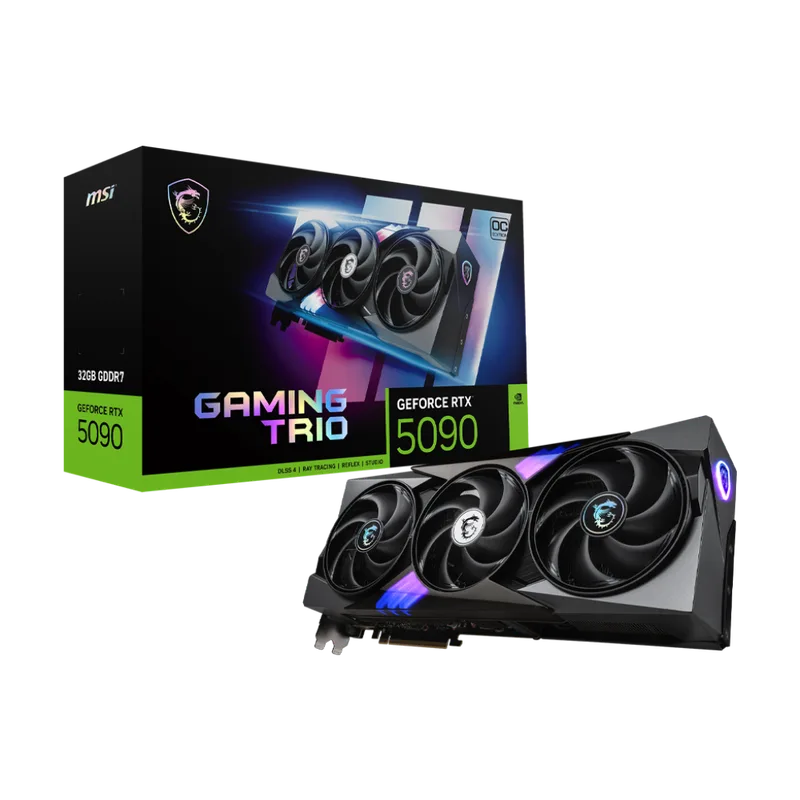
MSI GeForce RTX 5090 32G Gaming Trio OC
The MSI GeForce RTX 5090 32G Gaming Trio OC is built on NVIDIA’s full GB202 die with all 21,760 CUDA cores enabled. In ray tracing benchmarks, the 5090 leads the RTX 4090 by 37% in titles like Dying Light 2 at 4K — the 4090 averages 80 FPS while the 5090 hits 109 FPS. The 3rd-generation RT cores handle 2.8x more ray-triangle intersections per clock, and the 32GB GDDR7 frame buffer means path-traced titles at 4K won’t run out of VRAM.
The honest caveat: street prices of $3,299+ are brutal. NVIDIA’s $1,999 MSRP exists mostly on paper. AI memory demand is consuming GDDR7 supply, and prices were reportedly trending toward $5,000 at the high end before settling around $3,000–$3,800 for most AIB models. The Trio OC’s 575W TDP also demands a 1000W+ PSU and a case with strong positive airflow — don’t cheap out on either.
DLSS 4 Multi-Frame Generation is the actual superpower at this price point. With MFG engaged, Cyberpunk Overdrive Mode runs above 60 FPS at native 4K on the 5090. Without it, no GPU can sustain that.
2. Gigabyte GeForce RTX 5080 Gaming OC 16G — Enthusiast Sweet Spot
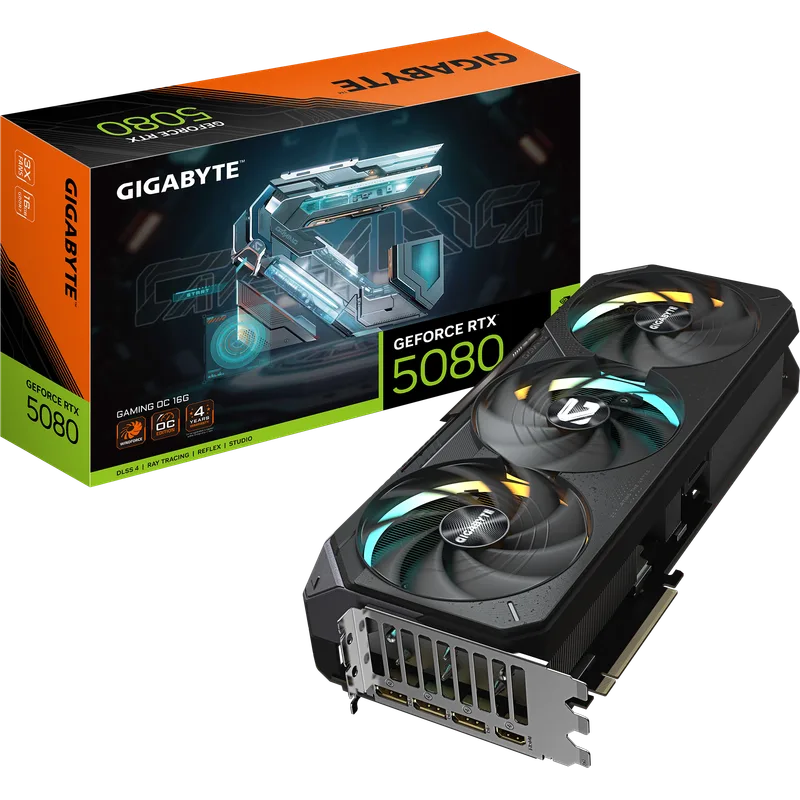
The Gigabyte GeForce RTX 5080 Gaming OC 16G slots in as the practical choice for anyone who wants the best RT experience without paying flagship prices. At $1,249 street, it’s still above MSRP, but the performance gap versus the 5090 is large enough that the 5090’s $2,050 premium is hard to justify for gaming.
In ray tracing benchmarks, the RTX 5080 leads the RTX 5070 Ti by 8–16% at 4K, with the gap widening as resolution and RT complexity increase. At 1440p with hybrid ray tracing enabled, it sustains 60+ FPS without DLSS in all current titles — a bar the 5070 Ti misses in the most demanding scenes.
The 960 GB/s of memory bandwidth from the 256-bit GDDR7 bus keeps textures and RT geometry streaming fast. Gigabyte’s Windforce triple-fan cooler handles the 360W TDP without throttling in a well-ventilated case, and it runs cooler and quieter than the ROG Astral variants at similar boost clocks.
3. Gigabyte GeForce RTX 5070 Ti Gaming OC 16G — Best Value Nvidia RT
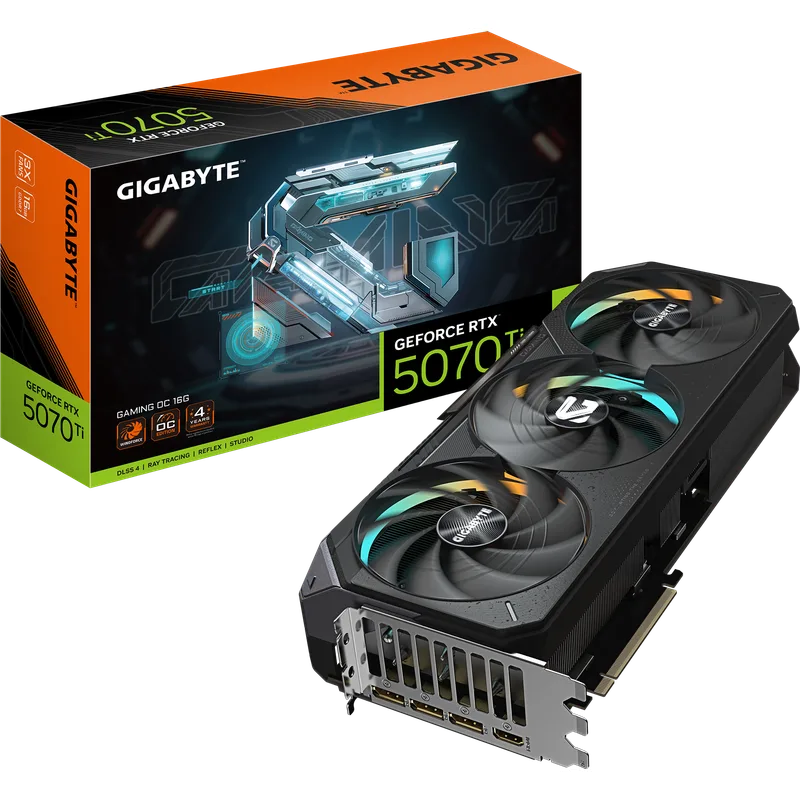
Gigabyte GeForce RTX 5070 Ti Gaming OC 16G
At $999 street, the Gigabyte GeForce RTX 5070 Ti Gaming OC 16G is the last point on the Nvidia curve where you’re paying a reasonable premium over the competition. It leads the RX 9070 XT by 14% in ray tracing workloads on average, with the gap growing in path-traced workloads where Nvidia’s RT hardware has a deeper generational advantage over RDNA 4.
The 8,960 CUDA cores and 16GB GDDR7 at 896 GB/s make it a comfortable 1440p card with RT maxed, and a capable 4K card with DLSS Quality or Balanced mode engaged. TechSpot’s review found the 5070 Ti consistently ahead of the RX 9070 XT in Spider-Man 2 with ray tracing — DLSS 4 scaling more aggressively than FSR 4 was a big part of that.
A 750W PSU covers it at 300W TDP. Gigabyte’s Gaming OC cooler keeps the card at 72°C under full load in standard cases, and the factory OC keeps it within 5% of the ROG Strix variants at a ~$150 discount.
4. Sapphire Pulse AMD Radeon RX 9070 XT Gaming 16GB — Best Value RT
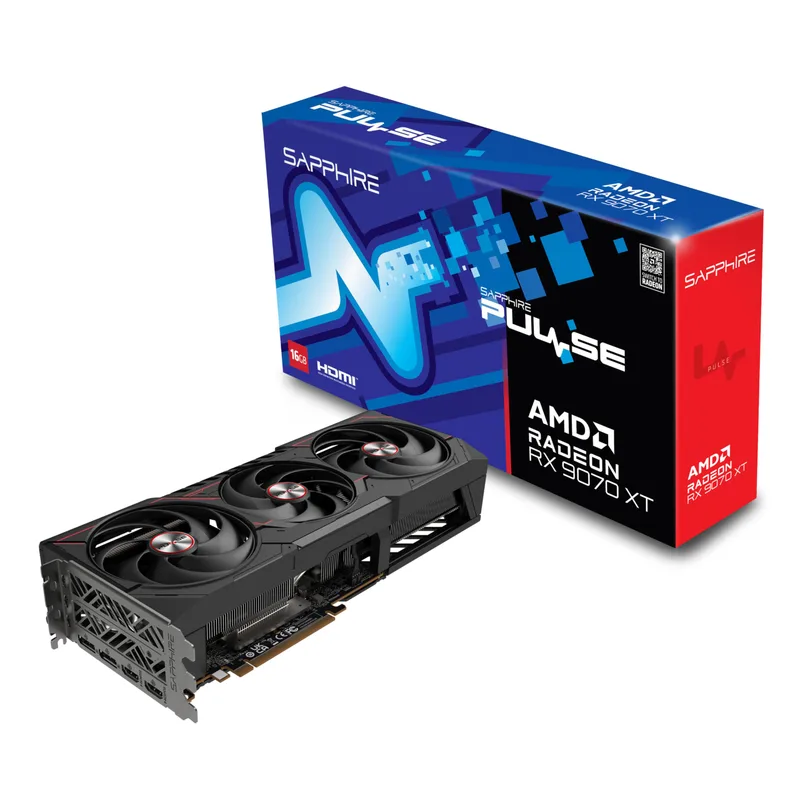
The Sapphire Pulse AMD Radeon RX 9070 XT is the most interesting card in this roundup for value-focused buyers. At $649, it ties the RTX 5070 in price but brings 16GB GDDR6 versus the 5070’s 12GB — a tangible advantage in VRAM-heavy RT workloads at 1440p and above.
GamersNexus’s full review of the Sapphire Pulse RX 9070 XT compared it against the RTX 5070 Ti and RTX 5070, finding it competitive with the latter in rasterization and within 14% of the 5070 Ti in ray tracing. The RDNA 4 RT accelerators are a substantial step up from the RX 7900 XT — AMD has closed the architectural gap considerably.
FSR 4 upscaling fills in the frames where the 9070 XT falls behind Nvidia in native RT performance. The Sapphire Pulse version is a consistently recommended AIB — dual-fan, compact at 2.5 slots, and runs at 71°C under load with a 304W TDP that a 750W PSU handles without complaint.
The limitations are real: 640 GB/s of memory bandwidth is 28% less than the 5070 Ti’s 896 GB/s, and the gap in path tracing specifically is larger than 14% once you’re running Overdrive Mode workloads at 4K. For 1440p RT, though, it’s a compelling buy.
5. MSI GeForce RTX 5070 12G Gaming Trio OC — Entry-Level Blackwell RT
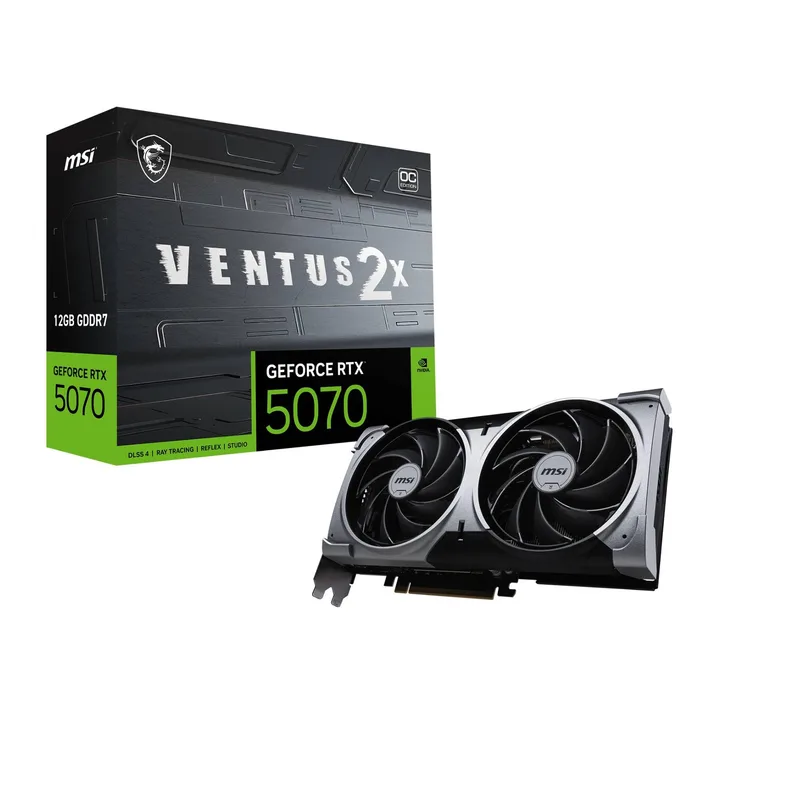
MSI GeForce RTX 5070 12G Gaming Trio OC
The MSI GeForce RTX 5070 12G Gaming Trio OC is the entry point for Blackwell’s full feature stack — including DLSS 4 Multi-Frame Generation — at a price that matches the RX 9070 XT. At $649, you’re getting 4th-generation RT cores, 12GB GDDR7, and the 250W TDP that makes it viable in smaller cases with less aggressive cooling.
The trade-off versus the RX 9070 XT at this price is: you get better RT performance and DLSS 4 MFG, but you give up 4GB of VRAM (12GB vs 16GB) and marginally lower rasterization performance in most titles. For a 1440p gaming setup where you plan to run ray tracing regularly, the RTX 5070 is the better choice. For pure rasterization value or future VRAM headroom, the 9070 XT edges it.
The Trio OC’s 6,144 CUDA cores on the GB205 die run cooler than the Ti variants — the 192-bit bus is narrower than the 5070 Ti’s 256-bit, which shows up in benchmarks but matters less in typical 1440p usage where you’re rarely saturating bandwidth.
FAQ
Which GPU has the best ray tracing performance in 2026? The RTX 5090 leads by a significant margin — 37% faster than the RTX 4090 in measured 4K RT benchmarks. Among cards under $1,500, the RTX 5080 is the fastest available at $1,249 street.
Is AMD’s RX 9070 XT good at ray tracing? Much better than previous RDNA generations. RDNA 4’s 2nd-generation RT accelerators bring it within 14% of the RTX 5070 Ti in typical ray tracing workloads. Path tracing (Cyberpunk Overdrive) is still a larger gap. For hybrid RT at 1440p, it’s competitive.
Do you need DLSS 4 for ray tracing to be playable? Not for all games, but yes for demanding ones. Cyberpunk Overdrive Mode and Alan Wake 2 with full ray tracing run below 30 FPS on the RTX 5070 without upscaling at 1440p. DLSS 4 Quality mode with MFG enabled makes both playable above 60 FPS.
How much VRAM do I need for ray tracing at 1440p? 12GB covers most games at 1440p with RT enabled and DLSS Quality mode on. Some path-traced titles like Cyberpunk Overdrive push above 12GB at 1440p with high texture settings — 16GB provides more headroom.
Is the RTX 5090 worth buying at $3,299 street price? Only if ray tracing performance is your single driving priority and budget is not a constraint. The RTX 5080 at $1,249 delivers the next tier down without paying a $2,050 premium for diminishing returns in most titles.
The Bottom Line
GPU prices in March 2026 are significantly above MSRP across the board, but RTX 5070 Ti at $999 remains the best Nvidia option for dedicated ray tracing without spending enthusiast money — it leads the RX 9070 XT by 14% in RT workloads and carries 16GB GDDR7. The RX 9070 XT is the value champion at $649 with 16GB and dramatically improved RDNA 4 RT compared to prior AMD generations. If you’re pushing 4K path tracing, the RTX 5080 at $1,249 is the minimum to sustain 60 FPS with DLSS engaged.