Affiliate disclosure: PCBuildRanked earns a commission on qualifying Amazon purchases at no extra cost to you.
SFF GPU selection in 2026 comes down to one hard constraint: card length. A 221mm card fits in a Fractal Node 202 but not a Dan A4-SFX. A 300mm card opens up 10L+ builds but closes off ultra-compact chassis entirely. Every card on this list was chosen because it fits in a meaningful slice of the mini-ITX case library — not just because it’s fast. Here are five confirmed-compact GPUs spanning budget Blackwell to flagship, with exact dimensions and PSU requirements for each.
| Spec | ZOTAC Gaming GeForce RTX 5060 Twin Edge OC 8GB Unavailable 8.3/10 | PowerColor Hellhound AMD Radeon RX 7600 XT 16GB Unavailable 8.4/10 | ZOTAC Gaming GeForce RTX 5060 Ti 16GB Twin Edge OC Unavailable 8.8/10 | ZOTAC Gaming GeForce RTX 5070 Solid OC 12GB 9/10 | ZOTAC Gaming GeForce RTX 5070 Ti SOLID SFF OC 16GB 9.2/10 |
|---|---|---|---|---|---|
| gpu | GB206 (Blackwell) | Navi 33 (RDNA 3) | GB206 (Blackwell) | GB205 (Blackwell) | GB203 (Blackwell) |
| vram | 8GB GDDR7 128-bit | 16GB GDDR6 128-bit | 16GB GDDR7 128-bit | 12GB GDDR7 192-bit | 16GB GDDR7 256-bit |
| boost_clock | 2497 MHz | 2755 MHz | 2572 MHz | 2542 MHz | 2482 MHz |
| tdp | 145W | 190W | 165W | 250W | 300W |
| length | 220.5mm | 220mm | 220.5mm | 300mm | 304mm |
| psu_required | 550W | 650W | 650W | 750W | 850W |
| Rating | 8.3/10 | 8.4/10 | 8.8/10 | 9/10 | 9.2/10 |
Prices change daily — tap Check Price for the current Amazon price.
Prices change daily — tap Check Price for the current Amazon price.
Quick Picks
- Best budget SFF GPU: ZOTAC RTX 5060 Twin Edge OC — 220.5mm, 145W, DLSS 4, fits any standard 8L+ ITX case
- Best AMD value for SFF: PowerColor Hellhound RX 7600 XT 16GB — 16GB VRAM at $279 in a 220mm card
- Best mid-range SFF: ZOTAC RTX 5060 Ti Twin Edge OC 16GB — Blackwell DLSS 4, 16GB GDDR7, officially SFF-Ready
Buying Guide: What to Check Before Picking an SFF GPU
GPU Length vs. Case Clearance
Most mini-ITX cases fall into three size tiers:
- Sub-8L (Dan A4-SFX, Sliger SM550): caps GPU length at roughly 200-205mm and power at ~200W. Nothing on this list fits a Dan A4-SFX.
- 8-12L (Louqe Ghost S1, NR200P, Fractal Node 202): accepts cards up to 320mm in the standard GPU slot
- 12L+ (Fractal Design Ridge, Meshroom S, NCASE M1): comfortable with 300-320mm cards and up to 350W GPUs
The RTX 5060 and RTX 5060 Ti Twin Edge OC at 220.5mm each work across 8-12L and 12L+ cases. The RTX 5070 and RTX 5070 Ti at 300-304mm require 10L+ builds.
Slot Width
Every card on this list is a true 2-slot design. This matters in tight ITX builds where a 2.5- or 3-slot card can block M.2 slots or RAM clearance. Verify the bracket height too — a few Blackwell cards have slightly taller PCB fins within a nominal 2-slot spec.
PSU Requirements for SFF Builds
SFX and SFX-L PSUs max out at 850W for most units. Match your PSU to the GPU tier:
- RTX 5060 Twin Edge OC (145W): 550W SFX
- RX 7600 XT Hellhound (190W): 650W SFX
- RTX 5060 Ti Twin Edge OC (165W): 650W SFX
- RTX 5070 SOLID OC (250W): 750W SFX-L
- RTX 5070 Ti SOLID SFF OC (300W): 850W SFX-L or full ATX
DLSS vs. FSR in SFF Builds
Thermal headroom is tighter in small cases, which means sustained boost clocks are harder to maintain under load. DLSS 4 and FSR 4 matter more here than in open-air tower builds — rendering at 1080p and upscaling to 1440p reduces GPU load significantly, letting the card boost longer before thermal throttling kicks in. Every Blackwell card on this list supports DLSS 4 Multi Frame Generation.
Detailed Reviews
ZOTAC Gaming GeForce RTX 5060 Twin Edge OC 8GB
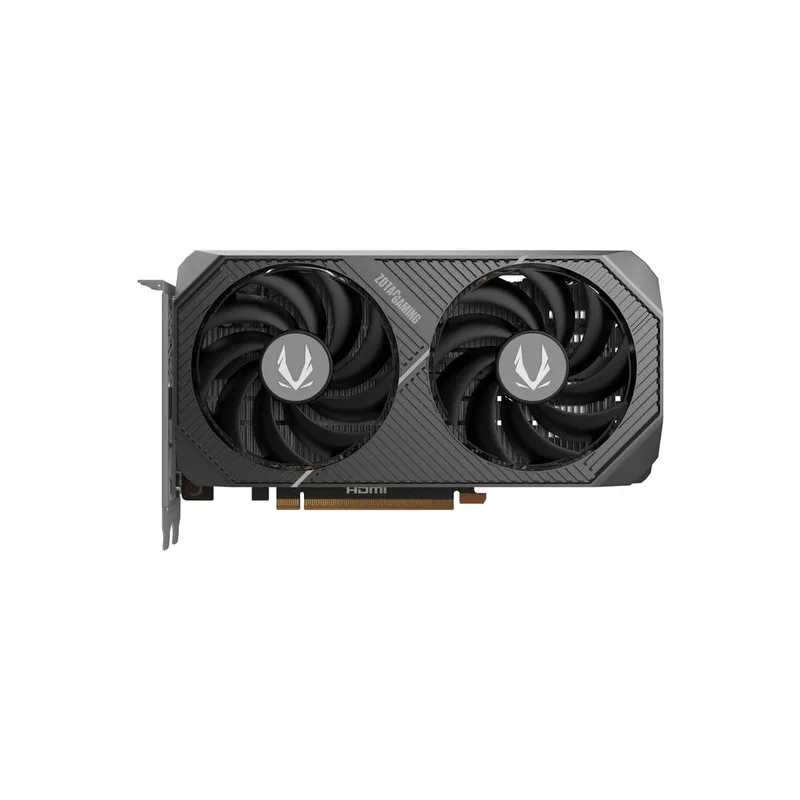
ZOTAC Gaming GeForce RTX 5060 Twin Edge OC 8GB
The ZOTAC RTX 5060 Twin Edge OC is the most affordable Blackwell SFF card available in 2026. At 220.5mm and 145W with ZOTAC’s SFF-Ready certification, it fits every standard mini-ITX case in the 8L+ range while drawing 30W less than the previous-generation RTX 4060 Twin Edge OC at comparable performance levels.
The jump from Ada Lovelace to Blackwell at this price tier is a concrete bandwidth upgrade. The RTX 5060 moves 448 GB/s across its GDDR7 memory vs. 272 GB/s for the RTX 4060’s GDDR6. That’s a 65% bandwidth increase on the same 128-bit bus, which improves frame times in open-world titles where texture streaming competes for bandwidth.
At 1080p, expect 70-90 fps in GPU-limited AAA titles with quality settings. DLSS 4 Quality mode at 1080p target resolution delivers near-native image quality while halving the render resolution, and Multi Frame Generation multiplies output frame rates in supported titles. The RTX 4060 supported DLSS 3; DLSS 4 MFG is meaningfully better for SFF builds that thermally constrain the GPU compared to open-air setups.
The 8GB VRAM ceiling is the honest limitation. A growing number of 2026 AAA titles allocate over 8GB at maximum texture quality at 1440p. For 1080p gaming with standard settings, 8GB covers the vast majority of current titles. Street price sits at $329 — $30 above the $299 MSRP. At 550W SFX compatibility, this is the only card on this list that pairs with the most compact PSU options.
PowerColor Hellhound AMD Radeon RX 7600 XT 16GB
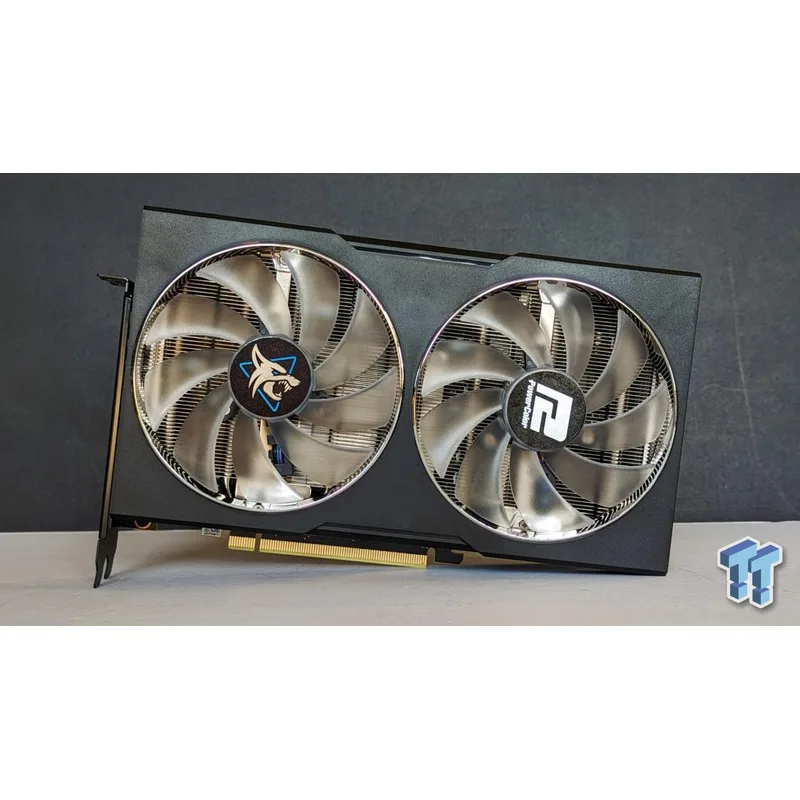
PowerColor Hellhound AMD Radeon RX 7600 XT 16GB
The PowerColor Hellhound RX 7600 XT ships with 16GB GDDR6 at $279 — double the VRAM of the RTX 5060 at $50 less. For an SFF build where upgrading a GPU means disassembling the entire system, the VRAM headroom advantage has real value when you’re planning to keep the card for several years.
Rasterization performance comes in 8-12% behind the RTX 5060 at 1080p in GPU-limited scenarios. In memory-bandwidth-limited workloads, the extra VRAM headroom prevents frame buffer overflow stuttering that affects 8GB cards in some newer open-world titles. The 220mm length sits 0.5mm shorter than the ZOTAC Blackwell twins — essentially identical case compatibility.
Where the Hellhound lags: AMD’s RDNA 3 ray tracing acceleration remains behind NVIDIA Blackwell in pure RT workloads, and FSR 4 adoption hasn’t matched DLSS 4 across the 2025-2026 game library. For streaming and content work, the AV1 hardware encoder performs well in OBS and DaVinci Resolve — a real advantage in a hybrid gaming/streaming compact build.
The 190W TDP is 45W more than the RTX 5060, bumping the minimum PSU recommendation to 650W and ruling out the smaller 550W SFX units like the Corsair SF600.
ZOTAC Gaming GeForce RTX 5060 Ti 16GB Twin Edge OC
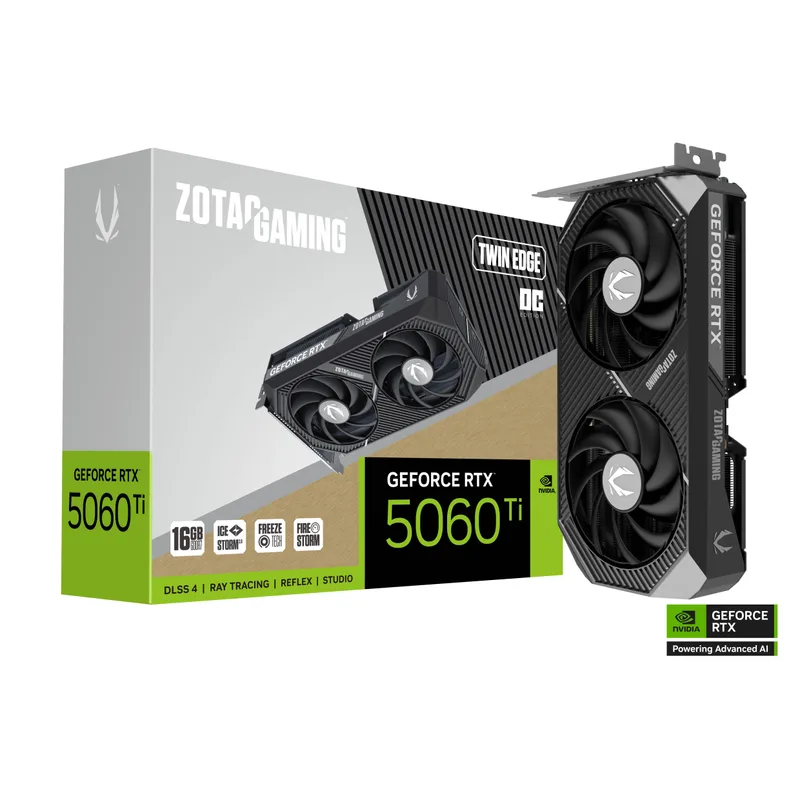
ZOTAC Gaming GeForce RTX 5060 Ti 16GB Twin Edge OC
The ZOTAC RTX 5060 Ti 16GB Twin Edge OC is ZOTAC’s officially certified SFF-Ready card in the mid-range tier. At 220.5mm and 165W, it fits the same case library as the RTX 5060 Twin Edge OC but brings more shader units, a faster clock, and 16GB GDDR7 — all within a 2-slot footprint.
The RTX 5060 Ti carries 4608 CUDA cores vs the RTX 5060’s 3840 — a 20% increase — at 165W vs 145W. Benchmarks from Hardware Unboxed show the RTX 5060 Ti 16GB running 15-20% faster than the RTX 4060 Ti 8GB at 1080p. At 1440p, the 16GB GDDR7 configuration provides meaningful headroom over 8GB cards in newer open-world titles where the frame buffer regularly exceeds 8GB.
DLSS 4 Multi Frame Generation is the headline feature for SFF builders specifically. In a thermally constrained chassis, the card may not always sustain peak boost clock under sustained load. DLSS 4 compensates by generating additional frames from rendered ones, keeping output frame rates smooth even when the raw render rate dips under thermal pressure.
The caveat is the 128-bit memory bus — 448 GB/s is adequate at 1440p with DLSS 4 but falls behind the RTX 5070’s 192-bit bus at higher resolutions. Street prices run around $499, roughly $70 above the $429 MSRP.
ZOTAC Gaming GeForce RTX 5070 Solid OC 12GB
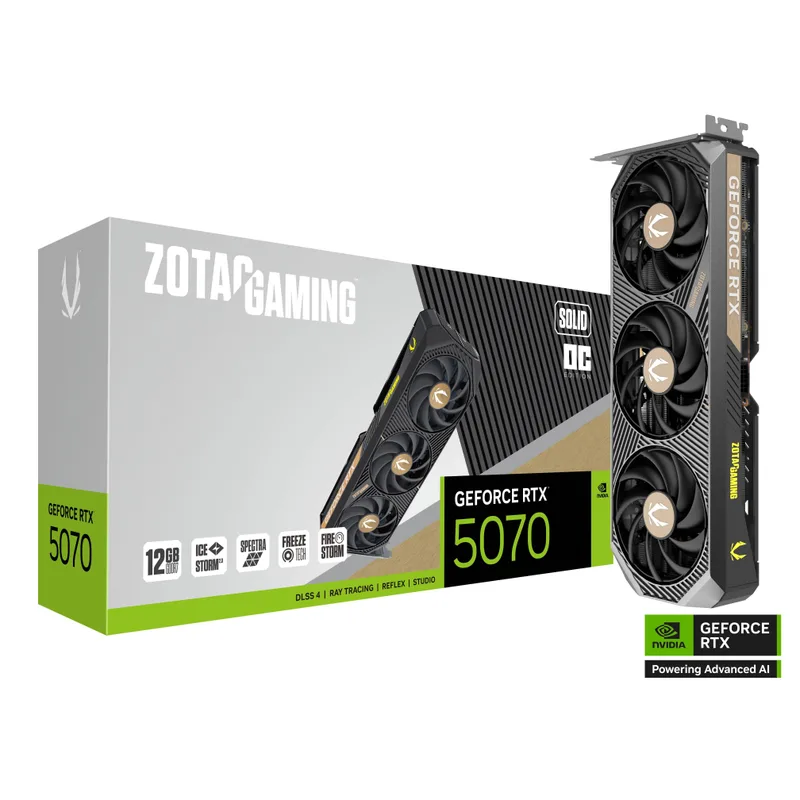
ZOTAC Gaming GeForce RTX 5070 Solid OC 12GB
The ZOTAC RTX 5070 Solid OC is the performance sweet spot for SFF builders with a 10L+ case. At 300mm and 2-slot thick, it carries a GB205 Blackwell die with 12GB GDDR7 on a 192-bit bus — 672 GB/s of memory bandwidth that the RTX 5060 Ti’s 128-bit bus can’t approach.
ThinkComputers.org’s review confirmed a boost clock of 2542 MHz under gaming load, temperatures peaking at 72°C in an open bench test. In a mid-tier SFF case with managed airflow, expect 76-80°C under sustained load — within Blackwell’s thermal spec. The IceStorm 2.0 cooling system with dual 90mm BladeLink fans handles 250W without coil whine or throttling.
Rasterization performance sits 20-25% above the RTX 4080 SUPER at 1440p. In Cyberpunk 2077 at 4K DLSS 4 Quality, it delivers 90+ fps sustained. For a compact build targeting 4K gaming under $700 for the GPU, nothing else on this list competes.
The 300mm length rules out sub-8L cases entirely — the Dan A4-SFX (205mm limit), Sliger SM550 (205mm limit), and similar ultra-compact chassis cannot fit this card. A 750W SFX-L PSU is mandatory; the Corsair SF750L or Seasonic Focus SGX-750 are proven pairings. Current street price is $669 at Newegg.
ZOTAC Gaming GeForce RTX 5070 Ti SOLID SFF OC 16GB
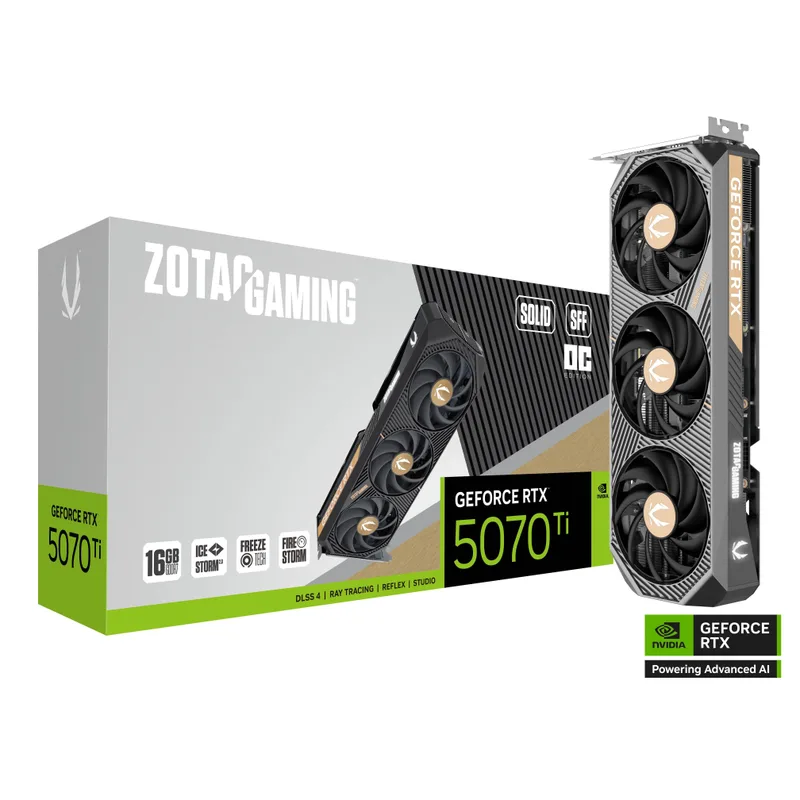
ZOTAC Gaming GeForce RTX 5070 Ti SOLID SFF OC 16GB
ZOTAC markets the RTX 5070 Ti SOLID SFF OC as a purpose-built small form factor card, and the design backs it: 304mm length, 2-slot at 41.6mm, with a GB203 die carrying 8960 CUDA cores on a 256-bit GDDR7 bus. That delivers 896 GB/s of bandwidth — 33% more than the RTX 5070’s 192-bit bus.
Benchmarks at launch showed the RTX 5070 Ti matching the RTX 4090 in rasterization at 1440p, outpacing it in DX12 Ultimate titles with DLSS 4. At 4K native without upscaling, it lands at roughly 85-90% of RTX 4090 performance while drawing 150W less.
ZOTAC’s heatsink exhausts toward the rear bracket rather than recirculating hot air into the case interior — a thermal advantage in compact chassis where GPU exhaust would otherwise heat nearby M.2 or NVMe drives. The 3x DisplayPort 2.1b outputs support 4K at 480Hz or 8K at 165Hz with DSC; the single HDMI 2.1 port covers 4K at 480Hz HDR.
At $999 street — $250 above the $749 MSRP — this card is expensive. Prices peaked above $1,100 in late 2025 and have since come down toward $999. For a compact workstation or a sub-30cm gaming PC you won’t upgrade for four-plus years, the price is defensible. For pure 1440p gaming, the RTX 5070 Solid OC at $669 delivers 85% of the performance for 33% less.
FAQ
What GPU length fits in most mini-ITX cases?
Most mainstream mini-ITX cases in the 8L+ range — NR200P, Meshroom S, Fractal Ridge, NCASE M1 — accept cards up to 320mm. The 4-liter category (Dan A4-SFX, Sliger SM550) caps at roughly 200-205mm, which rules out every card on this list. The RTX 5060 and RTX 5060 Ti Twin Edge OC at 220.5mm are the most case-compatible options here — any standard 8L+ ITX case works.
Can I run an RTX 5070 Ti on an SFX PSU?
Only with an 850W SFX-L unit like the Corsair SF850L or Seasonic Focus SGX-850. Standard SFX PSUs top out at 600-750W, which doesn’t leave adequate headroom for a 300W GPU plus a 125W+ CPU. Check your case’s PSU form factor support — some ITX cases accept SFX-L but not full ATX.
Is 8GB VRAM enough for a 2026 SFF build?
For 1080p gaming with standard texture settings, yes — the RTX 5060 covers the vast majority of current titles. At 1440p with maximum textures in 2026 open-world releases, 8GB surfaces frame buffer overflow stutters in a growing number of titles. For a system you plan to use for three-plus years, the 16GB options on this list are safer.
What’s the difference between an SFF GPU and a low-profile GPU?
Low-profile GPUs are shorter in height and fit in a half-height PCIe slot for slim desktop PCs. Every card on this list is a full-height card, just shorter in length to fit mini-ITX cases. Low-profile cards cap out at around 75W and 4GB VRAM in 2026; SFF-length cards reach flagship performance tiers at standard bracket height.
Do 2-fan compact cards run hotter in SFF cases?
The 2-fan design moves less air than a 3-fan card, so thermals depend heavily on case airflow. In an NR200P with two 140mm front intakes, the ZOTAC RTX 5060 Ti Twin Edge OC holds under 75°C sustained. In a passive or single-fan case, expect 80-85°C — within spec but at higher RPM and audible fan noise.
RTX 5060 vs RTX 4060 for an SFF build — worth upgrading?
Yes, at current prices. The RTX 5060 at $329 offers 65% more memory bandwidth from GDDR7, DLSS 4 Multi Frame Generation, and Blackwell efficiency improvements over the RTX 4060. Both are 220mm cards with near-identical case compatibility. Unless you find the RTX 4060 for under $200, the RTX 5060 is the better buy.
The Bottom Line
For most SFF builders, the ZOTAC RTX 5060 Ti 16GB Twin Edge OC is the straightforward mid-range pick: 220mm, 165W, 16GB GDDR7, SFF-Ready, and full DLSS 4 — all in a chassis you won’t need to disassemble again just to upgrade the GPU.
On a tighter budget, the ZOTAC RTX 5060 Twin Edge OC is the right entry point for Blackwell in an ITX build — DLSS 4, GDDR7 bandwidth, and 550W PSU compatibility in the same 220mm footprint. The PowerColor Hellhound RX 7600 XT remains the AMD value play when 16GB VRAM under $280 matters more than ray tracing or DLSS.
For builders with a 10L+ case and a 750W SFX-L PSU who want 4K from a compact box, the ZOTAC RTX 5070 Solid OC at $669 is the performance ceiling before the price curve turns steep. If you’re not constrained by case length, see our best GPUs under $700 guide for a broader look at full-size cards at this performance tier.