Disclosure: We may earn a commission if you buy through links on this page. Prices verified April 2026.
Intel’s Arc B570 Battlemage, NVIDIA’s RTX 5050, and AMD’s RX 7600 have made the budget GPU market the most competitive it’s been in years. Older RDNA 2 cards like the RX 6600 have inflated to $350+ with depleted first-party stock — their replacements deliver better drivers, newer features, and stronger long-term support. If you’re building or upgrading on a tight budget, your options are genuinely better than they were twelve months ago.
| Spec | ASRock Intel Arc B570 Challenger OC 8.8/10 | MSI Gaming RTX 5050 8G Shadow 2X OC Unavailable 8.2/10 | ASRock Radeon RX 7600 Challenger 8G OC 8.5/10 | MSI GeForce RTX 3050 Gaming 6G 7.3/10 | MSI GeForce RTX 3050 LP 6G OC Unavailable 7.1/10 |
|---|---|---|---|---|---|
| GPU | Intel Arc B570 (Battlemage Xe2) | NVIDIA Blackwell GB207 | AMD RDNA 3 (Navi 33 XL) | NVIDIA Ampere (GA107) | NVIDIA Ampere (GA107) |
| VRAM | 10GB GDDR6 | 8GB GDDR6 | 8GB GDDR6 | 6GB GDDR6 | 6GB GDDR6 |
| Memory Bus | 160-bit | 128-bit | 128-bit | 96-bit | 96-bit |
| Boost Clock | 2600 MHz | 2380 MHz | 2755 MHz | 1507 MHz | 1492 MHz |
| TDP | 150W | 70W | 165W | 70W | 70W |
| PSU Recommended | 550W | 350W | 550W | 350W | 350W |
| Rating | 8.8/10 | 8.2/10 | 8.5/10 | 7.3/10 | 7.1/10 |
Prices change daily — tap Check Price for the current Amazon price.
Prices change daily — tap Check Price for the current Amazon price.
Quick Picks
- Best Overall: ASRock Intel Arc B570 Challenger OC — 10GB GDDR6, best frames-per-dollar at $219–$249
- Best Budget NVIDIA: MSI Gaming RTX 5050 8G Shadow 2X OC — DLSS 4 + 70W draw in a pre-build-friendly package at $249–$269
- Best AMD: ASRock Radeon RX 7600 Challenger 8G OC — 15-20% faster than the RTX 5050 in rasterization at $259–$279
- Best Low-Profile: MSI RTX 3050 LP 6G OC — the only option for slim desktops and small pre-builts
Buying Guide
VRAM is the critical spec in 2026
The 6GB vs 8GB vs 10GB question matters more now than it did two years ago. Multiple recent AAA titles actively use 7–8GB of VRAM at 1080p high settings before texture streaming kicks in. The RTX 3050 6GB hits that wall regularly. If you’re choosing between a 6GB card and an 8GB card at the same price, the 8GB card is the right call every time.
PCIe generation affects the Arc B570
Intel’s Battlemage architecture benefits from PCIe 4.0. On a PCIe 3.0 system (older Intel or Ryzen platforms), Arc cards can lose 8–12% performance due to driver overhead. If your board only supports PCIe 3.0, the RX 7600 is the safer AMD choice — RDNA 3 shows minimal degradation on PCIe 3.0, same as older RDNA 2 cards.
PSU requirements
- Arc B570: 550W minimum. Uses a single 8-pin connector.
- RTX 5050 (MSI Gaming 8G OC): 350W minimum. Pulls 70W from the PCIe slot — no external power connector needed.
- RX 7600 (ASRock Challenger 8G OC): 550W minimum. Pulls 165W at full load.
- RTX 3050 6G / LP 6G: 350W minimum. No external power connector needed.
If you’re dropping a GPU into an existing pre-built with a small OEM PSU, the RTX 5050 and RTX 3050 are the bus-powered options that work without spare PCIe cables.
Resolution targets
Every card here is built for 1080p. The Arc B570 can handle 1440p medium settings in older titles, but both RX 6600 picks and the RTX 3050 should not be considered 1440p cards — you’ll hit both frame rate and VRAM limits quickly.
Detailed Reviews
ASRock Intel Arc B570 Challenger OC
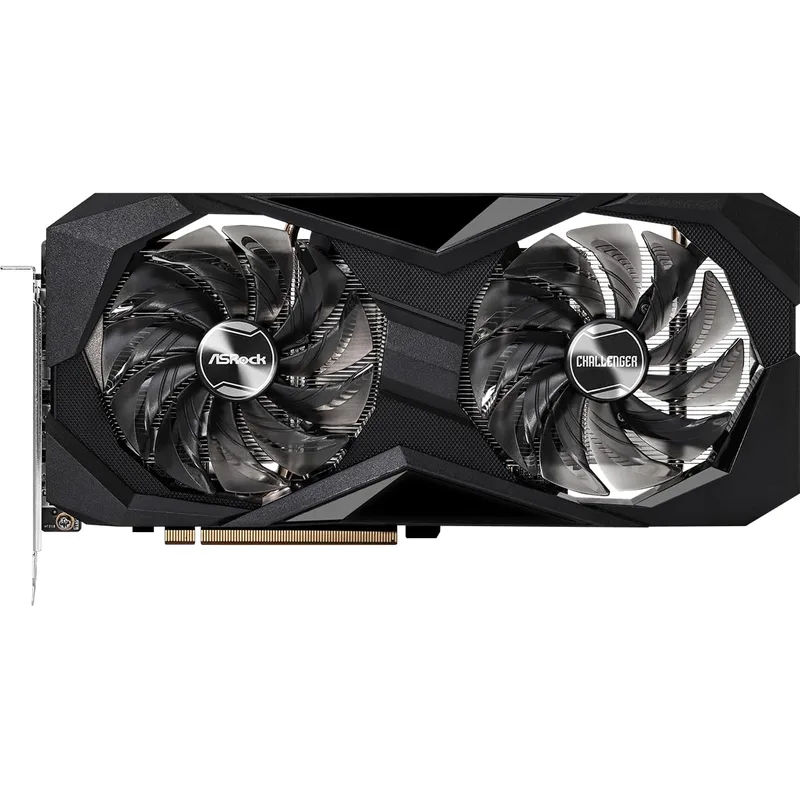
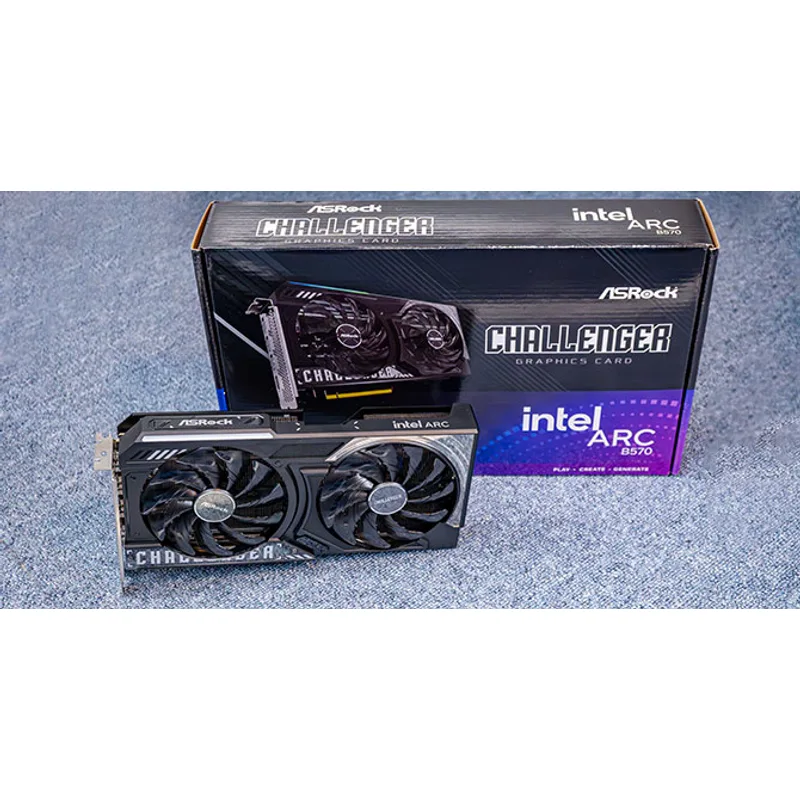
The Arc B570 is the most interesting GPU launch in the budget segment in years. With 10GB of GDDR6 on a 160-bit bus and 18 Xe2 cores running at 2600 MHz, it delivers 1080p performance within 5% of AMD’s RX 7600 — a card that costs $279.
At 1080p across a broad game selection, the B570 averages around 80 FPS in demanding titles on high settings. That puts it clearly ahead of the RX 6600 XT (roughly 15% faster) and well ahead of the RTX 3050 6GB (roughly 30% faster). The 10GB VRAM buffer means you won’t see texture streaming issues for at least two more years of 1080p gaming.
The ASRock Challenger OC runs the 2600 MHz GPU clock with a dual-fan cooler that drops to 0 dB at idle. Thermals sit around 68–72°C under sustained load. The card pulls 150W through a single 8-pin connector.
The main caveat: Intel’s drivers have improved substantially since the Arc A-series days, but you’ll occasionally encounter a game with a compatibility quirk. Most issues self-resolve with driver updates within a few weeks. For buyers on PCIe 4.0 systems, this is the clearest recommendation at this price tier.
MSI Gaming RTX 5050 8G Shadow 2X OC

MSI Gaming RTX 5050 8G Shadow 2X OC
The MSI Gaming RTX 5050 is the most power-friendly 8GB card in this roundup. NVIDIA’s Blackwell GB207 chip draws only 70W through the PCIe slot — no external power connector required, meaning it physically works in any pre-built or system where the PSU has no spare cables. That alone makes it relevant to a large share of upgrade buyers.
Performance at 1080p sits within 5% of the Arc B570 in rasterization: expect 75–85 FPS in demanding AAA titles at high settings, 100+ FPS in lighter games. The 8GB GDDR6 on a 128-bit bus is sufficient for 1080p gaming in 2026 — it won’t compete at 1440p, but that’s not what this card is built for.
The real differentiator is DLSS 4. Multi Frame Generation generates additional interpolated frames, effectively multiplying displayed frame rates in supported titles. At 1080p in Cyberpunk 2077 or Alan Wake 2 with DLSS 4 Quality + Frame Generation enabled, the RTX 5050 can push well past 90 FPS on a card drawing under 75W. No AMD card in this price tier can match that combination.
At $249–$269, it sits above the Arc B570’s $219–$249 range. The premium buys DLSS 4 and a bus-powered footprint. For PSU-constrained builds or anyone who cares about DLSS 4 longevity, this is the pick. For pure rasterization performance per dollar, the B570 wins.
ASRock Radeon RX 7600 Challenger 8G OC
The ASRock RX 7600 Challenger is the fastest-rasterizing card in this roundup after the Arc B570. The Navi 33 XL die (RDNA 3) runs 32 compute units at 2755 MHz boost, delivering 15–20% more FPS at 1080p than the RTX 5050 and the older RX 6600 in GPU-bound titles. Expect 85–100 FPS in demanding AAA games on high settings, with esports titles running well above 144 FPS.
The 8GB GDDR6 is the same capacity as the RTX 5050, but RDNA 3 benefits more from bandwidth due to its rasterization-first architecture. On PCIe 3.0 boards, there’s no performance penalty — AMD’s RDNA 3 driver overhead is minimal on older bus generations, unlike Intel’s Arc cards.
ASRock’s Challenger cooler uses a dual-fan design with 0dB mode at idle. Thermals run mid-70s°C under load, fans staying quiet during typical gaming. The 165W TDP requires a 550W PSU and a single 8-pin connector — the one practical downside vs the RTX 5050’s bus-powered footprint.
FSR 3 upscaling is supported in a broad game catalog. AMD’s driver stack for RDNA 3 is mature after two-plus years on the market — compatibility issues are essentially nonexistent at this point.
At $259–$279, the RX 7600 Challenger costs $10–$30 more than the Arc B570 while losing 2GB of VRAM. The trade-off is better rasterization performance and AMD ecosystem compatibility. If raw frames at 1080p are the priority and you have a 550W PSU, the RX 7600 is the correct pick over the RTX 5050.
MSI GeForce RTX 3050 Gaming 6G
MSI GeForce RTX 3050 Gaming 6G
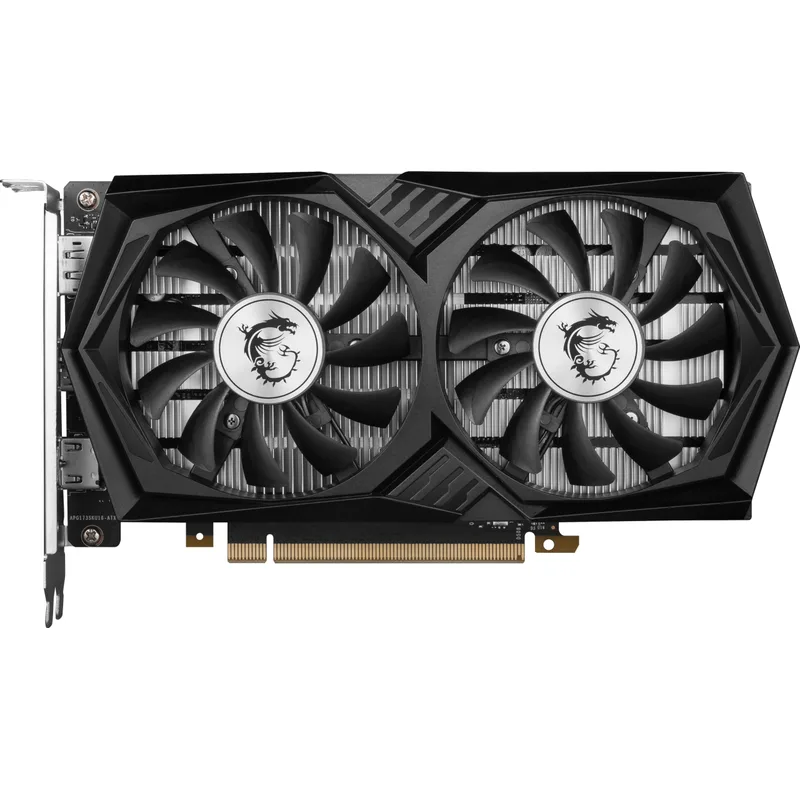
The RTX 3050 6GB is a bus-powered Ampere card — the GA107 die at 70W with 6GB GDDR6 on a 96-bit memory bus. That power envelope makes it the only card in this roundup that needs no PCIe power cables at all.
Performance at 1080p is noticeably behind the AMD options: roughly 25–30% slower than the Arc B570 and 15% behind the RX 6600 in rasterization. The 6GB VRAM becomes a real issue in titles like Hogwarts Legacy, Cyberpunk 2077, and newer open-world games where the card constantly streams textures. On medium settings with DLSS 2 enabled, the experience is manageable but not comfortable.
The use case is specific: you’re dropping this into an existing pre-built with a 350W OEM PSU and no spare PCIe power connectors. In that scenario, it’s your only real option from this generation, and it’s genuinely useful. If you have a proper PSU with power connectors, choose an 8GB card instead.
MSI GeForce RTX 3050 LP 6G OC
MSI GeForce RTX 3050 LP 6G OC
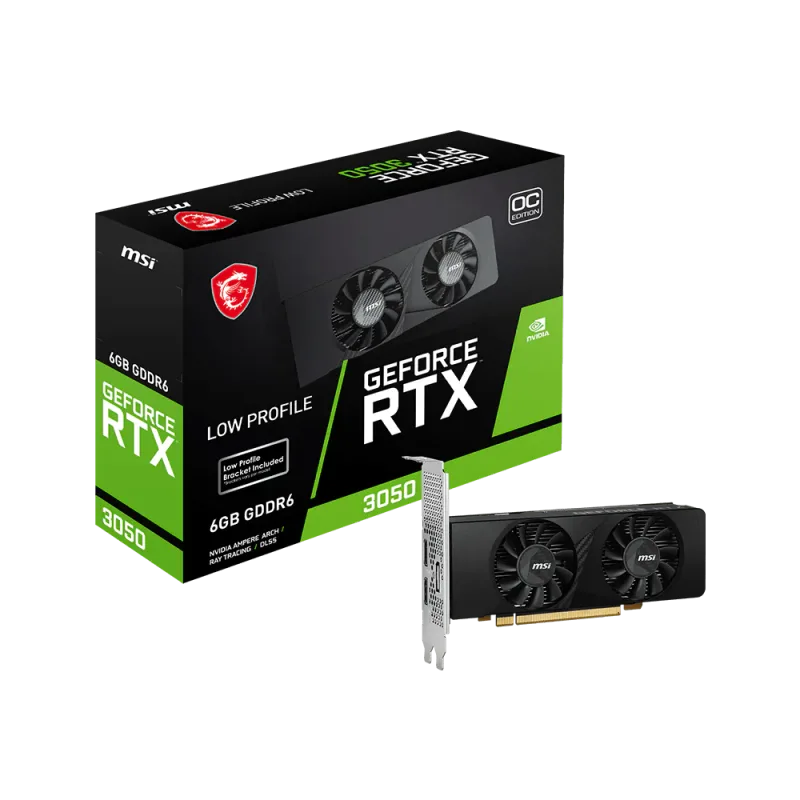
The LP (low-profile) version of the RTX 3050 6GB occupies an extremely specific niche: slim desktop pre-builts, HTPCs, and workstations where standard full-height cards physically won’t fit. The card is single-slot low-profile, runs at 1492 MHz boost (15 MHz below the Gaming 6G), and pulls the same 70W from the PCIe slot.
Performance is functionally identical to the standard RTX 3050 6GB — the 15 MHz clock difference produces a 1% variation that’s invisible in practice. The 2x HDMI 2.1 ports are a practical advantage for HTPC setups driving dual displays without adapters.
If you have a standard mid-tower and a proper PSU, the standard Gaming 6G or any 8GB card is the better buy. The LP variant exists for the cases where you have no other choice.
FAQ
Is the Arc B570 still worth buying above $200?
Yes. The B570 launched at $219 MSRP — some AIB cards briefly dipped to $189–$199 in January 2026, but street prices have settled at $219–$249. At that range it still delivers the best performance-per-dollar in this tier: 10GB GDDR6, RX 7600-class frames, and DisplayPort 2.1. No competing card at this price approaches its VRAM buffer.
Can these GPUs handle 1440p gaming?
The Arc B570 can push 1440p medium settings in older titles (Doom Eternal, Forza Horizon 5) at 60 FPS. Both RX 6600 picks hit VRAM limits quickly at 1440p high — you’ll see stuttering in VRAM-heavy scenes. The RTX 3050 6GB should not be used for 1440p. Target 1080p with all five cards here.
Do I need a new PSU for the RTX 3050 6GB?
No. The RTX 3050 6GB and 3050 LP draw power entirely through the PCIe slot at 70W. Any PSU — including small OEM units — can power them. Every other card in this roundup requires at least a 550W PSU with an available 8-pin PCIe connector.
Does PCIe 3.0 vs 4.0 matter for these cards?
It matters for the Arc B570 specifically — Intel’s Battlemage drivers have more PCIe overhead than AMD’s, so PCIe 3.0 boards can cost 8–12% performance. For the RX 6600 and RTX 3050, PCIe 3.0 vs 4.0 makes no meaningful difference at 1080p.
Is the RX 7600 worth buying over the Arc B570?
At 1080p for pure rasterization, the RX 7600 is faster (15–20%) despite costing $10–$30 more. The Arc B570 wins on VRAM (10GB vs 8GB), which matters for VRAM-hungry titles at 1440p or with high-res texture mods. For 1080p gaming only, the RX 7600 is the stronger frame-rate pick; for future-proofing with VRAM headroom, the B570 has the edge.
The Bottom Line
The ASRock Intel Arc B570 Challenger OC is the clearest recommendation at this price tier — 10GB GDDR6, strong 1080p performance, and a street price around $219–$249. For buyers who need DLSS 4 or have a PSU-constrained pre-built, the MSI Gaming RTX 5050 8G Shadow 2X OC at $249–$269 is the bus-powered Blackwell option. For the highest rasterization FPS in this tier and a mature AMD driver stack, the ASRock RX 7600 Challenger 8G OC at $259–$279 is the AMD pick. The MSI RTX 3050 6G and LP variant exist for the specific scenario where you have no PCIe power connectors and need a full-height or slim-desktop card — in any other situation, the 6GB VRAM is a liability worth avoiding.