The GPU market in 2026 has genuinely shifted. AMD’s RX 9060 XT launched in mid-2025 as an RDNA 4 card priced at $299–$349, and it has become the default recommendation in this price bracket — delivering 16GB of VRAM alongside hardware ray tracing that’s a full architecture ahead of RDNA 3. Meanwhile Intel’s Arc Battlemage line continues to mature, and the B580 remains arguably the best sub-$300 GPU available as long as you can live with its driver quirks. Nvidia holds the DLSS 3 Frame Generation advantage, but the RTX 4060 Ti’s 8GB ceiling is harder to justify now that AMD is putting 16GB at the same price point.
| Spec | PowerColor Reaper AMD Radeon RX 9060 XT 16GB Unavailable 9.2/10 | ASRock Intel Arc B580 Challenger 12GB OC 8.7/10 | MSI Gaming GeForce RTX 4060 Ti Gaming X 8G Unavailable 8.4/10 | Gigabyte Radeon RX 7700 XT Gaming OC 12G 8.1/10 | Gigabyte GeForce RTX 4060 Eagle OC 8G 7.9/10 |
|---|---|---|---|---|---|
| Architecture | RDNA 4 (Navi 44) | Xe2 Battlemage (BMG-G21) | Ada Lovelace (AD106) | RDNA 3 (Navi 32 XL) | Ada Lovelace (AD107) |
| Compute Units | 32 CUs / 2048 Stream Processors | — | — | 54 CUs / 3456 Stream Processors | — |
| VRAM | 16GB GDDR6 128-bit | 12GB GDDR6 192-bit | 8GB GDDR6 128-bit | 12GB GDDR6 192-bit | 8GB GDDR6 128-bit |
| Boost Clock | 3.13 GHz | 2.74 GHz (OC) | 2.685 GHz | 2.54 GHz | 2.475 GHz |
| Memory Bandwidth | 320 GB/s | 456 GB/s | 288 GB/s | 432 GB/s | 272 GB/s |
| TGP | 182W | — | — | 245W | — |
| Connectors | 1x 8-pin | 1x 8-pin + 1x 6-pin | 1x 16-pin (12V-2x6) | 2x 8-pin | 1x 16-pin (12V-2x6) |
| Rating | 9.2/10 | 8.7/10 | 8.4/10 | 8.1/10 | 7.9/10 |
Prices change daily — tap Check Price for the current Amazon price.
Prices change daily — tap Check Price for the current Amazon price.
Quick Picks
- Best overall under $450: PowerColor Reaper RX 9060 XT 16GB — 16GB RDNA 4 at $419, the best spec-per-dollar in this tier.
- Best under $300: ASRock Arc B580 Challenger 12GB OC — 12GB, 456 GB/s bandwidth, and solid 1440p at $279.
- Best for Nvidia ecosystem: MSI RTX 4060 Ti Gaming X 8G — DLSS 3 Frame Generation and 160W TDP at $449.
Buying Guide: What to Know Before You Choose
VRAM in 2026 matters more than it did in 2026
When the RTX 4060 launched at $299, its 8GB felt like it would last several years. By 2026, texture packs in titles like Hogwarts Legacy and Alan Wake 2 are regularly saturating 8GB at 1440p ultra, causing frame time spikes that reviewers and owners have flagged consistently. The minimum for comfortable 1440p gaming is now 12GB, and 16GB gives you meaningful headroom for the next two to three years.
If you’re gaming at 1080p and plan to stay there, 8GB still works fine for most titles — but if you’re targeting 1440p or plan to upgrade your monitor in the next year or two, the extra VRAM matters.
AMD vs Nvidia vs Intel in this price bracket
AMD’s RX 9060 XT is the clear VRAM winner and brings RDNA 4 hardware ray tracing that’s substantially better than RDNA 3. FSR 4 with AI upscaling (on compatible GPUs) is a major improvement over FSR 3, though it still trails DLSS 4 in image quality in head-to-head comparisons.
Nvidia’s RTX 4060 series has the strongest upscaling ecosystem with DLSS 4 Multi Frame Generation. If you play mostly Nvidia-partnered titles and prioritize frame rate over image quality at a given resolution, DLSS Frame Generation is a real advantage. The trade-off is that you’re paying the same money for half the VRAM.
Intel’s Arc B580 is the surprise pick. 12GB on a wider memory bus than either competitor at this price, and XeSS 2 is improving. The catch is driver maturity — Intel has fixed many issues, but DX9/DX11 game compatibility is still occasionally rough. If your game library is primarily modern DX12 titles, the B580 is a no-brainer value. If you play older titles, check compatibility first.
PSU requirements
- RTX 4060: 450W minimum, uses 12V-2x6 connector (adapter included)
- RTX 4060 Ti: 550W minimum, 12V-2x6 (adapter included)
- Arc B580: 550W minimum, requires both an 8-pin and 6-pin connector
- RX 7700 XT: 550W minimum, two 8-pin connectors
- RX 9060 XT: 500W minimum, single 8-pin connector — the easiest PSU requirement in this roundup
1080p vs 1440p recommendations
For 1080p high-refresh-rate gaming (144Hz+), the Arc B580 at $279 or the RTX 4060 at $299 are the value plays. Both reach 100–144 fps in most titles at 1080p high settings.
For 1440p 60–100 fps, the RX 9060 XT 16GB is the target. It handles 1440p high settings natively across current titles and uses FSR 4 or RSR to push frames where needed.
For 1440p 144Hz+, you’re at the upper edge of this price bracket — the RTX 4060 Ti with DLSS Frame Generation can reach 144Hz+ in supported titles, but you’re relying on frame gen to get there rather than raw rasterization.
Detailed Reviews
1. PowerColor Reaper AMD Radeon RX 9060 XT 16GB — Best Overall
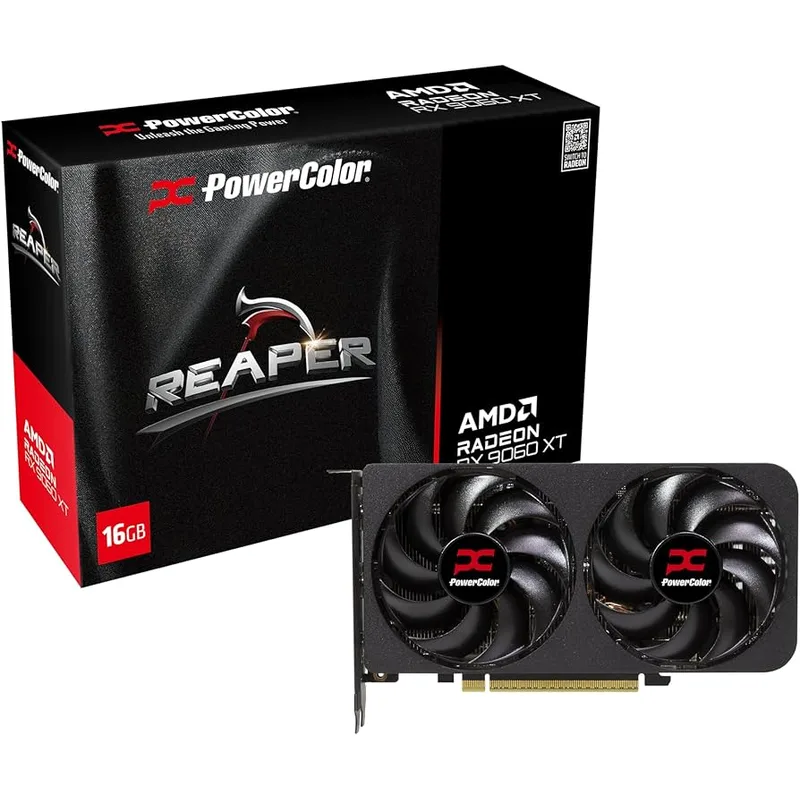
PowerColor Reaper AMD Radeon RX 9060 XT 16GB
The RX 9060 XT launched in mid-2025 as AMD’s entry-level RDNA 4 card, and in 2026 it has become the straightforward answer for anyone asking what GPU to buy under $400. The 16GB GDDR6 allocation is the defining spec — no other card in this price range comes close, with the nearest competitors (Arc B580 and RX 7700 XT) offering 12GB and Nvidia’s options sticking at 8GB.
RDNA 4 brings a new-generation ray tracing architecture. According to Tom’s Hardware’s review of the RX 9060 XT, it delivers roughly 2x the ray tracing performance of the RX 7700 XT in RT-heavy scenarios, narrowing the gap with Nvidia’s Ada Lovelace significantly. Rasterization at 1440p medium-high puts it ahead of the RX 7700 XT and competitive with the RTX 4060 Ti in raw frame counts before any upscaling is applied.
The 3.13 GHz boost clock — higher than the RX 9070 XT’s peak — means the GPU can burst aggressively in short render windows, which benefits competitive titles with short frame times. The single 8-pin power connector at 182W TGP is a practical advantage: no adapter needed, and most budget builds with a 500W+ PSU are covered.
The 128-bit memory bus is the technical concession. At 320 GB/s, bandwidth is lower than the 192-bit cards in this roundup despite using the same 20 Gbps memory chips. In practice, the 16GB capacity means the GPU almost never has to compress or page texture data at 1440p, which masks much of the bandwidth disadvantage. Owner reports confirm minimal texture streaming issues at settings where 8GB cards regularly stutter.
PowerColor’s Reaper cooler is a compact dual-fan design that keeps temperatures under 80°C in most cases and runs quietly under load. The card measures 240mm in length, fitting comfortably in mid-tower and most mini-tower cases.
Who should buy it: Anyone building or upgrading for 1440p gaming who doesn’t want to compromise on VRAM headroom. At $419, it undercuts the RTX 4060 Ti while offering twice the memory and a newer GPU architecture.
2. ASRock Intel Arc B580 Challenger 12GB OC — Best Value
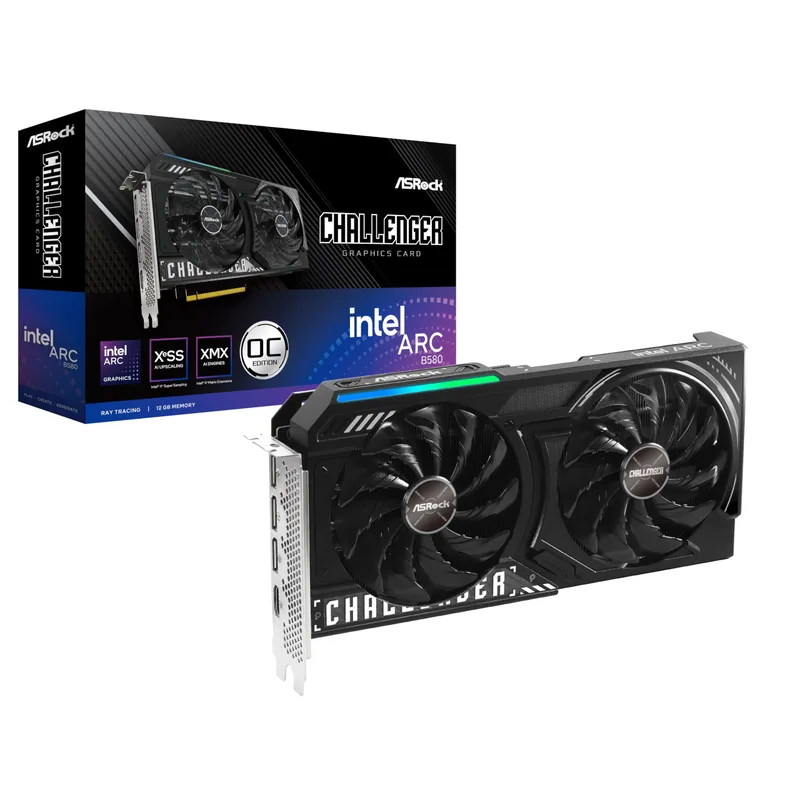
The Arc B580 launched in late 2026 at $249 MSRP and currently sits around $279 at retail. It remains the best graphics card under $300 by a significant margin if your game library consists of modern DX12 titles.
The spec that stands out is memory bandwidth: 12GB GDDR6 on a 192-bit bus delivers 456 GB/s. That’s 58% more bandwidth than the RTX 4060 Ti’s 288 GB/s and 42% more than the RX 9060 XT’s 320 GB/s. In memory-bandwidth-limited workloads — high-resolution texture streaming, compute, and certain upscaling algorithms — the B580 punches far above its price.
Rasterization performance at 1080p and 1440p medium settings is competitive with the RTX 4060, based on community benchmarks compiled from owner reports across Reddit’s r/hardware and r/buildapc. At 1080p high settings, the B580 and RTX 4060 trade blows depending on the title; the B580 wins in DX12 workloads, the RTX 4060 wins in DX11 and older engine titles.
XeSS 2 is Intel’s answer to DLSS and FSR. The AI upscaler has improved substantially since launch and produces clean image quality in supported titles at performance and balanced presets. Supported game coverage is smaller than DLSS or FSR but growing with each driver update.
The driver situation deserves honesty. Intel has resolved many of the launch issues, but DX9 and DX11 titles — particularly older esports games like CS2 running legacy code paths, some Blizzard titles, and older Steam library games — can still exhibit stuttering or black screen issues. If your library is modern (2022 and newer), this is rarely a concern. If you play a lot of pre-2018 titles, check Intel’s compatibility list first.
ASRock’s Challenger cooler is a dual-fan design that keeps the 190W TBP in check. It requires one 8-pin and one 6-pin power connector — an unusual combination that older PSUs may not have in a free 6-pin configuration. Confirm your PSU has the necessary connectors before purchasing.
Who should buy it: PC builders targeting 1080p gaming with a $280 budget, or anyone who wants maximum VRAM bandwidth for the money. Skip it if you play mostly older titles or need plug-and-play compatibility with legacy game engines.
3. MSI Gaming GeForce RTX 4060 Ti Gaming X 8G — Best Nvidia Option
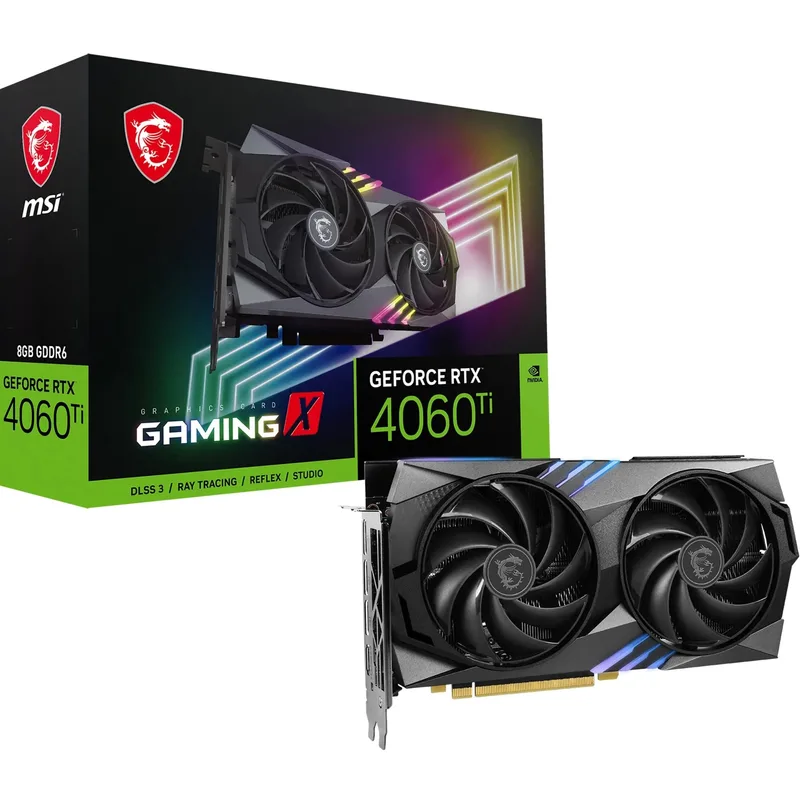
MSI Gaming GeForce RTX 4060 Ti Gaming X 8G
The RTX 4060 Ti sits at the top of this price bracket at $449, and its primary justification in 2026 is DLSS 3 with Frame Generation. If you’re playing titles that support DLSS FG — which includes most major Nvidia-partnered releases from 2026 onward — the frame rate multiplication is real and meaningful. Owner reports from titles like Cyberpunk 2077, Alan Wake 2, and The Finals confirm 60–100% higher displayed frame rates with FG enabled compared to native rendering at 1440p.
The hardware foundation is Ada Lovelace’s AD106 die with 4352 CUDA cores. In raw rasterization at 1440p, it’s measurably ahead of the RTX 4060 by around 20–25%, which puts it in competition with the RX 7700 XT. Against the RX 9060 XT, rasterization results are close — the 9060 XT edges ahead in some titles while the 4060 Ti maintains a lead in others, based on community-compiled benchmark data.
The 160W TDP is the lowest GPU power draw in this roundup and a genuine advantage for small form factor builds. A 450–500W PSU is sufficient, and the card runs cool enough that most cases won’t need aggressive airflow tuning.
The 8GB VRAM is the unavoidable con. At $449, you’re paying a premium for DLSS Frame Generation while accepting memory constraints that are increasingly real in 2026. In texture-heavy titles at 1440p ultra — specifically Hogwarts Legacy, Cyberpunk 2077 with path tracing, and Star Wars Outlaws — 8GB causes frame time spikes that 12GB and 16GB cards avoid. DLSS Frame Generation can compensate in average frame rate but doesn’t eliminate VRAM-induced stuttering.
MSI’s Gaming X cooler is well-regarded: dual 90mm fans, strong heatsink coverage, and quiet acoustic profile. The card runs under 75°C in most mid-tower configurations and around 80°C in tighter cases with restricted airflow.
Who should buy it: Nvidia loyalists who prioritize DLSS Frame Generation compatibility and plan to stay at 1080p or 1440p in titles that support Frame Gen. If DLSS FG isn’t a priority, the RX 9060 XT gives more VRAM and a newer GPU architecture for $30 less.
4. Gigabyte Radeon RX 7700 XT Gaming OC 12G
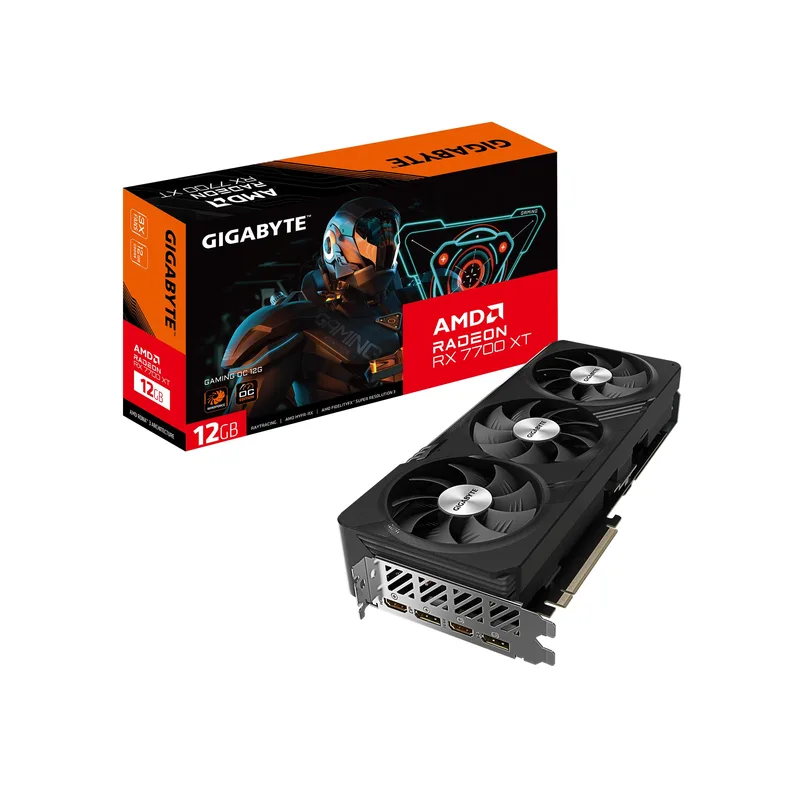
Gigabyte Radeon RX 7700 XT Gaming OC 12G
The RX 7700 XT launched in 2026 as AMD’s 1440p mid-tier RDNA 3 card and remains available at $279 in 2026. It’s the third option for 12GB GDDR6 in this roundup, after the Arc B580 and the RX 9060 XT, and it earns its spot through raw shader count and driver maturity.
54 Compute Units translate to 3456 stream processors — the highest shader count in this roundup. In fully threaded rasterization workloads, particularly open-world games and titles that push geometry density, the extra CUs contribute measurably. The 192-bit bus at 432 GB/s bandwidth is also strong, second only to the Arc B580 in this group.
After two years of driver support, RDNA 3 is mature. AMD Software Adrenalin runs cleanly, FSR 3 is available across a broad game library, and compatibility issues are essentially non-existent. If you’ve had AMD GPUs before and want a known quantity, the RX 7700 XT delivers that reliability.
The weaknesses are power draw and ray tracing. At 245W TGP, it draws significantly more than any other card in this roundup — 85W more than the RX 9060 XT for lower or similar rasterization performance. The two 8-pin connectors require a 550W+ PSU. RT performance in demanding titles like Cyberpunk 2077 with full ray tracing is roughly half what the RDNA 4 cards deliver, based on owner-reported settings comparisons.
Gigabyte’s Gaming OC cooler — three WINDFORCE fans — manages the 245W TGP well, keeping temperatures under 78°C in open-air mid-tower builds. Noise is acceptable under load but audibly louder than the 160W RTX 4060 Ti or 182W RX 9060 XT in a quiet room.
At $279, the RX 7700 XT has become a more interesting value proposition — it’s now $140 less than the RX 9060 XT at $419 if you specifically value the higher shader count, need proven driver stability, or are working with a strict budget. The $140 savings come at the cost of a full architecture generation, 4GB less VRAM, and 63W higher power draw.
Who should buy it: Budget builders who want 12GB GDDR6 at the lowest possible price, anyone who needs proven RDNA 3 driver compatibility for specific workloads, or secondhand buyers who find it below $250.
5. Gigabyte GeForce RTX 4060 Eagle OC 8G
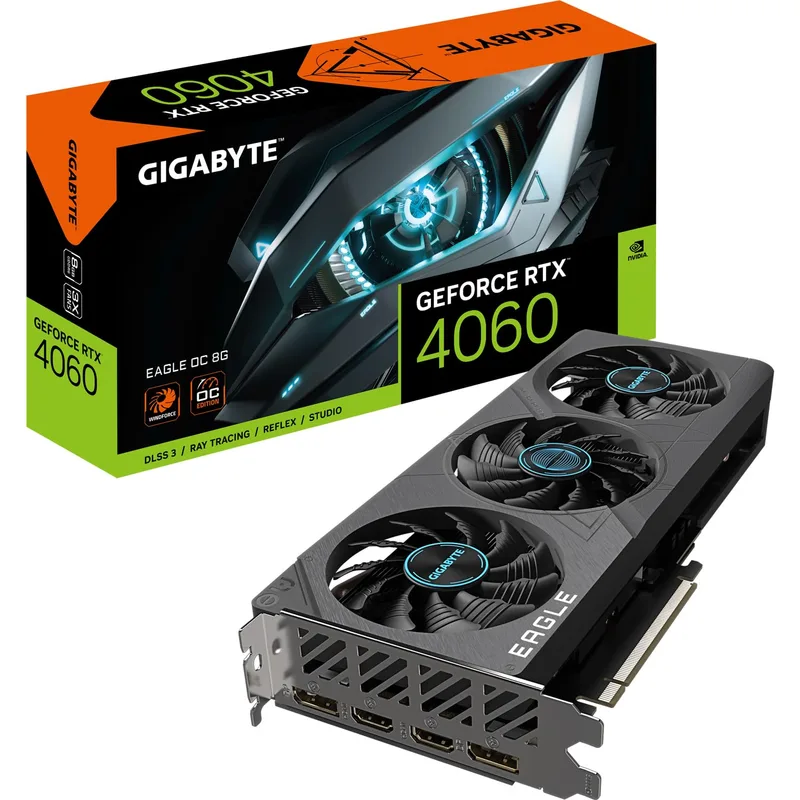
Gigabyte GeForce RTX 4060 Eagle OC 8G
The RTX 4060 is the most efficient GPU in this roundup at 115W TDP and the most accessible entry point to Nvidia’s Ada Lovelace ecosystem. At $299, it’s directly competitive with the Arc B580 and represents the choice between Intel’s raw VRAM bandwidth and Nvidia’s software ecosystem.
The AD107 die runs 3072 CUDA cores at 2.475 GHz boost. At 1080p high settings, owner reports and community benchmark compilations show consistent 100+ fps in most modern AAA titles — Baldur’s Gate 3, Elden Ring, and Helldivers 2 all run comfortably above 100 fps at 1080p high. At 1440p medium, the card holds 60+ fps in most titles, though it starts showing frame time variance in the most demanding scenes.
DLSS 3 Frame Generation is present but its value at 1080p is debated. At high frame rates — which 1080p gaming achieves with this card — the latency overhead of FG becomes more noticeable. The strongest use case for FG on the RTX 4060 is 1440p where raw performance is tighter.
The 8GB VRAM limitation is the same story as the RTX 4060 Ti but at a lower price. At 1080p, 8GB is still adequate for essentially all current titles. At 1440p ultra settings in texture-heavy games, frame time spikes appear, and the 272 GB/s bandwidth makes things worse when the GPU does have to page texture data.
Gigabyte’s Eagle OC cooler runs the card comfortably cool given its low TDP. Two fans, metal backplate, and factory overclock to 2475 MHz boost. Acoustics are nearly silent — the fans barely spin under light load and remain quiet even at full load given the card’s modest heat output.
Who should buy it: 1080p gamers on a strict $299 budget who value Nvidia’s driver reliability and DLSS ecosystem. If 1440p is in your near future or you play VRAM-hungry titles, stretch to the Arc B580 for $279 or the RX 9060 XT for $349 instead.
FAQ
Is 8GB VRAM enough for 1440p gaming in 2026?
It depends on the games and settings. At 1440p high (not ultra), 8GB is still sufficient for the majority of titles. At 1440p ultra with high-res texture packs — specifically Hogwarts Legacy, Cyberpunk 2077, and Alan Wake 2 — owner reports confirm frame time spikes when 8GB cards exceed their VRAM budget. If you’re targeting 1440p and play the most demanding AAA titles, 12GB is the safe minimum and 16GB adds two to three years of headroom.
Does the RX 9060 XT 8GB exist, and is it worth buying?
AMD also sells an 8GB version of the RX 9060 XT at $299–$329. It shares the same GPU architecture and shader count, but the halved VRAM and narrower memory subsystem make it less attractive compared to the 16GB model. For roughly $90–$120 more, the 16GB version is almost always the better buy unless stock or budget forces the choice.
Arc B580 vs RTX 4060 — which is actually better?
For pure 1080p gaming in modern DX12 titles, they’re close — the B580 wins in heavily texture-bound scenarios due to its wider memory bus. The RTX 4060 wins in DLSS compatibility and DX11/DX9 game support. The B580 gives 12GB vs 8GB for the same $279–$299 price range. If your library is modern, go Arc. If you rely on older titles or want DLSS, go Nvidia.
Do I need a new PSU for any of these GPUs?
- RTX 4060 (115W): Any 450W PSU with an 8-pin connector or 12V-2x6 adapter (included) is fine.
- Arc B580 (190W): Needs one 8-pin and one 6-pin connector — check your PSU for both before buying.
- RX 9060 XT (182W): Single 8-pin, 500W minimum — easy compatibility with most builds.
- RTX 4060 Ti (160W): 550W recommended, 12V-2x6 adapter included from MSI.
- RX 7700 XT (245W): 550W+ required, two 8-pin connectors — the most demanding in this group.
Which GPU is best for streaming and gaming simultaneously?
The RTX 4060 Ti is the strongest streaming pick in this price range due to Nvidia’s NVENC AV1 encoder, which is superior to AMD’s AMF encoder and Intel’s Arc encoder for quality-per-bitrate. If you’re streaming at high quality (6000+ kbps), NVENC produces noticeably cleaner video output than AMF or QuickSync at equivalent settings. For casual streaming (1080p60, 4000 kbps), all three encode well enough that the difference is minor.
The Bottom Line
For most builders in this GPU tier in 2026, the PowerColor Reaper RX 9060 XT 16GB is the answer: 16GB RDNA 4, a single 8-pin connector, and competitive 1440p rasterization for $419. If $279 is your ceiling, the ASRock Arc B580 Challenger 12GB offers the most VRAM bandwidth in the market and is a genuine value leader — just verify your DX11 game library is compatible first. Nvidia’s RTX 4060 Ti at $449 is the buy for DLSS Frame Generation devotees, but its 8GB ceiling is an increasingly hard sell against AMD’s 16GB options. The Gigabyte RX 7700 XT has dropped to $279, making it the most affordable 12GB GDDR6 option if you prioritize driver maturity over RDNA 4 architecture.