Affiliate disclosure: PCBuildRanked earns from qualifying Amazon purchases. Prices were verified in April 2026.
The high-end GPU market in 2026 is expensive and complicated. NVIDIA’s Blackwell RTX 50 series has been available for over a year, but street prices remain well above MSRP. The cause is structural: AI demand is competing with gaming for GDDR7 memory, compressing supply across the entire stack. Throw in tariff pressures and the result is the RTX 5090 averaging over $3,800 on Amazon against a $1,999 MSRP. The upside: the RTX 5080 has settled from its early-2026 peak of $1,400+ down to $1,150–$1,300, and AMD’s RX 9070 XT settled near $699–$729 at launch, but ASUS and other AIB partners raised prices by up to 17% in April 2026; current street prices sit at $849–$879.
| Spec | ASUS ROG Astral GeForce RTX 5090 OC Edition 9.2/10 | GIGABYTE GeForce RTX 5080 Gaming OC 16G 8.2/10 | MSI GeForce RTX 5070 Ti 16G Gaming Trio OC Plus 8.3/10 | ASUS TUF Radeon RX 9070 XT OC Edition 8.5/10 | MSI GeForce RTX 4090 Gaming X Trio 24G Unavailable 7/10 |
|---|---|---|---|---|---|
| Architecture | Blackwell (GB202) | Blackwell (GB203) | Blackwell (GB203) | RDNA 4 | Ada Lovelace (AD102) |
| CUDA Cores | 21,760 | 10,752 | 8,960 | — | 16,384 |
| VRAM | 32GB GDDR7 | 16GB GDDR7 | 16GB GDDR7 | 16GB GDDR6 | 24GB GDDR6X |
| Memory Bandwidth | 1,792 GB/s | 960 GB/s | 896 GB/s | 640 GB/s | 1,008 GB/s |
| Boost Clock | 2.41 GHz | 2.73 GHz | 2.61 GHz | 2.97 GHz | 2.52 GHz |
| TDP | 575W | 360W | 300W | 304W | 450W |
| Rating | 9.2/10 | 8.2/10 | 8.3/10 | 8.5/10 | 7/10 |
Prices change daily — tap Check Price for the current Amazon price.
Prices change daily — tap Check Price for the current Amazon price.
Quick Picks
- Best overall: ASUS ROG Astral RTX 5090 — the fastest gaming GPU available, if you can stomach the street price
- Best balance: MSI RTX 5070 Ti Gaming Trio OC Plus — within 6% of the RTX 5080 at 4K for $350–$550 less at current prices
- Best AMD: ASUS TUF RX 9070 XT OC — matches or beats the RTX 5070 Ti in rasterization after driver updates, for $849–$879
Buying Guide
VRAM: How Much Do You Need in 2026?
At 4K with texture mods and ray tracing enabled, 16GB is the practical floor. The RTX 5090’s 32GB matters most for content creators, AI inference workloads, and anyone targeting 8K or running heavily modded open-world titles. Standard 4K gaming at ultra settings fits comfortably within 16GB on every card in this roundup.
PSU Requirements
Every GPU over $600 on this list requires at least an 850W PSU. The RTX 5090 is a genuine outlier at 575W sustained draw — pair it with nothing less than a 1000W 80+ Gold unit. The RTX 5070 Ti and RX 9070 XT both peak around 300–304W, so an 850W supply covers them with headroom.
Ray Tracing vs. Rasterization
In rasterized titles — Elden Ring to Counter-Strike 2 to Starfield — the RX 9070 XT competes directly with the RTX 5070 Ti. The gap widens sharply in ray-traced workloads: Black Myth: Wukong at full RT and 4K puts the RTX 5070 Ti at approximately 52 FPS versus the 9070 XT’s 29 FPS. If heavy ray tracing is central to your gaming, NVIDIA is the clear choice.
Frame Generation: DLSS 4 vs. FSR 4
All RTX 50-series cards support DLSS 4 Multi-Frame Generation, which can generate up to 3 additional frames per rendered frame. AMD’s FSR 4 brings AI-enhanced upscaling to RDNA 4 hardware but lacks an equivalent to Multi-Frame Generation as of April 2026. This matters most in RT-heavy games where native framerates are low enough to need a multiplier to reach playable territory.
Tariffs and Supply: What’s Driving Prices in 2026
GPU prices are elevated for two overlapping reasons. First, AI demand for GDDR7 memory competes with gaming GPU production, keeping supply constrained across the RTX 50 series. Second, tariff pressure has added cost to imported components and finished goods. The RTX 5080 dropped from a $1,500 peak to $1,150–$1,300 as inventory expanded. The RTX 5090 remains volatile — averaging $3,800 with no clear near-term path to MSRP. Among the Blackwell tier, the RTX 5080 currently offers the best combination of availability and value.
PCIe 5.0 and Platform Compatibility
Every card here supports PCIe 5.0 but runs with negligible performance loss on PCIe 4.0 boards. On PCIe 3.0 platforms (8th-gen Intel or Ryzen 2000 and older), the RTX 5090 may show a minor bandwidth bottleneck at very high resolutions.
Detailed Reviews
1. ASUS ROG Astral GeForce RTX 5090 OC Edition
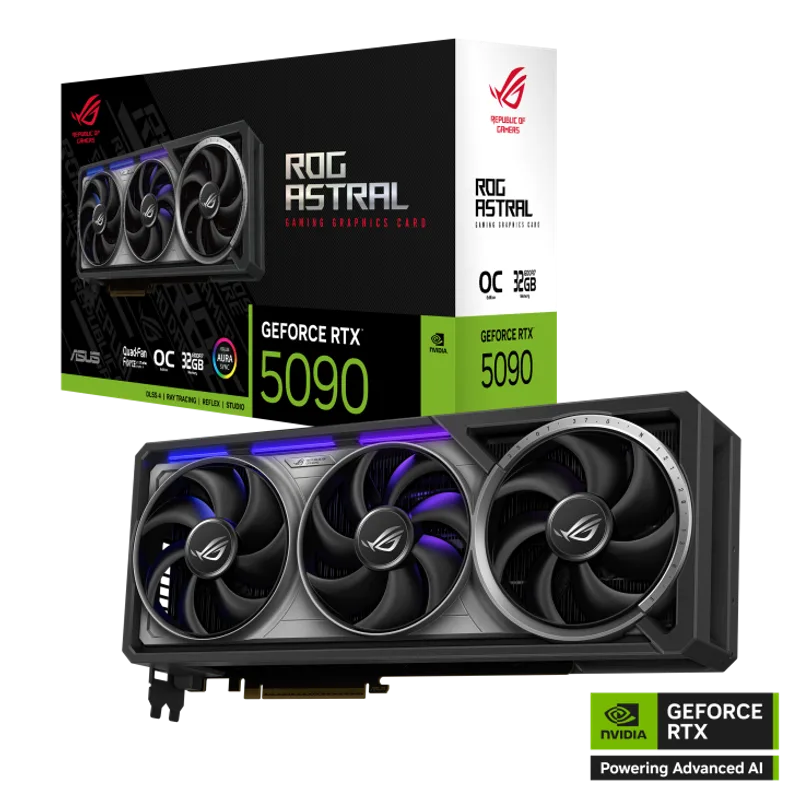
The ASUS ROG Astral RTX 5090 uses NVIDIA’s GB202 die with all 170 streaming multiprocessors enabled — 21,760 CUDA cores paired with 32GB GDDR7 at 1,792 GB/s bandwidth. Independent reviews consistently place it 20–50% ahead of the RTX 4090 at 4K native rasterization depending on the title, with ray tracing uplifts commonly landing between 27–35%.
The price is the story. MSRP is $1,999. Street price in April 2026 sits between $3,600 and $4,000+ for most AIB partner cards, with liquid-cooled variants exceeding $5,000. NVIDIA recommends a 1000W PSU for the 575W TDP — factor another $150–$200 if your current supply falls short.
For content creators and AI practitioners, 32GB GDDR7 is meaningfully useful. Adobe Premiere and DaVinci Resolve handle 8K RAW footage faster than 16GB cards when the frame buffer fills. Larger local language models also fit in VRAM without offloading, which matters for AI inference workflows. As a pure gaming GPU at current street prices, the RTX 5090 is hard to justify over the RTX 5080. As the undisputed fastest consumer GPU available, it is.
Pair with: AM5 or LGA1851 platform, 1000W+ 80+ Gold PSU, PCIe 5.0 slot.
2. GIGABYTE GeForce RTX 5080 Gaming OC 16G
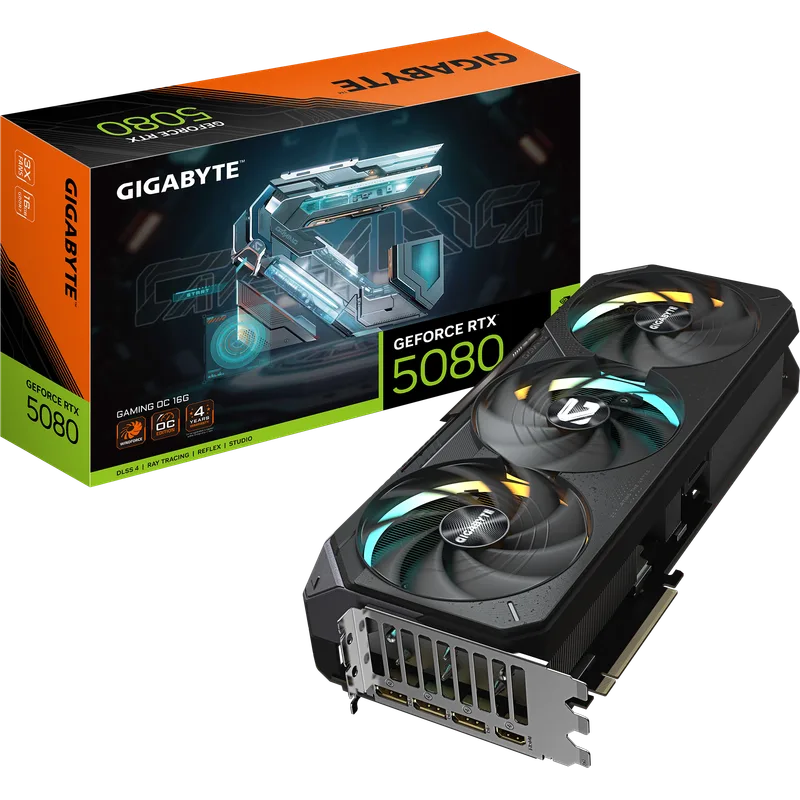
The GIGABYTE RTX 5080 Gaming OC uses NVIDIA’s GB203 die with 10,752 CUDA cores and 16GB GDDR7 at 960 GB/s. At 1440p it averages around 178 FPS across modern AAA titles — roughly 90% of the RTX 4090’s throughput at that resolution. At 4K, the performance gap over the previous-gen RTX 4080 Super is approximately 9% in rasterization. Modest for a new generation, but DLSS 4 expands that lead significantly in supported titles.
Where the RTX 5080 justifies its position is ray tracing with DLSS 4 MFG. In Cyberpunk 2077 at 4K overdrive RT, it sustains over 200 FPS with frame generation active — territory the RTX 4080 Super couldn’t reach with DLSS 3. F1 24 at 1440p goes from ~133 FPS native to 219 FPS with MFG on.
Street prices dipped to $1,150–$1,300 briefly as RTX 5080 inventory expanded, but tariff pressure has pushed prices back to $1,350–$1,550 as of late April 2026. At $1,400 versus $900 for the RTX 5070 Ti, the 5080’s 9–16% RT performance premium is harder to justify for most builds. If you’re building a 4K ray-tracing rig and frame generation support at the current tier matters, the 5080 earns its spot.
Pair with: AM5 or LGA1851 platform, 850W PSU minimum.
3. MSI GeForce RTX 5070 Ti 16G Gaming Trio OC Plus
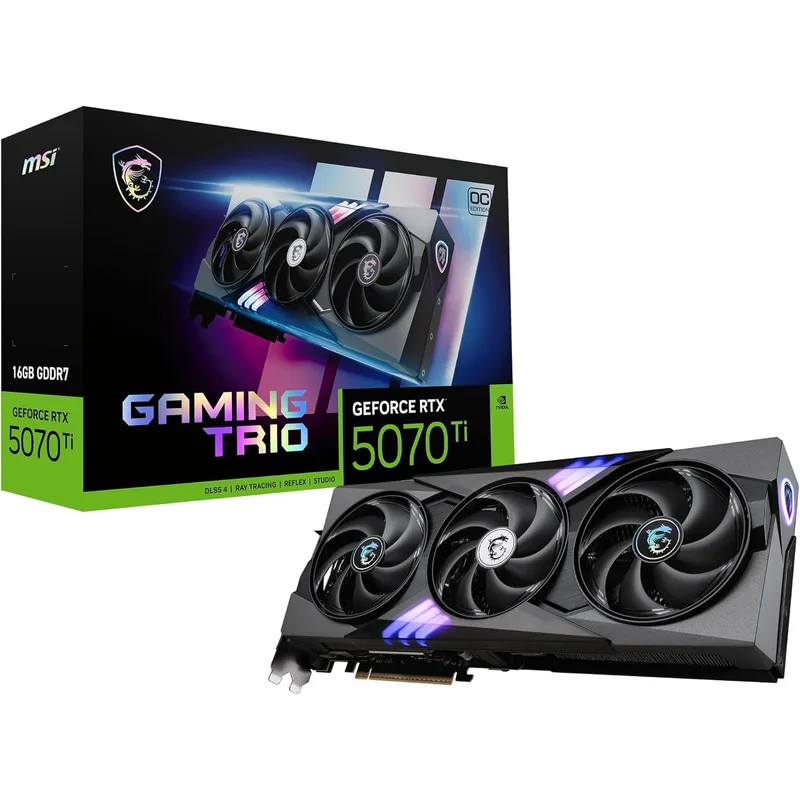
MSI GeForce RTX 5070 Ti 16G Gaming Trio OC Plus
The MSI RTX 5070 Ti Gaming Trio OC Plus is the high-end card that makes the most economic sense right now. Same GB203 die as the RTX 5080, cut to 8,960 CUDA cores with 16GB GDDR7 at 896 GB/s. At 4K rasterization, the gap to the RTX 5080 ranges from 6% to 16% — in practice, 5 to 12 FPS at typical 4K framerates. Against the RTX 4070 Ti Super, it’s 11% faster at 4K.
The TRI FROZR 4 cooler on this MSI variant runs quiet under gaming loads and holds stable thermals at 2.61 GHz boost. The 300W draw is identical to the RX 9070 XT and fits within an 850W power supply with headroom.
Street prices sit at $880–$1,000 in April 2026, elevated above the $749 MSRP by supply constraints and tariff pressure across the RTX 50 stack. GamersNexus raised concerns about the 5070 Ti’s value proposition when it briefly pushed past $1,000 — at $880–$950, those concerns ease. At $900 versus $1,400+ for the RTX 5080, the 5070 Ti is the stronger buy for the vast majority of 4K gaming builds.
Pair with: AM5 or LGA1851 platform, 850W PSU.
4. ASUS TUF Radeon RX 9070 XT OC Edition
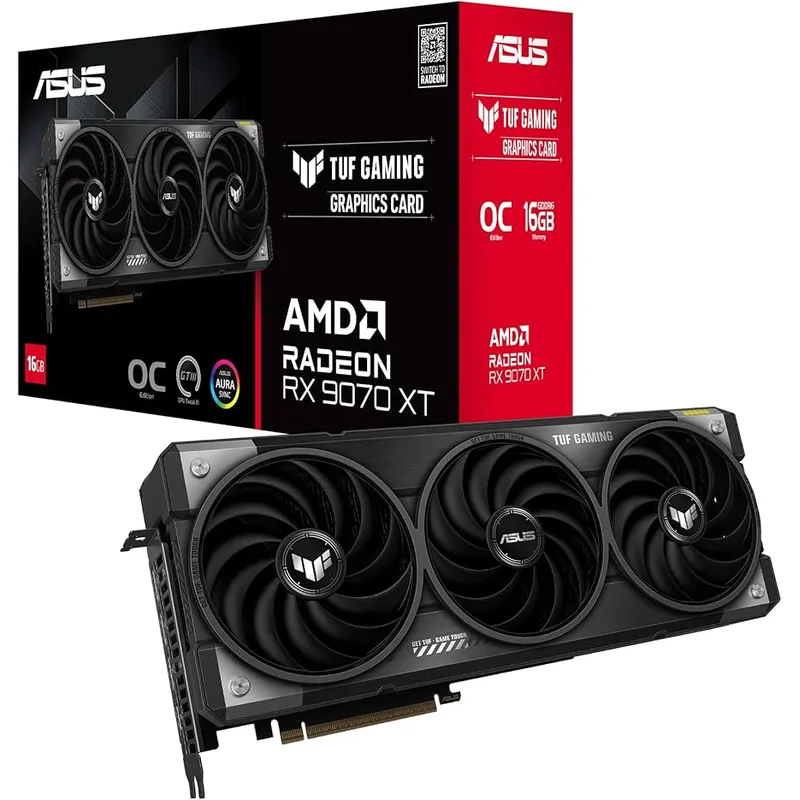
The ASUS TUF RX 9070 XT OC launched at $599 MSRP in early 2025 and initially settled to $699–$729. In April 2026, ASUS and other AIB partners raised RX 9070 XT prices by up to 17%, pushing current street prices to $849–$879. Built on RDNA 4 with 64 Compute Units, it initially trailed the RTX 5070 Ti by about 2.5% at 1440p rasterization. Post-launch driver updates closed that gap — it now matches or leads the RTX 5070 Ti in several rasterized titles at 1440p.
At 4K, the two cards trade blows within 6% across most games: Cyberpunk 2077 (rasterization), F1 24, Resident Evil 4, Starfield, and Total War: Warhammer 3 all fall within that range. The divergence appears in ray tracing, where the RX 9070 XT trails by roughly 14% overall. Black Myth: Wukong at full 4K path tracing is an outlier — the RTX 5070 Ti leads by approximately 78%.
AMD’s FSR 4 with AI-enhanced upscaling is RDNA 4-exclusive and performs well in supported titles. No frame generation multiplier equivalent to DLSS 4 MFG has shipped as of April 2026, which limits framerates in RT-heavy games where the RTX cards use generated frames to compensate.
At $849–$879 street, the ASUS TUF OC is the strongest AMD card in this bracket. It matches the RTX 5070 Ti in rasterization for $20–$150 less at current prices. Skip ray tracing as a priority? This is the pick.
Pair with: AM5 or LGA1700/1851 platform (PCIe 5.0 supported), 850W PSU, two 8-pin power connectors required.
5. MSI GeForce RTX 4090 Gaming X Trio 24G
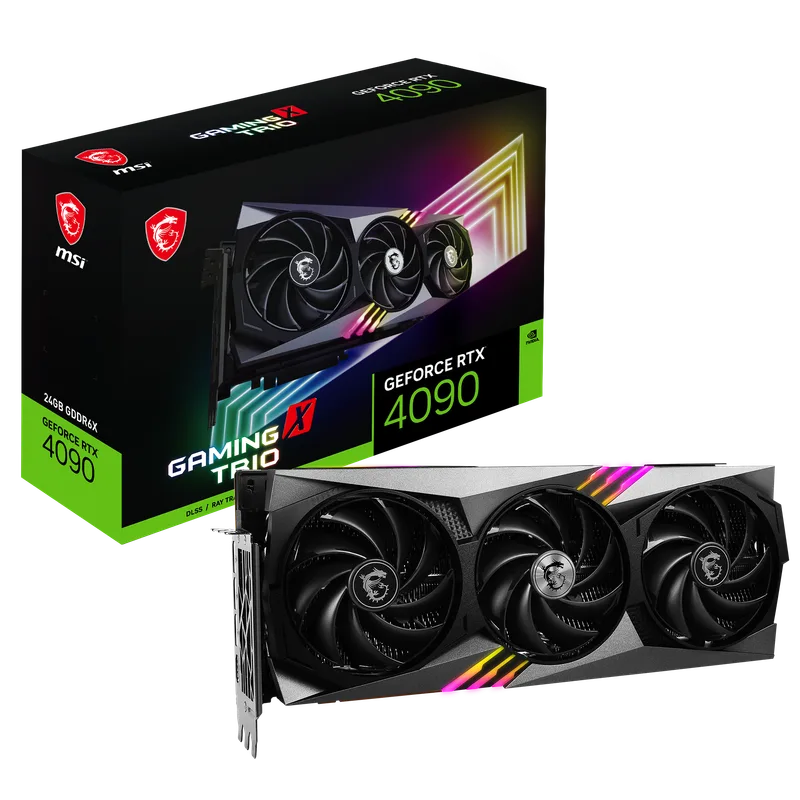
MSI GeForce RTX 4090 Gaming X Trio 24G
The MSI RTX 4090 Gaming X Trio is a reference point on this list, not an active recommendation. NVIDIA discontinued RTX 4090 production after launching the RTX 5090, and remaining new stock from resellers now runs $2,700–$2,900 — well above the card’s $1,599 MSRP at launch. Used units on secondary markets average $1,200–$1,800 depending on condition.
At $2,700–$2,900 new, the math doesn’t work. The RTX 5090 at ~$3,800 delivers 20–50% more 4K performance, 32GB GDDR7, and DLSS 4 MFG. The RTX 5080 at $1,350–$1,550 is nearly as fast as the RTX 4090 at 1440p while drawing 90W less and supporting the current generation of frame generation technology.
The RTX 4090’s 24GB GDDR6X retains legitimate value in AI inference, where VRAM capacity determines which local models fit in memory. For that use specifically, the 5090’s 32GB is a better choice anyway. A used RTX 4090 at $1,200–$1,400 makes sense for a 4K content creation workstation where the discount is real. At current new prices, choose the RTX 5080 instead.
Pair with: High-end LGA1700 or LGA1851 platform, 850W PSU minimum, PCIe 4.0 slot or better.
FAQ
Is the RTX 5090 worth it at current street prices?
At $2,000 MSRP, yes — it’s the best consumer GPU available. At $3,600–$4,000+ street, it’s only worth it if you need 32GB GDDR7 for professional workloads, or if 4K ray tracing fully maxed is non-negotiable. For gaming alone, the RTX 5070 Ti at $900 delivers roughly 70% of the RTX 5090’s 4K performance for about 23% of the street price.
Does the RX 9070 XT support ray tracing?
Yes. RDNA 4 includes third-generation ray tracing accelerators and holds up in moderate RT workloads. It struggles against the RTX 5070 Ti in titles with aggressive path tracing — Black Myth: Wukong and Alan Wake II at 4K are the clearest examples. For ray tracing as a primary use case, choose NVIDIA.
How much PSU do these GPUs need?
RTX 5090: 1000W minimum, 1200W recommended. RTX 5080: 850W. RTX 5070 Ti: 850W. RX 9070 XT: 850W (two 8-pin connectors required). Budget $100–$180 for a quality 850W–1200W PSU if you need to upgrade.
Is PCIe 4.0 enough for these cards?
Yes. Every card on this list supports PCIe 5.0 but runs without measurable gaming performance loss on PCIe 4.0. On PCIe 3.0 platforms (8th-gen Intel or Ryzen 2000 and earlier), the RTX 5090 may show a minor bandwidth bottleneck at very high resolutions.
Will high-end GPU prices drop in 2026?
The RTX 5080 dipped to $1,150–$1,300 as supply normalized but has rebounded to $1,350–$1,550 due to tariff pressure. The RTX 5090 remains volatile due to AI-sector demand for high-bandwidth memory. AMD’s RX 9070 XT settled near $699–$729 at launch but AIB prices were raised up to 17% in April 2026; current street sits at $849–$879. Significant reductions are unlikely until supply constraints ease or new GPU generations arrive — neither appears imminent through the rest of 2026.
What resolution is each card best suited for?
RX 9070 XT and RTX 5070 Ti: 1440p high refresh, or 4K at 60–90+ FPS native. RTX 5080: 1440p ultrawide or 4K high refresh with DLSS. RTX 5090: 4K native with heavy ray tracing, or 8K with upscaling.
The Bottom Line
For most high-end PC builders, the RTX 5070 Ti hits the right balance — within 6% of the RTX 5080 at 4K for $350–$550 less at current prices. AMD builders should look at the RX 9070 XT, which now matches the RTX 5070 Ti in rasterization at $849–$879 street after driver maturation. If budget is not a constraint and 4K ray tracing is the goal, the RTX 5090 is the only card that delivers it without compromise — budget $3,600–$4,000+ and plan around a 1000W PSU.