Affiliate disclosure: PCBuildRanked earns a commission on qualifying Amazon purchases at no extra cost to you.
Mini-ITX cases occupy a specific sweet spot: small enough to carry to a LAN party, powerful enough to house a full-power GPU and modern CPU. The SFF case market has matured considerably — you can now get dual-chamber airflow, PCIe 4.0 risers, and 280mm AIO support in boxes under 15 liters at reasonable prices. Here are the five cases worth considering in 2026, evaluated against current GPU dimensions, SFX power supply compatibility, and realistic assembly experience.
| Spec | Fractal Design Terra Graphite Unavailable 9.2/10 | Lian Li Q58 Black Unavailable 8.9/10 | SSUPD Meshlicious Black Unavailable 8.7/10 | NZXT H1 V2 Unavailable 8.5/10 | Cooler Master NR200P V2 8.6/10 |
|---|---|---|---|---|---|
| volume | 10.4L | 14.3L | 14.75L | 15.5L | 18L |
| formFactor | Mini-ITX | Mini-ITX | Mini-ITX / Mini-DTX | Mini-ITX | Mini-ITX |
| gpuClearance | 322mm | 336mm | 346mm (4-slot mode) | 324mm | 357mm |
| cpuCoolerMax | 77mm | 67mm | 73mm (3-slot GPU mode) | N/A (140mm AIO included) | 155mm |
| psuType | SFX | SFX | SFX | SFX 750W (included) | SFX / SFX-L |
| radSupport | 120mm (one side) | 240mm top or side | 280mm | 140mm (included AIO) | 280mm top |
| Rating | 9.2/10 | 8.9/10 | 8.7/10 | 8.5/10 | 8.6/10 |
Prices change daily — tap Check Price for the current Amazon price.
Prices change daily — tap Check Price for the current Amazon price.
Quick Picks
- Best Overall: Fractal Design Terra Graphite — premium aluminum build at 10.4L with an adjustable spine system that adapts to your GPU or CPU cooler dimensions
- Best Versatile: Lian Li Q58 — dual-chamber layout at ~$100 with PCIe 4.0 riser and swappable panels included
- Best Budget: Cooler Master NR200P V2 — 357mm GPU clearance and 155mm CPU cooler height for ~$90
Buying Guide: What to Know Before Choosing an ITX Case
SFX vs ATX Power Supplies
Every case in this roundup requires an SFX or SFX-L power supply. Full-size ATX PSUs physically won’t fit. SFX units from Corsair (SF750), Seasonic (Focus SGX), and NZXT (C750 SFX) run $100–$150. Budget SFX options from Silverstone and MSI exist around $70–$90. If you’re upgrading from an ATX build, factor this cost into your total budget.
Volume and What It Costs You
Volume (in liters) directly trades off against GPU and CPU cooler support:
| Volume Range | What You Give Up |
|---|---|
| Under 12L | Requires low-profile CPU cooler, careful GPU selection |
| 12–16L | Limited AIO options; most GPUs fit |
| 16–20L | Full GPU and CPU cooler flexibility, closest to mATX experience |
The Terra at 10.4L requires the most planning. The NR200P V2 at 18L gives you the most flexibility but is the largest case here.
PCIe Riser Cable Generation
Vertical GPU mounting in ITX cases uses a riser cable that must match or exceed your motherboard’s PCIe slot generation. Using a PCIe 3.0 cable on a PCIe 5.0 slot can cause GPU bandwidth drops. All five cases here ship with PCIe 4.0 risers, which handle every current gaming GPU without a meaningful performance penalty. If you specifically need a PCIe 5.0 riser, Cooler Master’s NR200P V3 (released 2025) includes one.
CPU Cooler Height Limits
ITX cases are hard on CPU coolers. The NR200P V2’s 155mm limit is the outlier — every other case here caps out at 77mm or less, requiring either a low-profile air cooler or a 240mm+ AIO. Check your CPU cooler’s height against the case spec before purchasing.
Detailed Reviews
1. Fractal Design Terra Graphite
Fractal Design Terra Graphite
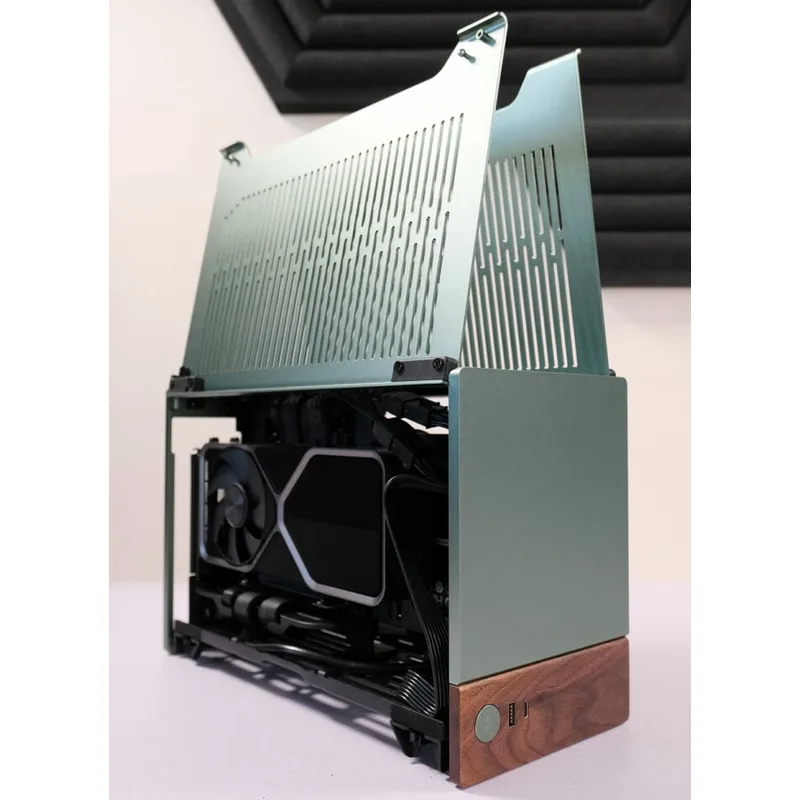
The Terra is the most distinctive case in this roundup — anodized aluminum panels, a solid walnut front section, and a steel internal structure that Fractal calls the “spine.” The spine slides laterally through 7 positions, letting you carve space for a thicker GPU (at the cost of CPU cooler height) or a taller cooler (at the cost of GPU width). You set this once at build time.
At 10.4L, it’s genuinely compact — about 40% smaller by volume than the NR200P V2. The GPU bay supports cards up to 322mm long and 72mm wide in the widest spine position, which covers most RTX 5070 and RX 9070 options. The RX 9070 XT at 58mm width fits with room to spare in max-GPU mode.
CPU cooling is the catch. Maximum height is 77mm with the spine set for max CPU cooler space — 48mm if you’ve moved the spine toward max GPU. The Noctua NH-L12S (70mm) works in most configurations. A 120mm AIO fits in one orientation but requires forgoing some GPU width. Anyone planning a 240mm AIO should look at the Q58 or Meshlicious instead.
At $199, this is case-only — an SFX PSU adds to the budget. The build quality is several tiers above other ITX cases at this price: aluminum panels with zero flex, real walnut, and a PCIe 4.0 riser included.
2. Lian Li Q58 Black
Lian Li Q58 Black
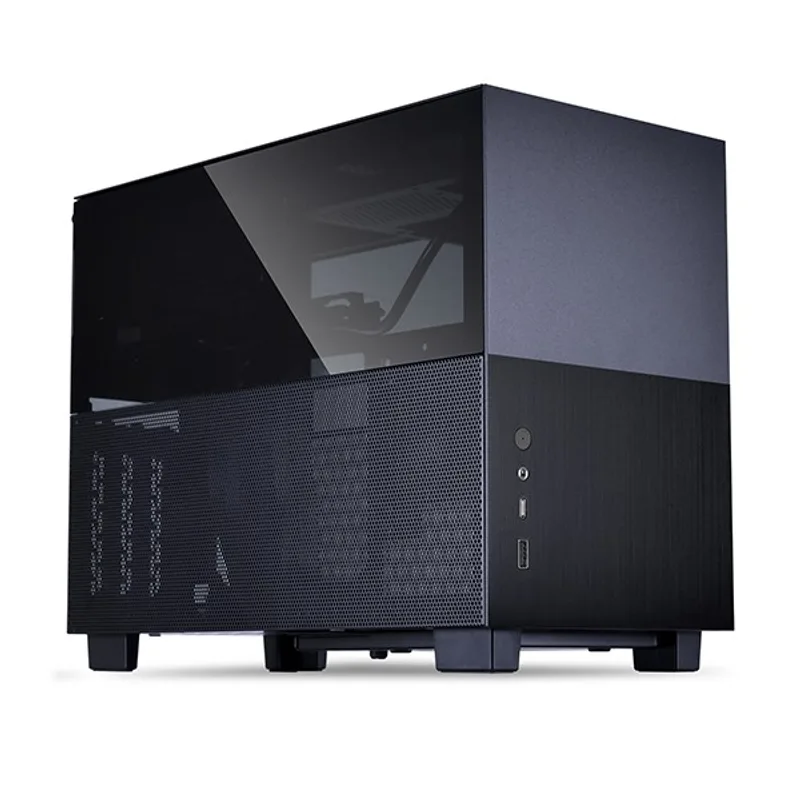
The Q58 uses a true dual-chamber layout: the GPU lives in its own chamber with dedicated front intake, while the CPU and PSU occupy the rear chamber. Both chambers have independent airflow paths, which is why GPU temps in the Q58 run lower than in single-chamber designs of similar volume. Independent intake chambers typically yield 4–8°C lower GPU temps under sustained load compared to shared-intake designs.
The case ships with two side panels — full mesh and tempered glass. You swap them without tools. Most builders use mesh for cooling-focused setups and glass for display purposes. Getting both in the box at ~$100 is genuinely useful; competing cases charge $30–$50 for the alternate panel separately.
GPU clearance is 336mm in dual-chamber mode, which accommodates any current-gen consumer GPU. The 67mm CPU cooler limit requires a Noctua L9i, L12S, or similar low-profile unit — standard tower coolers like the DeepCool AG400 won’t fit. For AIO cooling, the Q58 supports a 240mm radiator mounted at the top.
The PCIe 4.0 riser cable inclusion at ~$100 is the Q58’s most underrated feature. Budget ITX case buyers frequently discover too late that a PCIe 4.0 riser alone costs $35–$50 on Amazon.
3. SSUPD Meshlicious Black
SSUPD Meshlicious Black
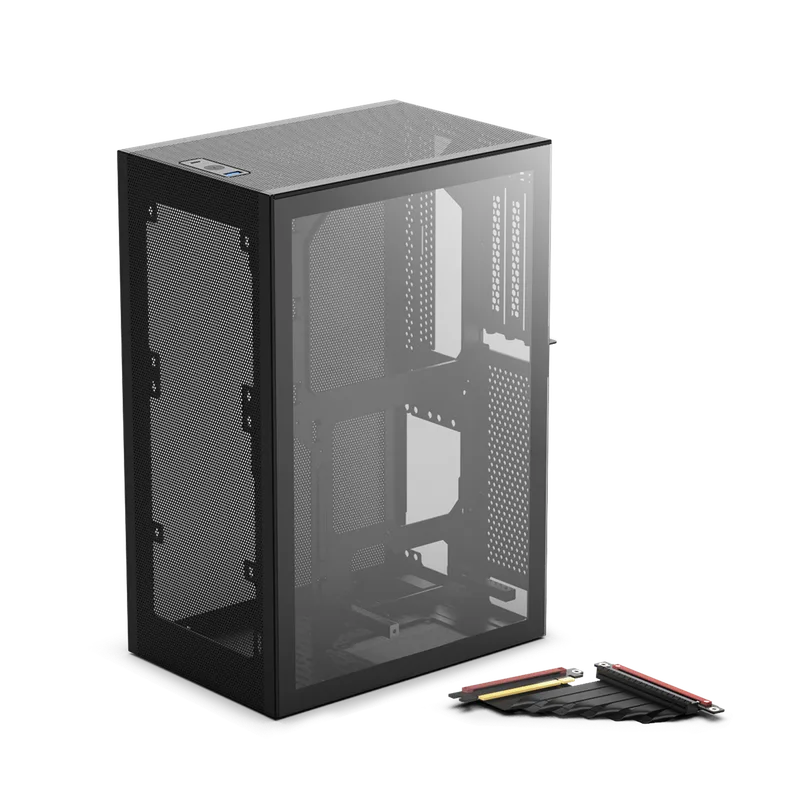
SSUPD is a Lian Li spinoff that built the Meshlicious around one design priority: airflow. The full-mesh front and left panels use a fine perforation pattern that passes substantially more fan-driven airflow than standard steel mesh. In GPU rendering workloads, the full-mesh Meshlicious runs 6–8°C cooler than the tempered glass variant under identical fan settings.
The GPU chamber is the widest in this roundup. Four-slot GPU mode supports cards up to 346mm long and 155mm tall — the extra height versus the 131–145mm limits of the Terra and Q58 means thicker AIB cards fit with less friction. The NR200P V2 is the only other case here with comparable GPU clearance.
CPU cooling height is the trade-off. In 3-slot GPU mode you get 73mm of clearance — in 4-slot mode, just 53mm. Pairing a 4-slot GPU like an ASUS ROG Strix RX 9070 XT with adequate CPU cooling requires a 240mm AIO mounted at the top.
At $119 with the PCIe 4.0 riser included, the Meshlicious sits above the Q58 in price. If maximum airflow for hot GPUs is the priority, the fine-mesh design justifies the premium.
4. NZXT H1 V2
NZXT H1 V2
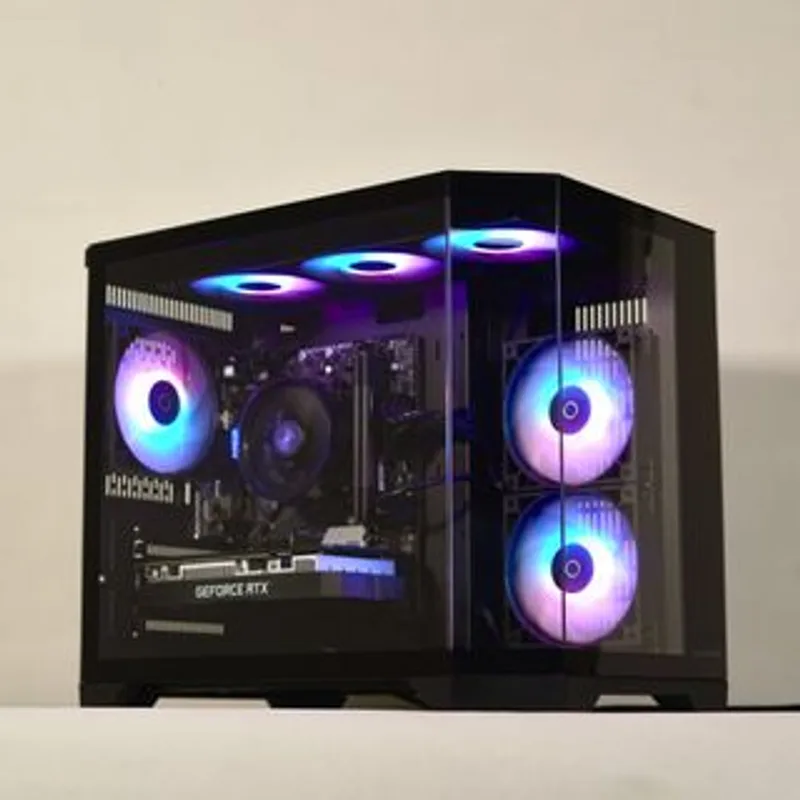
The H1 V2 solves a real problem that every Mini-ITX builder faces: unlike ATX builds, you need a dedicated SFX PSU and a CPU cooler that fits a tiny chassis, and both cost a premium over ATX alternatives. NZXT addresses this directly — the H1 V2 ships complete with a 750W 80+ Gold SFX PSU and a 140mm AIO at a $400 price that undercuts buying those components separately by a meaningful margin.
The dual-chamber layout separates CPU and GPU airflow, and NZXT improved both chamber volumes over the original H1. The CPU chamber uses positive-pressure airflow, and a 92mm exhaust fan at the top of the GPU chamber prevents heat soak during sustained gaming. Independent reviews show roughly 10–15% better thermals than the original H1 for both CPU and GPU.
The GPU width limit of 58mm is the H1 V2’s hard constraint. Most 2-fan GPUs fit, but triple-fan coolers and some thick 2-fan designs won’t. Before buying, measure your GPU’s cooler thickness at its widest point — not just the PCIe bracket height.
At $400, the recommendation is deliberate: if you’re starting a Mini-ITX build from scratch with no existing SFX PSU or AIO, the H1 V2 is often the best total value. If you already own either component, the Terra or Q58 make more sense.
5. Cooler Master NR200P V2
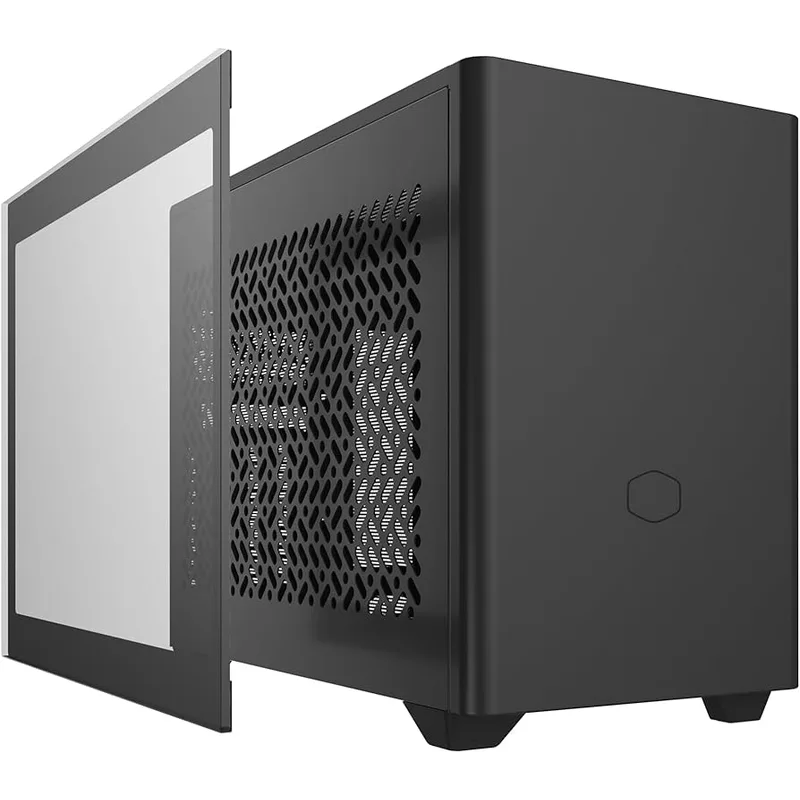
The NR200P V2 is the most accommodating ITX case in this roundup. The 155mm CPU cooler clearance is the standout spec — the DeepCool AG400 (148mm), Thermalright Peerless Assassin ITX (144mm), and ID-Cooling SE-224-XT (155mm) all fit. You’re not locked into low-profile coolers or AIO liquid cooling, which significantly cuts component cost.
GPU support at 357mm and triple-slot clearance means virtually any current consumer GPU fits without modification. The RTX 5080 (up to ~336mm on most AIB versions), RX 9070 XT, and even the RTX 5090 Founder’s Edition clear with room to spare.
The V2 revision added top-mounted 280mm radiator support, giving the case AIO flexibility that the original NR200P lacked. The included vented steel panel handles airflow well; the tempered glass variant is a separate product SKU rather than included.
At ~$90, the NR200P V2 undercuts every other case here by a significant margin while offering the largest GPU clearance and the only 150mm+ CPU cooler compatibility. The trade-off is the largest footprint at 18L — still far smaller than any ATX mid-tower, but noticeably bigger on a desk than the Terra or Q58.
FAQ
Do all these cases require an SFX power supply?
Yes. Every case in this roundup requires an SFX or SFX-L PSU. Standard ATX PSUs physically won’t fit. Budget approximately $80–$150 for a quality SFX unit from Corsair, Seasonic, or Silverstone if you’re upgrading from an ATX build. The NZXT H1 V2 includes a 750W SFX PSU in its $400 price.
What’s the largest GPU that fits in a Mini-ITX case?
The Cooler Master NR200P V2 leads with 357mm GPU clearance. The SSUPD Meshlicious supports up to 346mm in 4-slot mode. Both accommodate virtually every current consumer GPU. The Fractal Design Terra is the most restrictive at 322mm but still fits most RTX 5070-class and smaller cards.
Can I use a regular tower CPU cooler in any of these cases?
Only the NR200P V2 supports standard tower coolers — its 155mm clearance fits the DeepCool AG400, Thermalright Peerless Assassin ITX, and similar mid-range units. Every other case here caps out at 77mm or less, requiring low-profile air coolers or AIO liquid cooling.
Is a PCIe 4.0 riser cable enough for current GPUs?
For gaming, yes. All five cases include PCIe 4.0 risers, which handle every RTX 50-series and RX 9000-series GPU without meaningful bandwidth limitation. If you specifically need PCIe 5.0 riser support, Cooler Master’s NR200P V3 includes one.
Which case is easiest to build in for a first-time ITX builder?
The NZXT H1 V2 is the most guided build experience — tool-free panels and included hardware reduce the number of decisions. For case-only options, the NR200P V2’s full 360-degree accessibility (both side panels and top panel remove easily) makes it the most forgiving for first-time builders.
The Bottom Line
For most Mini-ITX builders in 2026, the Fractal Design Terra offers the best combination of compact volume, build quality, and flexibility — its adjustable spine system genuinely solves the GPU-vs-cooler trade-off that most ITX cases handle poorly. The Lian Li Q58 is the better pick if you want dual-chamber cooling and included swappable panels at ~$100. Budget-constrained builders should go with the Cooler Master NR200P V2 — ~$90 with 357mm GPU clearance and 155mm CPU cooler support is the best flexibility per dollar in the ITX market right now. Once you’ve chosen a case, see our how to build a small form factor PC guide for a step-by-step SFF build walkthrough covering component selection, assembly order, and thermal management.