PC case design went through a reset in late 2026 and early 2025. The launch of the Corsair 4000D RS Frame in January 2025 — with its InfiniRail mounting system and native reverse-connector motherboard support — pushed competing brands to catch up on modularity and airflow simultaneously. By early 2026, the gap between a $70 mesh case and a $150 premium airflow chassis has narrowed considerably: budget cases now routinely ship with four 140mm fans and triple-radiator support that once required spending $130+. This roundup covers the five cases that actually deliver on their airflow claims, based on independent thermal testing from GamersNexus, Tom’s Hardware, and KitGuru.
| Spec | Corsair 4000D RS Frame 9.4/10 | Lian Li Lancool 207 9/10 | Phanteks XT Pro Ultra Unavailable 8.8/10 | Fractal Design Torrent Unavailable 9.2/10 | NZXT H7 Flow 2024 Unavailable 8.6/10 |
|---|---|---|---|---|---|
| formFactor | Mid-Tower ATX | Mid-Tower ATX | Mid-Tower ATX | Mid/Full Tower E-ATX | Mid-Tower ATX |
| fans | 3x 120mm RS fans included | 2x 140mm ARGB + 2x 120mm PWM included | 4x M25-140mm ARGB fans included | 2x 180mm PWM + 3x 140mm PWM included (5 fans) | 3x 120mm fans included |
| fanMounts | 9x 120mm or 6x 140mm | 6x 120mm or 4x 140mm front, 2x 120mm top, 1x 120mm rear | 10x 120mm or 6x 140mm + 3x 120mm positions | 3x 120mm/140mm or 2x 180mm front, 3x 120mm/140mm or 2x 180mm floor, 1x 120mm/140mm rear | 3x 120mm front, 3x 120mm top, 2x 120mm bottom, 1x 120mm rear |
| radiatorSupport | 360mm front, 360mm top, 360mm side | 360mm front, 240mm top, 120mm rear | 360mm front, 360mm top | 360mm/420mm floor, 120mm/140mm rear | 360mm front, 360mm top, 240mm bottom |
| gpuLength | 420mm max | 375mm max | 435mm max | 461mm max | 400mm max |
| mbCompatibility | ATX, ASUS BTF, MSI Project Zero, Gigabyte Project Stealth | — | — | — | — |
| Rating | 9.4/10 | 9/10 | 8.8/10 | 9.2/10 | 8.6/10 |
Prices change daily — tap Check Price for the current Amazon price.
Prices change daily — tap Check Price for the current Amazon price.
Quick Picks
- Best overall: Corsair 4000D RS Frame — 6°C improvement over the original 4000D Airflow, modular InfiniRail system, reverse-connector motherboard support at $100
- Best value: Lian Li Lancool 207 — four fans included, compact 45.5L ATX chassis with 360mm front radiator support at $85
- Best premium: Fractal Design Torrent — five fans, two 180mm floor fans for direct GPU cooling, E-ATX compatible at $189
Buying Guide
Why Airflow Cases Outperform “Solid Panel” Designs
Tempered glass front panels look clean but block 30–50% of potential intake airflow depending on the gap around the panel edges. A case with a mesh or open-grille front drops intake restriction below 10% and lets fans spin slower for the same thermal output — which means lower noise. Every case in this roundup uses a mesh or open-grille front. If a case has a solid glass front and claims to be an “airflow” design, it’s misleading marketing.
Fan Size Matters: 140mm vs. 120mm
A 140mm fan at 800 RPM moves roughly the same air volume as a 120mm fan at 1000 RPM — but at measurably lower noise because the blades are moving slower relative to their diameter. Cases that ship with 140mm front fans (the Lancool 207 and Phanteks XT Pro Ultra) have a built-in acoustic advantage. If you care about silence as much as cooling, prioritize 140mm fan positions and bundled fans.
Radiator vs. Air Cooling Compatibility
All five cases here support a 360mm radiator in the front. The Fractal Design Torrent adds 420mm floor support, making it the only option for triple-120mm radiators mounted horizontally. If you’re using an air cooler, any case in this roundup gives you enough front-to-rear airflow to handle a 280W all-core load without thermal throttling on the case’s own fans — the CPU cooler quality matters far more than case choice for air-cooled builds. If water cooling is your primary consideration, see our best PC cases for water cooling guide for cases optimized specifically for custom loop and AIO radiator configurations.
Reverse Connector Motherboards in 2026
ASUS BTF, MSI Project Zero, and Gigabyte Project Stealth hide all cables behind the motherboard. These boards require cases with rear-routed cutouts specifically sized for their connector positions — a standard ATX case will fit the board but leave cables dangling through the wrong cutouts. The Corsair 4000D RS Frame is the only case in this roundup purpose-built for reverse-connector boards, though the Lancool 207 accommodates them with minor cable routing adjustments.
GPU Clearance Reality Check
RTX 5090 and RX 9070 XT triple-fan cards run 315–340mm long. A 360mm GPU clearance spec sounds comfortable, but thick power cables at the GPU tail can steal 20–30mm. The Phanteks XT Pro Ultra’s 435mm clearance is the safest option for any current or near-future GPU. The Lancool 207’s 375mm is tight with a triple-fan flagship.
Detailed Reviews
1. Corsair 4000D RS Frame
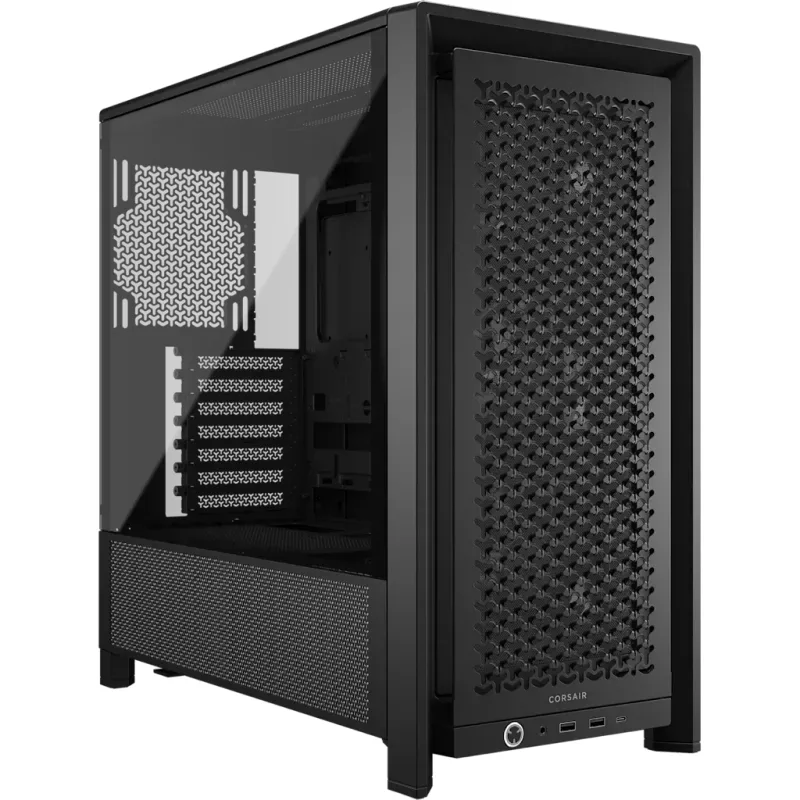
The Corsair 4000D RS Frame is the most significant case redesign Corsair has shipped in four years. The original 4000D Airflow was already competitive; the RS Frame cuts CPU temperatures by an additional 6°C at noise-normalized 27 dBA — confirmed by GamersNexus in their full thermal suite with a 125W CPU and 250W GPU test load. The change comes from Corsair’s new “3D Y-pattern” front panel mesh, which they claim passes 12% more airflow than the original perforated steel design, combined with repositioned intake paths that reduce recirculation inside the chamber.
The InfiniRail system is the headline feature for builders. Instead of fixed fan mounting positions, a continuous rail runs across the front, top, and bottom panels. You slide fans to any position along the rail and lock them with thumbscrews — no screwdriver required, no predefined holes. This matters practically when you’re mounting a 360mm radiator at the front and want to push the radiator slightly off-center to clear a tall VRM heatsink, or when you’re mixing 120mm and 140mm fans in the same panel.
Reverse-connector motherboard support is built into the cable management tray. The frame ships with pre-cut openings aligned to ASUS BTF, MSI Project Zero, and Gigabyte Project Stealth connector positions. If you’re building with one of those boards, cables disappear entirely into the rear compartment — the front chamber looks clean without any cable management sleeves.
The three included RS 120mm fans perform well but leave room for improvement: at 800 RPM they’re near-silent, at 1200 RPM they reach 35 dBA — acceptable, but not as quiet as 140mm fans at equivalent airflow. Budget an extra $20–40 for two 140mm front fans if noise is a priority.
2. Lian Li Lancool 207
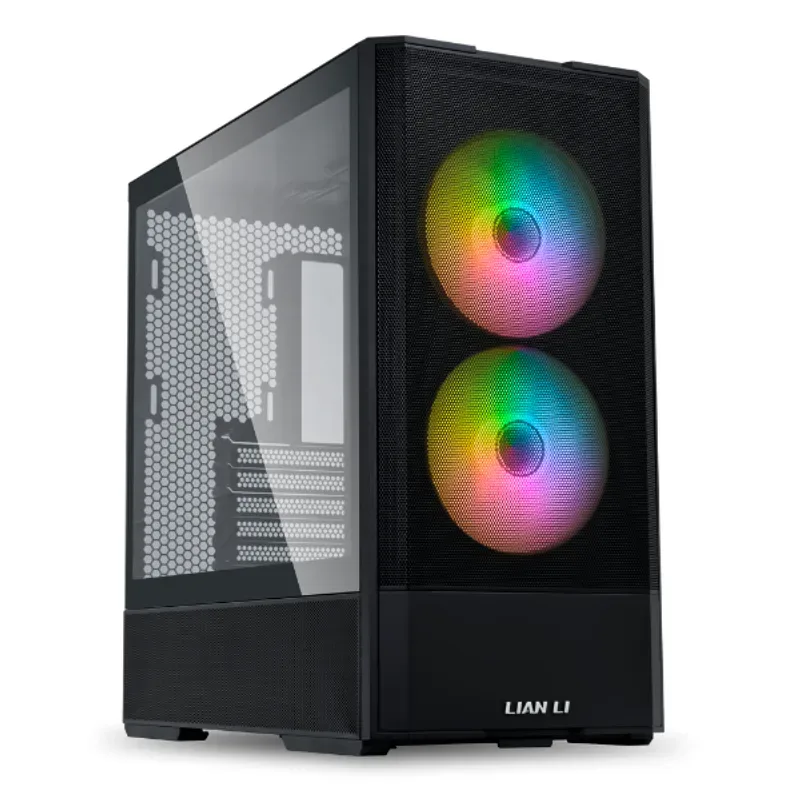
The Lian Li Lancool 207 is the case to buy when you want maximum out-of-box thermal performance at minimum cost. Lian Li ships it with four fans: two 140mm ARGB units on the front intake and two 120mm PWM fans pulling from the bottom floor. That four-fan configuration gives the Lancool 207 better static pressure through the front mesh and more active floor cooling than competitors that include three 120mm fans.
The compact 45.5L volume is a genuine engineering achievement. Lian Li fits a full ATX motherboard, a 360mm front radiator, and a 375mm GPU in a chassis that’s shorter and shallower than most mid-towers. The tradeoff is that PSU size is capped at 200mm and cable management behind the motherboard tray is tight — anything thicker than a modular cable bundle from a Seasonic or Corsair modular PSU becomes a puzzle. Fully modular PSUs are essentially required here.
The mesh coverage on the Lancool 207 is extensive: front, top, and bottom are all open mesh. In practice, that means intake air can reach the CPU cooler and GPU simultaneously without restriction from any direction. During GPU-heavy workloads, the bottom 120mm fans reduce GPU junction temps measurably compared to cases with a solid or dust-filter-only floor.
The ARGB fans need a sync point: a 5V ARGB header on your motherboard or a standalone hub. Lian Li doesn’t include a hub in the base model. ASUS, MSI, and Gigabyte boards include at least two ARGB headers, so this is a non-issue for most builds.
3. Phanteks XT Pro Ultra
Phanteks XT Pro Ultra
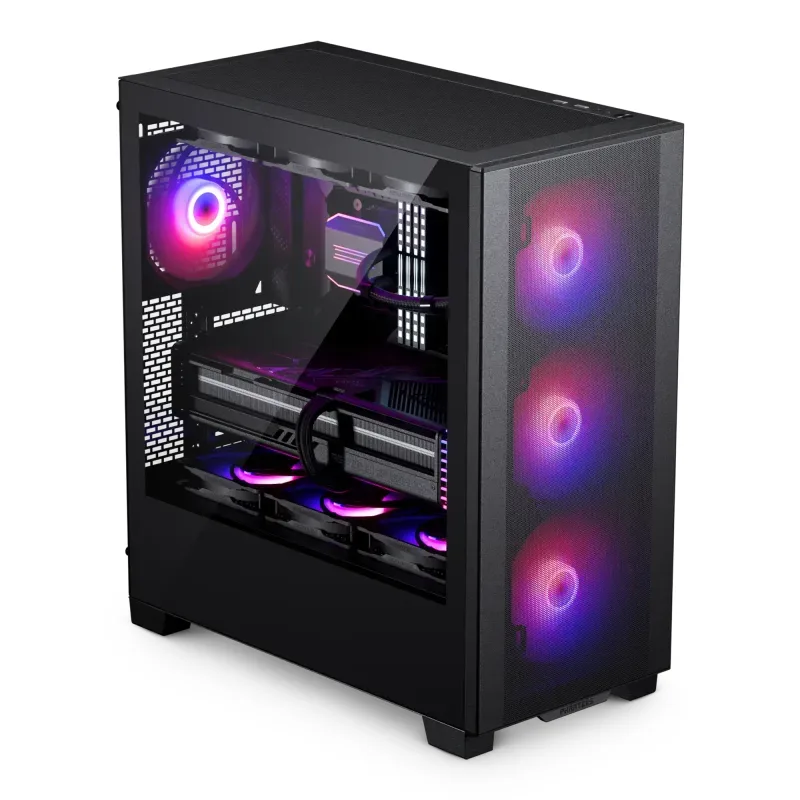
The Phanteks XT Pro Ultra ships with four M25-140mm ARGB fans for $70 — a combination no competitor matches at that price. Those fans use a dual-ball bearing design and spin at 1200 RPM under typical all-core gaming loads, generating around 32 dBA. For context, the Lancool 207’s bundled 140mm fans reach 34–35 dBA at comparable speeds. The M25 fans are genuinely quieter than most bundled options in this bracket.
Fan mounting positions are extensive: 10 total 120mm slots or six 140mm plus three 120mm positions across the front, top, and bottom. That means you can run a front 360mm radiator, a top 360mm radiator, and two bottom 120mm intake fans simultaneously — a configuration that handles extreme dual-GPU workstations or overclocked systems without adding external fan controllers.
The 435mm GPU clearance is the largest in this roundup and the most practical for future-proofing. Current flagships like the RTX 5090 FE measure 336mm; next-generation cards from unannounced vendors have shown engineering samples up to 390mm in leaked images. The XT Pro Ultra handles both with margin.
USB-C 3.2 Gen2 front IO is the premium feature that justifies choosing this over cheaper alternatives: it supports 10 Gbps data transfer and fast charging simultaneously, which matters if you’re using the front port for a USB-C SSD or external dock.
4. Fractal Design Torrent
Fractal Design Torrent
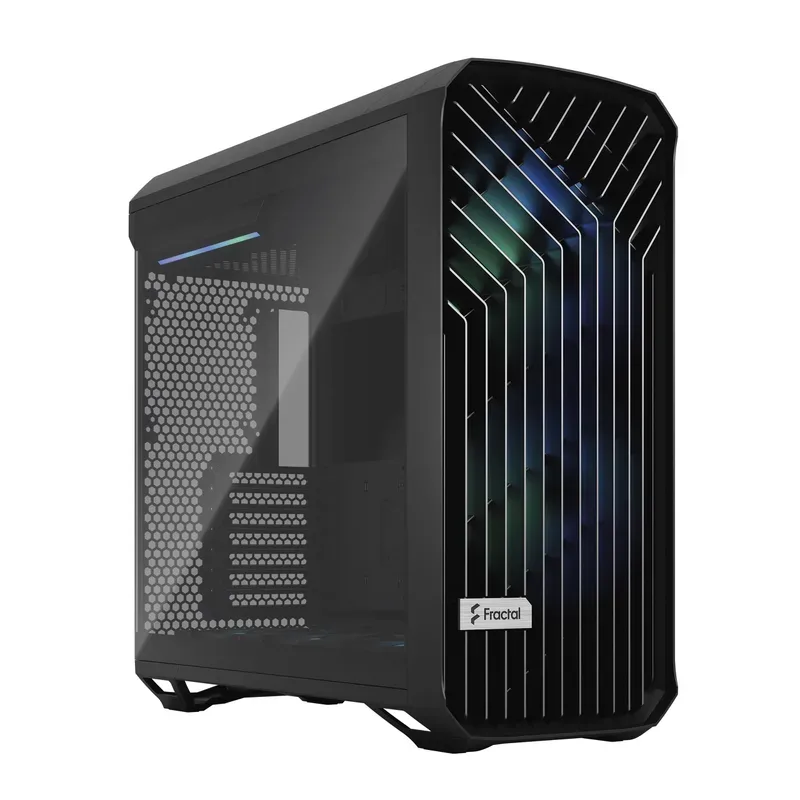
The Fractal Design Torrent uses a fundamentally different cooling philosophy from the other cases in this roundup: instead of relying purely on front mesh intake, it combines a massive open-grille front with large-format 180mm PWM fans mounted at the floor. Those floor fans pull fresh air directly across the GPU from underneath rather than relying on GPU case fans to manage their own airflow from recycled hot air inside the chamber.
In KitGuru’s thermal testing, the Torrent dropped GPU junction temps by 5–8°C compared to traditional front-intake-only designs at equivalent fan noise levels — a material difference that extends GPU boost clock sustainability under sustained gaming loads. The two 180mm fans are significantly quieter than equivalent 120mm fans at the same CFM: they run at 800 RPM for airflow that requires 1200 RPM from a 120mm unit.
E-ATX compatibility at 461mm GPU clearance makes the Torrent the only option in this roundup for workstation builds running HEDT boards like the AMD Threadripper platforms or Intel Xeon W processors. The floor radiator support — up to 420mm, meaning 3x140mm radiators — is unique in this price category.
The size is the honest limitation. At 530mm tall and 544mm deep, the Torrent is larger than a typical mid-tower by 80–100mm in each direction. It does not fit under a desk with standard 700mm clearance. If your setup requires under-desk placement, the Lancool 207 or 4000D RS Frame are the practical alternatives.
5. NZXT H7 Flow 2026
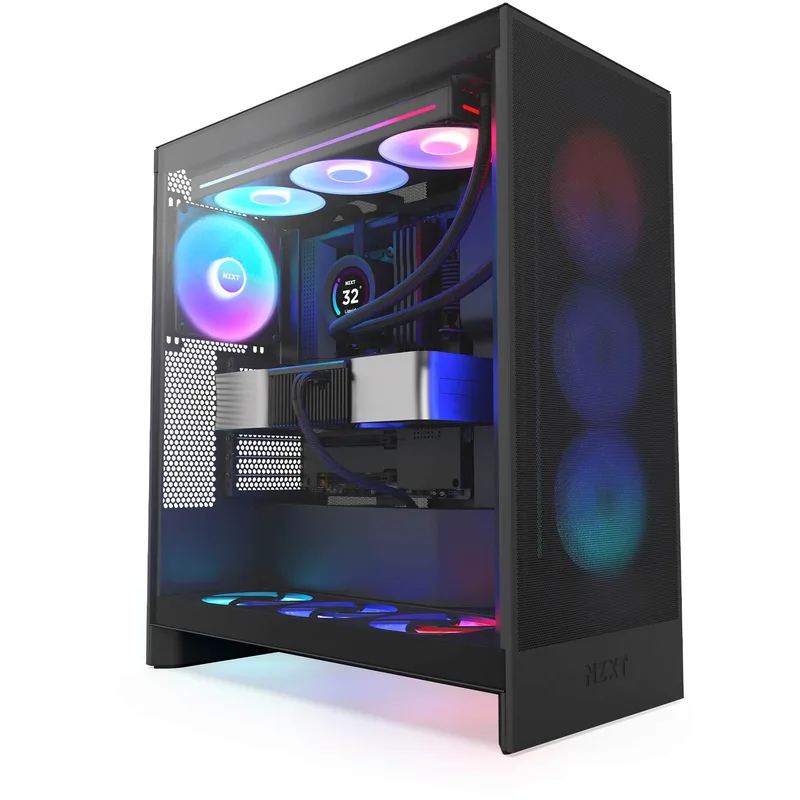
NZXT H7 Flow 2024
The NZXT H7 Flow 2026 is the most refined airflow case in NZXT’s lineup, addressing the H7 Flow’s original weakness: inadequate GPU cooling. The 2026 revision adds dedicated bottom fan mounts below the GPU chamber that push fresh air directly through the GPU heatsink fins, reducing GPU hotspot temps by 4–6°C compared to the original H7 Flow in NZXT’s own thermal validation data. For high-wattage cards like the RTX 4090 or RX 7900 XTX that throttle at hotspot rather than junction temperatures, those degrees translate to sustained boost clock performance.
The tool-free tempered glass side panel uses a single-button quick-release latch — the cleanest implementation in this roundup. One push releases the panel without magnets that lose grip over time or screws that strip. NZXT’s cable management system routes power cables through a purpose-built channel behind the motherboard tray, keeping the front chamber clean even with a non-modular PSU.
Three included 120mm fans are the value compromise at this price. At $100, the H7 Flow 2026 sits $15 above the Lancool 207 but ships with one fewer fan and narrower fan diameter. If you want to upgrade the front intake to 140mm (recommended for silent operation), that’s a $20–30 addition. The perforated front and top panels are clean enough for living room setups where other mesh cases look too industrial. For builders who want white colorways across any of these form factors, see our best white PC cases guide.
FAQ
Which case has the best airflow for gaming? The Fractal Design Torrent has the strongest thermal performance due to its 180mm floor fans targeting the GPU directly, but the Corsair 4000D RS Frame comes within 2–3°C at $89 less and fits in tighter spaces. For pure airflow in a standard mid-tower size, the 4000D RS Frame wins.
Do I need to buy extra fans for any of these cases? The Lancool 207 (4 fans) and Phanteks XT Pro Ultra (4 fans) and Fractal Design Torrent (5 fans) are complete out of the box. The Corsair 4000D RS Frame (3 fans) and NZXT H7 Flow 2026 (3 fans) benefit from adding two 140mm fans to the front if you’re cooling a 250W+ GPU — budget $20–40 extra.
Are these cases compatible with reverse-connector motherboards like ASUS BTF? The Corsair 4000D RS Frame is the only case here specifically designed for reverse-connector boards with pre-positioned cable cutouts. The Lian Li Lancool 207 fits BTF boards but requires routing cables through standard ATX cutouts, which works but doesn’t hide cables as cleanly.
What’s the minimum case for an RTX 5090 build? The Phanteks XT Pro Ultra at 435mm GPU clearance is the safest pick for any current flagship GPU. The Fractal Design Torrent at 461mm is more spacious. The Lian Li Lancool 207 at 375mm fits the RTX 5090 FE (approximately 340mm) but leaves limited margin.
Do airflow cases run louder than solid-panel cases? Mesh-front cases move more air at lower fan speeds, which typically results in quieter operation at equivalent thermal performance. At identical fan RPMs, mesh-front cases are slightly louder because sound escapes through the open grille — but in real use you’re spinning the fans slower, which more than offsets the difference. If eliminating noise is a top priority, see our how to build a silent PC guide for component selection and fan curve strategies focused on acoustics.
The Bottom Line
The Corsair 4000D RS Frame is the best all-around airflow case for standard mid-tower builds in 2026: it delivers measurably better thermals than its predecessor, handles reverse-connector motherboards natively, and the InfiniRail system makes radiator configuration genuinely flexible. For builders on a budget, the Lian Li Lancool 207 is the strongest value — four fans included, compact chassis, and triple-intake mesh that punches above its $85 price. If you’re building an E-ATX workstation or a system where GPU temperatures matter above everything else, the Fractal Design Torrent’s floor-mounted 180mm fans remain the most effective GPU cooling solution in a consumer case at any price.