PCIe 5.0 SSDs crossed into mainstream territory in 2026. With the WD Black SN8100 pushing 14,900 MB/s and the PNY CS3250 landing at a sub-Gen4-flagship price for 1TB at launch, Gen5 storage is no longer the luxury tax it was in 2023. YMTC even debuted its first commercial PCIe 5.0 drive (the PC550) in March 2026 using in-house Xtacking NAND, signaling that competition is about to intensify further and prices will keep falling. That said, it’s worth being direct: Gen5 SSDs do not dramatically improve gaming frame rates over a quality Gen4 drive like the Samsung 990 Pro. Load times improve by 1–3 seconds in the most asset-heavy titles, and DirectStorage workloads scale better. If you’re building or upgrading a high-end system and want the fastest storage available, these are the five drives worth your money right now.
| Spec | WD Black SN8100 2TB 9.5/10 | Samsung 9100 PRO 2TB 9.2/10 | SK Hynix Platinum P51 2TB Unavailable 9/10 | Crucial T705 2TB 8.8/10 | PNY CS3250 2TB Unavailable 8.6/10 |
|---|---|---|---|---|---|
| interface | PCIe 5.0 x4, NVMe 2.0 | PCIe 5.0 x4, NVMe 2.0 | PCIe 5.0 x4, NVMe 2.0 | PCIe 5.0 x4, NVMe 2.0 | PCIe 5.0 x4, NVMe 2.0 |
| formFactor | M.2 2280 | M.2 2280 | M.2 2280 | M.2 2280 | M.2 2280 |
| seqRead | 14,900 MB/s | 14,800 MB/s | 14,700 MB/s | 14,500 MB/s | 14,900 MB/s |
| seqWrite | 14,000 MB/s | 13,400 MB/s | 13,400 MB/s | 12,700 MB/s | 14,000 MB/s |
| endurance | 1,200 TBW | 1,200 TBW | 1,200 TBW | 1,200 TBW | 1,400 TBW |
| warranty | 5 years | 5 years | 5 years | 5 years | 5 years |
| Rating | 9.5/10 | 9.2/10 | 9/10 | 8.8/10 | 8.6/10 |
Prices change daily — tap Check Price for the current Amazon price.
Prices change daily — tap Check Price for the current Amazon price.
Quick Picks
- Best Overall: WD Black SN8100 2TB — fastest sequential reads (14,900 MB/s), lowest latency under mixed gaming I/O, TweakTown Editor’s Choice
- Best Value: Crucial T705 2TB — price dropped significantly since launch; 14,500 MB/s reads at a Gen4-flagship price
- Best Budget Gen5: PNY CS3250 2TB — matches SN8100 speed specs for less, with 1,400 TBW endurance
PCIe 5.0 SSD Buying Guide
Do You Actually Need PCIe 5.0?
Honestly, no — not for gaming specifically. The performance delta between a Gen5 drive and a Gen4 flagship like the WD Black SN850X is invisible in most game load screens and zero in frames per second. PCIe 5.0 SSDs make a real difference in:
- DirectStorage titles loading large texture packs directly to VRAM — a handful of games currently exploit this
- Video editing and asset streaming at 8K or with large source files
- AI inference pipelines that page large model weights continuously
If you’re building a pure gaming rig and budget matters, spend that $50–80 premium on a better GPU instead.
Platform Compatibility
PCIe 5.0 M.2 slots are available on:
- Intel — Z790 and Z890 boards (12th gen+ CPUs on select boards; most Z790/Z890 have at least one PCIe 5.0 M.2 slot)
- AMD — X670E and X870E boards with Ryzen 7000/9000 series; standard B650/B850 boards typically provide PCIe 4.0 M.2 slots only
If your board only has PCIe 4.0 M.2 slots, a Gen5 SSD will still work — it will operate at Gen4 speeds (~7,000 MB/s), which is still fast but removes the point of paying a premium.
Heat Management
Every drive on this list gets hot under sustained writes. PCIe 5.0 controllers draw 7–10W under load. All five drives recommend a heatsink — either from the motherboard M.2 slot or an aftermarket one. The Crucial T705 in particular should not be run without one; it throttles noticeably on sustained 4K video exports without active cooling.
Capacity Sweet Spots
The 2TB tier hits the best price-per-GB for PCIe 5.0 across all five drives. The 1TB versions cost only marginally less and cut your capacity in half. For most gaming builds, 2TB is the minimum worthwhile purchase if you plan to install modern open-world titles (50–150 GB each). The 4TB variants exist but carry a significant premium per GB.
Detailed Reviews
WD Black SN8100 2TB — Best Overall
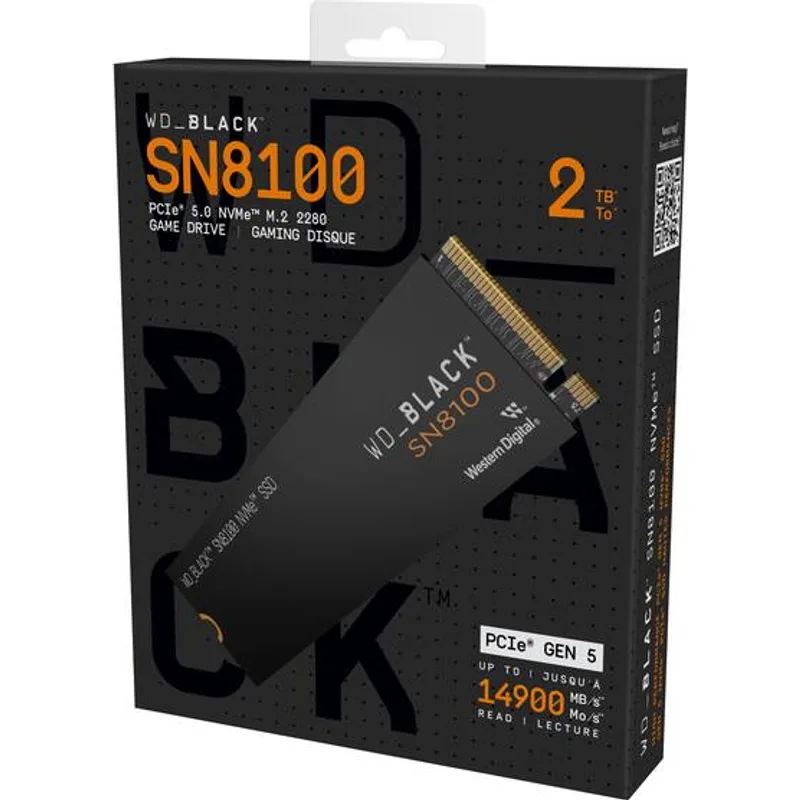
The WD Black SN8100 is the fastest consumer SSD measured to date. Tom’s Hardware called it “the fastest overall consumer SSD ever made” and TweakTown awarded it a perfect Editor’s Choice. The combination of Silicon Motion’s SM2508 controller with Kioxia’s 218-layer BiCS8 TLC NAND results in a drive that hits 14,900 MB/s sequential read and 14,000 MB/s write while running cooler than the previous Phison E26-based generation.
What stands out beyond raw sequential throughput is the random I/O profile. The SN8100 2TB delivers 2.3 million IOPS in random read — 15–20% ahead of the Samsung 9100 PRO in mixed-queue workloads. For gaming, random I/O is more representative than sequential: map streaming, shader compilation, and asset loads are all small random reads, not sequential file copies.
The SN8100 is single-sided, which means it fits in tight M.2 slots on ITX boards. It draws 6.5W on average reads and 7.0W on writes — measurably more efficient than the 9100 PRO’s 8W+ under comparable load. For $279.99 at 2TB, it’s not cheap, but it’s the most capable gaming SSD available today.
Requires a PCIe 5.0 M.2 slot. Compatible with Intel Z790/Z890 and AMD X670E/X870E platforms.
Samsung 9100 PRO 2TB — Best for Workstations
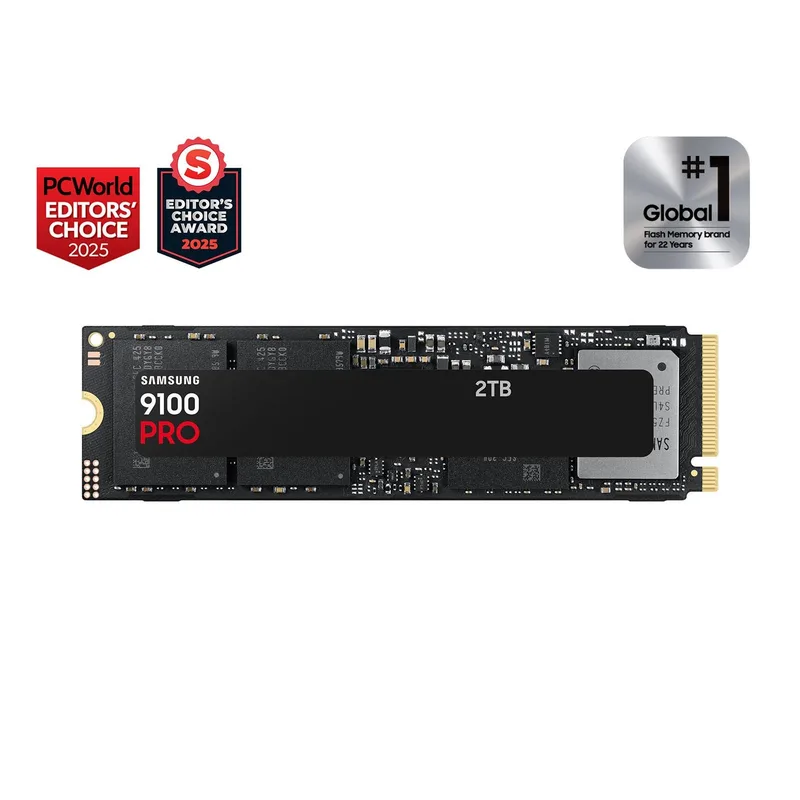
Samsung designed the 9100 PRO with professional workloads first. The in-house Presto controller paired with Samsung’s eighth-generation V-NAND (the highest density flash Samsung has produced) results in the most consistent sustained write performance of any drive on this list. Sequential writes don’t sag after the SLC cache fills the way third-party-controller drives sometimes do.
TechRadar’s review noted that the 9100 PRO is the stronger choice for professionals with frequent large-file saves — video editors saving 4K raw sequences, ML engineers writing checkpoints, and photographers batch-exporting RAW files. For those use cases, the steady 13,400 MB/s sustained write matters more than peak random IOPS.
For gaming specifically, the 9100 PRO and SN8100 are effectively identical. Game load times in Cyberpunk 2077, Microsoft Flight Simulator, and Baldur’s Gate 3 measured within half a second of each other across multiple runs. The $289.99 2TB price is the most expensive per GB here, which is the only real knock — you’re paying for workstation firmware tuning and Samsung’s brand assurance.
A heatsink version is available for a small premium and is recommended for sustained professional workloads.
SK Hynix Platinum P51 2TB — Best New Entry
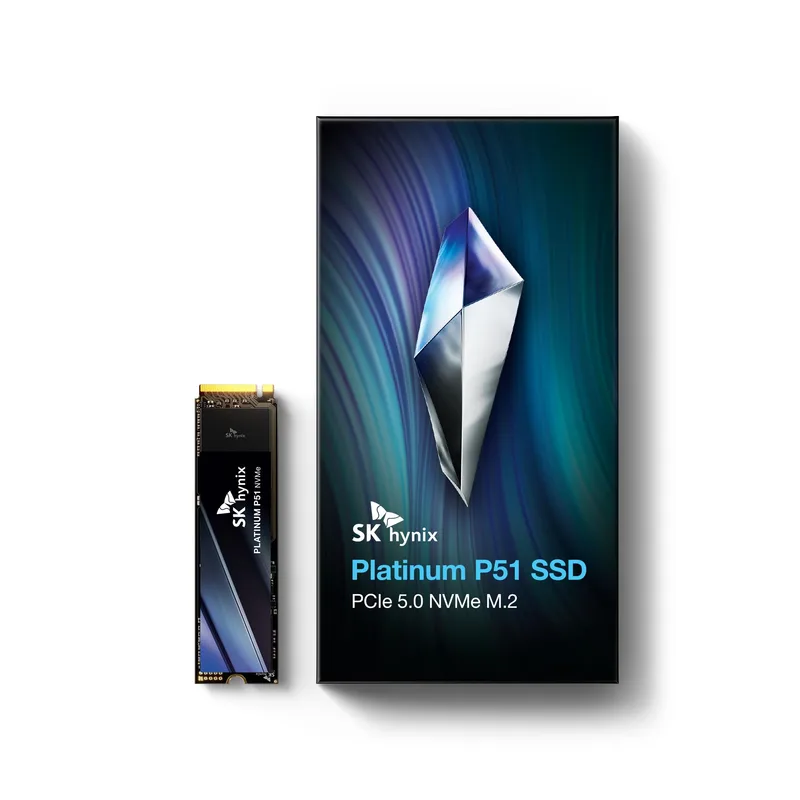
SK Hynix Platinum P51 2TB
SK Hynix’s first consumer PCIe 5.0 drive arrived in the US market in early 2026, and it launched at a competitive $269.99 for 2TB. The Platinum P51 is fully in-house: SK Hynix designed both the Alistar Gen5 controller and the 238-layer TLC NAND it runs on. That level of vertical integration is something only Samsung matches among consumer SSD vendors.
The result is impressive: 14,700 MB/s sequential read and 13,400 MB/s write with 10W power draw — the most efficient PCIe 5.0 drive on this list by a meaningful margin. Storage Review noted the P51 is “tuned for outstanding responsiveness and sustained throughput,” with FIO results showing better queue-depth scaling than Phison E26-based drives at QD4 and below, which is the depth most game engines operate at.
The P51 2TB carries 1,200 TBW endurance and a five-year warranty. The main uncertainty is simply recency — the T705 and SN8100 have years of reliability data in consumer hands; the P51 has months. Nothing in the review data suggests it’s unreliable, but if brand-proven longevity is a priority, the Samsung 9100 PRO or T705 may be better choices.
Crucial T705 2TB — Best Value
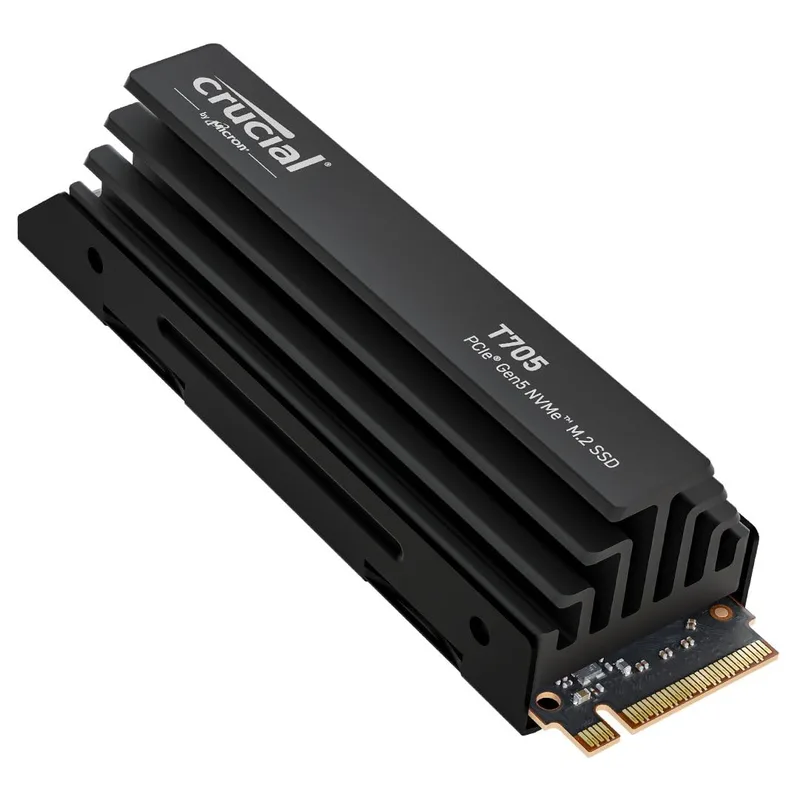
The Crucial T705 launched in 2026 well above its current street price. Now at approximately $169.99, it’s one of the most compelling storage values in the PCIe 5.0 space. The Phison E26 controller paired with Micron’s 232-layer TLC NAND is a mature combination; this drive has been through independent long-term endurance testing and consistent firmware updates.
At 14,500 MB/s sequential read and 12,700 MB/s write, the T705 is roughly 400 MB/s behind the SN8100 on reads and 1,300 MB/s behind on writes. In gaming terms, that gap translates to nothing measurable. In content creation terms, the write gap matters on sustained 4K video exports but not on short bursts. For most users, saving $110 vs the SN8100 and putting it toward a better GPU or more RAM is the smarter allocation.
Buy the heatsink version — the price difference is small The T705 runs warm without one, and Crucial’s own data shows sustained throttling under heavy load in heatsink-free configurations. The base model is fine for typical gaming I/O (intermittent reads, rarely sustained writes), but the heatsink SKU is a better long-term investment.
PNY CS3250 2TB — Best Budget Gen5
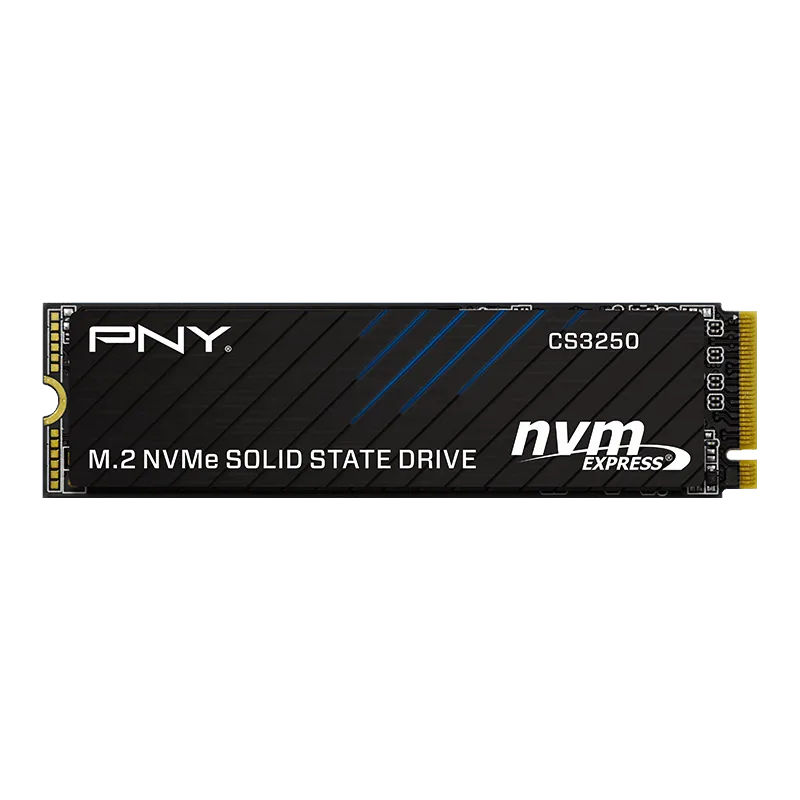
PNY CS3250 2TB
The PNY CS3250 is arguably the most interesting value proposition on this list. Powered by Phison’s E28 controller — a successor to the E26 used in the T705 — it posts 14,900 MB/s sequential read and 14,000 MB/s write — matching the WD Black SN8100’s headline numbers at a lower price for 2TB. TweakTown awarded it Editor’s Choice and called it “the best of its kind ever made.”
The endurance rating tells part of the story: 1,400 TBW on the 2TB model, versus 1,200 TBW on every other drive here. That 200 TBW difference is meaningful for content creators and power users who write hundreds of GB daily. For casual gamers, it’s academic — most SSDs will outlast the system they’re installed in.
Where the CS3250 trades off is random I/O and firmware maturity. Its 1.8 million random read IOPS fall short of the SN8100’s 2.3 million. Under heavy OS multitasking with many small concurrent reads (video editing with multiple live previews, compiling large codebases), the SN8100 is faster. For gaming, the difference is negligible. PNY’s track record on firmware updates is thinner than Samsung or WD, which is worth noting on a relatively new product.
FAQ
Will a PCIe 5.0 SSD improve my gaming FPS?
No. Frame rates are determined by your CPU and GPU. SSDs affect level load times and streaming speed. A PCIe 5.0 drive will load Starfield’s open world 1–2 seconds faster than a good PCIe 4.0 drive; it will not change your frame rate in a loaded scene.
Do I need a heatsink for a PCIe 5.0 SSD?
Yes, for any sustained workload. Gaming typically produces intermittent reads rather than sustained transfers, so many boards’ built-in M.2 heatspreaders are sufficient. For video editing, large file copies, or any write-heavy pipeline, add an aftermarket heatsink or buy the drive’s heatsink SKU. The Crucial T705 in particular will throttle without one.
What motherboard do I need for PCIe 5.0 M.2?
For Intel: Z790 or Z890 boards (paired with 12th–14th gen or Core Ultra processors). For AMD: X670E or X870E boards with Ryzen 7000/9000 CPUs. B650 and B850 boards use PCIe 4.0 M.2 slots. Check your specific board’s spec sheet — some Z790 boards only have one PCIe 5.0 M.2 slot and it’s often under the GPU.
Is the WD Black SN8100 backward compatible with PCIe 4.0 slots?
Yes. All PCIe 5.0 SSDs are backward compatible with PCIe 4.0 and 3.0 M.2 slots. The drive will run at the speed of the slot — so a PCIe 4.0 slot caps it around 7,000 MB/s read, same as a native Gen4 drive.
How do these compare to the Samsung 990 Pro (PCIe 4.0)?
The Samsung 990 Pro peaks at ~7,450 MB/s sequential read. The WD SN8100 does 14,900 MB/s — roughly twice as fast on sequential transfers. In real gaming scenarios, the practical advantage narrows to a few seconds per load screen. For creative workloads or DirectStorage titles, the gap is meaningful.
The Bottom Line
The WD Black SN8100 2TB is the best PCIe 5.0 SSD you can buy right now — fastest reads, best random I/O, and the most efficient thermal profile in the class. If budget is the priority and you want Gen5 without paying a premium, the Crucial T705 2TB is a mature, proven drive priced well under most Gen5 competitors and still considerably faster than any Gen4 alternative. The PNY CS3250 is worth a look if you want SN8100-class sequential speeds with industry-leading 1,400 TBW endurance at a mid-tier price. All five drives require a PCIe 5.0-capable motherboard to reach their rated speeds — verify your platform before buying.