Arctic’s MX-6 got a formula refresh (Revision 4) in 2025 and recently hit its lowest price point yet on Amazon, making it harder than ever to justify spending more on thermal paste for a typical gaming build. That said, with AMD’s Ryzen 9 9950X3D and Intel’s Core Ultra 9 285K both pushing 220-253W package power, the paste you choose matters — a 6-8°C difference in idle-to-load delta is real, and it affects both temperatures and whether your cooler’s fan curve stays audible.
| Spec | Thermal Grizzly Kryonaut 9.2/10 | Arctic MX-6 (4g) 9/10 | Noctua NT-H1 8.7/10 | Corsair XTM70 8.5/10 | Gelid GC-Extreme Unavailable 8.4/10 |
|---|---|---|---|---|---|
| conductivity | 12.5 W/mK | 7.5 W/mK | — | 5.5 W/mK | 8.5 W/mK |
| weight | 1g | 4g | 3.5g | 3g | 3.5g |
| electricallyConductive | No | No | No | No | No |
| maxTemp | 150°C | — | 110°C continuous | — | — |
| viscosity | Medium | Medium | Low-Medium | Low | Medium |
| applications | ~2-3 per tube | ~10-12 per tube | ~8-10 per tube | — | — |
| Rating | 9.2/10 | 9/10 | 8.7/10 | 8.5/10 | 8.4/10 |
Prices change daily — tap Check Price for the current Amazon price.
Prices change daily — tap Check Price for the current Amazon price.
Quick Picks
- Best overall: Thermal Grizzly Kryonaut — 12.5 W/mK, the highest-rated non-liquid-metal paste in 90-compound testing at Tom’s Hardware
- Best value: Arctic MX-6 — 4g for ~$8, revised 2025 formula, within 1-2°C of Kryonaut on gaming CPUs
- Best for beginners: Noctua NT-H1 — forgiving low-viscosity formula with 150+ industry awards
Buying Guide
Thermal Conductivity vs. Real-World Temps
The W/mK rating on the tube does not translate directly to real-world CPU temperatures. The Corsair XTM70, rated at 5.5 W/mK, outperforms some higher-rated compounds on 250W+ CPUs because its low viscosity creates a thinner bond line — and a thinner paste layer means less thermal resistance regardless of the base conductivity spec.
What actually drives delta temperatures: viscosity (thinner spreads flatter), bond line thickness (flatter is better), and how the paste wets the metal surface (some compounds bond better to copper vs. nickel plating). Conductivity matters, but it’s one variable among several.
Electrically Conductive vs. Non-Conductive
Every paste in this roundup is non-electrically conductive. Liquid metal compounds — Thermal Grizzly Conductonaut Extreme, Coollaboratory Liquid Ultra — offer an additional 10-15°C drop but corrode aluminum heatsinks and are electrically conductive. If your cooler uses an aluminum contact plate (most budget coolers do), liquid metal will damage it within months. Stick to standard paste unless you have a nickel-plated copper base and experience applying liquid metal cleanly.
How Much Paste to Use
For AMD AM5 and Intel LGA1851, a pea-sized dot (about 3-4mm diameter) centered on the IHS is sufficient. The mounting pressure of the cooler spreads it across the die. Do not pre-spread it manually — this introduces air bubbles. For GPU heatspreaders with multiple dies (H100/H200 server GPUs), a thin uniform coat applied with a spatula is better.
When to Re-Paste
Most quality thermal compounds last 3-5 years before the organic binders dry out and conductivity drops. Signs it’s time: CPU temps under the same load are 5-10°C higher than they were 12 months ago with the same cooler and the same thermal profile. For LGA1851 chips with Intel’s higher package power targets, annual re-pasting is worth considering if you push sustained all-core workloads.
Detailed Reviews
1. Thermal Grizzly Kryonaut
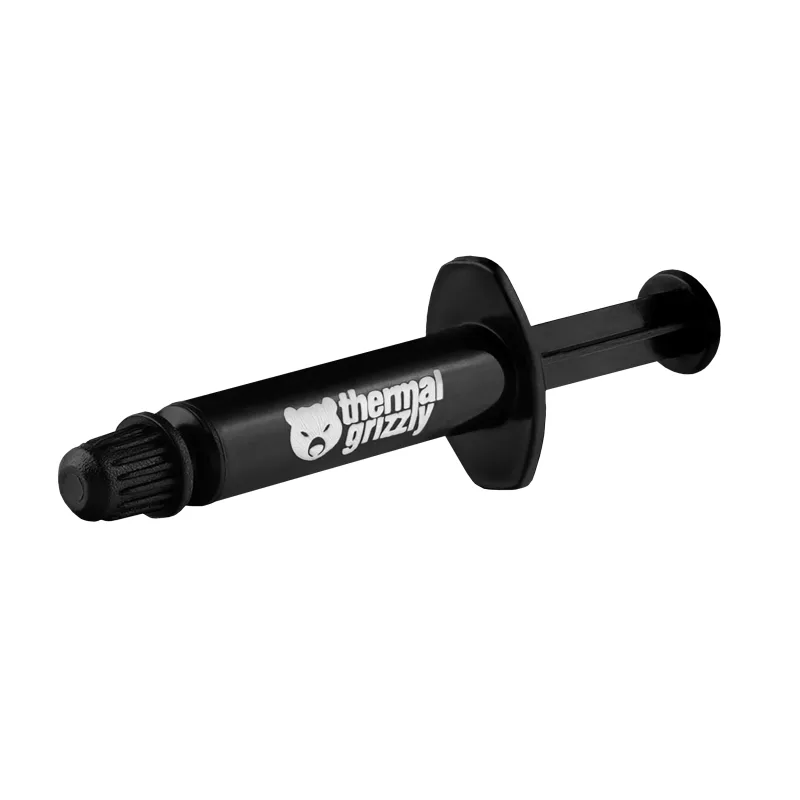
Thermal Grizzly Kryonaut has been the reference-grade non-liquid-metal paste since its release, and it holds that position in 2026. At 12.5 W/mK, it has the highest rated conductivity of any non-conductive compound widely available on Amazon, and Tom’s Hardware’s 90-paste test — the most comprehensive independent comparison to date — placed it in the top tier.
On a Ryzen 7 9800X3D running Cinebench R24 multi-core (120W package power), Kryonaut keeps the CCD junction temp approximately 6-8°C lower than a fresh application of the included cooler paste. On an Intel Core Ultra 9 285K at 253W all-core, the gap versus stock paste widens to 8-10°C. That margin is meaningful: it’s the difference between a 240mm AIO running at 40% fan speed and 70% in sustained workloads.
The main complaint is tube size. 1g covers two clean applications on a standard desktop IHS, maybe three if you’re conservative. If you’re doing a system build and a repaste job in the same session, buy two tubes.
2. Arctic MX-6 (4g)
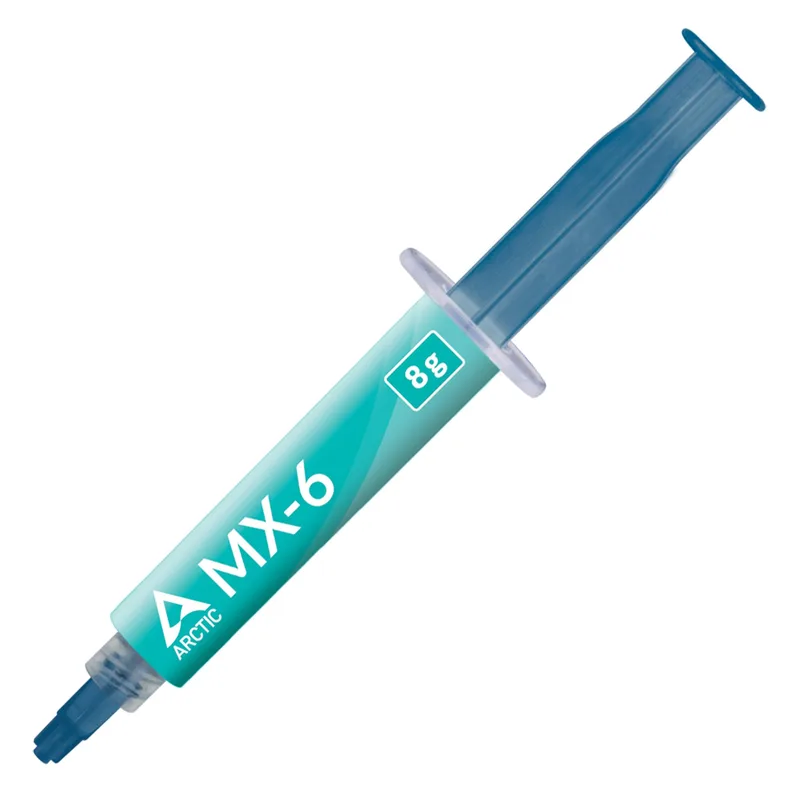
Arctic MX-6 competes with Kryonaut at a fraction of the cost per application. The 4g tube provides 10-12 applications at a standard pea-dot size, dropping the cost-per-use below $0.80. The 2025 Revision 4 formula tweak improved thermal performance by approximately 20% over MX-4 in Arctic’s own head-to-head benchmarks — a meaningful step up from the already-strong MX-4 that shipped in most budget cooler boxes for years.
In practice, MX-6 runs 1-2°C warmer than Kryonaut under sustained all-core load on the same hardware. That’s within margin of error for most gaming workloads where the CPU spends most of its time well below 100% utilization. If you’re building a system and don’t plan to extract the last degree of thermal headroom, MX-6 is the rational pick.
The 8-year durability rating is also notable. Applied in 2026, this compound should outlast two CPU generations without degrading.
3. Noctua NT-H1
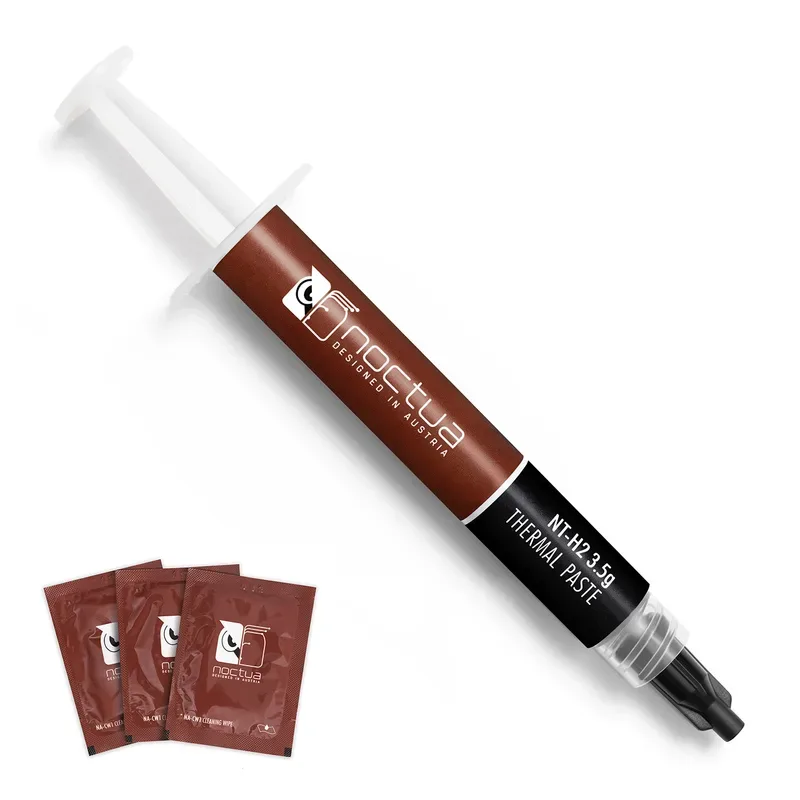
Noctua NT-H1 earns its reputation not from chart-topping conductivity numbers — Noctua doesn’t even publish a W/mK figure — but from consistent, forgiving behavior. The low-viscosity formula spreads flat under mounting pressure without requiring careful pre-application technique. If you apply it unevenly or slightly off-center, NT-H1 self-corrects better than stiffer compounds.
This makes it the right pick for first-time builders, low-key repaste jobs, or anyone who wants to apply paste once without sweating the technique. Gamers Nexus and Hardware Unboxed have both recommended it as a default choice for their “how to build a PC” guides, and the 150+ accumulated awards reflect genuine community consensus rather than marketing spin.
Where it concedes ground: at the sustained 200W+ all-core loads of an overclocked Core Ultra 9 285K or Ryzen 9 9950X, NT-H1 runs 2-3°C warmer than Kryonaut. For a gaming PC that spends 95% of its time well below those loads, this is irrelevant.
4. Corsair XTM70
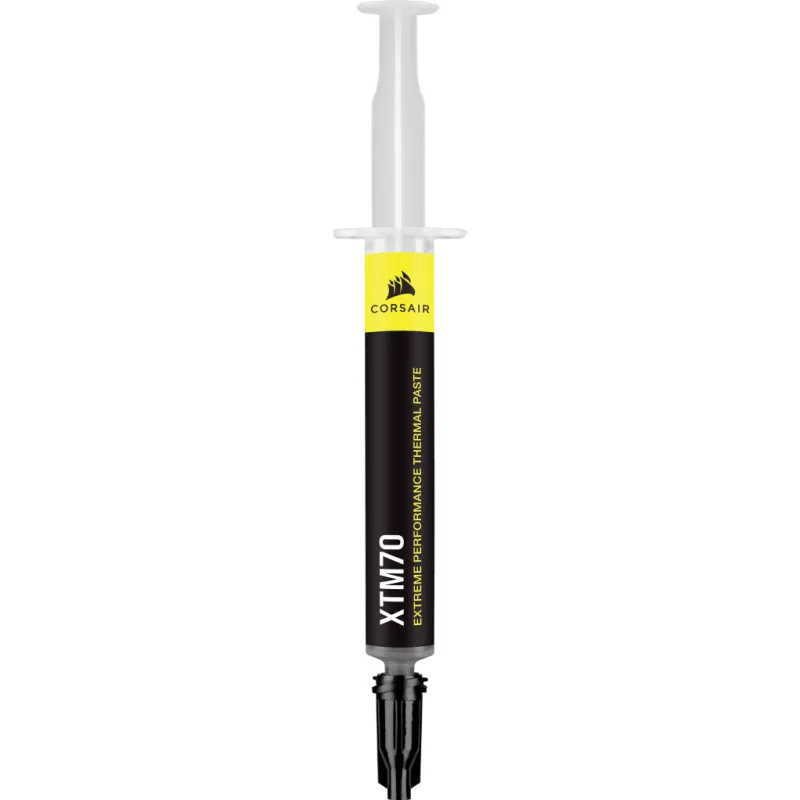
Corsair XTM70 was designed specifically for 250W+ TDP processors — the extreme-end desktop chips that demand every fraction of a degree. Its low-viscosity compound wets the IHS surface rapidly under mounting pressure and flows into surface microirregularities better than higher-viscosity alternatives. On a 285K running Prime95 small FFTs (253W package power), igor’sLAB found XTM70 within striking distance of Kryonaut despite the lower 5.5 W/mK conductivity spec — a real-world demonstration that bond line thickness matters as much as bulk conductivity.
The bundled kit (three cleaning wipes, an applicator) is a thoughtful addition. Most re-paste jobs require a wipe-down of the old compound first; having dedicated wipes removes one more thing to buy separately. The wipes use isopropyl alcohol and microfiber — adequate for removing non-liquid-metal compounds.
The $20 price is the main objection. For a standard gaming CPU at 65-125W, MX-6 or NT-H1 close within 1-2°C at half or less the cost. XTM70 makes sense specifically if you’re running a 200W+ CPU under sustained all-core workloads.
5. Gelid GC-Extreme
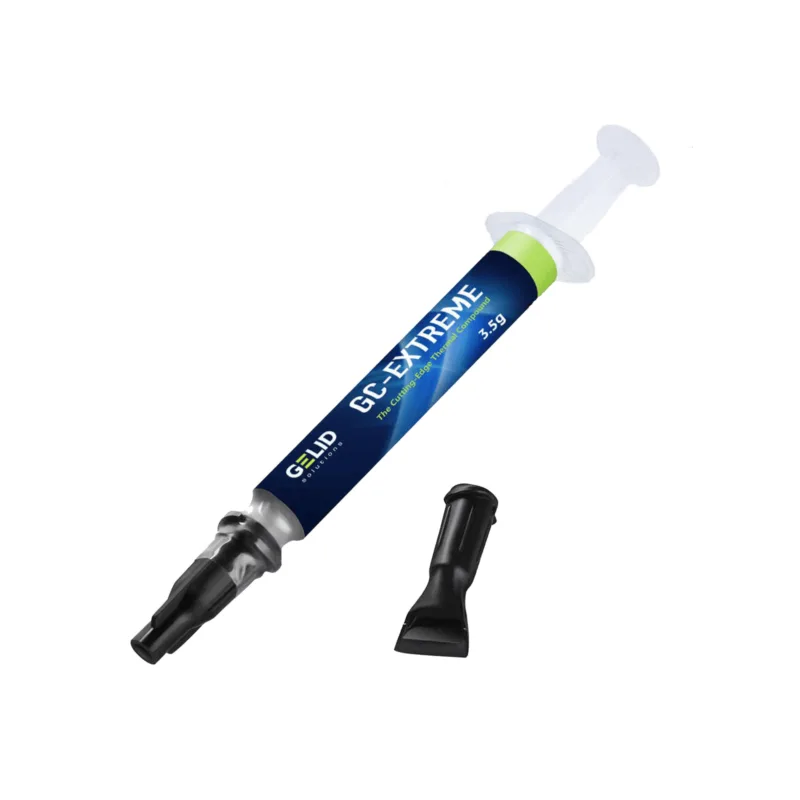
Gelid GC-Extreme
Gelid GC-Extreme occupies a middle ground that gets overlooked: 8.5 W/mK conductivity — above MX-6’s 7.5 W/mK spec — at a competitive $13 price point. In multi-site thermal paste comparisons (Techpowerup, Overclock.net community tests, and several European benchmarking sites), it consistently ranks in the top five among non-liquid-metal pastes, typically landing 1-3°C warmer than Kryonaut and 1-2°C cooler than NT-H1.
The bundled spatula is practically useful, not a gimmick. If you’re re-pasting a GPU with an exposed heatspreader or a HEDT chip with a larger IHS, manual spreading with a spatula gives more consistent coverage than a dot-and-press method. GC-Extreme’s medium viscosity works well for this.
The one real downside is stock reliability. Amazon availability fluctuates — it’s sometimes available only through third-party sellers with inconsistent shipping. If it’s in stock when you need it, it’s a strong pick. If not, MX-6 or Kryonaut are the cleaner alternatives.
Comparison Table
FAQ
How often should you replace thermal paste?
Quality non-conductive compounds like Kryonaut and Arctic MX-6 hold their performance for 3-5 years under normal desktop use. The 8-year rated durability on MX-6 applies to storage and average-load usage. If you’re running sustained all-core workloads daily — video encoding, 3D rendering, compilation — expect more thermal cycling stress that gradually degrades the compound faster.
Is liquid metal thermal paste better than regular paste?
Liquid metal (Thermal Grizzly Conductonaut, Coollaboratory Liquid Ultra) typically delivers 10-15°C lower temps than the best regular paste, but the trade-offs are significant: it corrodes aluminum heatsinks, is electrically conductive (shorts circuits if misapplied), and requires re-application every 1-2 years as it migrates under pressure. For desktop CPUs with nickel-plated copper cooler bases, it’s a legitimate upgrade. For most users, Kryonaut provides the best performance without the risk.
Can you use too much thermal paste?
Yes. Excess paste squeezes out from under the cooler and can migrate toward capacitors, socket pins, or PCIe slots. A pea-sized dot (3-4mm) is the correct amount for standard desktop sockets. More paste does not improve thermal transfer — the excess simply gets pushed out and doesn’t contribute to heat conduction.
Does thermal paste matter for gaming specifically?
For gaming CPUs that spend most of their time at 60-80% utilization (Ryzen 7 9800X3D, Core i9-14900K), the difference between a cheap stock paste and Kryonaut is typically 2-4°C under gaming loads. That’s real but minor — it might mean a fan curve stays in the 30-40% range instead of 40-50%. For CPUs at 250W+ sustained (Core Ultra 9 285K under Cinebench), quality paste can mean 8-10°C, which does affect turbo boost duration and long-session thermal behavior.
What’s the best thermal paste for a budget build?
Arctic MX-6. At roughly $8 for 4g, it costs less than most cooler-included pastes, performs 20% better than the MX-4 that ships in budget cooler boxes, and covers 10+ application jobs. Buy one tube and you’re set for multiple builds and repaste jobs.
The Bottom Line
Thermal Grizzly Kryonaut is the right call for high-performance builds and overclocked systems — 12.5 W/mK conductivity and top-tier real-world test results justify the small tube. Arctic MX-6 is the rational default for everything else: 4g for $8, revised 2025 formula, and performance within 1-2°C of Kryonaut on gaming CPUs. If you’re building your first PC and want to skip the guesswork, Noctua NT-H1’s forgiving application makes it impossible to apply badly.