The Kingston Fury Renegade G5 launched in late 2025 with Silicon Motion’s SM2508 controller and Kioxia’s BiCS8 NAND — directly targeting the Crucial T705 that had held the Gen5 value crown since 2024. With NAND prices up significantly from 2025 lows due to AI-driven demand, both drives now cost more than they did at launch, making the choice between them more consequential. Here’s how they stack up, including the Samsung 9100 Pro as the surprise value option and the original Renegade Gen4 for buyers who don’t need PCIe 5.
| Spec | Crucial T705 1TB PCIe Gen5 NVMe SSD 9/10 | Kingston Fury Renegade G5 1TB PCIe Gen5 NVMe SSD 8.7/10 | Samsung 9100 Pro 1TB PCIe Gen5 NVMe SSD 8.9/10 | WD Black SN8100 1TB PCIe Gen5 NVMe SSD 8.6/10 | Kingston FURY Renegade 1TB PCIe Gen4 NVMe SSD Unavailable 8.3/10 |
|---|---|---|---|---|---|
| Interface | PCIe 5.0 x4, NVMe 2.0 | PCIe 5.0 x4, NVMe 2.0 | PCIe 5.0 x4, NVMe 2.0 | PCIe 5.0 x4, NVMe 2.0 | PCIe 4.0 x4, NVMe 1.4 |
| Sequential Read | 13,600 MB/s | 14,800 MB/s | 14,700 MB/s | 14,900 MB/s | 7,300 MB/s |
| Sequential Write | 10,000 MB/s | 14,000 MB/s | 11,600 MB/s | 11,000 MB/s | 7,000 MB/s |
| Random Read IOPS | 1,500K | 2,000K | 1,850K | 1,600K | 900K |
| Random Write IOPS | 1,500K | 2,200K | 2,600K | 1,600K | 1,000K |
| Endurance | 600 TBW | 700 TBW | 600 TBW | 600 TBW | 600 TBW |
| Warranty | 5 years | 5 years | 5 years | 5 years | 5 years |
| Rating | 9/10 | 8.7/10 | 8.9/10 | 8.6/10 | 8.3/10 |
Prices change daily — tap Check Price for the current Amazon price.
Prices change daily — tap Check Price for the current Amazon price.
Quick Picks
- Best random IOPS and proven platform: Crucial T705 1TB — Phison E26 still leads in low-queue-depth random access; best for virtualization, databases, and mixed workloads
- Best sequential throughput for the price: Kingston Fury Renegade G5 1TB — 14,800 MB/s reads and cooler-running SM2508 at $49 less than the T705
- Best value Gen5: Samsung 9100 Pro 1TB — $199 for Gen5 speeds that now beat the Samsung 990 Pro Gen4 on both performance and price
Gen5 NVMe Buying Guide
Do You Actually Need PCIe 5?
For gaming alone, no. Independent benchmark comparisons show Gen4 drives like the Kingston Fury Renegade loading games within 1–3 seconds of any Gen5 drive. The PCIe 5 bandwidth advantage is real in sustained sequential transfers — moving large video files, loading AI models, or running DirectStorage-enabled games with next-gen asset streaming. If your workload is primarily gaming, the $139 Gen4 Renegade is rational.
If you edit video, run local LLMs, or build in resolutions where DirectStorage matters, the $60 step to Gen5 pays off in file transfer speeds you’ll notice daily.
PCIe 5 Slot Requirements
All five drives in this comparison use M.2 2280 form factor. Gen5 drives (the T705, Renegade G5, 9100 Pro, and SN8100) require a PCIe 5.0 x4 M.2 slot to reach rated speed. Check your motherboard specs — Intel 12th Gen and earlier, and AMD Ryzen 5000 and earlier, do not have PCIe 5 M.2 slots. On those platforms, Gen5 drives run at Gen4 speeds, making the Gen4 Renegade the better purchase.
Thermal Considerations
Every Gen5 drive generates significantly more heat than Gen4 under sustained load. Manufacturer specs rate both the T705 and Renegade G5 for continuous operation, but without a heatsink — either an aftermarket one or the integrated heatsink variant — sequential write speeds will drop within 60–90 seconds on most board configurations. Most Z790 and X870 motherboards include M.2 thermal pads or heatsink covers; use them.
Sequential vs. Random — Which Matters for Your Use Case
The T705 and Renegade G5 diverge on this axis. The Renegade G5’s SM2508 controller prioritizes sequential throughput — ideal for video editing, large file transfers, and workloads that issue long queues of sequential requests. The T705’s Phison E26 is stronger in random IOPS at low queue depths, which matters for OS responsiveness, boot times, and workloads like compiling large codebases or running many small database transactions simultaneously.
For most buyers, the difference is invisible in day-to-day use. But if you’re choosing between them specifically for a workstation, match the drive to your workload type.
Crucial T705 1TB — Best Random IOPS
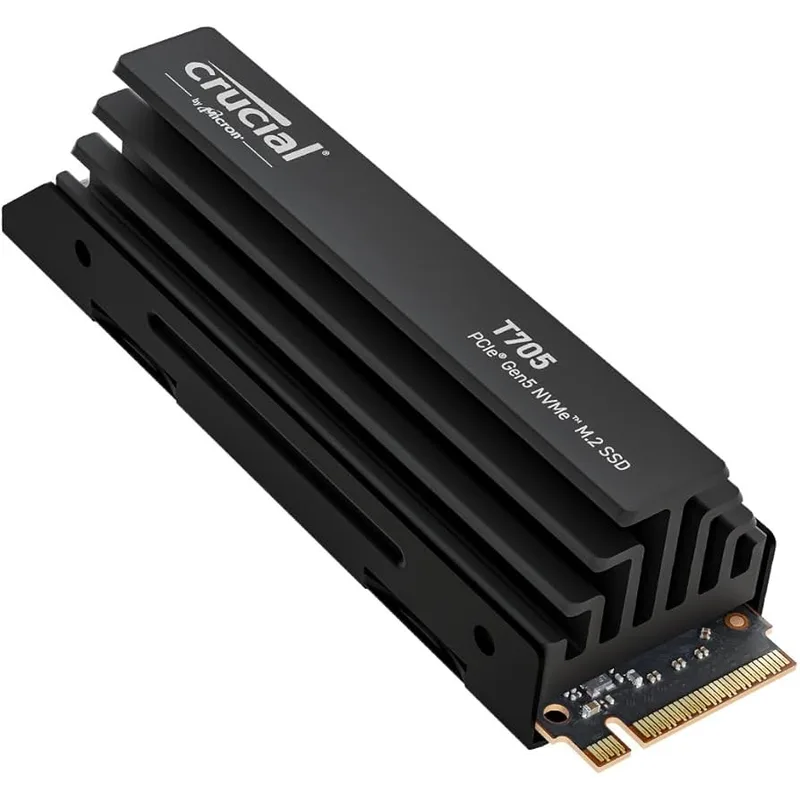
The T705 arrived in 2026 as the Phison E26’s showcase product, and it remains the leader for random IOPS in the 1TB tier. At 1,500K random read IOPS according to manufacturer specs, and measured at up to 2.7M IOPS in the 2TB configuration per independent storage reviews, the E26 platform handles mixed small-block workloads better than any current Gen5 competitor.
The real-world tradeoff is sequential speed. At 13,600 MB/s sequential read, the T705 1TB trails the Renegade G5 by 1,200 MB/s — a gap that matters in video production, AI inferencing, and large archive operations, but disappears entirely in gaming and standard desktop use.
At $248, the T705 is the most expensive option in this comparison after NAND price increases. For buyers who need the best random IOPS available in a Gen5 drive, it still earns its price. For sequential-heavy workloads, the Renegade G5 delivers more performance per dollar.
Best for: Workstations running virtualization, developers compiling large projects, OS drives where responsiveness matters
Kingston Fury Renegade G5 1TB — Best Sequential Speed
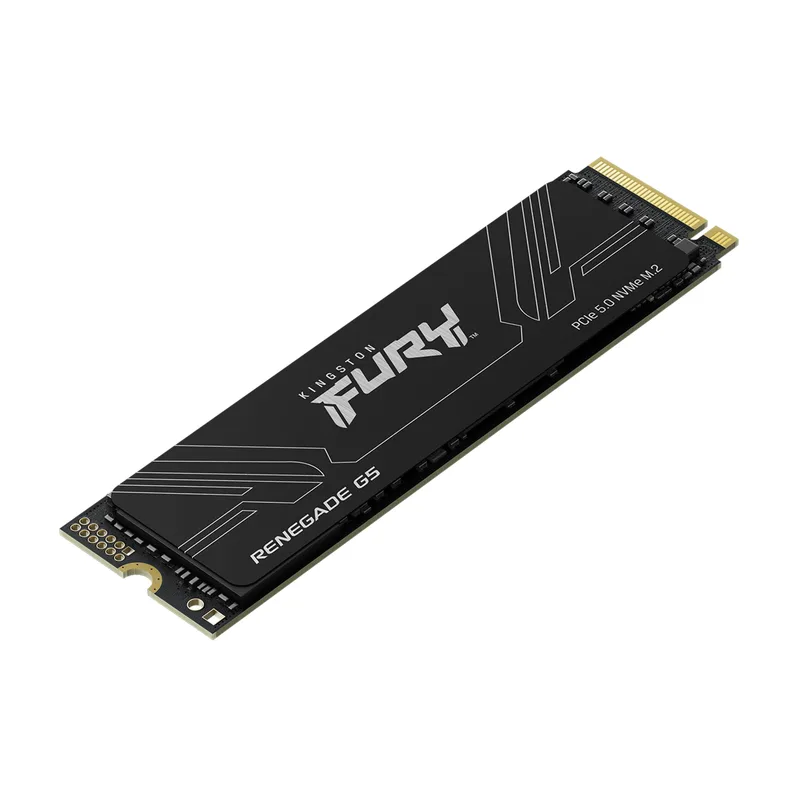
Kingston Fury Renegade G5 1TB PCIe Gen5 NVMe SSD
The Fury Renegade G5 is Kingston’s first Gen5 drive, built on Silicon Motion’s SM2508 controller with Kioxia’s BiCS8 3D TLC NAND. The SM2508’s 6nm fabrication process is the key differentiator: it generates less heat than the Phison E26, which means sustained sequential performance stays higher before throttling kicks in.
StorageReview’s benchmark data places the Renegade G5 at 5,670 on 3DMark Storage — 11% above the T705’s 5,100 — with peak Blackmagic write speed of 10,831 MB/s, the highest of any drive in that comparison. At 14,800 MB/s sequential read, it matches or exceeds every competitor except the WD SN8100’s 14,900 MB/s.
The concession is random IOPS: at low queue depths, the SM2508 trails the Phison E26’s random access performance. Owner reports and independent reviews confirm this shows up in boot time measurements and OS responsiveness benchmarks, though the margin is small enough to be irrelevant for most users.
At $199, the Renegade G5 undercuts the T705 by $49 while exceeding it in sequential throughput. It’s the better buy for content creators and anyone moving large files regularly.
Best for: Video editors, large file transfers, DirectStorage workloads, users who prioritize sequential throughput over random IOPS
Samsung 9100 Pro 1TB — Best Value Gen5
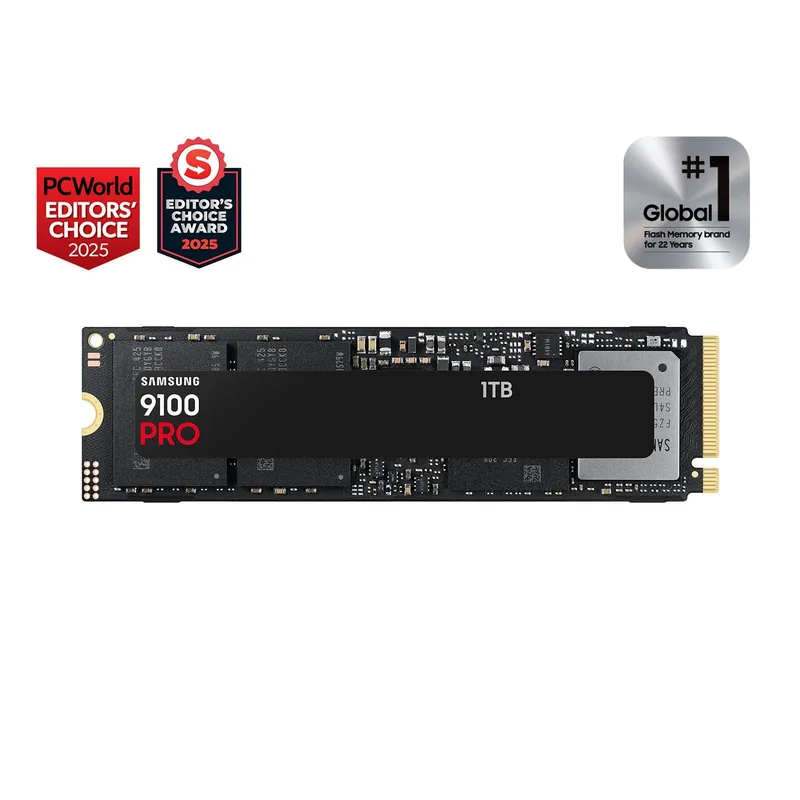
The most surprising story in Gen5 storage in 2026 is the Samsung 9100 Pro. Thanks to Samsung’s V8 NAND efficiency advantages, the 9100 Pro currently sells for $199 — meaning Samsung’s Gen5 drive is now cheaper than Samsung’s own Gen4 flagship, the 990 Pro, which is at $330 due to NAND shortage dynamics affecting older NAND processes.
Performance-wise, the 9100 Pro’s 14,700 MB/s sequential read is competitive with the Renegade G5 and faster than the T705. Its standout metric is random write IOPS: manufacturer specs list 2,600K random write IOPS, which leads the entire Gen5 comparison group and shows up in write-intensive scenarios like video editing timeline saves and database writes.
The tradeoff is sequential write — at 11,600 MB/s, it trails the Renegade G5’s 14,000 MB/s considerably on sustained sequential write benchmarks. Samsung Magician software adds toolbox functionality that Kingston and Crucial lack: drive health monitoring, benchmark history, and secure erase, all without needing third-party software.
At $199, the 9100 Pro competes directly with the Renegade G5 on price while offering different performance characteristics. Buyers optimizing for random write IOPS should choose it; those prioritizing sequential write throughput should choose the Renegade G5.
Best for: Mixed workloads, buyers who want Samsung’s ecosystem, write-heavy workflows
WD Black SN8100 1TB — Fastest Sequential Read
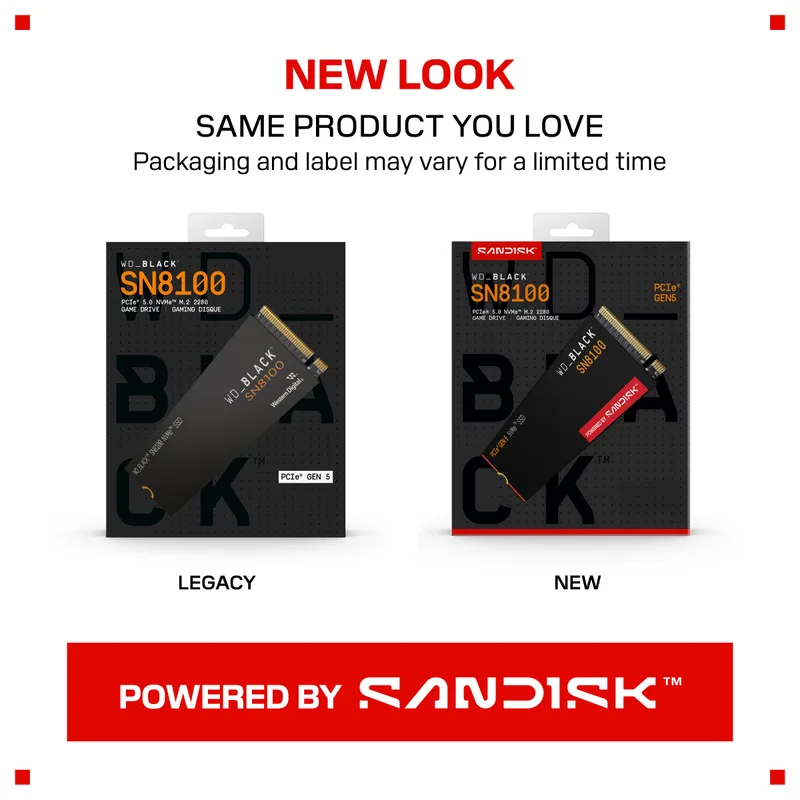
The WD Black SN8100 uses SanDisk’s customized implementation of the SM2508 controller, tuned differently from Kingston’s Renegade G5 despite sharing controller silicon. The result is the highest sequential read speed of any drive reviewed here: 14,900 MB/s — and the best 3DMark Storage score at 6,047, ahead of the Renegade G5’s 5,670 and T705’s 5,100.
The SN8100 also outperforms the Renegade G5 in LLM model load benchmarks and AI inference workloads per independent reviews — the area where Gen5 drives show the clearest differentiation from Gen4. If you’re running local AI models, the SN8100’s controller tuning shows a measurable advantage.
The tradeoff is sequential write: at 11,000 MB/s, it posts the lowest sequential write of the Gen5 group, behind even the Samsung 9100 Pro. And at $284, it’s $85 more than the Renegade G5 — for a 100 MB/s sequential read advantage and AI-workload advantages that most gamers and creators won’t encounter.
Best for: AI/ML workloads, users running local LLMs, anyone who specifically needs the fastest sequential read speed available
Kingston FURY Renegade Gen4 1TB — Best Budget
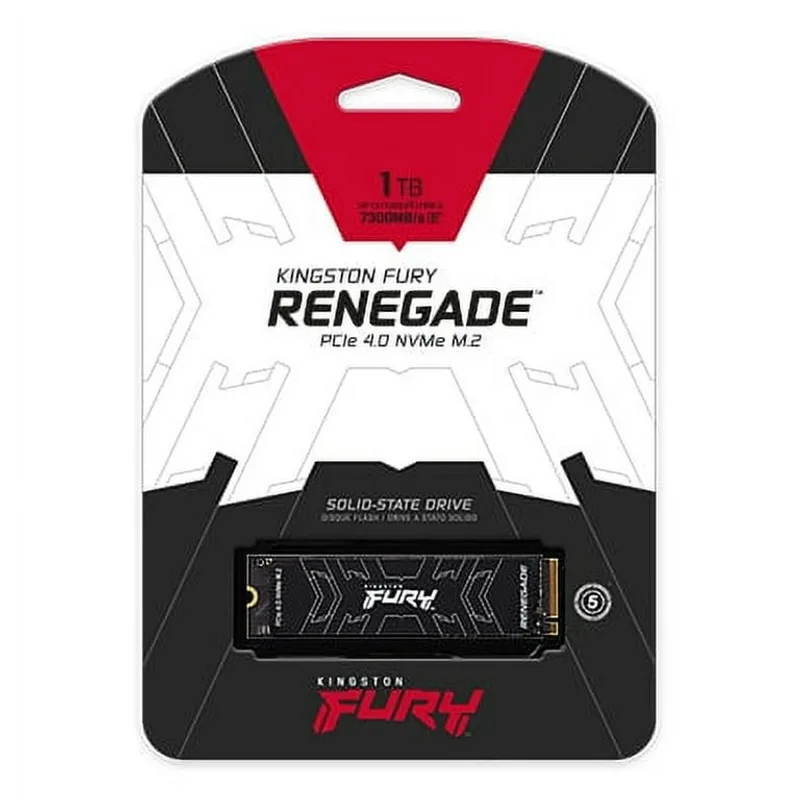
Kingston FURY Renegade 1TB PCIe Gen4 NVMe SSD
The original Fury Renegade built its reputation on the Phison E18 controller with Micron 176-layer TLC NAND — a combination that delivers 7,300 MB/s sequential read speeds and 1,000K random IOPS. Published game load time comparisons between Gen4 and Gen5 NVMe drives consistently show differences of under 2 seconds; for gaming-only builds, the Gen4 Renegade reaches parity with drives costing twice as much.
At $139, the Gen4 Renegade occupies an interesting position in 2026: NAND shortage pricing has narrowed the price gap between it and the Gen5 options. The Samsung 9100 Pro Gen5 at $199 now costs only $60 more. If your budget allows $199, the 9100 Pro is the better long-term investment — the Gen5 bandwidth ceiling will matter more as DirectStorage adoption grows and AI workloads become more common on consumer hardware.
Where the Gen4 Renegade makes sense: older platforms without PCIe 5 M.2 slots (Intel 12th Gen and earlier, AMD Ryzen 5000 and earlier), PS5 storage upgrades, and buyers who specifically need a Gen4 drive for compatibility.
Best for: Older platforms without PCIe 5 slots, PS5 upgrades, budget-conscious buyers not needing Gen5 bandwidth
FAQ
Is the Kingston Fury Renegade G5 faster than the Crucial T705?
Depends on the workload. The Renegade G5 is faster in sequential read (14,800 vs 13,600 MB/s) and sequential write (14,000 vs 10,000 MB/s for 1TB), and scores higher on 3DMark Storage. The T705 holds the advantage in low-queue-depth random IOPS, which matters for database workloads, OS responsiveness, and some virtualization scenarios. For gaming and video editing, the Renegade G5 has the edge on paper; for mixed workloads with many small random reads, the T705 competes closely.
Do Gen5 NVMe drives actually make games load faster than Gen4?
Marginally at best. Multiple published comparisons between Gen5 and Gen4 drives show game load time differences of under 2 seconds in the vast majority of titles — often under 1 second. The PCIe 5 bandwidth advantage translates to real-world gains in large sequential file operations (video, AI model loading, OS imaging), not in random-access gaming reads. The $139 Gen4 Renegade loads games at effectively the same speed as a $284 WD SN8100.
Will the Samsung 9100 Pro Gen5 fit in a PCIe 4 slot?
Yes — all M.2 NVMe drives in this comparison are backward-compatible with PCIe 4 and PCIe 3 M.2 slots. Running the 9100 Pro in a PCIe 4 slot caps it at PCIe 4 x4 bandwidth (~7,000 MB/s), roughly equivalent to a fast Gen4 drive. You get the same controller and NAND but not Gen5 speeds. If you’re building on a Gen4 platform and plan to upgrade to Gen5 later, installing the 9100 Pro now and getting Gen5 speeds after the upgrade is a valid approach.
Do I need a heatsink for any of these drives?
For Gen5 drives (T705, Renegade G5, 9100 Pro, SN8100), a heatsink is strongly recommended for sustained workloads. Under gaming loads that mix sequential and random access, most Gen5 drives stay within thermal limits — but sustained sequential writes (video encoding source files, large backup operations) will trigger throttling without thermal management. Most Z790 and X870E boards include M.2 thermal pads or covers; use them. The Gen4 Renegade runs cool enough that heatsink coverage is optional.
The Bottom Line
The Kingston Fury Renegade G5 at $199 is the best value in this comparison for most users — it outperforms the T705 in sequential read and write while costing $49 less, and runs cooler under sustained load than Phison E26-based alternatives. The Crucial T705 remains the pick for workloads demanding maximum random IOPS, particularly in virtualization and database environments where the Phison E26’s low-queue-depth advantage shows.
If neither the T705 nor the Renegade G5 is the right fit, the Samsung 9100 Pro at $199 is the surprise recommendation: currently priced below Samsung’s own Gen4 flagship while delivering faster sequential reads, better random write IOPS, and full software toolbox support via Samsung Magician.