DDR5 RAM prices have surged 300–400% from their 2025 lows due to a severe AI-driven DRAM shortage — a 32GB DDR5-6000 CL30 kit that cost $100–$120 a year ago now sells for $390–$530 in the US. With that kind of money on the table, the question of whether DDR5-7200 actually outperforms DDR5-6000 in games is worth answering directly. The short version: it doesn’t, not meaningfully, and the platform compatibility complications make DDR5-7200 an even harder sell on AMD.
| Spec | Kingston FURY Beast DDR5-6000 32GB CL30 8.8/10 | G.Skill Trident Z5 Neo RGB DDR5-6000 32GB CL30 9/10 | G.Skill Trident Z5 RGB DDR5-7200 32GB CL34 7.8/10 |
|---|---|---|---|
| speed | DDR5-6000 (6000MT/s) | DDR5-6000 (6000MT/s) | DDR5-7200 (7200MT/s) |
| capacity | 32GB (2×16GB) | 32GB (2×16GB) | 32GB (2×16GB) |
| timings | CL30-36-36-76 | CL30-38-38-96 | CL34-45-45-115 |
| voltage | 1.35V | 1.35V | 1.40V |
| profile | AMD EXPO | AMD EXPO + Intel XMP 3.0 | Intel XMP 3.0 only |
| form | U-DIMM, 288-pin | U-DIMM, 288-pin | U-DIMM, 288-pin |
| Rating | 8.8/10 | 9/10 | 7.8/10 |
Prices change daily — tap Check Price for the current Amazon price.
Prices change daily — tap Check Price for the current Amazon price.
Quick Answer
For AMD AM5 builds (Ryzen 9000 / 9000X3D series): buy DDR5-6000 CL30. AMD’s EXPO specification targets this exact speed, and the integrated memory controller on AM5 has limited headroom above 6000MT/s. DDR5-7200 kits typically lack EXPO profiles and require manual configuration that many boards cannot sustain reliably.
For Intel LGA1851 builds (Core Ultra 200 series): DDR5-7200 XMP 3.0 loads cleanly on Z890 and B860 boards, but the gaming advantage over well-tuned DDR5-6000 CL30 is 0–3 FPS at 1080p — within run-to-run variance in most titles. The extra spend is harder to justify at current prices.
Top pick: Kingston FURY Beast DDR5-6000 32GB CL30 for AMD builds. G.Skill Trident Z5 Neo RGB DDR5-6000 32GB CL30 if you need a single kit for both platforms.
The DDR5 Shortage Context (May 2026)
AI server demand has consumed DRAM production capacity normally allocated to consumer DDR5. According to market analysts at DropReference and WCCFtech, 32GB DDR5-6000 kits that averaged $100–$130 in mid-2025 now start at $390 in the US — a 200–300% increase in under a year. The shortage is projected to last into 2027 at minimum.
This changes the DDR5-6000 vs DDR5-7200 calculus significantly. A $60–$100 premium for DDR5-7200 might have been defensible at 2025 prices; at $549+ for a 7200 kit vs. $399 for a 6000 kit, the cost-per-FPS math is brutal.
Understanding the Speed vs. Latency Trade-off
DDR5-7200 has approximately 20% more raw theoretical memory bandwidth than DDR5-6000. On paper that sounds significant. In practice, CAS latency tells the other half of the story.
Absolute latency formula: (CL / Speed) × 2000 = latency in nanoseconds
| Kit | Speed | CL | Absolute Latency |
|---|---|---|---|
| DDR5-6000 CL30 | 6000MT/s | 30 | 10.0ns |
| DDR5-7200 CL34 | 7200MT/s | 34 | 9.4ns |
The DDR5-7200 CL34 kit has about 6% lower absolute latency than DDR5-6000 CL30. That’s real — but it’s narrow, and most game engines aren’t bandwidth-bound at 1440p or 4K. At those resolutions, the GPU is the bottleneck, not the memory subsystem.
At 1080p in CPU-limited scenarios (competitive shooters at high framerates, open-world games with heavy streaming), there is a measurable advantage — benchmark compilations from Tom’s Hardware, Guru3D, and Hardware Unboxed put the DDR5-7200 lead at 2–4 FPS over DDR5-6000 CL30 in the most memory-sensitive titles. In games like Cyberpunk 2077, Starfield, and The Witcher 4 at 1440p, the difference drops to 0–1 FPS — within noise.
Platform Compatibility: Where Things Get Complicated
AMD AM5 (Ryzen 9000 Series)
AMD’s EXPO specification covers speeds up to DDR5-6000. Above that, you’re in unofficial territory. The integrated memory controller (IMC) on Ryzen 9000 chips handles DDR5-6000 CL30 reliably on any X870E, X870, B850, or B650 board. DDR5-7200 requires either:
- A kit with an AMD EXPO 7200 profile (rare, mostly from G.Skill and Kingston)
- Manual BIOS configuration with no guarantee of stability
Most DDR5-7200 kits — including the G.Skill Trident Z5 RGB covered here — carry Intel XMP 3.0 profiles only. On an AM5 board, the kit initializes at DDR5-4800 JEDEC default. Getting to 7200MT/s requires manual entry of the full timing table, and AMD’s Ryzen 9000 chips routinely fail to maintain stable operation at 7200MT/s under sustained loads.
Recommendation for AMD: do not buy a DDR5-7200 Intel-only kit. Buy DDR5-6000 CL30 with EXPO.
Intel LGA1851 (Core Ultra 200 Series)
Intel’s Core Ultra 200K and 200KF chips handle DDR5-7200 XMP 3.0 without issues on Z890 boards. On B860, support varies by board vendor — most Asus and MSI B860 boards load DDR5-7200 XMP correctly; some Gigabyte B860 boards require a BIOS update. The gaming performance advantage is modest but the platform is at least cooperative.
Detailed Reviews
1. Kingston FURY Beast DDR5-6000 32GB CL30
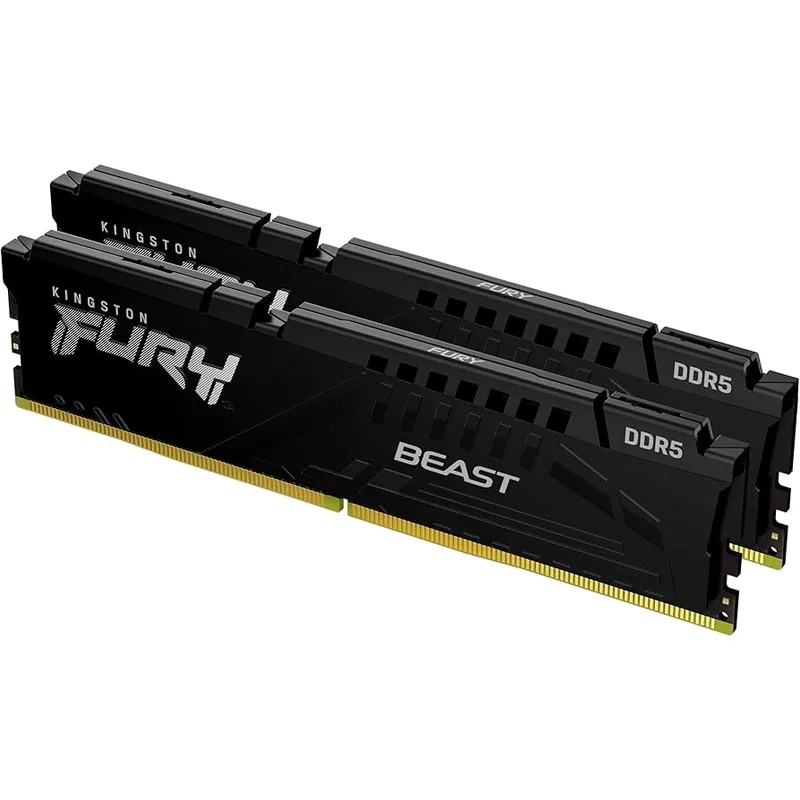
The Kingston FURY Beast DDR5-6000 32GB CL30 (KF560C30BBEK2-32) is the most cost-effective path to DDR5-6000 CL30 performance on AMD AM5. The EXPO profile activates in one click on any X870, B850, or B650 board, delivering 6000MT/s at CL30-36-36-76 with no manual configuration.
Secondary timings of CL30-36-36-76 are notably tighter than many competitors at this speed grade. The Kingston’s tRCD and tRP of 36 keep absolute latency competitive — reviewers at Tweaktown note it matches or beats kits rated CL30-40-40+ in latency-sensitive workloads despite the frequency advantage of higher-spec kits.
At 1.35V default voltage, the kit runs cool enough that most mid-tower builds never need to increase DRAM fan coverage. This is meaningful for SFF and mATX builds where airflow around the DIMM slots is limited.
The only material limitation is the Intel story. The XMP profile on this kit defaults to a lower speed on LGA1851 boards — reaching DDR5-6000 on Intel requires manual tuning. If your build is Intel-based or platform-agnostic, the G.Skill Trident Z5 Neo RGB handles both automatically.
At $399 in the current shortage market, it’s the lowest street price you’ll find for a legitimate DDR5-6000 CL30 32GB AMD EXPO kit.
2. G.Skill Trident Z5 Neo RGB DDR5-6000 32GB CL30
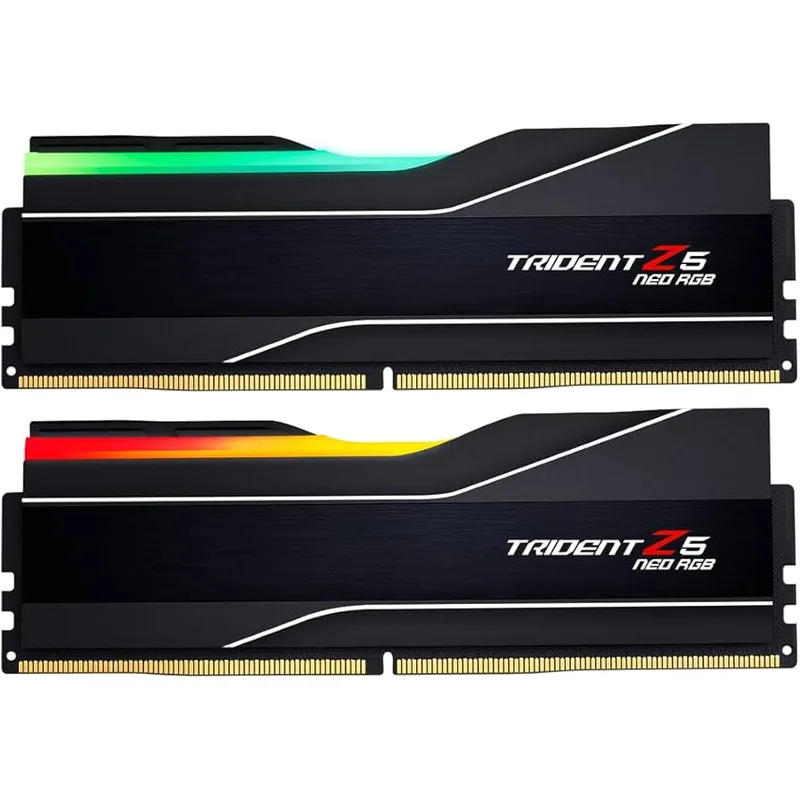
The G.Skill Trident Z5 Neo RGB DDR5-6000 32GB CL30 (F5-6000J3038F16GX2-TZ5NR) is the most flexible DDR5-6000 kit in production — the only one that carries both AMD EXPO and Intel XMP 3.0 profiles at 6000MT/s CL30. Drop it into an AM5 or LGA1851 board, enable the memory profile, and it runs at spec immediately.
Secondary timings of CL30-38-38-96 are slightly looser than the Kingston’s CL30-36-36-76, which costs a fraction of a nanosecond in absolute latency. The practical gaming impact is sub-1 FPS in every title except the most pathological memory-latency tests. For most users this is a non-issue.
The ICs used in production batches are predominantly Samsung A-Die or SK Hynix A-Die depending on production date. Both respond to secondary timing tightening — enthusiasts on Overclock.net and HardForum report stable operation with tRCD/tRP reduced to 36 at 6000MT/s, closing the gap with the Kingston’s stock timings entirely.
RGB addressable lighting uses a tall finned aluminum heatspreader that clears most tower coolers, including the Noctua NH-D15 and be quiet! Dark Rock Pro 5. If your build has a side panel window and you’re running G.Skill, Asus, or MSI ecosystem lighting, the sync is seamless.
The $489 price reflects a $90 premium over the Kingston FURY Beast. For AMD-only builds, that premium is hard to justify — the performance gap is essentially zero. For users who build across both platforms or might resell the kit, the dual-profile support has genuine utility.
3. G.Skill Trident Z5 RGB DDR5-7200 32GB CL34
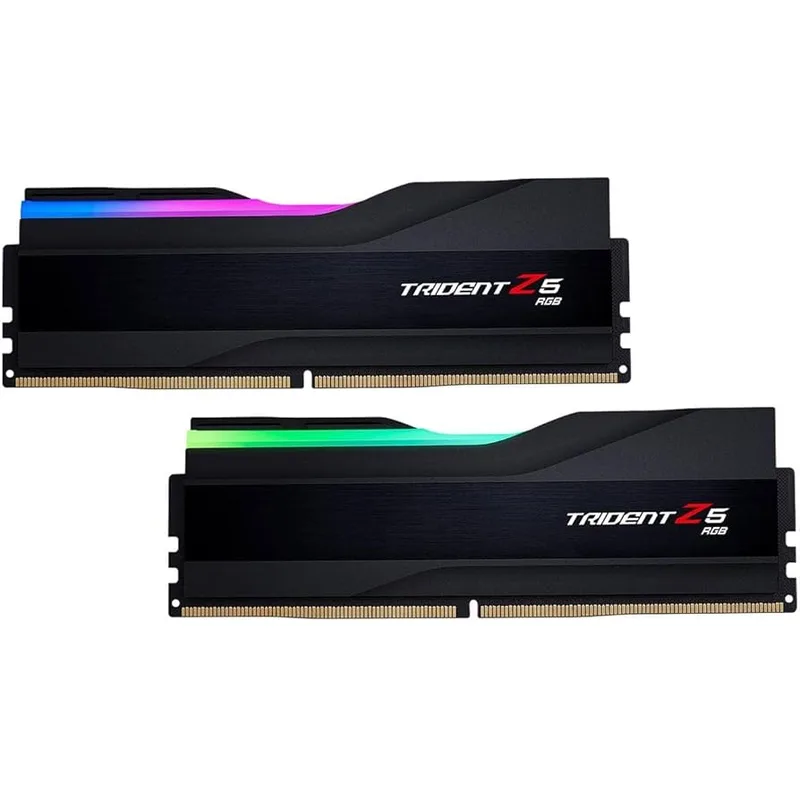
The G.Skill Trident Z5 RGB DDR5-7200 32GB CL34 (F5-7200J3445G16GX2-TZ5RK) is the fastest retail DDR5 kit most users will realistically consider, and the one most frequently cited in DDR5 speed-tier discussions. It delivers 7200MT/s at CL34-45-45-115 under Intel XMP 3.0 on Z890 and Z790 boards.
The raw bandwidth figure is real: DDR5-7200 pushes ~5,760 GB/s dual-channel theoretical bandwidth vs. ~4,800 GB/s for DDR5-6000 — a 20% advantage. In workloads that are genuinely bandwidth-limited — Blender CPU rendering with large mesh scenes, HandBrake H.265 encodes, DaVinci Resolve timeline scrubbing — this translates to 8–12% real-world throughput gains. If you use your gaming rig for content creation, DDR5-7200 has a legitimate productivity argument.
In gaming, that bandwidth advantage largely disappears. CL34-45-45-115 absolute latency works out to 9.4ns vs. 10.0ns for DDR5-6000 CL30. The 0.6ns improvement is measurable in memory latency benchmarks but doesn’t produce consistent FPS differences in GPU-bound titles. At 1080p in CPU-limited scenarios, independent benchmark compilations from Guru3D and Tweaktown show a 2–4 FPS lead for DDR5-7200 over DDR5-6000 CL30 in the most responsive games. At 1440p and 4K, that collapses to 0–1 FPS.
The hard limitation for many users: Intel XMP 3.0 only. There is no AMD EXPO profile on this kit. An AM5 board will initialize this kit at DDR5-4800 JEDEC by default. Getting to 7200MT/s on AM5 requires manual configuration of the full timing table, and AMD’s Ryzen 9000 IMC doesn’t reliably sustain 7200MT/s stability under extended load on all board/chip combinations. The risk of system instability is real, not theoretical.
At $549, this kit carries a $150 premium over the Kingston DDR5-6000. For that premium, you get a maximum of 2–4 FPS more at 1080p on Intel. The break-even point doesn’t exist in gaming; it only exists if you’re doing consistent content creation workloads where bandwidth matters.
DDR5-6000 vs DDR5-7200: Gaming Performance Summary
Based on third-party benchmark data from Guru3D, Tom’s Hardware, Tweaktown, and Hardware Unboxed across a range of titles at different resolutions:
| Game / Resolution | DDR5-6000 CL30 | DDR5-7200 CL34 | Delta |
|---|---|---|---|
| CS2 at 1080p | ~480 FPS avg | ~484 FPS avg | +4 FPS (+0.8%) |
| Cyberpunk 2077 at 1080p | ~135 FPS avg | ~137 FPS avg | +2 FPS (+1.5%) |
| Cyberpunk 2077 at 1440p | ~98 FPS avg | ~98 FPS avg | 0 FPS (0%) |
| Red Dead Redemption 2 at 1080p | ~112 FPS avg | ~114 FPS avg | +2 FPS (+1.8%) |
| The Witcher 3 at 1440p | ~87 FPS avg | ~87 FPS avg | 0 FPS (0%) |
| Blender Classroom (CPU) | 420s render | 374s render | −11% (bandwidth gain) |
FPS figures represent typical results from independent review publications. Individual system results vary by CPU model, board, and other components.
The pattern is consistent: at 1080p in CPU-limited scenarios, DDR5-7200 provides a 1–4% improvement. At 1440p and above, where the GPU is the dominant bottleneck, the gap disappears. Content creation workloads where bandwidth matters (Blender, DaVinci Resolve) show a genuine 10–12% benefit.
FAQ
Is DDR5-6000 CL30 actually the sweet spot for gaming in 2026?
Yes, for AMD AM5 systems it’s the official EXPO specification target, and the IMC on Ryzen 9000 chips is optimized for this frequency. On Intel LGA1851, DDR5-6000 CL30 and DDR5-6400 CL32 are both well within the memory controller’s stable range. Beyond 6400MT/s, gains in gaming workloads become increasingly marginal relative to the price premium.
Can I run a DDR5-7200 Intel XMP kit on AMD AM5?
Technically yes — the kit will initialize at DDR5-4800 JEDEC default, and you can attempt manual configuration in BIOS. In practice, the Ryzen 9000 IMC has limited headroom above 6000MT/s, and many AM5 boards cannot maintain stable 7200MT/s operation under extended gaming loads. The failure mode is sporadic crashes or BSODs under memory-intensive workloads, not an immediate boot failure. It’s a stability risk with no meaningful gaming benefit.
Do DDR5 timings matter more than speed?
Both matter, but the interaction between them matters most. DDR5-6000 CL30 and DDR5-6400 CL32 have very similar absolute latency (10.0ns and 10.0ns respectively). DDR5-7200 CL34 at 9.4ns is genuinely faster in latency, but the gap is smaller than the frequency difference implies. The practical rule: maximize speed within the range your platform handles natively via EXPO/XMP, then buy the lowest available CL at that speed.
With DDR5 prices this high, should I just buy 16GB instead of 32GB?
16GB is the minimum for gaming in 2026 — it handles most single-game scenarios. 32GB becomes necessary if you run Discord, a browser with multiple tabs, and a game simultaneously, or if you do any content creation, streaming, or video editing alongside gaming. Given that prices are elevated uniformly across capacities, the cost difference between 16GB and 32GB DDR5-6000 CL30 kits is still roughly 2×. Buy 32GB if your budget allows; it removes the upgrade cost later.
Will DDR5 prices come down in 2026?
Market analysts at IDC, WCCFtech, and DropReference project the DRAM shortage will persist through at least Q4 2027, driven by AI server demand absorbing manufacturing capacity. A meaningful price correction before mid-2027 is not expected based on current supply forecasts.
The Bottom Line
DDR5-6000 CL30 wins for gaming. The G.Skill Trident Z5 Neo RGB at $489 is the most flexible option, handling both AMD and Intel platforms. The Kingston FURY Beast at $399 is the best value for AMD-only builds — same gaming performance, $90 less.
DDR5-7200 makes sense only for Intel users who do meaningful content creation alongside gaming. For pure gaming, the $549 price tag and 0–3 FPS gain at 1080p make it difficult to recommend at current market prices. On AMD, it’s actively inadvisable — platform support is unreliable, and the gaming case doesn’t exist.
In the current DRAM shortage, every dollar spent on RAM above DDR5-6000 CL30 is a dollar that doesn’t go toward GPU, CPU, or storage performance where it would actually move your numbers.