The VRAM situation in 2026 has moved fast. Indiana Jones and the Great Circle hits 22GB at 4K path trace. Black Myth: Wukong overflows 8GB at 1080p ultra textures. At the same time, the RTX 5070 — stuck above $649 for months — has settled around $639 as Blackwell supply continues to normalize. The gap between the 12GB and 16GB tiers has never been cheaper to bridge. This guide covers exactly how much VRAM you need by resolution, workload, and budget, and names the GPUs that deliver it.
| Spec | MSI GeForce RTX 4060 Ventus 2X Black 8G OC 7.5/10 | MSI RTX 5070 12G Ventus 2X OC Unavailable 8.4/10 | GIGABYTE Radeon RX 9070 XT Gaming OC 16G 9/10 | MSI RTX 5070 Ti 16G Gaming Trio OC Plus 8.8/10 | ASUS TUF GeForce RTX 5090 32GB GDDR7 9.3/10 |
|---|---|---|---|---|---|
| vram | 8GB GDDR6 | 12GB GDDR7 | 16GB GDDR6 | 16GB GDDR7 | 32GB GDDR7 |
| memory_bus | 128-bit | 192-bit | 256-bit | 256-bit | 512-bit |
| architecture | Ada Lovelace | Blackwell | RDNA 4 | Blackwell | Blackwell |
| tdp | 115W | 250W | 250W | 285W | 575W |
| target_resolution | 1080p | 1440p | 1440p / 4K | 1440p / 4K | 4K / 8K |
| psu_requirement | 550W | 650W | 700W | 750W | 1000W |
| Rating | 7.5/10 | 8.4/10 | 9/10 | 8.8/10 | 9.3/10 |
Prices change daily — tap Check Price for the current Amazon price.
Prices change daily — tap Check Price for the current Amazon price.
Quick Picks
- 1080p budget: MSI RTX 4060 Ventus 2X 8G — $259, 115W, handles 1080p competitive gaming and older AAA at high settings
- 1440p standard build: MSI RTX 5070 12G Ventus — $639, GDDR7 bandwidth compensates for the 12GB cap in most 1440p scenarios
- Best value 16GB: GIGABYTE RX 9070 XT Gaming OC 16G — $679, rasterization within 5% of RTX 5070 Ti at $370 less
- NVIDIA 16GB / ray tracing: MSI RTX 5070 Ti Gaming Trio OC Plus — $1,049, 896 GB/s GDDR7 + DLSS 4 Multi Frame Generation
- AI workloads / 4K path trace: ASUS TUF RTX 5090 32GB — ~$2,699, the only consumer GPU that fits 70B LLMs fully in VRAM
VRAM Tiers at a Glance
| VRAM | Target Resolution | Use Case | Representative GPU | Price |
|---|---|---|---|---|
| 8GB | 1080p medium–high | Competitive gaming, older titles | RTX 4060 8GB | Check current price |
| 12GB | 1440p high–ultra | Modern AAA at 1440p with upscaling | RTX 5070 12GB | Check current price |
| 16GB | 1440p ultra / 4K high | All current titles at max, light AI | RX 9070 XT / RTX 5070 Ti | Check current price |
| 32GB | 4K path trace / AI workloads | No VRAM limits in any current game, local LLMs | RTX 5090 (32GB) | Check current price |
Why These GPUs
Five cards, five VRAM tiers, representing the best available value as of May 2026. Worth noting before you read: the RTX 5060 Ti 16GB launched in April at $429 MSRP with Blackwell architecture and GDDR7 — a new budget path to 16GB that didn’t exist two months ago. It isn’t in this guide’s product lineup but is worth cross-referencing if the $679 RX 9070 XT exceeds your budget.
8GB (RTX 4060): Still the most popular 1080p GPU on Steam in 2026. Ada Lovelace efficiency and DLSS 3 Frame Generation keep it viable at 1080p. The 128-bit bus at 272 GB/s bandwidth is the real constraint — it saturates at 1440p before VRAM fills, causing frame-time irregularities regardless of settings adjustments.
12GB (RTX 5070): Blackwell supply constraints have eased. The MSI Ventus is now trading around $639 — down from the $649+ prices of early 2026, but still above the $549 MSRP. GDDR7 delivers 560 GB/s on a 192-bit bus — double the RTX 4060’s bandwidth — which is why this card handles 1440p scenarios where bandwidth-constrained predecessors stuttered.
16GB (RX 9070 XT): Launched at $599, peaked above $729 during the initial demand surge, and has settled around $679 as supply improved. AMD’s FSR 4 with machine-learning reconstruction has closed the quality gap with DLSS 4 in independent evaluations. Ray tracing remains the exception — NVIDIA holds a 20–25% lead in path-traced workloads.
16GB Nvidia (RTX 5070 Ti): RTX 5070 Ti street pricing has recovered in May 2026. The MSI Gaming Trio OC Plus, as a premium three-fan AIB, sits around $1,049 — up from sub-$900 dips seen earlier in 2026. Entry-tier 5070 Ti AIBs are available near $850–$900 for budget-focused buyers. The GDDR7 bandwidth advantage (896 GB/s vs. the 9070 XT’s 576 GB/s) and ray tracing lead justify the premium for path-trace-heavy libraries.
32GB (RTX 5090): Initial scarcity premiums have eased — the ASUS TUF is now around $2,699, down from $2,910+ at launch. The 32GB GDDR7 capacity is the minimum for consumer 70B parameter LLM inference, and the 1,792 GB/s bandwidth is unchallenged outside workstation hardware.
Component Deep Dives
MSI GeForce RTX 4060 Ventus 2X Black 8G OC — Best 8GB Budget Pick
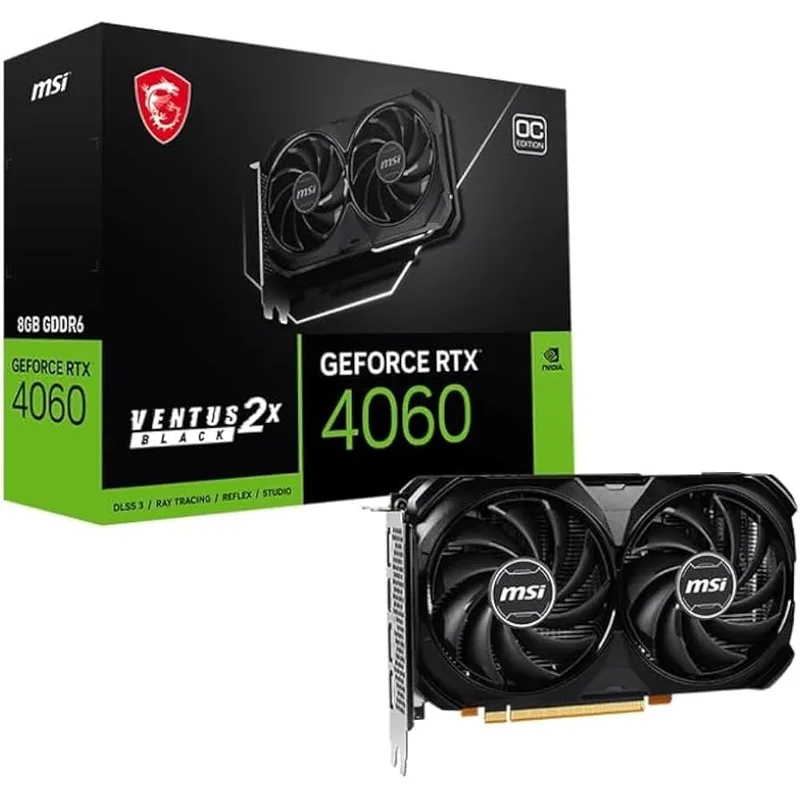
The MSI RTX 4060 Ventus 2X is the cheapest path to a functioning 1080p gaming system in 2026: 115W, requires only a 550W PSU, handles all competitive titles above 120 FPS at 1080p high, and remains the most-used gaming GPU on Steam’s hardware survey.
Where 8GB becomes a liability: Hogwarts Legacy at 1080p ultra high textures overflows into system RAM and causes frame-time spikes that require a texture quality reduction. Black Myth: Wukong at cinematic settings hits the same wall. The 128-bit memory bus at 272 GB/s is the secondary constraint — at 1440p, the bus saturates before VRAM fills, causing erratic frame pacing regardless of settings adjustments.
Worth knowing: the RTX 5060 launches May 19 at $299 with 8GB GDDR7 and the full Blackwell feature set including DLSS 4 Multi Frame Generation. GDDR7 bandwidth is a meaningful improvement over the RTX 4060’s GDDR6, and the $40 premium over the current $259 street price is modest. For builds going together after May 19, comparing the two before purchasing is sensible.
Bottom line for the 8GB tier: Strong for 1080p competitive and older AAA titles at $259. Any build targeting 1440p or new AAA releases at max settings should start at 12GB.
MSI RTX 5070 12G Ventus 2X OC — Best 12GB Pick
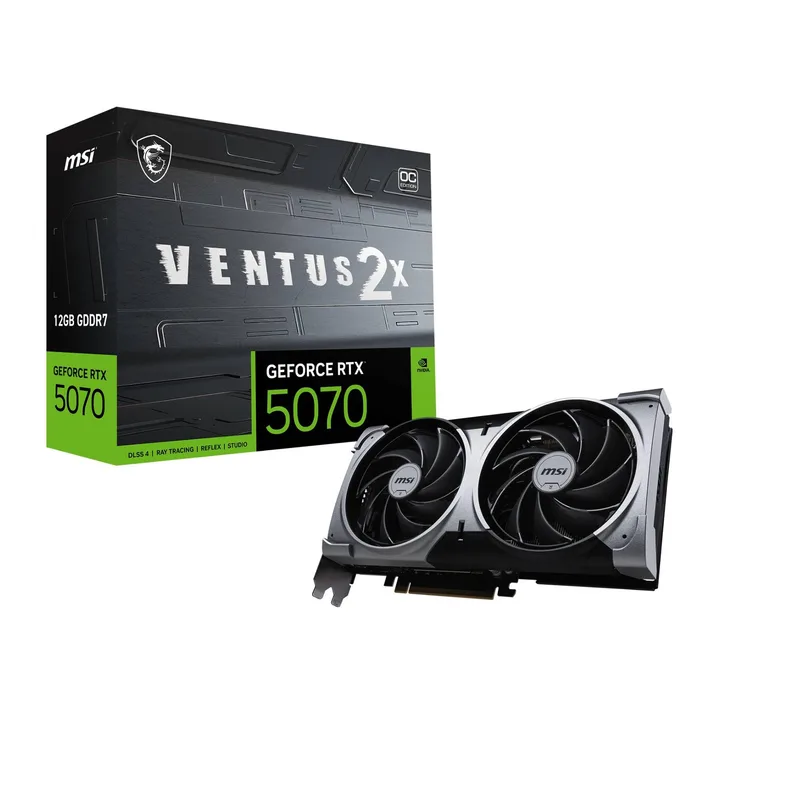
MSI RTX 5070 12G Ventus 2X OC
The MSI RTX 5070 12G Ventus 2X OC is the most accessible Blackwell GPU, now trading around $639 after months of $649+ pricing. Entry Blackwell RTX 5070 AIBs have briefly dipped to $600–$610 on Amazon during demand lulls — the $549 MSRP remains below current street pricing as supply normalizes gradually.
GDDR7 at 560 GB/s is the key specification here, not just the 12GB capacity. That bandwidth is double the RTX 4060’s 272 GB/s, which is why 1440p gaming on this card stays fluid where bandwidth-limited predecessors stuttered at the same resolution. Published benchmark analysis shows Cyberpunk 2077 with path tracing at 1440p DLSS 4 Quality mode averaging 65–70 FPS. Multi Frame Generation can double or quadruple that count in supported titles, though input latency scales with each frame multiplier step.
The 12GB ceiling surfaces at 4K ultra textures. Indiana Jones at 4K max settings, Black Myth: Wukong with cinematic textures, and Alan Wake 2 with path tracing all push past 12GB at native 4K. The practical fix is 4K DLSS 4 Quality mode — rendering internally at roughly 1440p where 12GB is comfortable.
Bottom line for the 12GB tier: The right card for 1440p gaming through 2027, now at a fair price. If 4K native or two-plus years of full-settings headroom matter, move to 16GB.
GIGABYTE Radeon RX 9070 XT Gaming OC 16G — Best Value 16GB
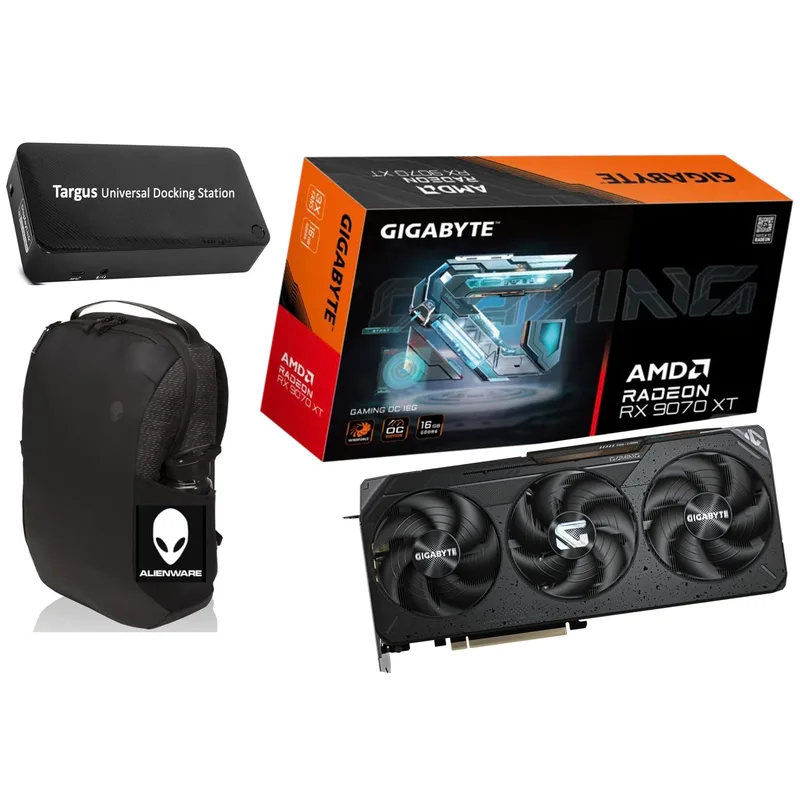
AMD launched the RX 9070 XT at $599 MSRP in February 2026. Street prices peaked above $729 during initial demand and have since moderated to around $679 for the GIGABYTE Gaming OC variant.
The 16GB GDDR6 on a 256-bit bus at 576 GB/s bandwidth eliminates VRAM-related frame pacing at 1440p ultra and 4K high settings. Published benchmarks place rasterization performance within 5% of the RTX 5070 Ti at 1440p. AMD’s FSR 4, using machine-learning-based reconstruction, has matched DLSS 4 output quality in independent evaluations at 1440p and 4K — a genuine step forward from FSR 3.
Ray tracing is the clear weakness. Published comparisons show Alan Wake 2 at 4K full path trace: RTX 5070 Ti averaging approximately 45 FPS with DLSS 4 Quality, RX 9070 XT averaging approximately 34 FPS with FSR 4 Quality. Indiana Jones at 4K ultra RT: RTX 5070 Ti approximately 60 FPS versus RX 9070 XT approximately 47 FPS. For rasterization gaming — which describes the majority of titles — these gaps don’t appear.
Bottom line for the 16GB AMD tier: The strongest value in the $650–$700 GPU range. The $150 savings versus the RTX 5070 Ti makes sense unless path-traced titles are a regular part of your library.
MSI RTX 5070 Ti 16G Gaming Trio OC Plus — Best Nvidia 16GB
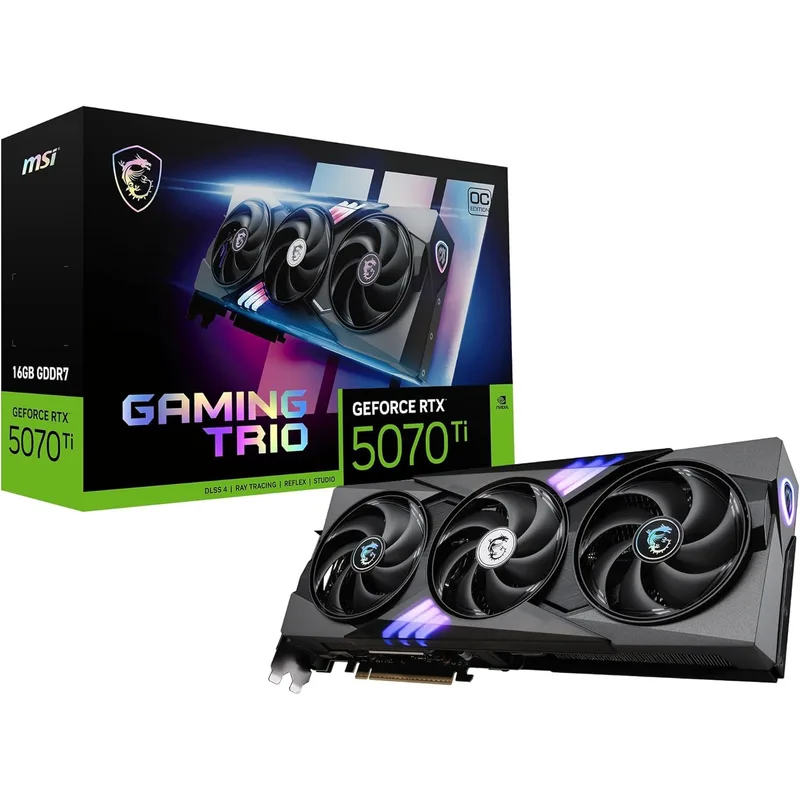
The MSI RTX 5070 Ti 16G Gaming Trio OC Plus delivers a 2580 MHz boost clock and 896 GB/s GDDR7 bandwidth — the highest bandwidth figure below the RTX 5080 and 5090. At 1440p, published benchmarks place it level with or ahead of the RTX 4090 in rasterization; at 4K it closes to within 3%.
RTX 5070 Ti street pricing has recovered in May 2026. The MSI Gaming Trio OC Plus, as a premium three-fan design, sits at approximately $1,049 as of May 2026. Entry-tier 5070 Ti AIBs are available near $850–$900 for budget-focused buyers.
The GDDR7 bandwidth advantage over the RX 9070 XT is most visible in path-traced workloads. Multi Frame Generation at 2x doubles perceived frame rates in supported titles — cap at 2x for competitive multiplayer to manage the input latency increase that 4x MFG introduces.
Bottom line for the 16GB Nvidia tier: Worth the $150 premium over the RX 9070 XT if ray tracing, DLSS 4 latency, or maximum GDDR7 bandwidth are priorities. For rasterization-only gaming, the value gap doesn’t justify the price difference.
ASUS TUF GeForce RTX 5090 32GB GDDR7 — Best 32GB / AI Workloads
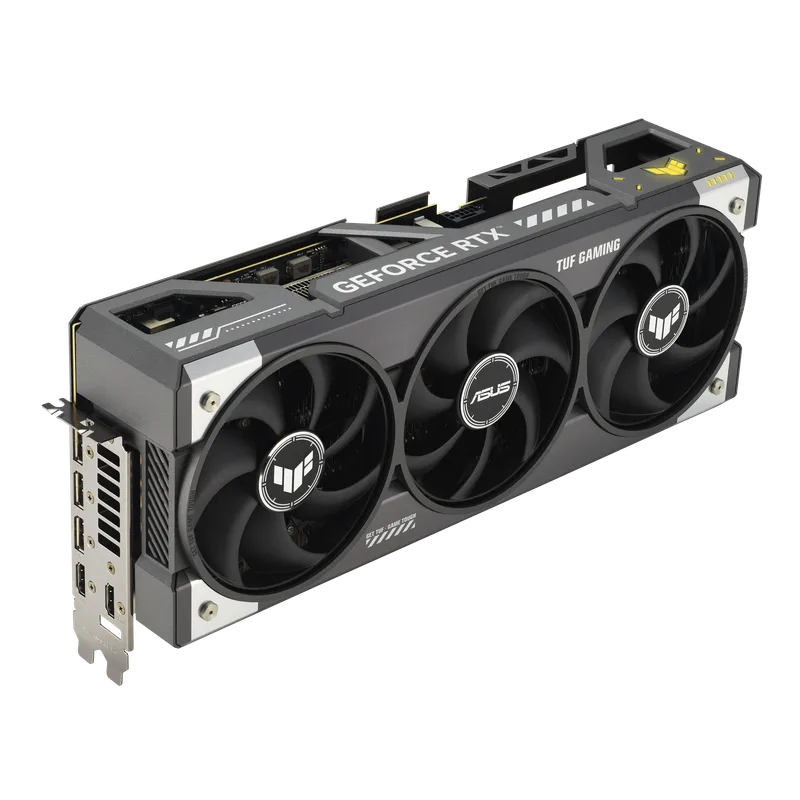
The ASUS TUF RTX 5090 is the most affordable RTX 5090 AIB, with street pricing settling around $2,699 as initial scarcity premiums have eased. Premium AIBs (ROG Strix, Noctua OC edition) remain at $3,200–$3,800.
At 4K gaming, this card has no ceiling in any current title. Published benchmark data shows Indiana Jones at 4K path trace exceeding 80 FPS with DLSS 4 Quality mode, and Black Myth: Wukong at 4K cinematic settings above 95 FPS. VRAM usage in these scenarios peaks around 22GB — 16GB cards are approaching their limit, while the 5090’s 32GB is unfazed.
The AI distinction is the defining argument for this tier. A quantized Llama 3 70B at INT4 requires approximately 24–28GB to load fully into VRAM. The RTX 5090 is the minimum consumer GPU that handles 70B parameter models without offloading to system RAM. Once a model splits between VRAM and system memory, tokens-per-second drops sharply due to PCIe bandwidth constraints.
Documented peak power draw under load exceeds 650W despite the 575W TDP spec. You need a 1000W+ PSU, a 16-pin power adapter, and a case with rear exhaust. The card spans 3.6 slots — verify clearance before purchasing.
Bottom line for the 32GB tier: Not a mainstream gaming purchase at any price. If 4K path trace without compromise or local 70B LLM inference is the goal, there’s no alternative in the current generation. Otherwise, the RTX 5070 Ti or RX 9070 XT delivers 90% of the gaming experience at a fraction of the cost.
How to Pick Your VRAM Tier
The 8GB case is narrowing. New AAA releases consistently push past 8GB at 1080p ultra textures. You can manage on an RTX 4060 by dropping texture quality settings — but you’re making compromises on a card bought new in 2026. The RTX 5060 launching May 19 at $299 with 8GB GDDR7 offers better bandwidth, but 8GB is still 8GB. For any build targeting new releases at max settings, start at 12GB minimum.
12GB covers 1440p, but GDDR7 bandwidth matters as much as capacity. The RTX 5070’s 560 GB/s addresses the bandwidth bottleneck that made older 12GB cards stutter at 1440p. With DLSS 4 Quality mode, the 12GB ceiling doesn’t surface until 4K native in demanding titles. If budget reaches 16GB, the additional headroom lasts two to three years.
16GB is the safe floor for high-end 2026 builds. Both 16GB cards handle 4K high settings, all current 1440p scenarios without compromise, and tolerate texture mods. The RX 9070 XT at $679 is the value choice; the RTX 5070 Ti at $1,049 is the choice for path trace-heavy libraries. The RTX 5060 Ti 16GB at $429 MSRP (April 2026 launch) is a new budget entry to 16GB worth checking if $679 is over budget.
PSU requirements scale with tier. RTX 4060: 550W. RTX 5070: 650W. RTX 5070 Ti: 750W. RTX 5090: 1000W+. Moving up a VRAM tier mid-build often means a PSU swap — factor that into the total upgrade cost.
Don’t buy 32GB VRAM for gaming alone. The jump from 16GB to 32GB is not a gaming necessity — it’s an AI and professional workload story. The only current 32GB option is the RTX 5090 at $2,699+.
Real-World VRAM Usage
| Game | Settings | 1080p | 1440p | 4K |
|---|---|---|---|---|
| Cyberpunk 2077 (RT Ultra) | Path Trace on | 9GB | 12GB | 18GB |
| Black Myth: Wukong | Cinematic textures | 8–9GB | 11–12GB | 20–22GB |
| Indiana Jones (RT Max) | All lights on | 10GB | 14GB | 22GB |
| Alan Wake 2 (Full Path Trace) | Max settings | 7GB | 10GB | 16–18GB |
| Hogwarts Legacy | Ultra high textures | 8–10GB | 12GB | 16–18GB |
| Counter-Strike 2 | High | 3–4GB | 4–5GB | 6–7GB |
| Fortnite | Epic + RT on | 5–6GB | 7–8GB | 10–12GB |
Competitive titles (CS2, Valorant, Apex Legends) are VRAM-light — 8GB is more than enough. Demanding single-player AAA at max settings is where the tiers separate. The 4K column shows where 12GB cards hit their ceiling and 16GB becomes necessary.
Upgrade Path
From 8GB: The trigger to upgrade is frame-time spikes in newer titles that persist even after dropping texture quality — that’s VRAM overflow with no settings-based fix. The meaningful step is to 16GB, not 12GB, if budget allows. The RTX 5060 Ti 16GB at $429 MSRP is the lowest-cost path to double-digit VRAM in the current generation.
From 12GB: Upgrade pressure arrives when 4K becomes a target or when native 1440p in new releases shows frame-time irregularities despite acceptable FPS. The RX 9070 XT at $679 is the logical step that doesn’t require changing the rest of the system.
From 16GB: At 1440p, a 16GB card won’t run out of VRAM for at least two to three release cycles at the current trajectory. The only upgrade motivation is 4K native with path tracing or local AI inference. The RTX 5090 at 32GB is the only upgrade destination in the current generation above 16GB Blackwell cards.
FAQ
Is 8GB VRAM enough in 2026?
For 1080p medium-to-high settings and competitive gaming: yes. For 1080p ultra textures in demanding new AAA titles: you’ll need to manage texture quality to avoid overflow. For 1440p: 8GB is insufficient in many modern titles at high settings without significant quality compromises. If your library is older titles or esports games, 8GB works fine. If you buy new releases on launch day at max settings, buy 12GB minimum.
Is 12GB enough for 1440p gaming?
In 2026: yes, with upscaling. The RTX 5070’s GDDR7 bandwidth makes 12GB comfortable at 1440p with DLSS enabled. Native 1440p in the most demanding titles — Black Myth: Wukong cinematic textures, Cyberpunk 2077 path trace — pushes past 12GB. Upscaling at Quality mode resolves the issue in practice, but you’re buying a card with headroom partially used in the most demanding titles on day one.
Should I buy 16GB or 24GB VRAM?
There is no 24GB Blackwell GPU. The RTX 4090 at 24GB is previous-generation with no DLSS 4 support; the RTX 5090 jumps straight to 32GB at $2,699+. For gaming, 16GB covers all current titles through at least 2027. For local AI inference, 32GB is the minimum for 70B parameter models fully in VRAM.
Will VRAM requirements keep increasing?
Yes. In 2026, 8GB was standard for 1440p. By 2026, new AAA titles push past 12GB at 4K and some exceed 8GB at 1080p ultra. Higher-resolution texture packs, path tracing, and open-world scene complexity are all driving the trend. 16GB purchased in 2026 provides two to three years of headroom; 12GB provides one to two years before settings compromises begin.
Does more VRAM improve FPS when not maxed out?
No. VRAM is a buffer — when usage stays below the limit, 32GB doesn’t improve performance over 16GB. The performance impact only appears when VRAM fills and the GPU begins paging to system RAM over PCIe, causing frame-time spikes. More VRAM prevents a cliff edge; it doesn’t raise the performance floor.
The Bottom Line
For 1080p gaming on a budget, the RTX 4060 at $259 handles the job with the understanding that ultra texture settings in newer titles need managing. The RTX 5060 Ti 16GB at $429 (April 2026) is now the most compelling budget step-up — Blackwell, GDDR7, and no VRAM ceiling for $170 more. For dedicated 1440p builds, the RTX 5070 at $639 handles 1440p comfortably with upscaling enabled. 16GB is the floor for any high-end 2026 build — the RX 9070 XT at $679 covers the AMD side at best value, and the RTX 5070 Ti at $1,049 covers the NVIDIA side for path-trace and frame-generation use cases. The RTX 5090 at 32GB is for 4K path trace enthusiasts and local LLM inference; it’s not a mainstream gaming recommendation at any price.