The Intel Arc B580 launched in late 2026 and sold out immediately — Intel had not built a legitimately competitive budget GPU in years, and buyers noticed. The AMD Radeon RX 7600 has been the default $200 recommendation since its 2026 release, but the B580’s arrival shifted the entire conversation. Now that B580 stock has stabilized and prices have settled, the comparison is clear enough to call.
This article breaks down which card to buy based on your target resolution, VRAM requirements, and power budget — no filler, just the numbers and trade-offs.
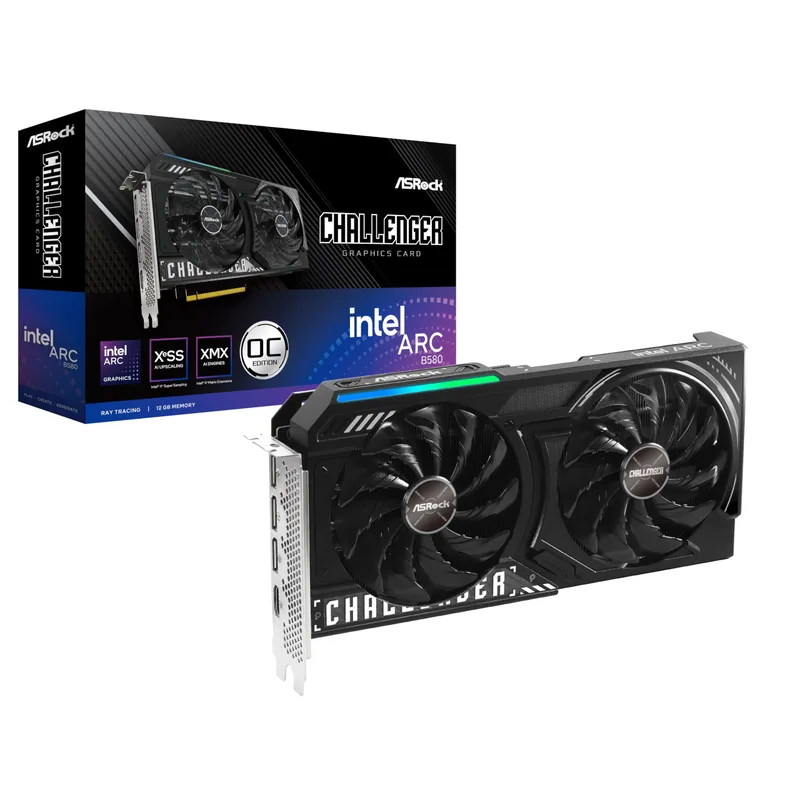
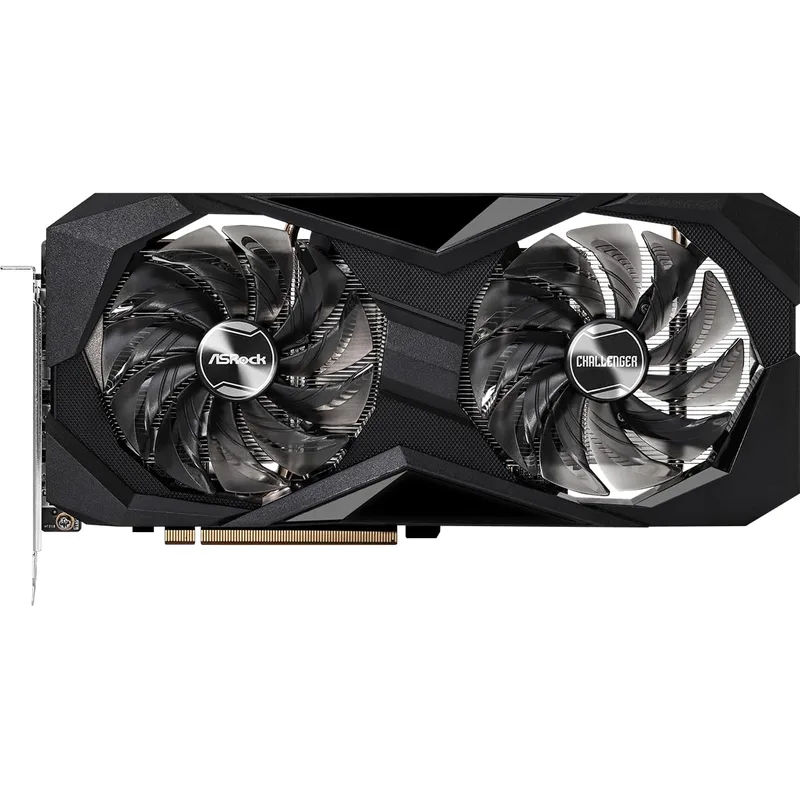
| Spec | ASRock Intel Arc B580 Challenger 12GB OC 8.5/10 | ASRock Radeon RX 7600 Challenger 8GB OC 7.2/10 |
|---|---|---|
| GPU | Intel Battlemage BMG-G21 | AMD Navi 33 (RDNA 3) |
| VRAM | 12GB GDDR6 | 8GB GDDR6 |
| Memory Bus | 192-bit | 128-bit |
| Memory Bandwidth | 456 GB/s | 288 GB/s |
| Boost Clock | 2800 MHz (OC) | 2625 MHz |
| TDP | 190W | 165W |
| Rating | 8.5/10 | 7.2/10 |
Prices change daily — tap Check Price for the current Amazon price.
Prices change daily — tap Check Price for the current Amazon price.
Quick Verdict
If you game at 1440p, buy the B580. Its 12GB GDDR6 and Battlemage architecture put it 31% ahead of the RX 7600 at that resolution based on aggregated review data from GamersNexus and Tom’s Hardware. At current street pricing, the B580 at $299 is $20 more than the RX 7600 at $279, but you get 31% more performance, 50% more VRAM, and significantly better ray tracing. The value case for the B580 remains strong at every resolution above 1080p.
If you game at 1080p and nothing else, the RX 7600 at around $279 street price is the budget pick — the B580 at $299 still delivers better performance for only $20 more, but the gap is narrower at 1080p. For anything beyond 1080p, the B580 is the correct card.
Specs Comparison
| Spec | Arc B580 | RX 7600 |
|---|---|---|
| GPU | Intel BMG-G21 (Battlemage) | AMD Navi 33 (RDNA 3) |
| Shaders | 2560 (20 Xe2 cores) | 2048 (32 CUs) |
| VRAM | 12GB GDDR6 | 8GB GDDR6 |
| Memory Bus | 192-bit | 128-bit |
| Memory Bandwidth | 456 GB/s | 288 GB/s |
| TDP | 190W | 165W |
| Power Connector | 1× 8-pin | 1× 8-pin |
| MSRP (Launch) | $249 | $269 |
| Current Street Price | ~$299 | ~$279 |
The bandwidth gap is the single most important number on this table. At 456 GB/s versus 288 GB/s, the B580 moves data 58% faster — which explains why the performance delta at 1440p and 4K is so much larger than at 1080p, where the RX 7600’s 288 GB/s is still adequate.
Performance: 1080p
At 1080p, both cards are capable of 60+ FPS in essentially every game at high to ultra settings. The B580 leads by roughly 10% on average based on GamersNexus’s review — meaningful but not a tier-changing gap. If 1080p/60 or 1080p/144 (in less demanding titles) is the goal, the RX 7600’s lower price makes it the value winner here.
Specific figures at 1080p from published reviews:
- Resident Evil 4: B580 ~128 FPS, RX 7600 ~100–110 FPS
- FFXIV Endwalker: B580 ~124 FPS, both cards are CPU-limited in many scenarios
The RX 7600 is a comfortable 1080p card in 2026. Its 8GB VRAM is only a liability when texture packs push past that limit — and at 1080p, most games don’t.
Performance: 1440p
This is where the B580 separates itself. At 1440p ultra, the B580 averages 31% faster than the RX 7600 based on review aggregation across multiple titles. In memory-intensive workloads, the gap widens further because the RX 7600’s 8GB buffer starts to be taxed.
- Resident Evil 4 (1440p): B580 ~85 FPS, RX 7600 struggles to stay above 60 in demanding areas
- Black Myth: Wukong (1440p): B580 ~35 FPS versus RX 7600 at sub-30 in heavy scenes
- FFXIV (1440p): B580 ~86 FPS, RX 7600 in the mid-60s range
The RX 7600 can run 1440p games, but you’ll need to drop settings or enable FSR 2/3 to maintain smooth frametimes. The B580 handles 1440p at high settings natively without requiring upscaling as a crutch.
Ray Tracing
The B580 is significantly stronger here. Intel’s Xe2 architecture brought genuine ray tracing improvements: according to GamersNexus, the B580 leads the RX 7600 by 44% in Dying Light 2 with RT enabled, and by 62% in Cyberpunk 2077 at Medium RT settings.
The RX 7600’s RDNA 3 RT performance falls below even the last-gen RTX 3060 in heavily RT-dependent scenes. If ray tracing matters to you — Cyberpunk, Alan Wake 2, Indiana Jones — the RX 7600 is not the card for it. The B580 can actually deliver playable RT framerates at 1080p in most titles.
Upscaling: XeSS vs FSR
Both cards support AMD FSR (which runs on any GPU), but only the B580 benefits from Intel XeSS’s DP4a path on its dedicated XMX AI engines. In side-by-side quality comparisons at 4K with Performance mode, XeSS at balanced quality lands close to native — slightly ahead of FSR 2 in sharpness based on user reports and reviewers.
The RX 7600 uses FSR, which is excellent but not quite at the quality level of DLSS or XeSS’s best modes. Neither card supports DLSS.
Power and Thermals
The RX 7600’s 165W TDP has a practical advantage in compact builds. The B580’s 190W is not extreme, but it matters for ITX cases with tight airflow. Both cards use a single 8-pin connector, so no adapter headaches for either.
The more notable difference is idle power: the B580 draws around 35W at desktop idle, compared to roughly 10–15W for the RX 7600. For a system that runs 24/7 or doubles as a workstation, that adds up over time. In a dedicated gaming rig that you shut down after sessions, it’s mostly irrelevant.
Driver Stability
AMD’s RDNA 3 driver stack has had three-plus years of refinement at this point. Radeon Software for the RX 7600 is mature and virtually problem-free across the game library.
Intel’s Arc driver situation has improved substantially since the Alchemist era. Battlemage launched with a relatively clean driver experience, and reviewers noted minimal game-breaking bugs — but Intel’s ecosystem is newer. Niche titles, older DX9/DX11 games, and some compute workloads may still hit edge cases that AMD handles without issue.
Who Should Buy the Arc B580?
- You’re targeting 1440p as your primary resolution
- You want to enable ray tracing and XeSS for supported titles
- Your build has enough airflow to handle 190W comfortably
- You’ve confirmed your games are compatible with Intel Arc drivers
Who Should Buy the RX 7600?
- 1080p gaming is your primary use case and you don’t plan to step up
- You specifically want AMD’s plug-and-play driver ecosystem and 165W TDP
- You want a plug-and-play AMD driver experience with no surprises
- Your case or PSU is marginal and 165W vs 190W matters
FAQ
Is the Intel Arc B580 worth buying over the RX 7600? At current prices ($299 vs. $279), the B580 costs $20 more but delivers 31% more performance at 1440p, 50% more VRAM, and significantly better ray tracing. For 1440p gaming or any resolution above 1080p, the B580 is the better buy. At 1080p only, the RX 7600’s $20 savings is a reasonable trade-off if you’ll never step up.
Does the RX 7600’s 8GB VRAM cause problems in current games? At 1080p, rarely. At 1440p with maximum textures in titles like Hogwarts Legacy, Star Wars Joutlaws, or Cyberpunk 2077, the 8GB buffer is genuinely limiting and forces lower texture settings.
Is Intel Arc B580 compatible with my motherboard? The B580 uses PCIe 4.0 x8. It will work in PCIe 3.0 x16 slots with minimal performance loss (verified per Intel specs). It will also work in PCIe 4.0/5.0 x16 slots — the x8 electrical interface is not a handicap at this GPU tier.
Can either card run 4K gaming? Neither is a 4K card without significant quality compromises. The B580 with XeSS Performance mode can reach playable framerates in some titles at 4K, but native 4K at high settings is beyond either GPU’s spec.
Which GPU has better software for content creation? For GPU compute and video encoding, the RX 7600 has broader ROCm support and a longer track record. The B580 supports AV1 hardware encode/decode, as does the RX 7600. For Blender GPU rendering, AMD’s HIP and Intel’s Xe Score are both supported but AMD has wider community tooling.
The Bottom Line
The Intel Arc B580 is the better GPU in 2026 at every resolution — its 12GB GDDR6, Battlemage architecture, and 31% performance lead over the RX 7600 at 1440p make it the stronger card at roughly $299. At current street pricing the B580 costs $20 more than the RX 7600 at $279, but that premium buys meaningfully better 1440p performance, double the VRAM headroom, and far better ray tracing. For most buyers targeting 1440p in 2026, the B580 is the correct pick.