Computex 2026 confirmed what the showcase-case market already suspected: panoramic glass and dual-chamber layouts aren’t a niche flex anymore, they’re the default expectation at the mid-tower tier. NZXT used the show to unveil the H6, one of its smallest dual-chamber cases yet, and Corsair leaned into the same fish-tank-glass trend with the WARTHOG. The Lian Li O11 Dynamic EVO is the case those newer entries are chasing — a dual-chamber ATX design Lian Li has been refining since the original O11 Dynamic launched in 2018, now with a flippable Reverse Mode and three independent radiator zones. This review covers the current in-stock Black-with-Fans configuration, which ships with seven pre-installed ARGB fans instead of the empty shell the base O11 Dynamic EVO has historically shipped as, and checks it against two of its closest 2026 alternatives: the NZXT H9 Flow and the Fractal Design North.
| Spec | Lian Li O11 Dynamic EVO (Black, with Fans) 9.2/10 | NZXT H9 Flow (2025, Black) 8.8/10 | Fractal Design North 8.7/10 |
|---|---|---|---|
| Motherboard | E-ATX (280mm max), ATX, mATX, Mini-ITX | ATX, mATX, Mini-ITX (back-connect ready) | ATX / mATX / ITX |
| Dimensions | 465mm D x 285mm W x 459mm H | — | — |
| GPU Clearance | 426mm max | 435mm max | 355mm |
| Radiator Support | 360mm top, 360mm bottom, 360mm or 280mm side | 420mm top, 360mm side | Front 360mm / Top 280mm |
| Fans Included | 7x UNI FAN SL-Infinity 120mm ARGB (this SKU) | 3x 140mm + 1x 120mm | 2x 140mm Aspect PWM |
| Front IO | 2x USB 3.0 Type-A, 1x USB 3.1 Type-C, audio combo | — | — |
| Rating | 9.2/10 | 8.8/10 | 8.7/10 |
Prices change daily — tap Check Price for the current Amazon price.
Prices change daily — tap Check Price for the current Amazon price.
Quick Picks
- Best if you want maximum showcase flexibility: The Lian Li O11 Dynamic EVO is the only case here with Reverse Mode and three separate 360mm radiator zones.
- Best if a thick top radiator is the priority: The NZXT H9 Flow fits a 420mm radiator up top, 60mm wider than the O11 Dynamic EVO allows.
- Best if you want airflow and a different look over glass: The Fractal Design North trades dual-chamber cable isolation for a wood front panel and quieter stock acoustics.
Why Dual-Chamber Still Wins for Showcase Builds
A dual-chamber case splits the build into two compartments: a primary chamber that holds the motherboard, GPU, and radiator, and a secondary rear chamber that isolates the PSU and bulk cable routing. That separation is what lets the O11 Dynamic EVO and NZXT H9 Flow present a front-to-side glass view with no PSU shroud or cable spine breaking up the sightline — the same layout GamersNexus and other reviewers pointed to when the original O11 Dynamic first popularized the format. The Fractal Design North takes the opposite approach: a single chamber with a solid wood front panel instead of glass, trading showcase visibility for simpler cable management and quieter stock fans.
Which layout wins depends on what you’re building for. If the point of the build is to be looked at — RGB, custom loop tubing, a matched color scheme — a dual-chamber glass case earns its complexity. If you’d rather spend less time on cable routing and more on raw airflow, the North’s mesh side panel and wood front are the more practical pick.
Lian Li O11 Dynamic EVO: The Showcase Standard
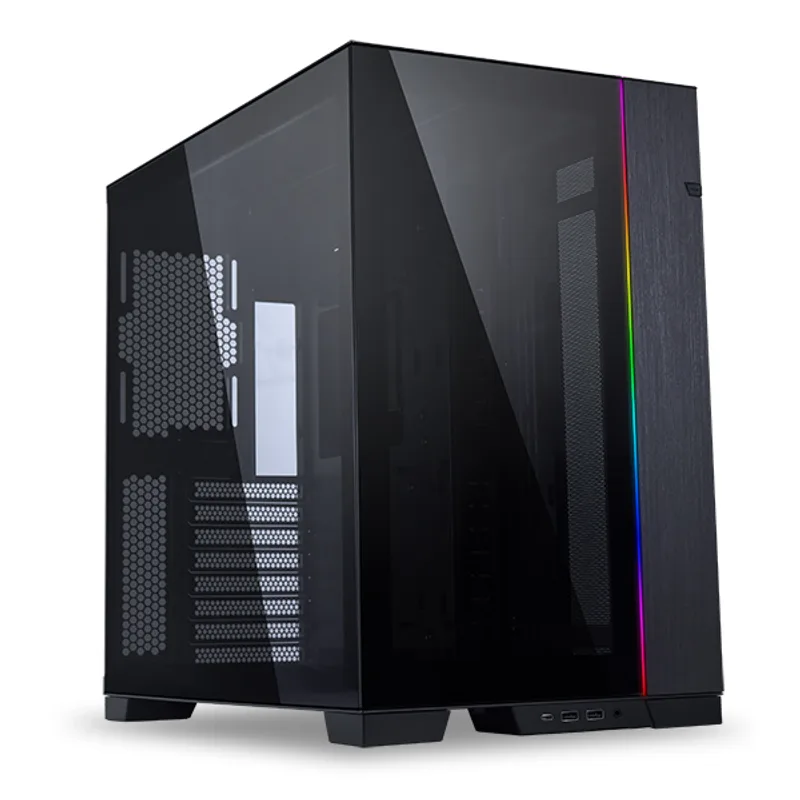
The defining feature carried over from the original O11 Dynamic is Reverse Mode: the entire internal layout can flip, so the front and side glass panels face left instead of right. That matters more than it sounds — most showcase cases assume a right-side desk placement, and flipping orientation on a fixed-layout case usually means the motherboard tray ends up facing the wrong way. The O11 Dynamic EVO’s I/O module is also relocatable across three standard positions plus an optional top mount, so the front-panel ports don’t get stranded by whichever mode you pick.
The case supports E-ATX motherboards up to 280mm wide alongside ATX, mATX, and Mini-ITX, and the 426mm GPU clearance combined with 167mm CPU cooler height covers essentially every current air-cooled or single-radiator build. Where it separates from the competition here is radiator flexibility: independent 360mm zones on the top, bottom, and side (360mm or 280mm) give custom-loop builders room for a full loop without compromising on radiator size in any single location.
The specific SKU covered in this review — Black, with fans — ships with seven UNI FAN SL-Infinity 120mm ARGB fans pre-installed. That’s a real change from the case’s reputation over the years; the standard O11 Dynamic EVO has historically shipped with zero fans, pushing the real cost of a complete build higher than the case price alone suggested. Buying the fan-included configuration sidesteps that entirely.
The trade-off is the same one dual-chamber cases have always carried: owner reviews consistently flag that cable routing needs real planning, since sloppy routing in the rear chamber can still show through the front and side glass where there’s no fabric cover to hide it. Budget extra build time versus a single-chamber case if this is your first dual-chamber build.
NZXT H9 Flow: The Wider Radiator Zone
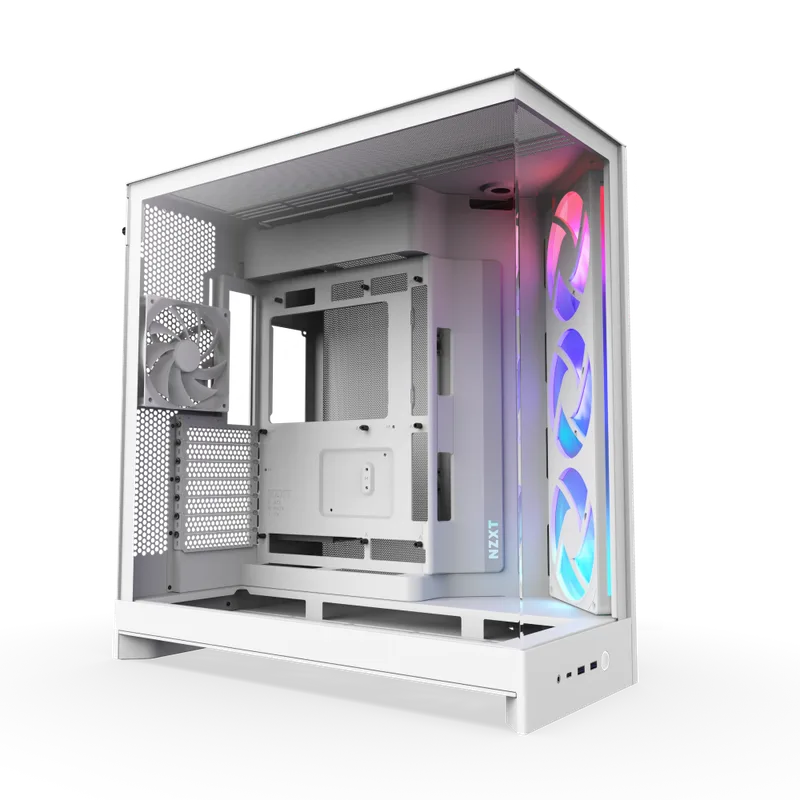
The H9 Flow is the O11 Dynamic EVO’s most direct dual-chamber competitor, and it wins on two specific numbers: a 420mm top radiator zone versus the O11 Dynamic EVO’s 360mm ceiling, and 435mm of GPU clearance versus 426mm. If your build centers on the thickest possible top-mounted radiator or the single longest graphics card on the market, the H9 Flow has more room to work with.
It also ships four fans standard on the plain black SKU — three 140mm units plus one 120mm — without needing to pay extra for an RGB-branded configuration just to get fans included at all. The 2025 revision added native back-connect motherboard support for boards like the ASUS BTF and MSI Project Zero, routing power cables behind the tray entirely for a front-glass view that needs no cable-cover panel to look clean.
What it doesn’t have is the O11 Dynamic EVO’s Reverse Mode or three-zone radiator layout — the H9 Flow’s side radiator support tops out at 360mm with no independent bottom zone, so total simultaneous radiator capacity across a full custom loop is lower than what the O11 Dynamic EVO supports.
Fractal Design North: The Airflow-First Alternative

The North is the case for builders who want out of the glass-showcase arms race entirely. Its FSC-certified walnut wood front panel is a genuinely different aesthetic from every case in this comparison, and the mesh side-panel variant drops GPU temperatures 3-5°C versus the tempered glass option, per Fractal’s own airflow testing — a real thermal argument for skipping glass altogether if temperatures matter more than a full view of the build.
Single-chamber construction means simpler cable management than either dual-chamber case here, with fewer routing decisions for builders doing their first PC. The two included 140mm Aspect PWM fans also run quieter at stock — around 25 dBA at medium RPM — than either dual-chamber alternative’s stock fan configuration.
The trade-offs are real: 355mm GPU clearance is the tightest of the three cases and can block some triple-fan flagship cards without removing the optional drive bracket, and the single-chamber layout means more visible cabling on the glass variant since there’s no separated rear compartment to hide it in.
FAQ
Does the Lian Li O11 Dynamic EVO come with fans included?
It depends on the SKU. The base O11 Dynamic EVO has historically shipped without fans, but the Black-with-Fans configuration covered in this review includes seven UNI FAN SL-Infinity 120mm ARGB fans pre-installed. Check the specific listing before buying if fan inclusion matters to your budget.
What’s the difference between the O11 Dynamic EVO and the O11 Dynamic EVO XL?
The standard O11 Dynamic EVO is a mid-tower supporting E-ATX motherboards up to 280mm wide. The XL is a larger full-tower variant built for wider E-ATX boards and bigger radiators, at the cost of significantly more desk or cabinet footprint.
Is Reverse Mode difficult to set up?
Reverse Mode involves flipping the internal layout and relocating the I/O module to one of its alternate positions, which takes more time than a standard build but doesn’t require any tools beyond what’s included. It’s worth planning for during the initial build rather than retrofitting after cables are routed.
How does the O11 Dynamic EVO compare to the NZXT H9 Flow for a custom water-cooling loop?
The O11 Dynamic EVO supports three independent 360mm radiator zones (top, bottom, side), while the H9 Flow’s radiator support is concentrated in a wider 420mm top zone and a 360mm side zone with no separate bottom mount. For a full loop with multiple radiators, the O11 Dynamic EVO’s three-zone layout gives more total capacity; for a single very thick top radiator, the H9 Flow’s 420mm zone has more headroom.
Do I need a dual-chamber case for a showcase build?
Not strictly, but it helps. Dual-chamber cases like the O11 Dynamic EVO and H9 Flow isolate the PSU and bulk cabling in a rear compartment, keeping the primary chamber’s glass sightline clear. A single-chamber case like the Fractal Design North can still look clean with careful routing, but there’s no separated compartment to hide mistakes in.
The Bottom Line
The Lian Li O11 Dynamic EVO remains the showcase-case benchmark in 2026, and the Black-with-Fans configuration reviewed here closes the one real gap the line has carried since 2018 — you’re no longer buying an empty shell and pricing out fans separately. Reverse Mode and three independent 360mm radiator zones still aren’t matched anywhere else in this comparison. The NZXT H9 Flow is the better pick if a single wide top radiator or the largest possible GPU clearance matters more to your build than layout flexibility. The Fractal Design North is worth a look if you’d rather skip the glass-showcase format entirely in favor of better stock thermals, quieter fans, and simpler cable management.