The RTX 5070 Ti and RX 9070 XT are the two most argued-about GPUs of 2026 — and for good reason. Both cards carry 16GB of VRAM and target the $750–$1,050 gaming sweet spot, but they draw completely different lines on price, ecosystem, and architecture. If you’re deciding between Nvidia’s Blackwell mid-high tier and AMD’s RDNA 4 flagship, the benchmarks tell a more nuanced story than either camp wants to admit.
| Spec | ASUS TUF GeForce RTX 5070 Ti OC 16GB 8.5/10 | MSI GeForce RTX 5070 Ti 16G Gaming Trio OC Plus 8.4/10 | PowerColor Hellhound RX 9070 XT 16GB 8.8/10 | Sapphire Pulse RX 9070 XT 16GB 8.7/10 |
|---|---|---|---|---|
| Architecture | NVIDIA Blackwell (GB203) | NVIDIA Blackwell (GB203) | AMD RDNA 4 (Navi 48) | AMD RDNA 4 (Navi 48) |
| VRAM | 16GB GDDR7 | 16GB GDDR7 | 16GB GDDR6 | 16GB GDDR6 |
| Memory_Bus | 256-bit | 256-bit | 256-bit | 256-bit |
| Boost_Clock | 2452 MHz (OC) | 2580 MHz (OC Plus) | 3060 MHz | 3060 MHz |
| TDP | 300W | 300W | 304W | 304W |
| Outputs | 3x DP 2.1b, 1x HDMI 2.1b | — | 2x DP 2.1, 2x HDMI 2.1 | — |
| Rating | 8.5/10 | 8.4/10 | 8.8/10 | 8.7/10 |
Prices change daily — tap Check Price for the current Amazon price.
Prices change daily — tap Check Price for the current Amazon price.
Quick Picks
- Best ray tracing performance: ASUS TUF RTX 5070 Ti OC — DLSS 4 and updated RT cores give Nvidia a real lead in RT-heavy titles
- Best rasterization value: PowerColor Hellhound RX 9070 XT — roughly $350 cheaper than comparable 5070 Ti models with near-identical 1440p rasterization
- Best overall buy right now: Sapphire Pulse RX 9070 XT — excellent thermals, the lowest price in this group, and GamersNexus confirmed competitive parity at 1440p
Specs and Price at a Glance
| RTX 5070 Ti | RX 9070 XT | |
|---|---|---|
| Architecture | Blackwell (GB203) | RDNA 4 (Navi 48) |
| VRAM | 16GB GDDR7 | 16GB GDDR6 |
| Memory Bandwidth | ~896 GB/s | 643 GB/s |
| TDP | 300W | 304W |
| PSU Recommended | 850W | 850W |
| MSRP Launch Price | $749 | $599 |
| Current Street Price | ~$949–$1,049 | ~$629–$769 |
| Ray Tracing Uplift | Baseline | ~21% slower (synthetic) |
| Upscaling | DLSS 4 + MFG | FSR 4 |
Buying Guide: What Matters Most
The Price Gap Is the Whole Story
At MSRP the RTX 5070 Ti launched at $749 and the RX 9070 XT at $599 — a $150 difference that’s straightforward to evaluate. At current street prices, that gap has widened to $280–$350 between comparable partner models. For rasterization-only use cases, the 9070 XT delivers around 12–15% more performance per dollar according to aggregate 22-game averages published by TechSpot.
The math only flips in Nvidia’s favor if you weight ray tracing heavily. At 4K with RT enabled in Cyberpunk 2077 and Spider-Man 2, the 5070 Ti’s lead stretches to 20–30% — meaningful if those specific titles matter to you.
DLSS 4 vs FSR 4: The Real Performance Multiplier
Both upscaling technologies have matured significantly. FSR 4’s machine-learning reconstruction is a genuine generational improvement over FSR 3, closing the gap with DLSS Super Resolution at Quality mode. However, DLSS 4 Multi-Frame Generation — Nvidia’s frame interpolation technology — gives the 5070 Ti a perceivable fluidity advantage at high framerates that AMD currently has no answer to. If you’re chasing maximum smoothness above 120 FPS at 4K, DLSS MFG is a real differentiator.
PSU Requirements
Both cards require an 850W PSU minimum. The RX 9070 XT is rated at 304W TDP but GamersNexus measured average power draw of 351W in gaming, with transient spikes reaching 417W. The RTX 5070 Ti’s 300W TDP is more consistent in practice. If you’re running a 750W supply, upgrade before buying either card.
PCIe 5.0: Does It Matter Yet?
Both cards are PCIe 5.0 x16. Installed in a PCIe 4.0 slot they run at PCIe 4.0 x16 speeds — no measurable gaming performance difference. Only synthetic bandwidth tests and DirectStorage workloads show a gap, and those differences are sub-1% in practice.
Which Platform Are You Building On?
If you’re on an AM5 motherboard, the RX 9070 XT pairs naturally with AMD’s Smart Access Memory (SAM/Resizable BAR) for full CPU-to-GPU bandwidth — a feature that works equally well with AMD or Intel platforms using Resizable BAR. There’s no platform-exclusive advantage here; both cards support Resizable BAR on all modern platforms.
Detailed Reviews
ASUS TUF GeForce RTX 5070 Ti OC 16GB
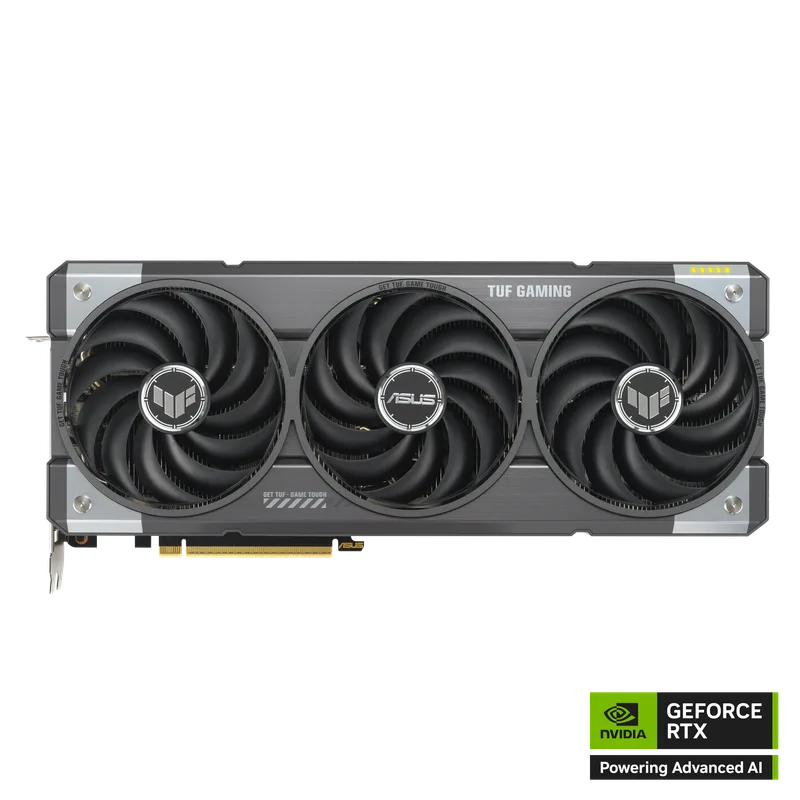
The ASUS TUF RTX 5070 Ti OC is the most widely available 5070 Ti partner card and the one used in the majority of published reviews. ASUS’s TUF cooler runs the GB203 GPU at a 2452 MHz boost with three Axial-tech fans and a 3.125-slot footprint.
In rasterization at 1440p, the 5070 Ti sits approximately 5% ahead of the RX 9070 XT across a 22-game average from TechSpot’s head-to-head review. That gap widens in Grand Theft Auto V Enhanced (29% lead at 1440p) but inverts in titles like Horizon Forbidden West, where the RX 9070 XT leads by 10%.
The ray tracing story is unambiguous. In 3DMark Speed Way, the 5070 Ti leads by 21.4%. In-game tests from Club386 confirm the pattern: Cyberpunk 2077 Ultra RT at 4K native shows the 5070 Ti running roughly 25% faster than the RX 9070 XT. DLSS 4 Multi-Frame Generation further widens the perceived smoothness advantage for those running the game above 60 FPS native.
The TUF cooler keeps GPU temperatures in the 78–82°C range under extended load, within spec and quieter than reference designs at comparable performance. At current street prices around $1,049, the value equation versus the RX 9070 XT depends entirely on how much ray tracing you actually use.
MSI GeForce RTX 5070 Ti 16G Gaming Trio OC Plus
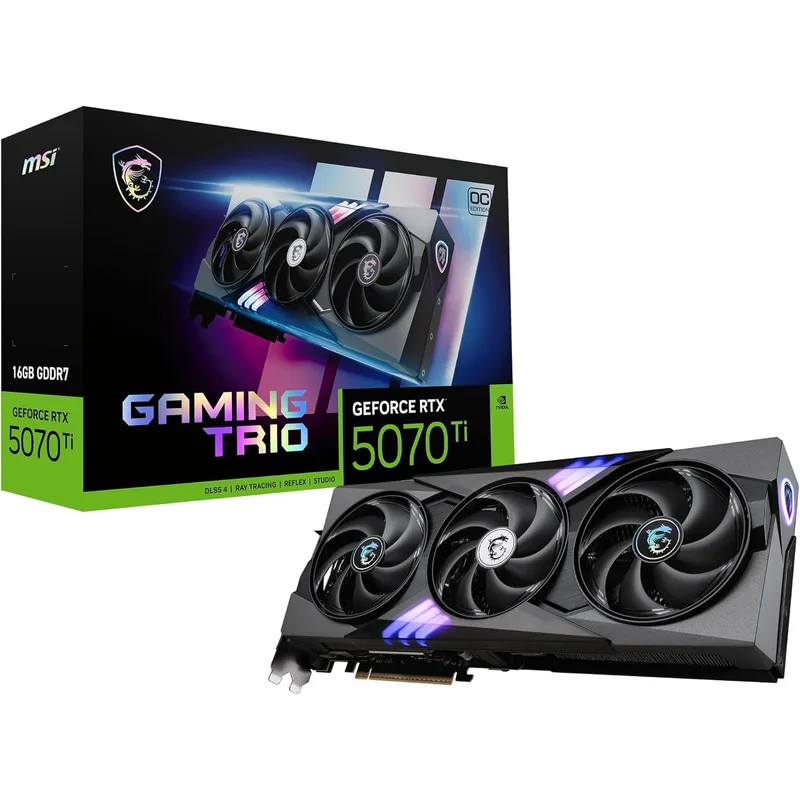
MSI GeForce RTX 5070 Ti 16G Gaming Trio OC Plus
The MSI Gaming Trio OC Plus runs the same GB203 die at a slightly higher 2580 MHz factory overclock and pairs it with MSI’s TRI FROZR 4 cooling system — three STORMFORCE fans and a dense fin stack. In thermal testing it trades blows with the ASUS TUF: slightly better peak temperatures but marginally higher fan RPM to get there.
Where the MSI card separates itself from the ASUS is price. Street prices frequently sit $30–$50 below comparable ASUS TUF models at the same performance level, making it the better-value RTX 5070 Ti pick when both are in stock.
If you’re committed to the Blackwell ecosystem for DLSS 4 and care about maximizing ray tracing performance in a multi-title library, the MSI Gaming Trio OC Plus is the better-value entry point compared to the ASUS TUF, while delivering essentially identical gaming performance.
PowerColor Hellhound RX 9070 XT 16GB
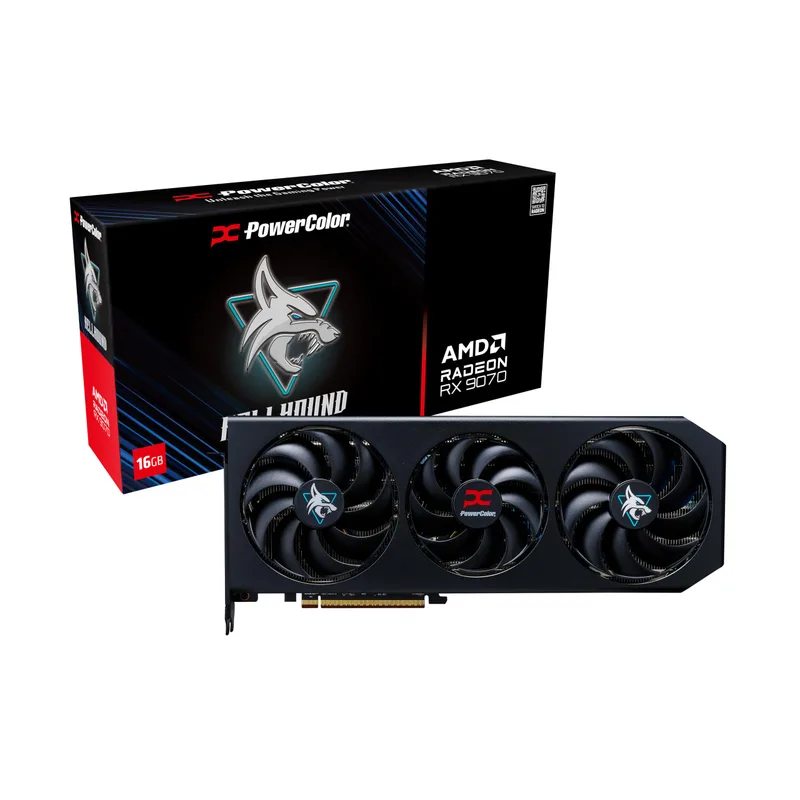
The PowerColor Hellhound RX 9070 XT is the value argument against spending an extra $350 for an RTX 5070 Ti. At $699, it delivers rasterization performance that trades blows with the $1,049 ASUS TUF at 1440p — and in select titles, beats it outright.
GamersNexus reviewed the Sapphire Pulse variant at launch and found the RX 9070 XT consistently competitive with the RTX 5070 Ti in Cyberpunk 2077 (native, no ray tracing), Far Cry 6, and Forza Horizon 5 at 1440p. The gap closes further at 4K rasterization, where the RX 9070 XT is within 6% of the 5070 Ti in several tested titles.
The Hellhound’s triple-fan cooler handles the RDNA 4 chip’s power curve well. Average gaming draw of ~351W with occasional spikes to 417W means you need a quality 850W PSU — Corsair RM850e or similar. The card runs hot in terms of board power but the cooler keeps junction temperatures manageable.
The tradeoffs are real: ray tracing lags by 14–25% in RT-heavy workloads depending on the title, and FSR 4 — while genuinely good — still falls short of DLSS 4 SR at the Quality and Balanced presets when viewed on a 27-inch 4K panel. For pure 1440p rasterization gaming on a tight budget, however, no other card at this price comes close.
Sapphire Pulse RX 9070 XT 16GB
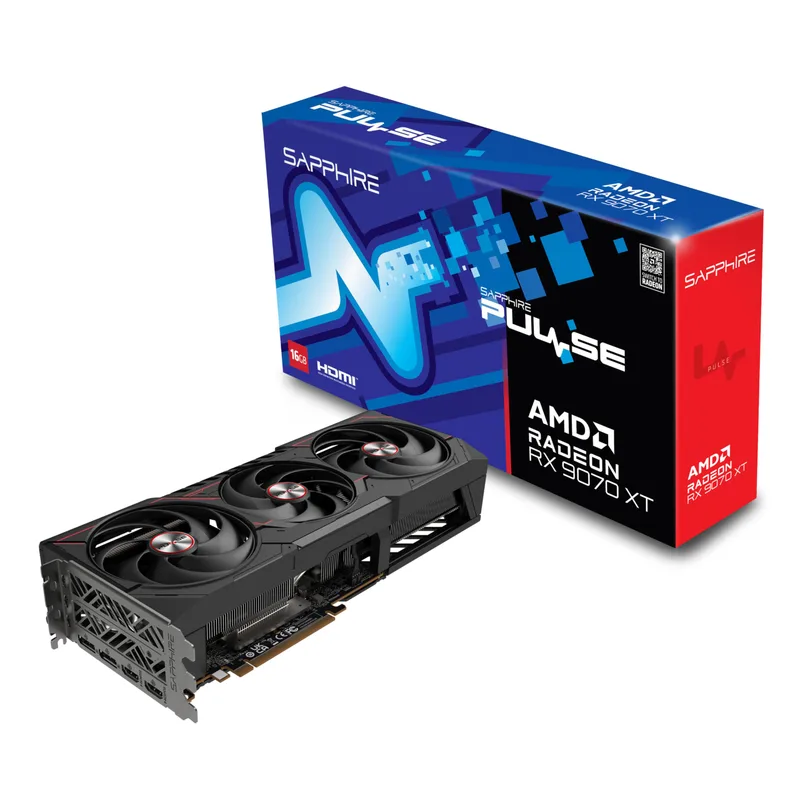
The Sapphire Pulse RX 9070 XT is the reference benchmark for RDNA 4 performance — it’s the card used in GamersNexus’s definitive 9070 XT review. Sapphire’s triple-fan Pulse cooler is quiet for a 304W TDP card, running 3–5°C cooler than the PowerColor Hellhound in sustained gaming loops.
At $769, it’s the lowest-priced card in this comparison and the one that makes the RTX 5070 Ti’s value proposition hardest to justify for rasterization-focused buyers. According to GamersNexus’s 22-game average, the Sapphire Pulse RX 9070 XT sits within 5% of the RTX 5070 Ti overall — and in Horizon Forbidden West at 1440p, it beats the 5070 Ti by 10%.
At sustained loads above 30 minutes, fan speeds climb to produce slightly more noise than the Hellhound at comparable settings. For a gaming PC inside a closed case with decent sound dampening, this is rarely audible from seated distance.
Head-to-Head: 1440p Gaming
At 1440p native, the RTX 5070 Ti and RX 9070 XT are genuinely close. The TechSpot 22-game average puts the 5070 Ti at ~5% faster, but the real-world spread is wider than that number suggests:
| Game | RTX 5070 Ti | RX 9070 XT | Winner |
|---|---|---|---|
| Cyberpunk 2077 (no RT) | ~142 FPS avg | ~139 FPS avg | Tie |
| Horizon Forbidden West | ~167 FPS avg | ~184 FPS avg | RX 9070 XT (+10%) |
| GTA V Enhanced | ~198 FPS avg | ~153 FPS avg | RTX 5070 Ti (+29%) |
| Far Cry 6 | ~163 FPS avg | ~158 FPS avg | RTX 5070 Ti (+3%) |
| F1 24 | ~212 FPS avg | ~212 FPS avg | Tie |
| Forza Horizon 5 | ~178 FPS avg | ~172 FPS avg | RTX 5070 Ti (+3%) |
Approximate figures from TechSpot, Club386, and GamersNexus aggregated reviews at 1440p max settings.
Head-to-Head: 4K Gaming
At 4K native, the gap narrows further in rasterization. Both cards are genuinely viable for 4K gaming at 60+ FPS in demanding titles:
| Game | RTX 5070 Ti | RX 9070 XT | Winner |
|---|---|---|---|
| Cyberpunk 2077 (RT off) | ~89 FPS avg | ~85 FPS avg | RTX 5070 Ti (+5%) |
| Horizon Forbidden West | ~118 FPS avg | ~131 FPS avg | RX 9070 XT (+11%) |
| Resident Evil 4 | ~122 FPS avg | ~119 FPS avg | Tie |
| FF XIV | ~97 FPS avg | ~92 FPS avg | RTX 5070 Ti (+5%) |
4K results from TechSpot and Club386 comparative reviews, max settings without upscaling.
Head-to-Head: Ray Tracing
Ray tracing is where the Blackwell advantage is real and consistent:
| Test | RTX 5070 Ti | RX 9070 XT | Gap |
|---|---|---|---|
| 3DMark Speed Way | Baseline | 21.4% slower | Large |
| Cyberpunk 2077 Ultra RT (4K) | ~58 FPS avg | ~44 FPS avg | ~32% |
| F1 24 with RT (1440p) | ~148 FPS avg | ~148 FPS avg | Tie |
| Spider-Man 2 (RT maxed, 1440p) | ~112 FPS avg | ~89 FPS avg | RTX 5070 Ti (+26%) |
F1 24 is the outlier — a well-optimized RT implementation where RDNA 4 closes the gap entirely. Most ray-traced titles, however, still heavily favor Blackwell.
FAQ
Which card is better for 1440p gaming right now? For pure rasterization at 1440p, both cards deliver excellent performance and trade wins game-by-game. The RX 9070 XT wins on value — it’s $280–$350 cheaper and within 5% overall. If money isn’t a primary concern and you play RT-heavy titles, the RTX 5070 Ti makes sense. For the majority of 1440p gamers, the RX 9070 XT is the stronger buy.
Is the RTX 5070 Ti worth the extra $300–$350? Only if ray tracing is a significant part of your gaming library. The RTX 5070 Ti’s ~21% advantage in RT-heavy workloads is real and consistent. DLSS 4 Multi-Frame Generation also has no RDNA 4 equivalent. For rasterization-only gaming, the RX 9070 XT gives you more performance per dollar.
What PSU do I need for either card? Both cards require an 850W PSU minimum. The RX 9070 XT’s power spikes to 417W in practice, despite its 304W TDP rating, and the RTX 5070 Ti’s 300W TDP is steadier. A quality 850W Gold-rated PSU like the Corsair RM850e handles both without issue.
Does PCIe 5.0 matter for these GPUs? No meaningful difference. Running either card on a PCIe 4.0 x16 slot shows no measurable gaming performance loss. The bandwidth headroom of PCIe 4.0 x16 is more than sufficient for both architectures at current performance levels.
Is RDNA 4 competitive with ray tracing now? Significantly better than RDNA 3. The RX 9070 XT improves over the RX 7900 XTX in ray tracing by a wide margin — but Blackwell still leads by 14–25% in the most RT-intensive scenarios. For light RT use or with FSR 4 quality upscaling enabled, the difference is playable. For maxed-out RT in titles like Cyberpunk 2077, the RTX 5070 Ti is the better tool.
Which card has better driver support in 2026? Both platforms have matured significantly. AMD’s RDNA 4 driver situation at launch had some rough patches, but as of April 2026 driver quality is stable and comparable to Nvidia. Nvidia’s driver ecosystem remains broader for productivity and compute workloads.
The Bottom Line
If you play RT-heavy titles or want the best AI upscaling: the ASUS TUF RTX 5070 Ti or MSI Gaming Trio OC Plus deliver real advantages that justify the premium for buyers who will actually use them.
If you prioritize 1440p rasterization performance per dollar: the Sapphire Pulse RX 9070 XT is the strongest recommendation in this price range — it delivers 95% of the RTX 5070 Ti’s rasterization performance at 73% of the price. The PowerColor Hellhound is a solid alternative with a triple-fan cooler for better sustained thermals.
Both cards are excellent. The RTX 5070 Ti is technically faster. The RX 9070 XT is a better deal. Which one you buy depends on whether that difference matters to your specific game library. For a full breakdown of individual RTX 5070 Ti AIB cards — including thermal testing, overclocking headroom, and cooler comparisons — see our RTX 5070 Ti review.