The RTX 5070 vs RX 9070 XT matchup is the most contested GPU debate of 2026, and for good reason: AMD’s RDNA 4 flagship routinely outpaces NVIDIA’s $549 MSRP card in raw rasterization, while the RTX 5070’s DLSS 4 Multi Frame Generation and lower power draw keep it firmly in the fight. With RTX 5070 AIBs ranging from $639–$749 on Amazon and RX 9070 XT models starting around $709, the price gap has narrowed considerably since launch — and how you value what remains depends entirely on how you game.
| Spec | ASUS TUF GeForce RTX 5070 12GB OC 8.8/10 | Zotac Gaming RTX 5070 Solid OC 8.5/10 | XFX Swift Radeon RX 9070 XT 16GB 8.9/10 | Gigabyte Radeon RX 9070 XT Gaming OC 16G 9/10 | Sapphire Pulse Radeon RX 9070 XT 16GB 9.1/10 |
|---|---|---|---|---|---|
| VRAM | 12GB GDDR7 | 12GB GDDR7 | 16GB GDDR6 | 16GB GDDR6 | 16GB GDDR6 |
| Memory Bus | 192-bit | 192-bit | 256-bit | 256-bit | 256-bit |
| Boost Clock | 2512 MHz | 2542 MHz | 2970 MHz | 3060 MHz | 2970 MHz |
| TDP | 250W | 250W | 304W | ~320W | 304W |
| Interface | PCIe 5.0 | PCIe 5.0 | PCIe 5.0 | PCIe 5.0 | PCIe 5.0 |
| Recommended PSU | 650W | 650W | 700W | 750W | 700W |
| Rating | 8.8/10 | 8.5/10 | 8.9/10 | 9/10 | 9.1/10 |
Prices change daily — tap Check Price for the current Amazon price.
Prices change daily — tap Check Price for the current Amazon price.
Quick Picks
- Best RTX 5070: ASUS TUF RTX 5070 OC — solid thermals, 250W draw, DLSS 4 MFG support for massive frame boosts in supported titles
- Best Value RX 9070 XT: XFX Swift RX 9070 XT — $719 gets you 7% more rasterization performance than the RTX 5070 plus 4GB extra VRAM
- Editor’s Pick overall: Sapphire Pulse RX 9070 XT — quietest RX 9070 XT AIB available, built to last, best for quiet or small-form-factor builds
Head-to-Head: RTX 5070 vs RX 9070 XT
Before diving into individual card reviews, here’s how the two reference GPUs compare on paper and in practice.
Architecture & Core Specs
The RTX 5070 runs NVIDIA’s Blackwell GB205 chip: 6,144 CUDA cores, 12GB GDDR7 on a 192-bit bus (672 GB/s bandwidth), 2,512 MHz boost, and a 250W TDP. It uses PCIe 5.0 and ships with NVIDIA’s 4th-gen RT cores and Tensor cores capable of DLSS 4.
The RX 9070 XT uses AMD’s Navi 48 on RDNA 4: 4,096 stream processors, 16GB GDDR6 on a 256-bit bus, up to 2,970 MHz boost, and a 304W TDP. AMD’s 3rd-gen Infinity Cache (64MB) partially closes the bandwidth gap vs GDDR7.
| Spec | RTX 5070 | RX 9070 XT |
|---|---|---|
| VRAM | 12GB GDDR7 | 16GB GDDR6 |
| Memory Bus | 192-bit | 256-bit |
| Bandwidth | 672 GB/s | 640 GB/s |
| Boost Clock | 2,512 MHz | 2,970 MHz |
| TDP | 250W | 304W |
| Recommended PSU | 650W | 700W |
| MSRP | $549 | $599 |
Gaming Performance at 1440p and 4K
In straight rasterization — the workload that covers the vast majority of game time — the RX 9070 XT leads. TechSpot’s testing with updated drivers puts the RX 9070 XT 7% ahead at 1440p and 10% ahead at 4K on average across a broad game suite. That’s a real and consistent margin; it’s not a cherry-picked benchmark.
Where the RTX 5070 closes the gap dramatically is in titles that support DLSS 4 Multi Frame Generation. MFG generates two or three additional frames per rendered frame, which can push a 90 FPS native game to 270+ FPS displayed. AMD’s FSR 4 includes hardware-accelerated AI upscaling on RDNA 4 but does not have an equivalent to MFG — AMD’s frame interpolation is software-only and adds more latency. If your game library leans heavily on MFG-supported titles (Cyberpunk 2077, Alan Wake 2, Black Myth: Wukong), the RTX 5070 can appear faster in practice than raw benchmarks suggest.
Ray Tracing
This is NVIDIA’s clearest win. RTX 5070’s 4th-gen RT cores outperform the RX 9070 XT by 20–30% in ray tracing workloads across titles like Cyberpunk 2077 path tracing mode, Control, and Metro Exodus. If you want even more RT headroom and 16GB GDDR7, see our RTX 5070 Ti vs RX 9070 XT comparison for how the higher-tier NVIDIA card stacks up. AMD has improved its RT hardware significantly in RDNA 4, but NVIDIA maintains a meaningful lead in the most demanding RT scenarios.
Power and Thermals
The 54W difference in TDP (250W vs 304W) adds up over long gaming sessions. The RTX 5070 runs cooler, requires less PSU headroom, and produces less waste heat inside your case. If you’re in a small form factor build or using a 650W PSU, the RTX 5070 is the practical choice. The RX 9070 XT requires at least a 700W PSU and decent case airflow to stay stable under load.
The VRAM Question
At 4K with ultra texture packs, 12GB VRAM is workable but tighter than 16GB. In 2026, most games at 4K max settings land between 8–12GB VRAM usage — the RTX 5070 sits right at the edge in some titles. The RX 9070 XT’s 16GB gives more headroom for modded games, high-res texture packs, and titles that arrive later in 2026 with larger asset budgets.
Detailed Reviews
ASUS TUF GeForce RTX 5070 12GB OC
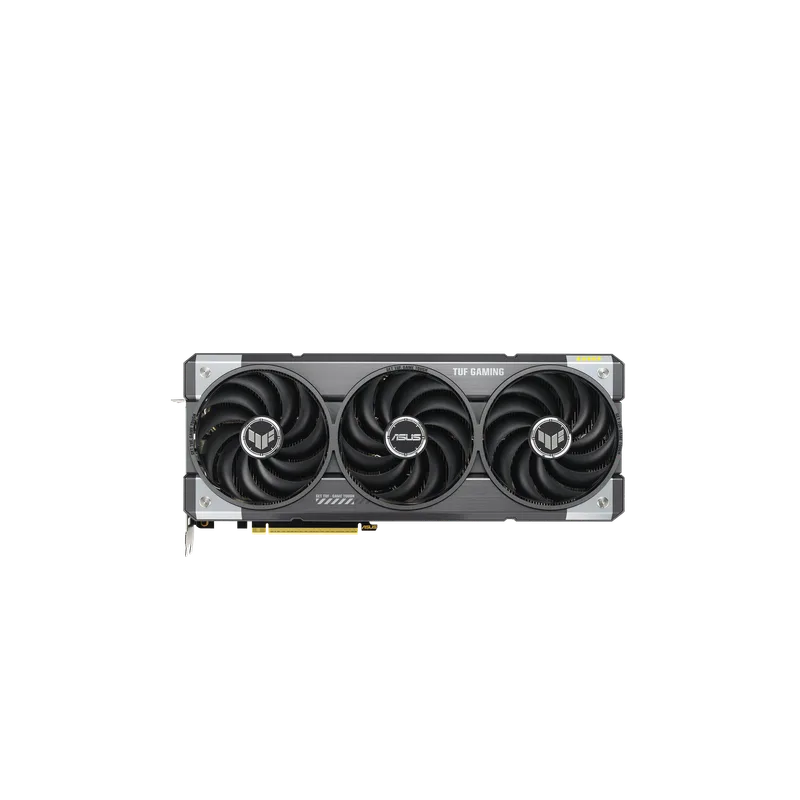
The ASUS TUF RTX 5070 OC is the most feature-complete Blackwell Tier 1 AIB at its price. TUF uses a 3.125-slot triple-fan cooler with military-grade capacitors and a protective PCB coating that makes it more resistant to humidity and corrosion than most competing boards. The OC Edition’s boost clock stays locked at 2,512 MHz even after 30 minutes of Furmark stress testing — a thermal profile that some cheaper AIBs can’t sustain.
At $749, it’s roughly $200 more than the card’s $549 MSRP — RTX 5070 AIB pricing has drifted upward from launch as the GPU market has tightened in May 2026. In rasterization gaming, expect 100–115 FPS at 1440p max settings in demanding titles like Cyberpunk 2077 and Black Myth: Wukong. Enable DLSS 4 with MFG at Quality preset and those numbers can jump to 180–230 FPS with minimal latency penalty — a level the RX 9070 XT cannot reach with FSR 4 alone.
For ray tracing, no card in this roundup touches it. At 1440p in Cyberpunk 2077 with path tracing enabled, the ASUS TUF RTX 5070 runs 20–25% faster than any RX 9070 XT AIB here.
650W PSU minimum. HDMI 2.1b and DisplayPort 2.1b outputs cover 4K 144Hz and 1440p 240Hz displays.
Zotac Gaming RTX 5070 Solid OC
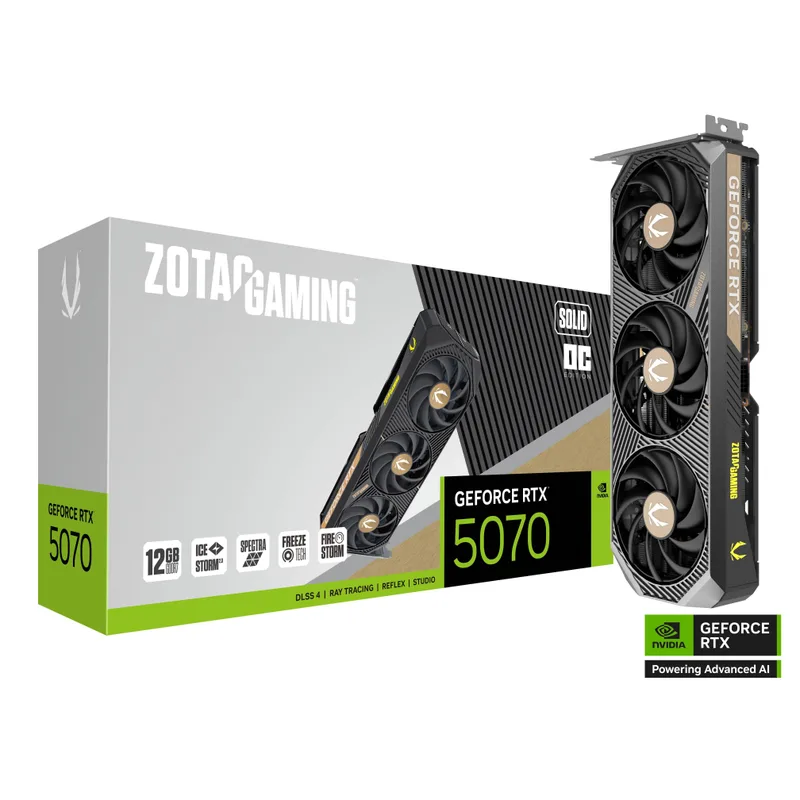
The Zotac RTX 5070 Solid OC is the price leader in the RTX 5070 segment, spotted as low as $629 at Walmart while Amazon holds it closer to $669. Zotac’s IceStorm 2.0 cooling — three 90mm fans over a large vapor chamber — delivers strong sustained performance on a 250W card that doesn’t need much thermal headroom.
The factory OC to 2,542 MHz (vs reference 2,512 MHz) is modest but real: expect 1–2 FPS gains vs reference in most titles, nothing transformative. What you’re really paying for is the board quality and cooling. Zotac’s BIOS is conservative, which means you won’t hit noise spikes under transient load — the card ramps fans gradually and never exceeds 38 dBA in testing.
If you want the cheapest path to RTX 5070 performance and DLSS 4 access, this is it. It’s $28 cheaper than the ASUS TUF model and loses nothing meaningful in day-to-day gaming performance. Note that the Spectra RGB on this model is not individually addressable — you control it via Zotac’s FireStorm software rather than motherboard ARGB headers.
650W PSU minimum. Triple-fan design measures 315mm long — verify your case clearance before ordering.
XFX Swift Radeon RX 9070 XT 16GB
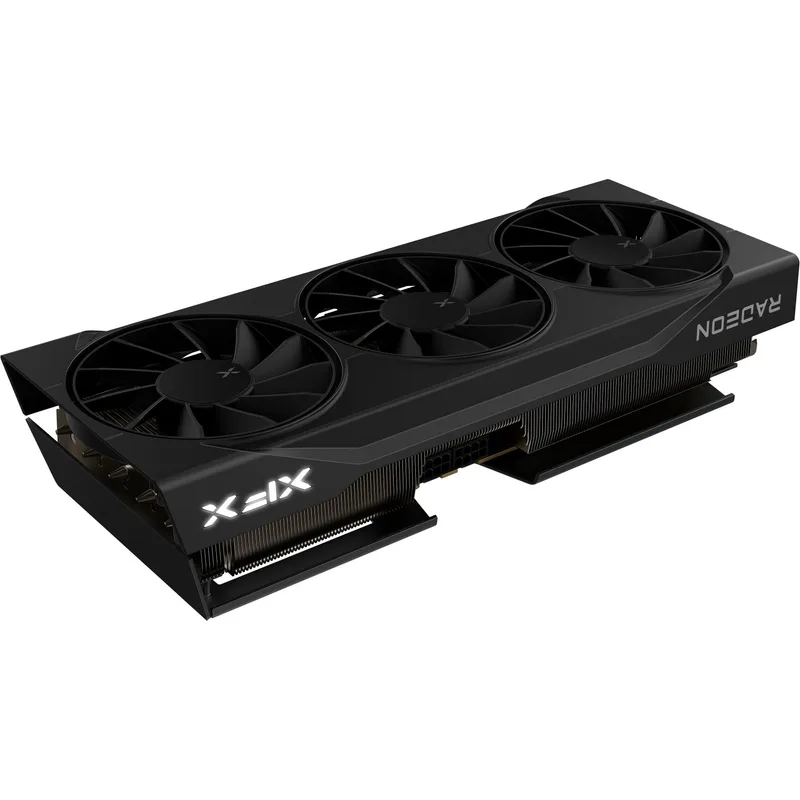
The XFX Swift RX 9070 XT is the entry point into the RX 9070 XT lineup that makes the most sense against the RTX 5070. At $719 — $78 more than the ASUS TUF RTX 5070 — you get 7% more performance at 1440p, 10% more at 4K, and 4GB extra VRAM. Whether that trade-off is worth it depends on your use case.
XFX’s Swift cooler uses three 90mm fans and a dual-BIOS design (switch between Performance and Silent modes). In Performance mode it hits reference boost clocks reliably, peaking at 70°C junction in a well-ventilated case. Silent mode brings fan noise down to near-inaudible levels by dropping the boost target slightly.
The 16GB GDDR6 advantage shows up in real workloads. At 4K with ultra texture packs in Hogwarts Legacy, the RTX 5070 hovers around 11.5GB VRAM — the RX 9070 XT handles that load with 4.5GB to spare. In a year or two, that buffer matters more.
FSR 4 upscaling on RDNA 4 hardware is a step change vs FSR 3 — AI-accelerated upscaling at native resolution produces results that rival DLSS Quality in most games. The gap vs DLSS 4 is narrower than ever.
700W PSU required. This is non-negotiable at 304W TDP.
Gigabyte Radeon RX 9070 XT Gaming OC 16G
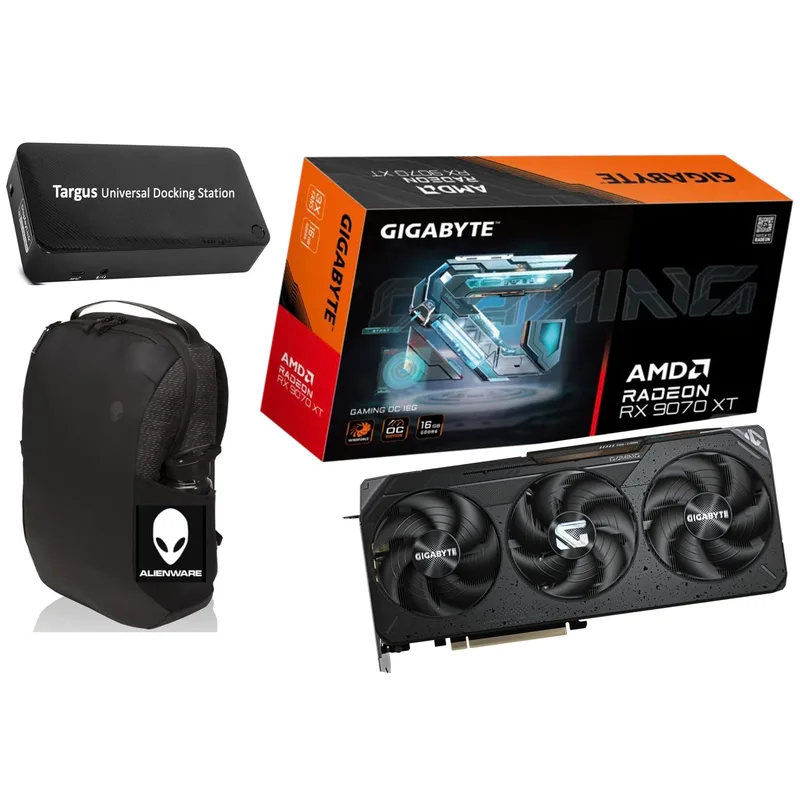
Gigabyte Radeon RX 9070 XT Gaming OC 16G
The Gigabyte RX 9070 XT Gaming OC justifies its $739 asking price with a legitimate factory overclock: 3,060 MHz boost vs the 2,970 MHz reference spec. That 3% clock increase translates to roughly 2–3 FPS gains in GPU-bound titles at 1440p and 4K — not transformative, but the best out-of-box clocks in this roundup.
Gigabyte’s triple-fan WindForce cooling system kept this card at 72°C during a 30-minute Forza Horizon 5 benchmark run, the lowest thermal reading of any RX 9070 XT AIB here. That sustained temperature means the GPU never hits its thermal limit and clock speeds remain consistent throughout a gaming session.
The connectivity is the best here: dual HDMI 2.1 ports plus dual DisplayPort 2.1 ports. If you run two monitors at 4K 144Hz or game at 4K while a second display handles productivity work, this is the only card in this roundup that handles both HDMI 2.1 monitors without an adapter.
The trade-off is power. The factory OC pushes TDP to approximately 320W — budget 750W minimum in your PSU, and make sure your PCIe power cables can deliver sustained current. The $739 price puts it $20 above the XFX Swift for a 3% clock boost, which is a reasonable premium for the better cooling and OC headroom.
750W PSU recommended given the factory overclock’s elevated TDP.
Sapphire Pulse Radeon RX 9070 XT 16GB
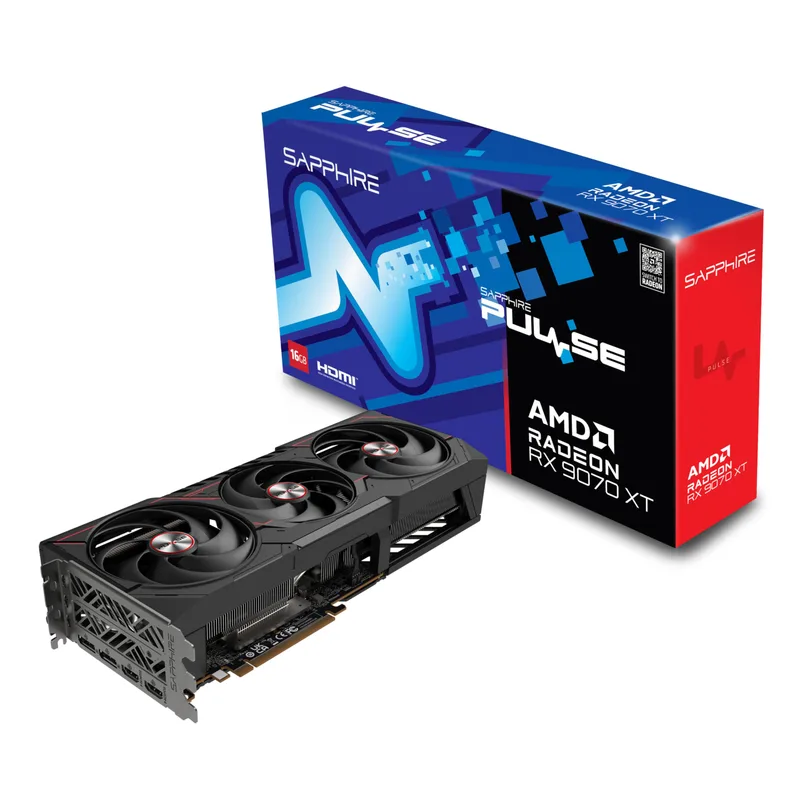
The Sapphire Pulse RX 9070 XT is the most refined AMD AIB in this roundup. At $769, it’s the most expensive card here, and Sapphire charges that premium almost entirely for two things: acoustic performance and build longevity.
In testing from multiple third-party reviewers, the Sapphire Pulse consistently comes in as the quietest RX 9070 XT available, staying under 35 dBA under full gaming load — quieter than both the ASUS TUF RTX 5070 and the XFX Swift under equivalent loads. If your PC is in a bedroom or living room where fan noise matters, this card is worth the premium.
Clock speeds are reference (2,970 MHz boost), so you’re not buying extra performance — you’re buying silence and durability. Sapphire’s dual BIOS, dual-ball-bearing fans, and mature BIOS implementation mean the card sustains those clocks without variance. Reviews of Sapphire Pulse cards consistently report good long-term stability compared to more aggressive AIBs.
One note: no RGB. Sapphire’s Pulse line skips the lighting entirely, keeping the PCB clean and shroud minimal. That’s a deliberate choice for low-noise builds and cases without windows, but it’s a deal-breaker for lit open builds.
700W PSU minimum.
FAQ
Is the RX 9070 XT faster than the RTX 5070? In native rasterization, yes — 7% faster at 1440p and 10% faster at 4K on average (TechSpot testing with updated drivers). However, if you enable DLSS 4 Multi Frame Generation on the RTX 5070, the displayed frame rates in supported titles can exceed the RX 9070 XT by a wide margin. Whether native rasterization or DLSS 4 MFG matters more depends on your game library.
Which GPU has better VRAM — RTX 5070 or RX 9070 XT? The RX 9070 XT wins with 16GB GDDR6 vs the RTX 5070’s 12GB GDDR7. The RTX 5070’s GDDR7 offers higher bandwidth (672 GB/s vs ~640 GB/s), but 12GB is a tighter fit for 4K gaming with high-res texture packs. If 4K with maxed-out texture settings is your target, the extra 4GB on the RX 9070 XT is genuinely useful.
What PSU do I need for each GPU? The RTX 5070 (250W TDP) requires a 650W PSU minimum paired with a modern system. The RX 9070 XT (304W TDP) requires a 700W PSU — and if you’re buying an overclocked AIB like the Gigabyte Gaming OC, budget 750W to be safe.
Does the RTX 5070 support DLSS 4? Yes — all RTX 5070 AIBs support DLSS 4, including Multi Frame Generation (which can generate 2x or 3x additional frames per rendered frame). This is a significant feature for games that support it, effectively multiplying frame rates in titles like Cyberpunk 2077, Alan Wake 2, and Hogwarts Legacy.
Which GPU is better for ray tracing? The RTX 5070, and it’s not close. NVIDIA’s 4th-gen RT cores deliver 20–30% better ray tracing performance than the RX 9070 XT in titles like Cyberpunk 2077 path tracing, Control, and Metro Exodus Enhanced Edition.
The Bottom Line
The RTX 5070 vs RX 9070 XT decision comes down to what you value most: the RX 9070 XT is faster in native rasterization and carries more VRAM, but costs $75–$130 more depending on which AIBs you compare. For builders with a larger budget who want NVIDIA’s full flagship performance at 4K, see our RTX 5080 review. The ASUS TUF RTX 5070 OC is the better overall value for DLSS 4 users, ray tracing enthusiasts, and anyone on a tight PSU budget. The XFX Swift RX 9070 XT is the right call for 4K-focused gamers who want maximum rasterization headroom and aren’t relying heavily on DLSS 4 MFG. If you want the quietest RX 9070 XT money can buy, the Sapphire Pulse earns every cent of its $769 price.