One of the stranger market anomalies of 2026: the Samsung 9100 Pro 1TB, a PCIe 5.0 drive with 14,700 MB/s sequential reads, is currently selling for $199 — roughly $130 less than the older 990 Pro Gen4 1TB, which is stuck near $330 due to the NAND shortage hitting older node yields harder. If you have a PCIe 5.0 M.2 slot on a current-gen board, the case for Samsung’s flagship Gen5 drive is unusually strong right now.
The 9100 Pro launched in early 2025 on Samsung’s in-house Presto controller — a 5nm design that pushes the NVMe 2.0 protocol across PCIe 5.0 x4 lanes. According to PC Perspective’s testing and StorageReview benchmarks, sequential reads land around 14,700–14,800 MB/s depending on capacity, and sequential writes reach 13,300–13,400 MB/s — approximately double the 990 Pro’s 7,450/7,450 MB/s. For gaming, that raw sequential speed is largely invisible, but for anyone moving large files, doing 4K/6K/8K video edits, or running AI workloads from local storage, the performance gap is real and immediate.
| Spec | Samsung 9100 Pro 1TB NVMe SSD 9.2/10 | Samsung 9100 Pro 2TB NVMe SSD 8.8/10 | Samsung 9100 Pro 4TB NVMe SSD 8.5/10 |
|---|---|---|---|
| interface | PCIe 5.0 x4, NVMe 2.0, M.2 2280 | PCIe 5.0 x4, NVMe 2.0, M.2 2280 | PCIe 5.0 x4, NVMe 2.0, M.2 2280 |
| seq_read | 14,700 MB/s | 14,700 MB/s | 14,800 MB/s |
| seq_write | 13,300 MB/s | 13,300 MB/s | 13,400 MB/s |
| random_read | 1,850K IOPS | 1,850K IOPS | 2,200K IOPS |
| random_write | 2,600K IOPS | 2,600K IOPS | 2,600K IOPS |
| nand | Samsung V-NAND TLC (8th gen) | Samsung V-NAND TLC (8th gen) | Samsung V-NAND TLC (8th gen) |
| Rating | 9.2/10 | 8.8/10 | 8.5/10 |
Prices change daily — tap Check Price for the current Amazon price.
Prices change daily — tap Check Price for the current Amazon price.
Specifications at a Glance
| Spec | 9100 Pro 1TB | 9100 Pro 2TB | 9100 Pro 4TB | 990 Pro 1TB (Gen4) |
|---|---|---|---|---|
| Interface | PCIe 5.0 x4, NVMe 2.0 | PCIe 5.0 x4, NVMe 2.0 | PCIe 5.0 x4, NVMe 2.0 | PCIe 4.0 x4, NVMe 2.0 |
| Seq Read | 14,700 MB/s | 14,700 MB/s | 14,800 MB/s | 7,450 MB/s |
| Seq Write | 13,300 MB/s | 13,300 MB/s | 13,400 MB/s | 6,900 MB/s |
| Rand Read IOPS | 1,850K | 1,850K | 2,200K | 1,500K |
| Rand Write IOPS | 2,600K | 2,600K | 2,600K | 1,550K |
| NAND | V-NAND TLC (8th gen) | V-NAND TLC (8th gen) | V-NAND TLC (8th gen) | V-NAND TLC (7th gen) |
| Street Price (May 2026) | $199 | $489 | $779 | $330 |
The 4TB SKU noticeably benefits from higher die parallelism: random read IOPS jumps to 2,200K versus 1,850K on the smaller capacities. Sequential speeds are nearly identical across all three.
Does PCIe 5.0 Speed Matter for Gaming?
Bluntly, no — not in any measurable way for loading screens or in-game performance. Game engines read 4K random blocks, and the 9100 Pro’s 1,850K random read IOPS is fast enough that any NVMe drive above PCIe 3.0 completes game asset loads near-identically. DirectStorage titles in 2026 show marginal gains from higher IOPS on Gen5 drives versus Gen4 in controlled testing, but owner reports and independent reviews indicate real-world loading is indistinguishable from a 990 Pro or WD Black SN8100.
Where the speed is felt: exporting a 4K Resolve timeline, moving a 500 GB video archive to a secondary drive, or running an AI model pipeline with large checkpoint files. In those workloads, the 9100 Pro’s ~97% sequential read advantage over Gen4 cuts transfer time roughly in half compared to the 990 Pro.
Who Should Buy the 9100 Pro Right Now
The 1TB at $199 is the easiest recommendation. If you have a Z790 (Intel 13th/14th gen), Z890, X870/X870E (Ryzen 9000) or any current-gen board with a PCIe 5.0 M.2 slot, there is no reason to buy the Gen4 990 Pro at $330 when the newer, faster Gen5 drive costs less. That pricing inversion is directly caused by the 2026 NAND shortage: older NAND nodes used in the 990 Pro have seen steeper supply pressure than Samsung’s newer 8th-gen TLC cells.
The 2TB and 4TB capacities are harder to justify at current street prices ($489 and $779 respectively, versus MSRPs of $299 and $549). Buyers who need those capacities specifically for high-throughput work should consider whether the timing is right — TrendForce projects NAND supply tightness continuing through Q4 2026, with some relief expected by Q1-Q2 2027.
Compatibility: PCIe Slot Requirements
The 9100 Pro is an M.2 2280 form factor drive (standard 80mm length, fits almost all motherboards). The critical compatibility check is the M.2 slot’s PCIe generation. A PCIe 5.0 slot is required to reach 9100 Pro speeds. On PCIe 4.0, the drive still operates but is limited to ~7,400 MB/s read — no faster than a 990 Pro. Boards that have PCIe 5.0 M.2 slots include:
- Intel Z790 / Z890: Most boards have at least one PCIe 5.0 M.2 slot (verify per model)
- AMD X870 / X870E: PCIe 5.0 M.2 is standard on X870-class boards
- AMD B850: Most B850 boards include one PCIe 5.0 M.2 slot
- AMD B650 / X670E: PCIe 5.0 M.2 depends on the specific board — check the spec sheet
The drive works in any slot (backwards-compatible with PCIe 4.0 and 3.0) but runs at reduced bandwidth on older interfaces.
Thermal Performance and Heatsinks
Under sustained sequential writes at 8W peak draw, the 9100 Pro runs warmer than the 990 Pro (which peaks at 6W). Samsung includes no heatsink in the standard variants. Most current motherboards include an M.2 thermal pad and cover plate that handles the drive adequately in typical airflow conditions. If the M.2 slot lacks a heatsink, or if the drive is in a cramped NAS/workstation chassis, the 1TB heatsink variant adds about $20–$30 and is worth considering in those edge cases.
In normal gaming desktop conditions with a motherboard heatsink, thermal throttling is not commonly reported by owners, and throttle behavior does not affect random read IOPS at typical gaming load levels.
Detailed Capacity Reviews
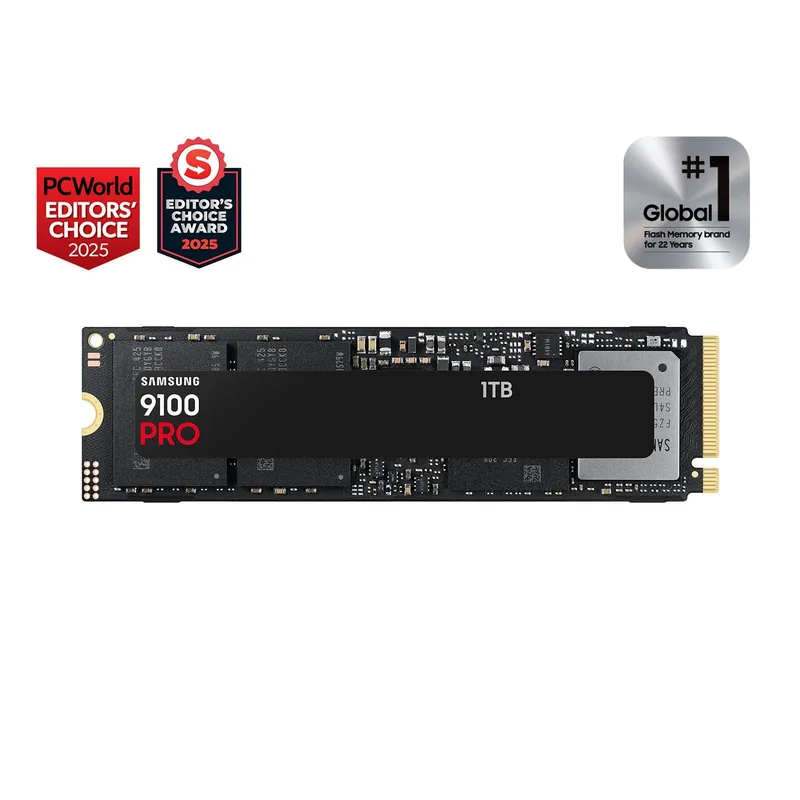
The Samsung 9100 Pro 1TB is the value anchor of the lineup. At $199, it lands below not just the Gen4 990 Pro but also the Crucial T705 Gen5 ($248) and WD Black SN8100 1TB ($284) — the three main competitors for PCIe 5.0 storage in mid-2026. The 1TB gives you 14,700 MB/s read in a single M.2 slot at the most competitive Gen5 price currently available from a Tier 1 manufacturer.
For gaming-only builds, 1TB is often the starting point; the 9100 Pro covers a full Steam library (most AAA titles run 50–100 GB) plus the OS without overflow. The drive’s 5-year warranty matches the 990 Pro and WD Black lines — no compromise on longevity assurance for the lower price.
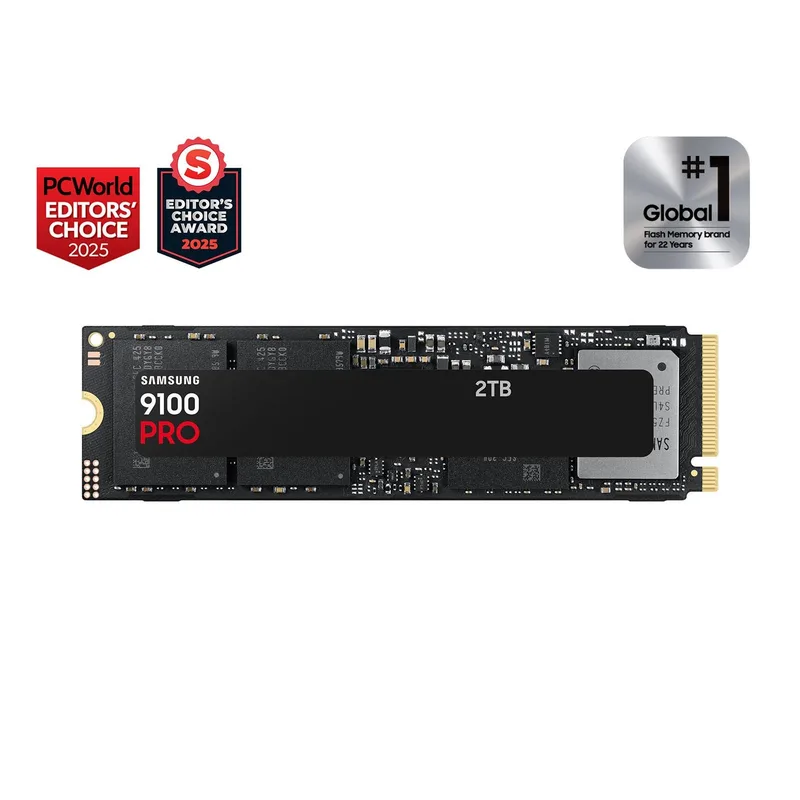
The Samsung 9100 Pro 2TB brings the same 14,700 MB/s read and 13,300 MB/s write performance with double the capacity. The $489 current price is elevated by the NAND shortage — this drive launched at $299 and was tracking near there on Prime Day 2025 — so buyers who can wait have a reasonable argument for patience. That said, the 2TB is where the 9100 Pro starts making real sense for content creators: 2TB fits a working project folder and a game library in the same M.2 slot, and sequential write throughput at 13,300 MB/s means a 500 GB export directory moves in under 40 seconds.
Compared to the Gen4 990 Pro 2TB (currently ~$479 at market), the 2TB 9100 Pro is barely more expensive while offering double the sequential throughput and full NVMe 2.0 support. The price gap between Gen4 and Gen5 at this capacity tier has closed substantially.
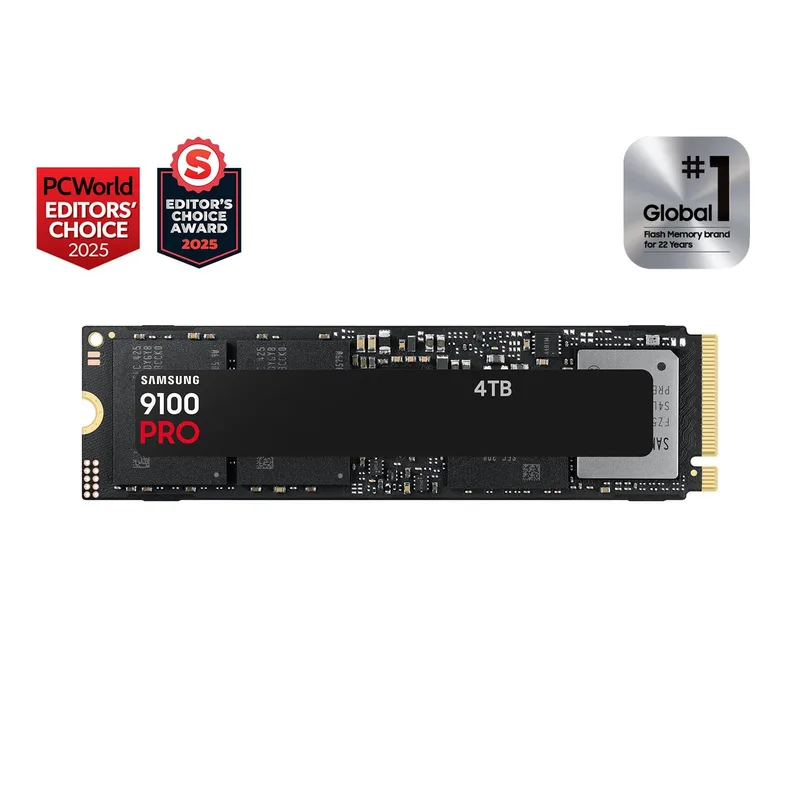
The Samsung 9100 Pro 4TB tops the lineup with 14,800 MB/s sequential reads and 2,200K random read IOPS — the higher IOPS versus the smaller capacities reflects the additional die parallelism available across more NAND packages. At $779, it’s 42% above the $549 MSRP, which is a difficult premium to absorb unless you specifically need 4TB in a single slot. The WD Black SN850X 4TB with heatsink runs ~$729 at Gen4 speeds — slightly cheaper for a drive that’s more than adequate for gaming at any resolution.
The 4TB 9100 Pro makes the most sense in a small form factor build where only one M.2 slot is accessible, or in a workstation where sequential throughput matters and the cost is amortized across professional use.
Build Tips for Installing the 9100 Pro
Use the motherboard’s M.2 heatsink. Most mid-range and high-end boards ship with a thermal pad pre-installed under the M.2 cover. If yours is missing the pad, a 0.5mm thermal pad cut to M.2 2280 size works. Remove the adhesive film from the pad before installing.
Check the M.2 slot’s PCIe generation in your motherboard manual before ordering, not after. Boards with multiple M.2 slots often have one PCIe 5.0 slot (usually the first from the CPU) and additional PCIe 4.0 slots. Installing the 9100 Pro in a 4.0 slot still works but caps performance at 7,400 MB/s — the same as the 990 Pro.
BIOS recognition: On AM5 boards, the Samsung 9100 Pro is typically plug-and-play. Some Intel Z790 boards may require a BIOS update for full PCIe 5.0 enumeration; check the board manufacturer’s compatibility list if you encounter 4.0 speeds after installation.
FAQ
Does the Samsung 9100 Pro show a speed difference in gaming? Not in practical terms. Game load times on NVMe PCIe 5.0 versus PCIe 4.0 are measured in fractions of a second across hundreds of trials in independent testing. The 9100 Pro’s advantage appears in file transfer throughput and professional workloads — Davinci Resolve exports, AI model loading, large archive operations.
Can I install the 9100 Pro in an older board without a PCIe 5.0 slot? Yes — the drive is backwards-compatible and installs fine in PCIe 4.0 or 3.0 M.2 slots. At Gen4, it reads at ~7,400 MB/s; at Gen3, speeds drop to ~3,500 MB/s. The drive works, but you lose the primary reason to buy it over a cheaper Gen4 option.
Is the 9100 Pro better than the WD Black SN8100? At the 1TB tier, the 9100 Pro ($199) is significantly cheaper than the WD Black SN8100 1TB (~$284) while offering comparable PCIe 5.0 performance. The SN8100 uses a slightly different controller (WD’s Obsidian) with competitive sequential specs; both are strong options. The Samsung advantage right now is pure price.
Why is the 9100 Pro 1TB cheaper than the 990 Pro Gen4? The 2026 NAND shortage has hit older NAND process nodes harder than Samsung’s newer 8th-gen TLC. The 990 Pro uses 7th-gen NAND with higher per-bit production costs under current supply conditions; the 9100 Pro uses the newer, more cost-efficient 8th-gen fab process. Combined with lower brand-new inventory restocking costs, the Gen5 drive ended up cheaper than its Gen4 predecessor — an unusual inversion that may normalize once shortage conditions ease.
What encryption does the 9100 Pro support? AES 256-bit hardware encryption with TCG Opal 2.0, consistent with the 990 Pro and enterprise Samsung NVMe lines. Self-encrypting drive (SED) capability is available; enabling encryption requires OS-level setup (eDrive/BitLocker on Windows, or full-disk encryption on Linux).
The Bottom Line
The Samsung 9100 Pro 1TB at $199 is the easiest storage recommendation in mid-2026 if you have a PCIe 5.0 M.2 slot. It costs less than the Gen4 990 Pro while delivering nearly double the sequential throughput — a direct result of market distortions from the ongoing NAND shortage. For gaming, the speed difference is invisible at the framebuffer; for content creation and file-heavy workflows, 14,700 MB/s is meaningfully faster. The 2TB ($489) works for prosumers who need the capacity and can accept the premium; the 4TB ($779) is best reserved for workstation use where single-slot 4TB capacity justifies the elevated price.