NAND flash prices have been climbing hard in early 2026 — AI server demand is soaking up supply faster than fabs can add capacity, and Tom’s Hardware reports that some Gen4 drives have crept back up after their 2025 lows. That makes the Samsung 990 Pro vs WD Black SN850X choice more consequential: you’re picking between two premium PCIe 4.0 drives at prices that aren’t getting cheaper any time soon. One edges ahead in professional workloads; the other is quietly better for the thing most buyers actually do — load games.
| Spec | Samsung 990 Pro 2TB 9.2/10 | WD Black SN850X 2TB Unavailable 9/10 |
|---|---|---|
| interface | PCIe 4.0 x4 NVMe 2.0 | PCIe 4.0 x4 NVMe 1.4 |
| formFactor | M.2 2280 | M.2 2280 |
| seqRead | 7,450 MB/s | 7,300 MB/s |
| seqWrite | 6,900 MB/s | 6,300 MB/s |
| randRead | 1,400K IOPS | 1,200K IOPS |
| randWrite | 1,550K IOPS | 1,100K IOPS |
| Rating | 9.2/10 | 9/10 |
Prices change daily — tap Check Price for the current Amazon price.
Prices change daily — tap Check Price for the current Amazon price.
Quick Verdict
Pick the Samsung 990 Pro if you move large files regularly, run creative workloads, or are squeezing every MB/s out of a PS5-adjacent use case. Its random IOPS advantage (1,550K write vs 1,100K) is real under sustained load, and the power efficiency gap is meaningful in laptops and small-form-factor builds.
Pick the WD Black SN850X if gaming is the primary use case. Its 1MB QD1 sequential read hits 5,214 MB/s versus the 990 Pro’s 4,637 MB/s — a 12.4% lead in the exact low-queue-depth scenario that describes every game loading screen. Game Mode 2.0 adds predictive prefetch algorithms that reduce micro-stutter in open-world streaming. The SN850X is also typically around fifteen dollars cheaper at 2TB.
Spec Comparison
| Spec | Samsung 990 Pro 2TB | WD Black SN850X 2TB |
|---|---|---|
| Interface | PCIe 4.0 x4, NVMe 2.0 | PCIe 4.0 x4, NVMe 1.4 |
| Sequential Read | 7,450 MB/s | 7,300 MB/s |
| Sequential Write | 6,900 MB/s | 6,300 MB/s |
| Random Read | 1,400K IOPS | 1,200K IOPS |
| Random Write | 1,550K IOPS | 1,100K IOPS |
| 1MB QD1 Read | 4,637 MB/s | 5,214 MB/s |
| TBW Endurance | 1,200 TBW | 1,200 TBW |
| Idle Power | 0.055W | ~0.08W |
| Max Temp (no HS) | ~70°C | ~78°C |
| NAND | 176L TLC V-NAND | 112L TLC NAND |
Both drives carry the same 1,200 TBW endurance rating at 2TB and come with 5-year warranties, so neither edges the other on longevity.
Sequential Speed: Almost a Tie
The 990 Pro’s 7,450/6,900 MB/s spec sheet leads over the SN850X’s 7,300/6,600 MB/s sounds impressive until you see real-world deltas. In CrystalDiskMark sequential runs, the 990 Pro posts 7,153 MB/s read and 6,820 MB/s write — a 2.4% and 2.1% lead respectively. For file copies, video exports, and daily workloads, you will not feel that gap. The drives are interchangeable in sequential scenarios.
Random IOPS: 990 Pro Wins — But Context Matters
At high queue depths (QD32), the Samsung pulls away decisively. Its 1,550K random write IOPS is 29% above the SN850X’s 1,100K ceiling. For NAS-style multi-user workloads, database operations, and any scenario with heavy simultaneous I/O, the 990 Pro’s Pascal controller handles parallelism significantly better.
For desktop and gaming tasks — which mostly run at QD1 to QD4 — neither drive saturates its IOPS limit. The difference doesn’t show up in Windows responsiveness or game load times.
Gaming Performance: SN850X Has the Edge
This is the counterintuitive finding that matters. Game loading is almost entirely QD1 sequential reads — your GPU or CPU requests one large file block, waits for it, requests the next. At 1MB QD1 reads, the SN850X hits 5,214 MB/s versus the 990 Pro’s 4,637 MB/s — a 12.4% advantage for the WD drive. In real-world game loads, that’s a measurable difference on open-world titles with aggressive streaming like Cyberpunk 2077 or Starfield.
Game Mode 2.0 on the SN850X adds a software layer: the firmware tracks access patterns and prefetches data it predicts the game will request next. Western Digital claims this reduces open-world micro-stutter, and user reports on r/hardware generally back that up for titles with heavy asset streaming.
If you’re building a dedicated gaming rig or a PS5 storage upgrade (both drives are PS5 compatible), the SN850X is the better-targeted choice.
Power and Thermals
The 990 Pro idles at 0.055W versus roughly 0.08W for the SN850X. In a desktop tower, this doesn’t matter. In a compact SFF build or a laptop, the 990 Pro’s thermal efficiency gives it an edge — it also runs cooler under sustained load without a heatsink (peaking around 70°C versus the SN850X’s 78°C). If your M.2 slot has no heatsink and your case has limited airflow, the 990 Pro is the safer pick.
WD sells a heatsink variant of the SN850X that brings its thermals in line; if you’re going heatsink, that concern disappears.
Workstation and Creative Use
For video editors, 3D artists, and anyone moving multi-gigabyte project files: the 990 Pro is the right call. Its NVMe 2.0 certification means it handles higher command queue counts than the SN850X’s NVMe 1.4, and its IOPS advantage becomes real when your NLE is scrubbing 4K RAW footage with simultaneous cache writes. The Samsung also holds up better under sustained sequential writes — it doesn’t thermal throttle as early without active cooling.
Pricing Reality in 2026
Both drives hit their all-time lows during mid-2025 sale events before NAND supply tightened. As of early 2026, expect to pay roughly $145-160 for either drive at 2TB — the SN850X typically sits around fifteen dollars lower. At 1TB, both hover in the eighty to ninety dollar range. The gap isn’t dramatic enough to be the deciding factor; buy based on use case.
Samsung 990 Pro 2TB
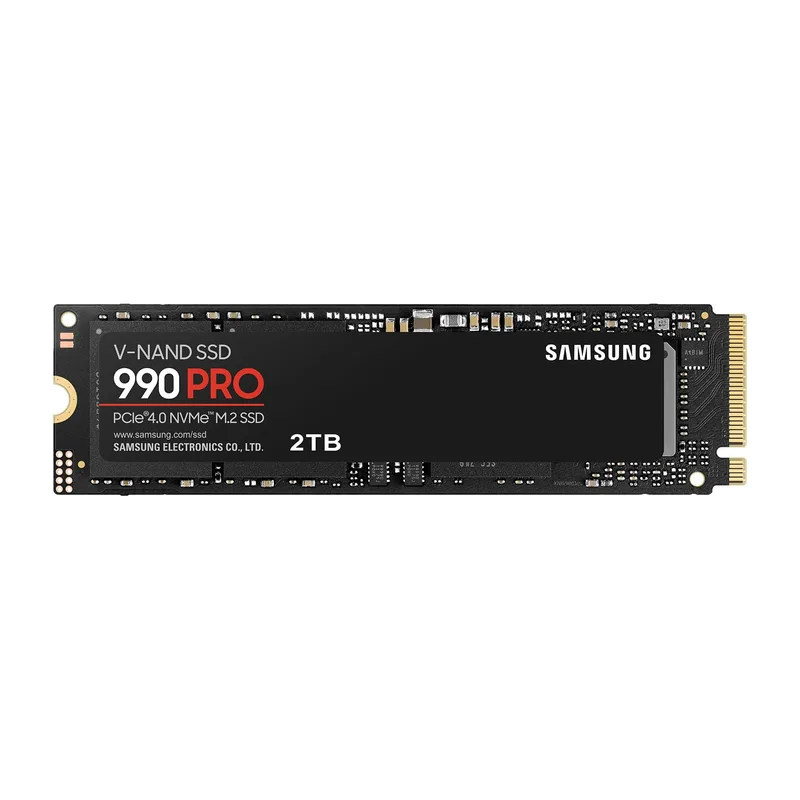
Samsung’s 990 Pro uses a custom Pascal controller paired with 176-layer TLC V-NAND — the same NAND architecture found in Samsung’s enterprise drives. The NVMe 2.0 certification enables features like Error Recovery Control (ERC) and improved power states not available on NVMe 1.4 drives. At 2TB, it’s rated for 1,200 TBW with a 5-year warranty. The drive ships without a heatsink but Samsung sells a 1TB heatsink variant.
It’s the better drive for mixed workloads, sustained I/O, and power-constrained systems. For pure gaming, the SN850X’s QD1 advantage partially offsets the 990 Pro’s IOPS lead.
WD Black SN850X 2TB
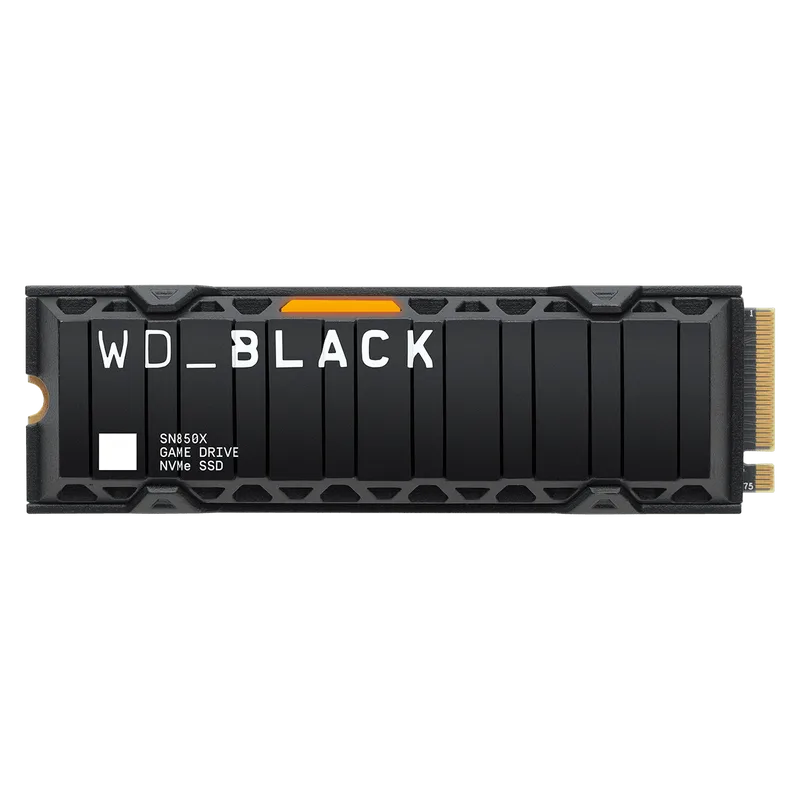
WD Black SN850X 2TB
The SN850X uses WD’s in-house controller with 112-layer TLC NAND. The architecture doesn’t match the Samsung’s raw IOPS ceiling, but WD has optimized the firmware specifically for consumer gaming patterns. Game Mode 2.0, accessible via the WD Dashboard software, monitors access patterns and adjusts prefetch behavior dynamically. The 1TB version and the heatsink variants are priced identically on most retailers.
The SN850X’s QD1 sequential read advantage isn’t a marketing claim — it’s verified in independent testing and reflects firmware choices that favor the 99th-percentile consumer use case: loading one game level at a time.
FAQ
Does the Samsung 990 Pro work in a PS5? Yes. Both drives meet PS5’s minimum 5,500 MB/s requirement with room to spare. Either will work as a PS5 storage expansion. The SN850X’s QD1 edge may translate to slightly faster game loads, though the difference in practice is small.
Is the WD Black SN850X better for gaming than the Samsung 990 Pro? In isolated load tests, yes — the SN850X’s 12.4% QD1 read advantage maps directly to game loading. But in a real gaming PC, both drives will load games in fractions of a second; other bottlenecks (CPU, RAM speed, game engine) limit observed differences. The SN850X is the more gaming-optimized firmware, but neither drive will disappoint in practice.
Which drive is better for video editing? The Samsung 990 Pro. Its 1,550K random write IOPS and NVMe 2.0 command queue depth advantages are real in sustained read/write workloads like 4K video editing, 3D rendering, and large file transfers. The SN850X is adequate but the 990 Pro holds higher sustained throughput under prolonged stress.
Do both drives get hot without a heatsink? Yes, both do. The 990 Pro peaks around 70°C, the SN850X around 78°C under heavy sustained load. For gaming workloads (intermittent loads, not sustained writes), neither will throttle in a reasonably cooled case. For workstations with sustained I/O, add a heatsink regardless of which drive you choose.
Does the cache affect performance on large file copies? Both drives use SLC write caching, and both will slow down on writes that exceed the cache window (roughly 70-100GB on 2TB models). Once you exhaust the cache, both drives drop to native TLC write speeds (~2,000-3,000 MB/s). This only matters if you’re copying extremely large archives in a single operation. For everyday use, it’s a non-factor.
The Bottom Line
For professional and mixed workloads, the Samsung 990 Pro is the stronger drive — its IOPS lead at high queue depths, lower power consumption, and NVMe 2.0 firmware make it the right call for workstations, compact SFF builds, and content creation rigs. For gaming, the WD Black SN850X wins on the benchmark that actually matters: QD1 sequential reads hit 5,214 MB/s versus the 990 Pro’s 4,637 MB/s, and Game Mode 2.0 adds real-world stutter mitigation for open-world titles. Both drives carry 5-year warranties, both hit 1,200 TBW, and at 2TB the price gap is typically under $20 — buy for your use case, not the spec sheet headline.