GPU prices are not coming down anytime soon. ASUS quietly raised its Radeon RX 9070 XT prices by up to 17.5% this week, and Tom’s Hardware reported a 15% average global price hike across Nvidia, AMD, and Intel GPUs in early 2026. In that environment, picking the right ecosystem matters as much as picking the right GPU — the software platform you invest in today shapes your upgrade path for the next three to four years.
The 2026 GPU landscape is the most competitive it has been in a decade. Nvidia’s Blackwell RTX 5000 series brings DLSS 4 Multi Frame Generation and a commanding ray tracing lead. AMD’s RDNA 4 RX 9000 series fires back with 16GB VRAM across the lineup, RDNA 4’s dramatically improved IPC, and prices that undercut Nvidia at every comparable tier. Intel’s Arc B580 holds a niche position but doesn’t factor into this ecosystem comparison.
| Spec | ASUS ROG Astral GeForce RTX 5090 OC 9.2/10 | Gigabyte GeForce RTX 5080 Gaming OC 16G 8.4/10 | MSI GeForce RTX 5070 Ti 16G Gaming Trio OC 8.6/10 | Sapphire Pulse Radeon RX 9070 XT Gaming 16GB 9/10 | Gigabyte Radeon RX 9070 Gaming OC 16G 8.5/10 |
|---|---|---|---|---|---|
| Architecture | Blackwell GB202 | Blackwell GB203 | Blackwell GB203 | RDNA 4 Navi 48 | RDNA 4 Navi 48 |
| VRAM | 32GB GDDR7 512-bit | 16GB GDDR7 256-bit | 16GB GDDR7 256-bit | 16GB GDDR6 256-bit | 16GB GDDR6 256-bit |
| CUDA Cores | 21,760 | 10,752 | 8,960 | — | — |
| Boost Clock | ~2.41 GHz | 2.73 GHz | 2.57 GHz | ~2.97 GHz | 2.52 GHz |
| TDP | 575W | 360W | 300W | 304W | 220W |
| PCIe | 5.0 x16 | 5.0 x16 | 5.0 x16 | 5.0 x8 | 5.0 x8 |
| Rating | 9.2/10 | 8.4/10 | 8.6/10 | 9/10 | 8.5/10 |
Prices change daily — tap Check Price for the current Amazon price.
Prices change daily — tap Check Price for the current Amazon price.
Quick Picks
- Best overall value: Sapphire Pulse RX 9070 XT — matches RTX 5080 rasterization performance at $739. The strongest price-to-performance card in the market right now.
- Best Nvidia mid-range: MSI RTX 5070 Ti Gaming Trio — DLSS 4 Multi Frame Generation, consistent 1440p 144+ FPS, holds MSRP at $999.
- Best 4K flagship: ASUS ROG Astral RTX 5090 — nothing else touches 4K at this frame rate, but only if you can stomach $3,499+.
Which Ecosystem: AMD or Nvidia?
Before choosing a GPU, you’re choosing a software ecosystem. That decision has real consequences.
Choose Nvidia if you:
- Use DLSS 4 Multi Frame Generation. MFG generates up to three additional frames per real rendered frame. In practice, a game running at 80 FPS natively can output 320 FPS perceived output. AMD’s FSR 4 does not include a comparable multi-frame generation mode. This is Nvidia’s biggest differentiator in 2026.
- Play ray-traced titles seriously. Nvidia’s RT cores and Shader Execution Reordering (SER) give the RTX 5000 series a consistent 25–40% RT performance lead over comparable AMD cards. In titles like Cyberpunk 2077 with path tracing enabled, the gap is measurable and visible.
- Do AI or creative work on the side. CUDA support is built into nearly every AI tool, video editor, and rendering application. If you’re using Stable Diffusion, DaVinci Resolve’s neural engine, or Blender’s OptiX renderer, Nvidia is still the more plug-and-play choice.
Choose AMD if you:
- Want the most rasterization performance per dollar. The RX 9070 XT at $739 matches or exceeds the RTX 5080 ($1,399) in rasterization at 1440p. That’s a $660 delta for the same gaming experience in most titles.
- Play primarily on Linux or use open-source tooling. AMD’s ROCm stack has improved significantly for ML inference workloads, and the open-source driver situation on Linux is more stable than it has ever been.
- Want 16GB VRAM without paying a premium. Nvidia’s RTX 5090 has 32GB, but the RTX 5080 and RTX 5070 Ti both ship with 16GB GDDR7. AMD matches 16GB across the entire RX 9000 lineup including the $549 MSRP RX 9070. As games start pushing 12–14GB VRAM budgets, AMD’s consistent 16GB allocation is a genuine longevity advantage.
A note on FSR 4 vs DLSS 4
FSR 4 is a meaningful step up from FSR 3. Owner reports and hardware review coverage confirm that the image quality gap between FSR 4 quality mode and DLSS 4 quality mode has closed substantially — at 1440p, the difference is hard to spot in static screenshots. The gap widens on motion detail and ghosting in fast-paced titles, where DLSS 4’s machine learning model trained on Blackwell hardware still has an edge. FSR 4 is also hardware-locked to RDNA 4 — if you switch to an Nvidia card next cycle, your FSR 4 investment doesn’t transfer.
Buying Guide: Which Tier Makes Sense
| Budget | Recommended Card | Reasoning |
|---|---|---|
| $680–$720 | RX 9070 | Best 1440p performance under $720, 16GB VRAM, 220W TDP |
| $730–$780 | RX 9070 XT | Matches RTX 5080 rasterization for $730 less |
| $1,000–$1,100 | RTX 5070 Ti | DLSS 4 MFG, strong 4K entry point, holds near MSRP |
| $1,450–$1,600 | RTX 5080 | Only if you need RT-heavy 4K performance and DLSS MFG at 4K |
| $3,000+ | RTX 5090 | Professionals and enthusiasts only — wildly above MSRP right now |
One thing to note on current pricing: both AMD and Nvidia are dealing with elevated prices above MSRP. The RTX 5090’s $1,999 MSRP is a distant memory — street prices hover around $3,499. The RX 9070 XT launched at $599 and now sits at $739 at most retailers, with ASUS’s own store pricing models at $939–$989. Buying from non-ASUS partners (Sapphire, XFX, PowerColor) gets you better pricing on AMD’s side right now.
Detailed Reviews
ASUS ROG Astral GeForce RTX 5090 OC
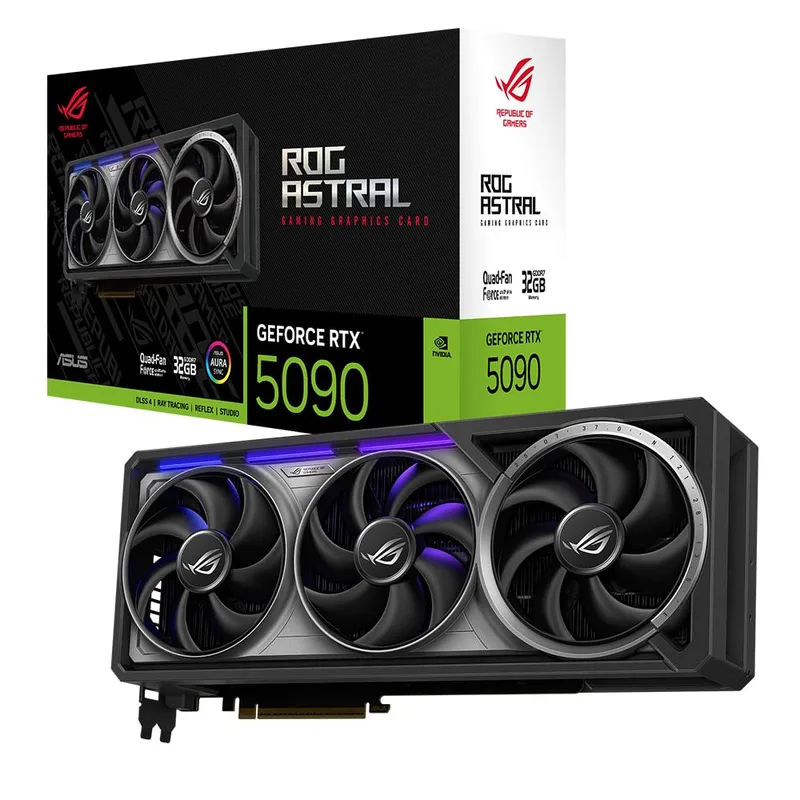
The RTX 5090 is the fastest consumer GPU ever built, and the ASUS ROG Astral OC is the best AIB version of it. The Astral’s patented vapor chamber and 3.8-slot quad-fan cooler keep the GB202 die at reasonable temperatures despite the 575W TDP — a necessary engineering feat when you’re dumping this much power into a gaming card.
Performance at 4K is genuinely untouched. Owner feedback from hardware forums and review data confirms the RTX 5090 hits 4K 120+ FPS at Ultra settings in virtually every current title without DLSS engaged. With DLSS 4 Quality mode active, framerates push into 200+ FPS territory. The 32GB GDDR7 on a 512-bit bus makes this the only consumer card currently capable of handling 4K texture packs, AI diffusion workloads, and real-time ray tracing simultaneously.
The problem is the price. Street pricing around $3,499 — nearly double the $1,999 MSRP — makes this a card for professionals recovering costs through productivity, or enthusiasts who view it as a multi-year investment. For pure gaming, the RTX 5080 at $1,499 delivers 75–80% of the performance at 43% of the price.
PSU requirement: 1000W minimum. 1200W recommended for headroom with a high-end CPU.
Gigabyte GeForce RTX 5080 Gaming OC 16G
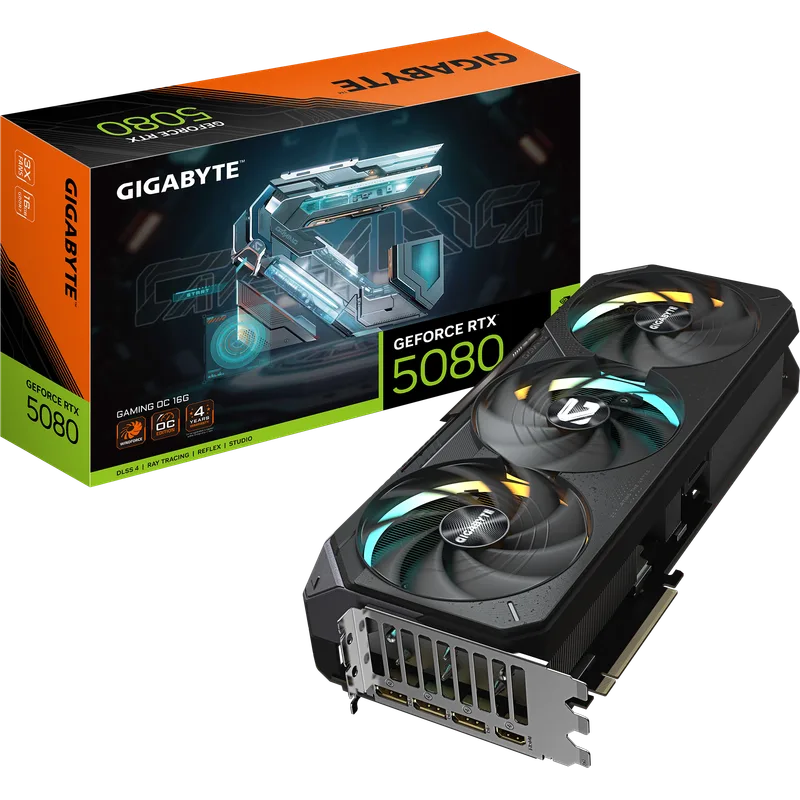
The RTX 5080 targets the 4K enthusiast who doesn’t need the RTX 5090’s headroom but wants consistent 100+ FPS at 4K with ray tracing enabled. The Gigabyte Gaming OC variant runs the GB203 die at a 2.73 GHz boost clock with Gigabyte’s WINDFORCE triple-fan cooling — adequate for most cases, though it runs warmer than the ASUS TUF or MSI Gaming Trio implementations.
At 1440p, the RTX 5080 is overkill by any reasonable metric. It delivers framerates in the 180–220 FPS range in most titles, which means you’re paying for 4K capability you may only partially use. The more meaningful question is whether the RTX 5080 justifies its ~$1,499 street price against the RTX 5070 Ti at $1,039. Hardware review consensus suggests the RTX 5080 is roughly 20–25% faster than the RTX 5070 Ti at 4K — a meaningful but not transformative gap for a 40% price premium.
The 16GB GDDR7 footnote is worth addressing: Nvidia shipped the RTX 5080 with 16GB while the RTX 5090 gets 32GB. At 4K with maximum settings in memory-hungry titles, users have reported hitting VRAM pressure in a small number of titles. It’s not a dealbreaker in 2026, but it’s a legitimate long-term concern for a $1,399 card.
PSU requirement: 850W minimum.
MSI GeForce RTX 5070 Ti 16G Gaming Trio OC
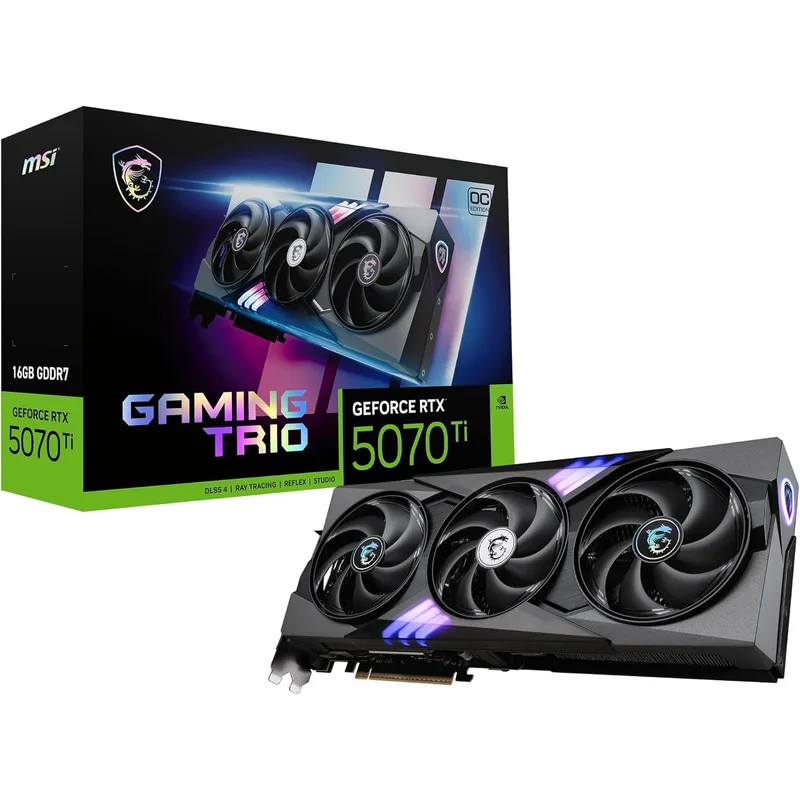
The RTX 5070 Ti is arguably the most interesting Nvidia GPU in 2026. At $999, it sits at a price point that has effectively become the new RTX 5080 MSRP thanks to market inflation — Tom’s Hardware noted in early 2026 that “$1,000 bought an RTX 5080 in November 2025, now it only buys an RTX 5070 Ti.” That context matters: you’re getting a card that technically underperforms the RTX 5080, but at a price that the RTX 5080 itself launched at.
MSI’s TRI FROZR 4 cooling implementation is among the best AIB solutions on the RTX 5070 Ti. Owner reports confirm core temps stay below 75°C under sustained gaming load with the fans barely audible. The 16GB GDDR7 matches the RTX 5080’s memory spec at the same die capacity — the primary architectural difference is 8,960 vs 10,752 CUDA cores, which translates to roughly a 20% performance gap in compute-heavy workloads.
For 1440p gaming, the RTX 5070 Ti is a generational upgrade. It consistently hits 144+ FPS in demanding titles at 1440p Ultra settings, and with DLSS 4 Multi Frame Generation engaged, it can push framerates well beyond what a 144Hz monitor can display. The 4K story is respectable — 60–80 FPS at native 4K Ultra without DLSS, which scales comfortably with DLSS Quality mode.
PSU requirement: 750W minimum.
Sapphire Pulse Radeon RX 9070 XT Gaming 16GB
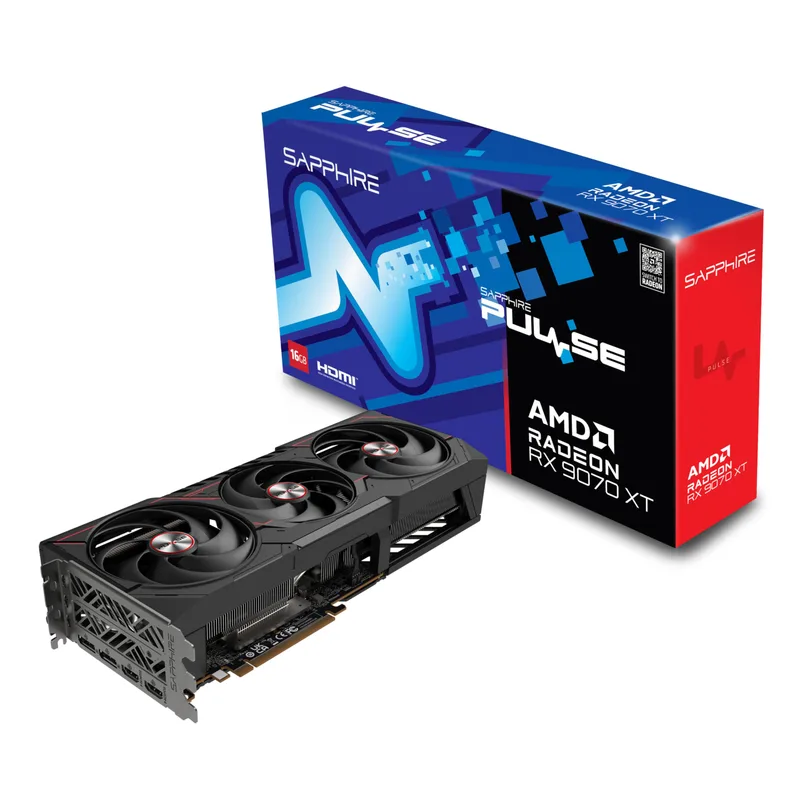
The RX 9070 XT is the card AMD needed. RDNA 4’s dramatic architectural improvement over RDNA 3 — increased IPC, improved infinity cache efficiency, reworked ray tracing engine — pushes Navi 48 to RTX 5080 rasterization territory at a fraction of the cost. In 1440p rasterization benchmarks covered by Tom’s Hardware and Hardware Unboxed, the RX 9070 XT consistently trades blows with the RTX 5080, with AMD winning a third of tested titles, Nvidia winning a third, and the remainder within margin of error.
Sapphire’s Pulse implementation is the safest pick at current pricing. ASUS raised its RX 9070 XT prices by up to 17.5% this week (the Prime OC now lists at $939 on ASUS’s store), while Sapphire’s Pulse has remained at ~$739. The Pulse uses a dual-fan design that’s more compact than competitor triple-fan configurations, fits in shorter cases, and runs quietly according to owner reports — the trade-off is slightly higher temperatures than the larger ASUS TUF, though still within safe operating range.
The 16GB GDDR6 on a 256-bit bus is a key advantage. While Nvidia’s GDDR7 offers higher bandwidth, the 16GB capacity is the same across both chips — and AMD’s consistent 16GB allocation across the entire RX 9000 lineup means you’re not compromising on memory at this price tier.
PSU requirement: 750W minimum.
Gigabyte Radeon RX 9070 Gaming OC 16G
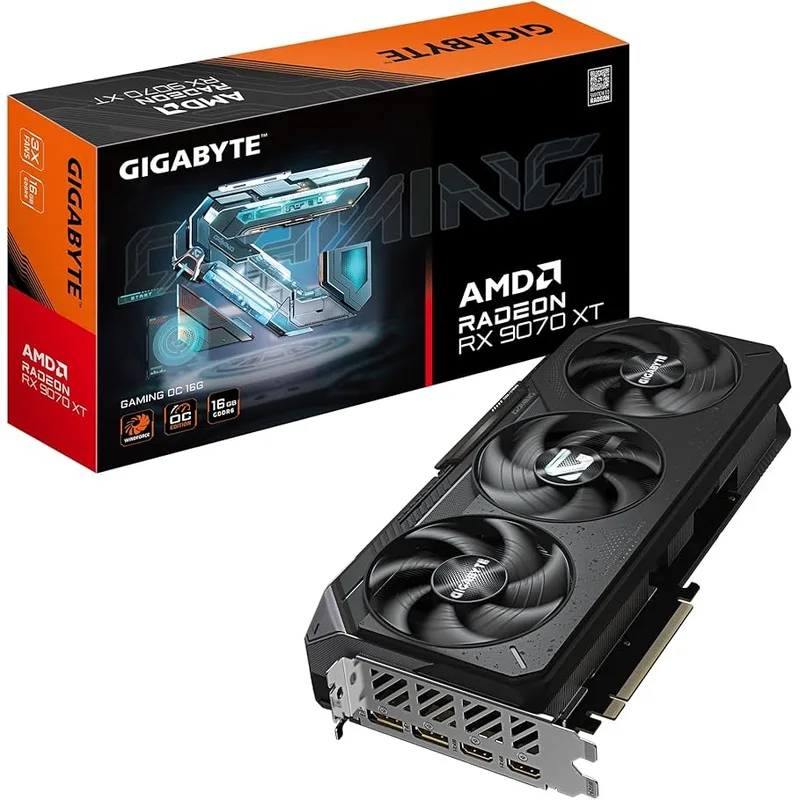
The RX 9070 is the quiet achiever of this roundup. Using the same Navi 48 die as the RX 9070 XT but with 8 fewer Compute Units active (56 vs 64) and a lower boost clock, it delivers roughly 8–10% less performance in most rasterization workloads. At a $619 street price vs $739 for the XT, the $120 gap narrows to almost nothing when you consider the performance delta per dollar.
The 220W TDP is the RX 9070’s most underappreciated feature. It runs cooler, demands less from your PSU, and fits more comfortably in builds where power delivery or thermal headroom is a constraint. Owner reports on hardware forums confirm it operates at 70°C or below on most AIB coolers under sustained gaming load — comparable to Nvidia cards in a higher price tier.
For 1440p gaming at high refresh rates, the RX 9070 delivers. It hits 100+ FPS in most demanding titles at 1440p Ultra settings without any upscaling, and with FSR 4 Quality mode engaged it comfortably feeds 144Hz monitors. It’s not a 4K card in the same way the RX 9070 XT is — native 4K performance will dip below 60 FPS in the most demanding titles — but it covers the mainstream gaming use case without compromise.
PSU requirement: 650W minimum.
FAQ
Is AMD or Nvidia better for gaming in 2026? At equivalent price points, AMD wins on rasterization performance per dollar. The RX 9070 XT at $739 matches the RTX 5080 at $1,399 in most 1440p gaming scenarios. Nvidia wins on ray tracing, DLSS 4 Multi Frame Generation, and AI/creative workloads. If you game exclusively in rasterization-heavy titles and don’t use frame generation, AMD offers better value. If DLSS MFG and RT performance are priorities, Nvidia justifies the premium.
Does DLSS 4 make a big difference over FSR 4? In upscaling quality alone, the gap has narrowed considerably — FSR 4 quality mode is hard to distinguish from DLSS 4 quality mode in static comparisons. The meaningful difference is Multi Frame Generation: DLSS 4 MFG can generate up to three additional frames per rendered frame, while FSR 4 does not include a comparable feature. For high-framerate gaming on high-refresh displays, MFG is a substantial advantage.
Will 16GB VRAM be enough in 2026 and beyond? For 1440p gaming, yes — 16GB comfortably covers current titles. At 4K with maximum texture settings, some titles are beginning to push against 12–14GB, making 16GB the minimum you should buy today. Neither the RTX 5080 nor the RX 9070 XT will face VRAM pressure in the majority of titles through at least 2027 based on current game memory requirements.
Are GPU prices going to drop? Based on current market conditions, not imminently. AI data center demand is consuming a significant share of GDDR6 and GDDR7 production, and ASUS raised RX 9070 XT prices by 17.5% this week alone. Tom’s Hardware reported a 15% average global GPU price increase already in 2026. If you need a GPU now, prices are unlikely to return to MSRP in the near term.
What PSU do I need for each of these cards? RTX 5090: 1000W minimum (1200W recommended). RTX 5080: 850W. RTX 5070 Ti: 750W. RX 9070 XT: 750W. RX 9070: 650W. Overbuilding PSU headroom is sensible given current prices — a quality 850W PSU will cover all but the RTX 5090.
The Bottom Line
At current prices, AMD’s RX 9070 XT is the most rational GPU purchase in 2026. It delivers RTX 5080 rasterization performance at $739 vs $1,399 — a $660 premium that Nvidia’s ray tracing lead and DLSS 4 Multi Frame Generation need to justify on their own merits. For users who live in DLSS MFG-supported titles or heavy ray-traced games, the MSI RTX 5070 Ti at $1,039 is the better Nvidia choice than the overpriced RTX 5080. The RTX 5090 remains in a class by itself for 4K enthusiasts and professionals, but its current $3,499+ street price is a market distortion, not a reflection of its value.