The 2026 FPS mouse market hit a genuine inflection point in January when Logitech introduced the PRO X2 SUPERSTRIKE — the first production gaming mouse to use haptic inductive triggers instead of traditional mechanical or optical switches. Meanwhile Razer’s FrameSync battery tech (announced earlier this year) is adding new dimensions to the wireless polling race. If you’re still using a 1K polling mouse from 2026, the gap to the current field is measurable in both latency and weight.
This roundup covers five mice — from a $40 wireless budget pick to a $179 haptic flagship — with specs verified against manufacturer pages and current Amazon pricing as of May 2026.
| Spec | Razer Viper V3 Pro Wireless Gaming Mouse 9.4/10 | Logitech G PRO X2 SUPERSTRIKE Wireless Gaming Mouse 9.1/10 | Logitech G PRO X Superlight 2 DEX Wireless Gaming Mouse Unavailable 9.2/10 | Razer DeathAdder V3 Pro Wireless Gaming Mouse 8.8/10 | Razer Viper V3 HyperSpeed Wireless Gaming Mouse 8.2/10 |
|---|---|---|---|---|---|
| Weight | 54g | 61g | 60g | 63g | 82g |
| Sensor | Focus Pro 35K optical | HERO 2 44K | HERO 2 44K | Focus Pro 30K optical | Focus Pro 30K optical |
| Max DPI | 35,000 | 44,000 | 44,000 | 30,000 | 30,000 |
| Polling Rate | 8,000 Hz | 8,000 Hz | 8,000 Hz | 8,000 Hz (with dongle) | 1,000 Hz |
| Switches | Gen-3 Optical (0.2ms) | — | LIGHTFORCE Hybrid | Gen-3 Optical | Gen-2 Mechanical |
| Battery | 95 hours | 90 hours | 95 hours | 90 hours | 280 hours |
| Connection | HyperSpeed Wireless 2.4GHz | LIGHTSPEED Wireless 2.4GHz | LIGHTSPEED Wireless 2.4GHz | HyperSpeed Wireless 2.4GHz | HyperSpeed Wireless 2.4GHz |
| Shape | Symmetrical | Symmetrical | Asymmetrical (right-hand) | Ergonomic right-hand | Symmetrical |
| Rating | 9.4/10 | 9.1/10 | 9.2/10 | 8.8/10 | 8.2/10 |
Prices change daily — tap Check Price for the current Amazon price.
Prices change daily — tap Check Price for the current Amazon price.
Quick Picks
- Best overall FPS mouse: Razer Viper V3 Pro — 54g symmetrical, 8K polling, Gen-3 optical switches, works for any grip style
- Best new tech: Logitech G PRO X2 SUPERSTRIKE — haptic clicks reduce latency by up to 30ms, 8K LIGHTSPEED, 44K DPI
- Best budget wireless: Razer Viper V3 HyperSpeed — Focus Pro 30K, 280-hour battery, symmetrical, under $50
What to Look for in an FPS Gaming Mouse
Weight
Pro players in CS2, Valorant, and Apex have converged around the 50–65g range. Below 50g most shapes become structurally fragile; above 70g you start accumulating wrist fatigue on flick-heavy titles. All five mice in this roundup fall under 85g, with three under 65g.
The 82g Viper V3 HyperSpeed is the outlier — still light by 2022 standards, but noticeably heavier than the sub-55g Viper V3 Pro when you pick them up back-to-back.
Polling Rate
Polling rate is how often the mouse reports its position to your PC. The standard is still 1,000 Hz (1ms report interval), but 4,000 Hz and 8,000 Hz options are now standard at the flagship tier. At 8K polling, the mouse reports every 0.125ms — roughly 8× more position data per second than a 1K mouse.
Whether that matters in practice depends on your setup. At framerates under 144 fps the improvement is marginal. At 360+ fps in competitive shooters, sub-millisecond polling contributes to lower input lag. The Viper V3 Pro, SUPERSTRIKE, and Superlight 2 DEX all ship with 8K polling in their wireless modes — a meaningful spec advantage over 1K-capped options.
Sensor
Any sensor from Razer’s Focus Pro 30K, Logitech’s HERO 2, or PixArt PAW3395 class delivers zero smoothing and zero acceleration at any real-world gaming DPI. The DPI ceiling numbers (30K, 35K, 44K) are marketing — no human plays above 6,400 DPI in competitive shooters. What matters is linearity at 400–1600 DPI and angle snapping behavior, both of which are excellent in every mouse reviewed here.
Grip Style and Shape
- Claw grip (fingertips on buttons, palm barely touches): benefits most from shorter, lighter bodies like the Viper V3 Pro
- Fingertip grip (only fingertips contact the mouse): needs a compact, flat profile — Viper V3 Pro and Viper V3 HyperSpeed suit this well
- Palm grip (full palm contact): benefits from a longer, higher-hump shape — the DeathAdder V3 Pro and Superlight 2 DEX deliver this
- Right-hand only: DeathAdder V3 Pro and Superlight 2 DEX — both asymmetrical
- Ambidextrous: Viper V3 Pro, SUPERSTRIKE, Viper V3 HyperSpeed
Detailed Reviews
1. Razer Viper V3 Pro — Best Overall
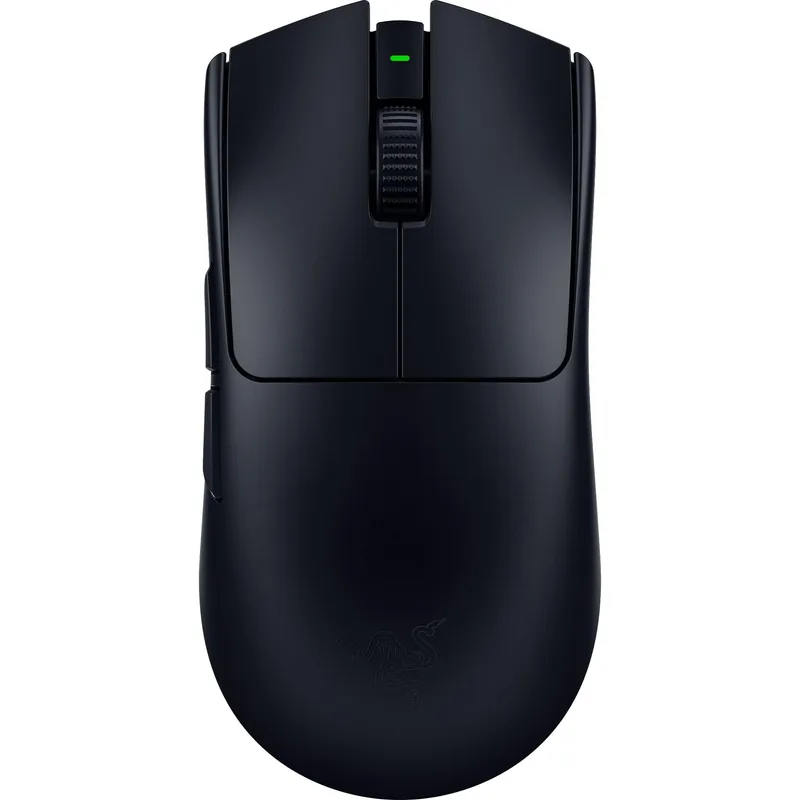
The Razer Viper V3 Pro is the standard reference point for competitive wireless mice in 2026. Its 54g symmetrical body is light enough for extended sessions and neutral enough for claw, fingertip, and shallow palm grips. The Gen-3 optical switches measure 0.2ms actuation with no debounce delay — the fastest response time in the non-haptic category. Eight programmable buttons cover all the binds serious FPS players need.
The Focus Pro 35K sensor tracks on cloth, hard pads, and glass — the glass tracking matters for productivity users who game, not competitive players, but it signals the broader sensor quality. At 8K polling over HyperSpeed wireless, latency is indistinguishable from the company’s wired products in back-to-back comparisons.
Battery life reaches 95 hours at 1K polling; expect 40–50 hours at the 8K polling rate. The USB-C charging cable means you’re not scrambling for a proprietary connector.
The one gap: the Viper V3 Pro is a symmetric, flat-ish design. If you have large hands and use full palm contact, the DeathAdder V3 Pro’s hump gives better contact distribution without lifting the ring finger.
Who it’s for: Claw and fingertip grippers, anyone who plays multiple titles across different genres, users who want the most-used pro pick in esports in 2026.
2. Logitech G PRO X2 SUPERSTRIKE — Most Innovative
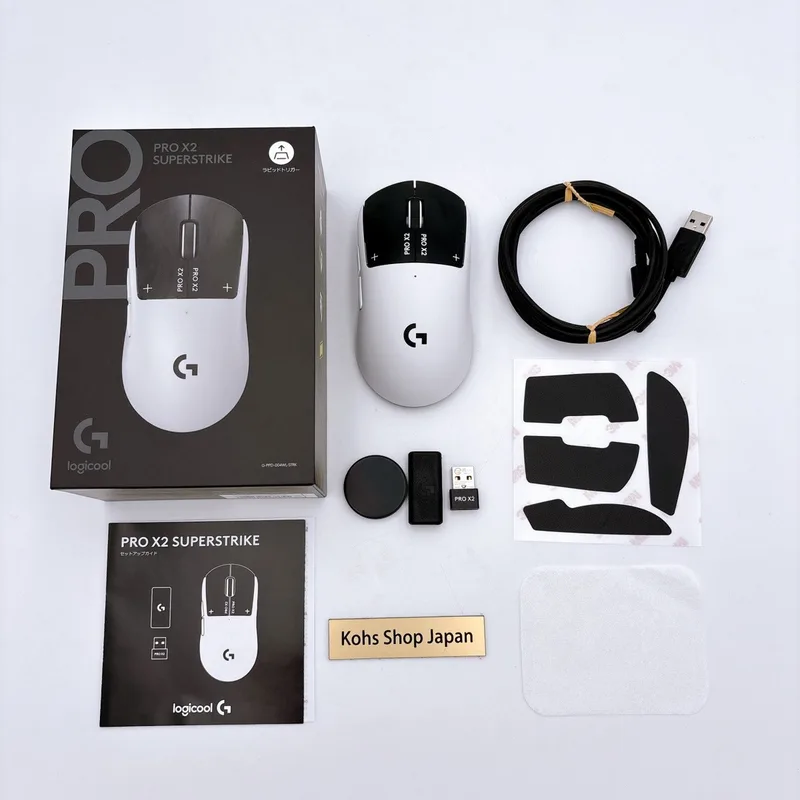
Logitech G PRO X2 SUPERSTRIKE Wireless Gaming Mouse
The Logitech G PRO X2 SUPERSTRIKE launched in early 2026 as the first mainstream mouse with a Haptic Inductive Trigger System. Instead of a physical click mechanism, each primary button uses electromagnetic haptics — the click feel is simulated, and the actuation threshold is adjustable in G HUB software. Logitech’s specification sheet claims up to 30ms reduction in click latency over traditional mechanical designs, attributed to eliminating debounce delay entirely.
The shape is a refined version of the G PRO X series — 61g, symmetrical, and sized slightly larger than the Superlight 2 to accommodate the haptic mechanism. The HERO 2 sensor (44K DPI, 888 IPS) runs the same silicon used in the Superlight 2 DEX, and LIGHTSPEED wireless runs at 8,000 Hz over 2.4GHz.
The adjustable actuation is the feature that splits opinion: competitive players who run light spring tension will love it, while players used to crisp mechanical clicks may need time to adapt to the haptic feedback profile. The mouse supports both default haptic and a more tactile preset that mimics a light mechanical feel.
At $179, the SUPERSTRIKE costs $30 more than the Viper V3 Pro and $59 more than the Superlight 2 DEX. Whether the haptic system is worth it depends on whether you find click latency a limiting factor — most players at sub-GM rank will not.
Who it’s for: Players who want the newest technology, anyone who has felt limited by traditional click debounce, competitive-focused buyers who don’t mind the premium.
3. Logitech G PRO X Superlight 2 DEX — Best Ergonomic
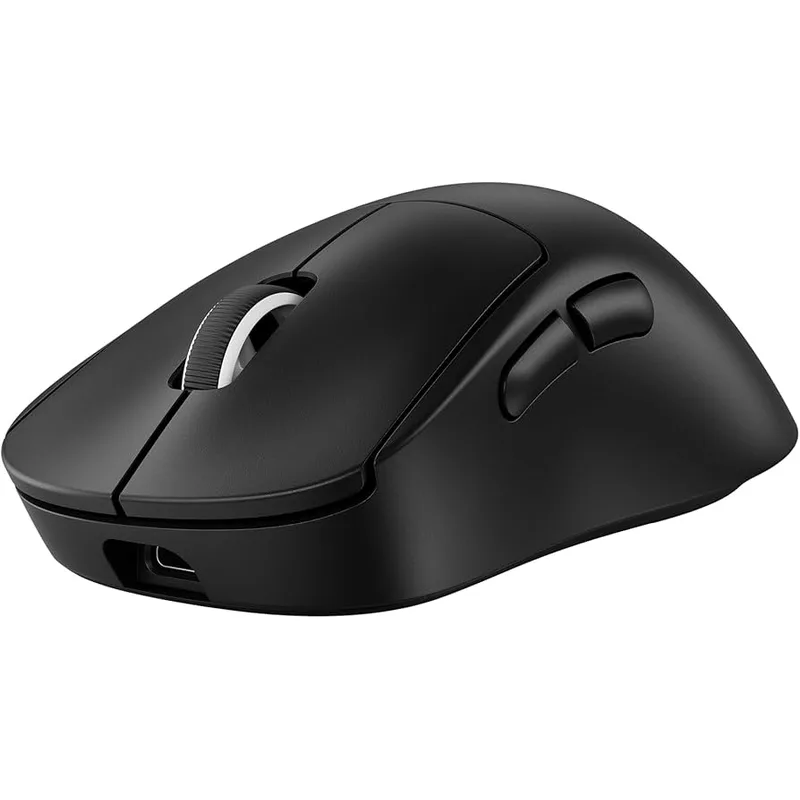
Logitech G PRO X Superlight 2 DEX Wireless Gaming Mouse
The Logitech G PRO X Superlight 2 DEX is the right-handed variant of the Superlight 2, adding a left-side flare that brings the thumb rest to the mouse body without increasing weight. At 60g it matches the standard Superlight 2 in weight while giving right-handed palm grippers the contact geometry they can’t get from a flat symmetrical shape.
LIGHTFORCE hybrid switches are the differentiating feature on the hardware side. They use an optical actuation mechanism within a physical switch housing — you get the zero-debounce of optical switches with a tactile feel closer to mechanical. At 90 million rated clicks, longevity isn’t a concern.
Competitive specs are identical to the standard Superlight 2: HERO 2 sensor at 44K DPI, 8K polling over LIGHTSPEED wireless, 95-hour battery at 1K polling. During Amazon Gaming Week in May 2026, the DEX dropped to $120 — its all-time low — making the ergonomic upgrade essentially free over the non-DEX Superlight 2 price.
If you’re left-handed, stop here — the DEX is right-hand only. If you’re right-handed and currently using a symmetrical mouse that causes hand fatigue, the asymmetrical flare is worth the switch.
Who it’s for: Right-handed palm and claw grippers who want Superlight 2 internals with ergonomic shaping, players who’ve found symmetrical mice cause hand fatigue.
4. Razer DeathAdder V3 Pro — Best for Large Hands
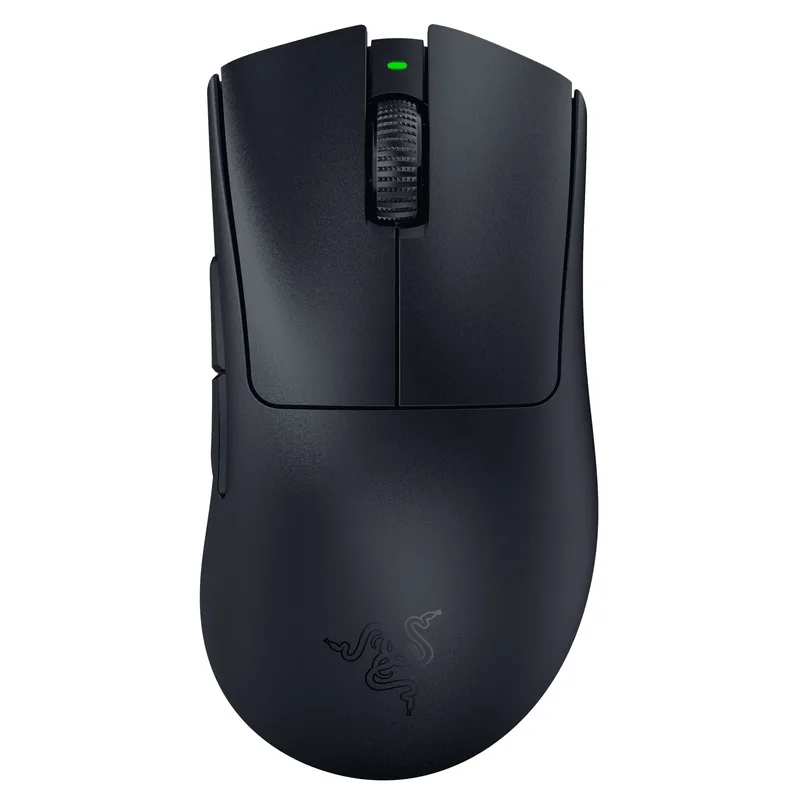
Razer DeathAdder V3 Pro Wireless Gaming Mouse
The Razer DeathAdder V3 Pro is the lightest DeathAdder Razer has ever produced at 63g, while keeping the iconic high-hump ergonomic right-hand shell that the series built its reputation on. The hump peaks earlier than most ergonomic mice, making it a natural fit for medium-large hands (17–19cm) with a palm grip.
Gen-3 optical switches provide the same 0.2ms actuation as the Viper V3 Pro. HyperSpeed wireless supports 8K polling with the included dongle. Battery life reaches 90 hours at 1K polling.
The Focus Pro 30K sensor trails the HERO 2 and Focus Pro 35K on paper, but at sub-6400 DPI gaming resolutions the difference is not measurable in crosshair accuracy. Where the DeathAdder has outpaced its competitors is on the price curve: it’s routinely $20–30 below its $149 MSRP on Amazon, with confirmed deals pushing it to $85–100. At $100 it’s substantially cheaper than the Viper V3 Pro for players who specifically want an ergonomic shell.
The trade-off versus the Superlight 2 DEX is shape philosophy. The DEX has a lower, more neutral profile; the DeathAdder V3 Pro has a more pronounced hump. Players coming from older DeathAdder models will feel at home immediately.
Who it’s for: Large-hand palm grippers, players who previously owned a DeathAdder and want to upgrade, anyone who finds flat symmetrical designs uncomfortable.
5. Razer Viper V3 HyperSpeed — Best Budget
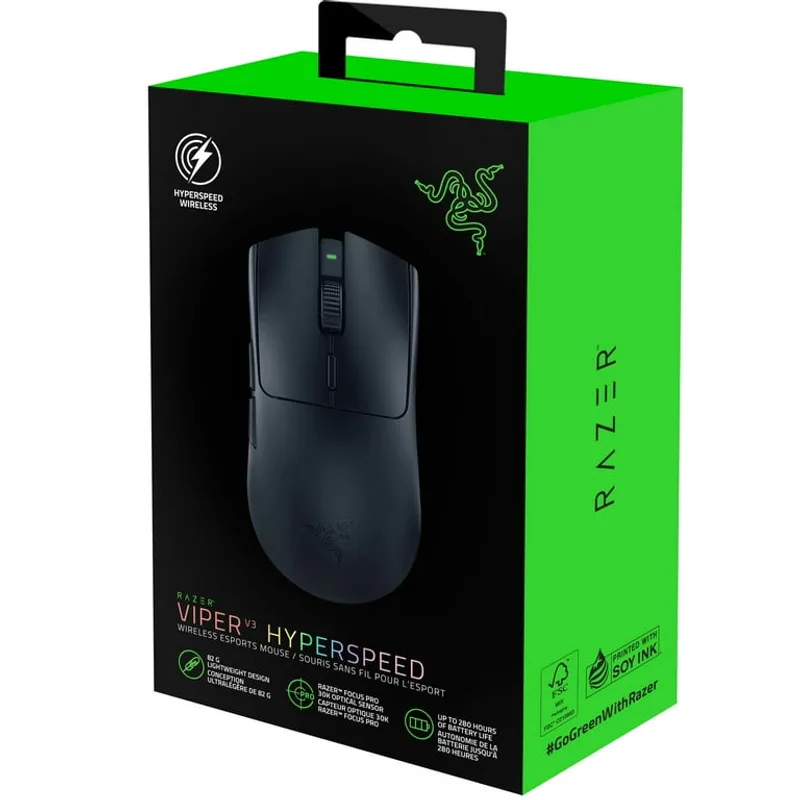
The Razer Viper V3 HyperSpeed proves that sub-$50 wireless doesn’t require sacrificing sensor quality. The Focus Pro 30K sensor matches the DeathAdder V3 Pro’s silicon — zero smoothing, zero acceleration — in a $40 symmetrical body. The headline trade-off is polling rate: the HyperSpeed connection caps at 1,000 Hz, not 4K or 8K.
At 82g it’s the heaviest mouse in this roundup, but the weight is intentional — it accommodates a standard AA battery rather than a rechargeable cell, which is how the mouse reaches 280 hours of battery life. For players who find USB-C charging inconvenient (a valid preference for desk setups with limited USB ports), the HyperSpeed’s AA design is a feature, not a limitation.
The multi-device dongle lets a single USB receiver pair with both this mouse and a compatible HyperSpeed keyboard, which is useful for clean desk setups. Gen-2 mechanical switches are slower than optical but have a 60-million click rating — not a durability concern.
At this price point the main competitor is the Logitech G305 LIGHTSPEED, which Logitech has moved to clearance pricing in 2026 as they sell off final stock. If you find the G305 below $30, it’s comparable sensor hardware; the HyperSpeed has the edge on button layout and newer switch generation.
Who it’s for: Players building their first wireless gaming setup, anyone on a strict budget who doesn’t want to compromise on sensor quality, users who prefer AA battery mice over USB-C rechargeable designs.
FAQ
Does polling rate matter for FPS gaming?
At 144 fps and below, the difference between 1K and 8K polling is not perceptible in gameplay. At 240 fps and above — common in competitive CS2 and Valorant setups — 8K polling contributes to lower overall input chain latency. The Viper V3 Pro, SUPERSTRIKE, and Superlight 2 DEX all support 8K polling wirelessly; the DeathAdder V3 Pro requires the included dongle to reach 8K; the Viper V3 HyperSpeed is limited to 1K.
Is a heavier mouse worse for FPS?
Not necessarily — it’s weight preference and grip style. Claw and fingertip grippers tend to prefer sub-60g mice for faster wrist pivots. Palm grippers often prefer 60–80g because the mouse sits on the hand rather than being moved purely by wrist and finger. The 82g Viper V3 HyperSpeed is heavier but works well for palm grips where the hand guides rather than flicks.
Do I need an 8K polling rate mouse to compete?
No. Top-ranked players use a range of polling rates from 1K to 8K. Polling rate is one variable in the input chain; monitor refresh rate, graphics settings, and mouse pad friction matter at least as much. Upgrade polling rate last, after other bottlenecks are addressed.
What DPI should I use for FPS games?
Most competitive FPS players run 400–1600 DPI with low in-game sensitivity. High DPI settings are typically unnecessary — the sensor accuracy above 3200 DPI provides no competitive advantage, and most players prefer the precision of lower DPI at a stable desk sensitivity. All five mice here perform identically below 6400 DPI.
Are optical switches better than mechanical for FPS?
Optical switches (used in the Viper V3 Pro and DeathAdder V3 Pro) actuate via a light beam interrupt rather than a physical contact, which eliminates debounce delay and improves click consistency. In direct comparisons, optical switches measure faster in raw click latency tests. The Logitech SUPERSTRIKE’s haptic system goes further — eliminating the mechanical actuation entirely — but requires evaluating whether the haptic feedback profile matches your click preference.
The Bottom Line
For most FPS players in 2026, the Razer Viper V3 Pro is the pick — 54g symmetrical, 8K wireless polling, Gen-3 optical switches, and proven sensor performance in a shape that works across grip styles. If you’re right-handed and want ergonomic contouring at a lower price, the Logitech G PRO X Superlight 2 DEX at $120 delivers comparable internals with better palm contact. Budget-limited players who want wireless without compromising the sensor should look at the Razer Viper V3 HyperSpeed — the 1K polling cap is the only meaningful sacrifice at $40.