Streaming microphones split into two camps in 2026: hybrid dynamic mics like the Shure MV7+ that scale from plug-and-play USB into a full XLR mixer setup, and condenser mics that stay simpler and cheaper but pick up more room noise. Elgato’s recent Wave:3 MK.2 revision added USB-C and a second-generation Clipguard, and RGB condensers from HyperX and Fifine keep pushing multi-pattern flexibility further down in price. These five cover $34.99 to $299 with real specs and current pricing.
| Spec | Shure MV7+ 9.4/10 | Elgato Wave:3 Unavailable 8.9/10 | HyperX QuadCast S Unavailable 8.5/10 | Logitech Creators Blue Yeti (Blackout) 8/10 | Fifine AmpliGame A6V 7.6/10 |
|---|---|---|---|---|---|
| Capsule | Dynamic, cardioid | Condenser, cardioid | Electret condenser | Tri-capsule condenser array | Condenser, cardioid, 16mm |
| Connection | USB-C and XLR (hybrid) | USB | USB | USB | USB |
| DSP | Auto Level Mode, real-time Denoiser, Digital Popper Stopper, 3 reverb types | Clipguard anti-distortion, capacitive tap-to-mute | — | — | — |
| Monitoring | Latency-free 3.5mm headphone jack | — | — | Built-in headphone amp with volume control | — |
| Software | Shure MOTIV Mix desktop app | Wave Link (up to 8-source mixing, 2 independent mixes) | HyperX NGENUITY (RGB customization) | Blue VO!CE voice effects and filters | — |
| Extras | Customizable LED touch panel, OBS certified | Zero-latency monitoring, plug and play | Tap-to-mute with LED status, integrated pop filter, gain dial | — | RGB indicator, quick-mute touch button, gain control dial |
| Rating | 9.4/10 | 8.9/10 | 8.5/10 | 8/10 | 7.6/10 |
Prices change daily — tap Check Price for the current Amazon price.
Prices change daily — tap Check Price for the current Amazon price.
Quick Picks
- Best overall: Shure MV7+ — a dynamic capsule with both USB-C and XLR outputs at $299, built to outlast a room upgrade or mixer purchase
- Best software ecosystem: Elgato Wave:3 — Wave Link’s 8-source mixing and Clipguard anti-distortion at $149.99
- Best budget: Fifine AmpliGame A6V — a complete desk-ready kit for $34.99, tripod and pop filter included
Buying Guide: What Matters for a Streaming Mic
Dynamic vs. condenser capsules
The Shure MV7+ is the only dynamic mic in this roundup. Dynamic capsules need the speaker closer to the mic but reject far more ambient noise — PC fans, keyboard clatter, room echo — than condensers pick up by default. The Wave:3, QuadCast S, Blue Yeti, and A6V are all condensers, which are more sensitive and easier to use at a normal desk distance, but need a quieter room or a noise gate in software to sound as clean as a dynamic mic.
USB vs. USB/XLR hybrid
Only the MV7+ offers XLR output alongside USB. That matters for anyone who might add an audio interface or mixer later — a hybrid mic covers both cases without a repurchase. The other four are USB-only, which is simpler for a first setup but means switching to XLR gear down the line requires buying a new microphone.
Polar pattern flexibility
- Fixed cardioid only: Fifine AmpliGame A6V
- Cardioid only (no software pattern switching): Elgato Wave:3
- 4 selectable patterns (cardioid, bidirectional, omnidirectional, stereo): HyperX QuadCast S, Logitech Creators Blue Yeti
Multi-pattern mics matter for co-streaming, in-person interviews, or recording a group around one desk. Solo streamers rarely need anything beyond cardioid.
Resolution and noise handling
The Wave:3 records at 24-bit/96kHz, ahead of the Blue Yeti’s 16-bit/48kHz and the A6V’s narrower 60Hz–18kHz frequency response. Higher resolution matters most to anyone editing VODs or exporting clips afterward — for live-only streaming where the mic feeds straight into OBS, the practical difference is smaller.
DSP and software features
The MV7+‘s Auto Level Mode and real-time Denoiser adjust automatically as a streamer moves or the room gets noisier, reducing manual gain-riding mid-stream. The Wave:3’s Clipguard prevents clipping outright rather than compressing after the fact. The QuadCast S and Blue Yeti lean on RGB customization (NGENUITY) and voice effects (Blue VO!CE) instead of adaptive processing — good for personality, less useful for consistent levels.
Detailed Reviews
1. Shure MV7+ — Best Overall
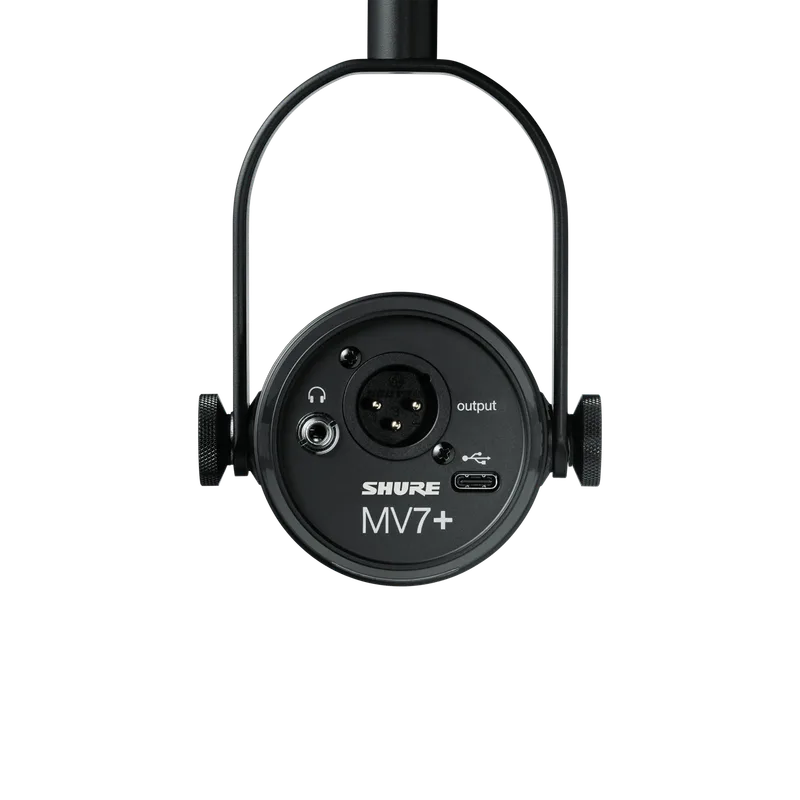
The Shure MV7+ is a dynamic cardioid microphone with both USB-C and XLR outputs, positioning it as the only mic in this roundup that doesn’t force a choice between simple USB setup and professional XLR expandability. At $299, it’s built for streamers who plan to grow into a mixer or audio interface rather than replace their microphone when they do.
Auto Level Mode continuously adjusts gain based on distance and volume, and the real-time Denoiser strips ambient noise without a manual noise gate. A Digital Popper Stopper and three onboard reverb types (Plate, Hall, Studio) round out the DSP, all controllable through Shure’s MOTIV Mix desktop app or the mic’s own LED touch panel. OBS certification means it integrates with the most common streaming software without extra configuration.
The dynamic capsule’s biggest adjustment is proximity — it needs the speaker within a few inches to sound full, unlike the more forgiving condensers in this list. That’s a small learning curve for streamers used to sitting back from a Blue Yeti or QuadCast S. At nearly triple the price of the next mic on this list, it’s also an investment that only pays off for streamers serious enough to want the XLR upgrade path.
2. Elgato Wave:3 — Best Software Ecosystem
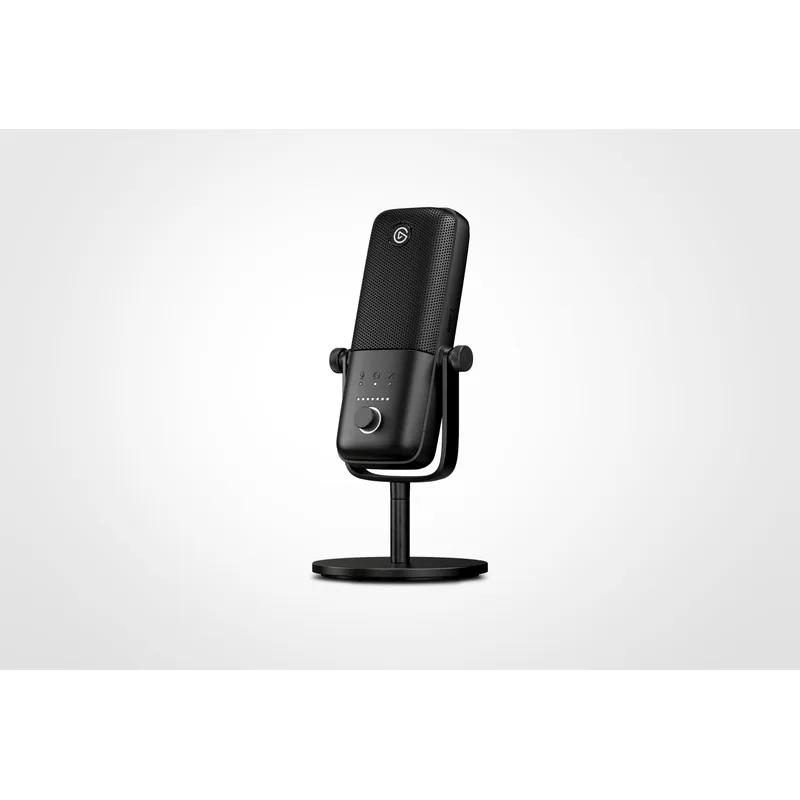
Elgato Wave:3
The Elgato Wave:3 pairs a 24-bit/96kHz cardioid condenser capsule with Wave Link, Elgato’s mixing software that combines up to eight audio sources into two independent mixes — one for a local recording, a separate one for Discord or teammates. At $149.99, it sits squarely between the QuadCast S and the MV7+.
Clipguard is the mic’s signature feature: rather than compressing audio after a volume spike, it makes clipping distortion functionally impossible at the hardware level, a real advantage for streamers with unpredictable mic volume (reaction content, gaming outbursts). Capacitive tap-to-mute on the body itself is faster to hit mid-sentence than a stand-mounted button.
The tradeoff is no XLR output — there’s no upgrade path beyond USB, so anyone who later wants a mixer or audio interface needs a different microphone. The condenser capsule is also more sensitive to room and keyboard noise than the dynamic MV7+, which matters more in untreated rooms with loud mechanical keyboards nearby.
3. HyperX QuadCast S — Best RGB / Most Flexible Patterns
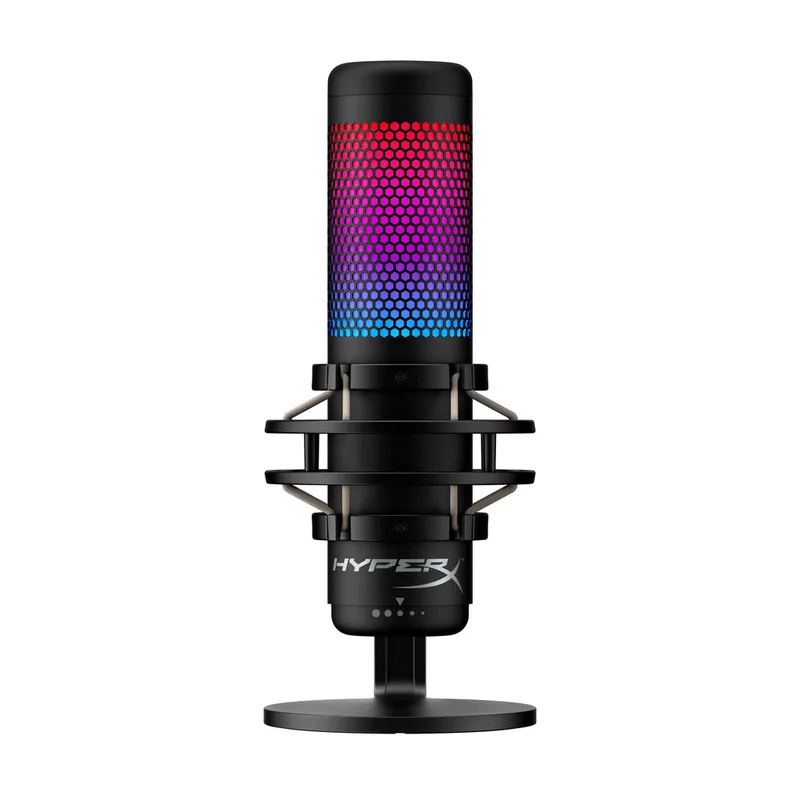
HyperX QuadCast S
The HyperX QuadCast S offers four selectable polar patterns — cardioid, bidirectional, omnidirectional, and stereo — more flexibility than any other mic in this roundup at $124.99. Omnidirectional and stereo modes make it useful beyond solo desk streaming, covering co-streaming setups or in-person interview recording that a fixed-cardioid mic like the Wave:3 or A6V can’t handle.
A built-in anti-vibration shock mount and integrated pop filter mean no extra accessory purchases are needed to get clean audio out of the box, and a physical gain dial on the base allows quick adjustment without opening software mid-stream. Customizable RGB lighting through HyperX’s NGENUITY software actually changes color rather than the Wave:3’s fixed accent lighting, a real difference for anyone matching a themed RGB setup.
The electret condenser capsule picks up more ambient room noise than the MV7+‘s dynamic capsule, especially in cardioid mode near a noisy PC case. The RGB lighting is also another always-on power draw and another piece of software to keep updated, a minor tradeoff for the extra personality it adds.
4. Logitech Creators Blue Yeti (Blackout) — Best Multi-Pattern Value
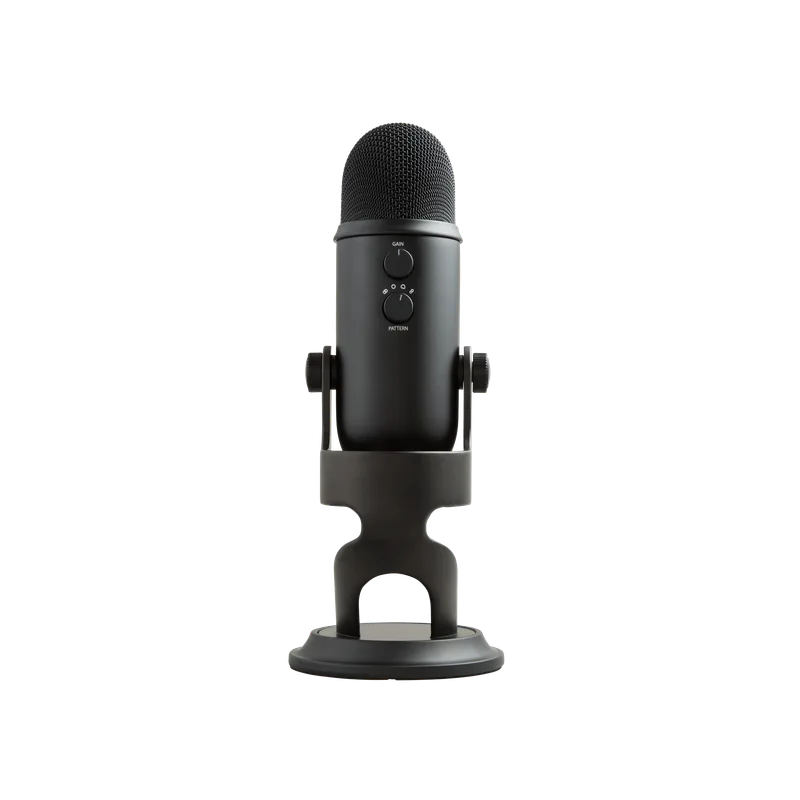
The Logitech Creators Blue Yeti (formerly Blue Microphones, now under Logitech’s Creators brand) undercuts the QuadCast S by $35 at $89.99 while matching its four polar patterns — cardioid, bidirectional, omnidirectional, and stereo — from a tri-capsule condenser array. A built-in headphone amp with independent volume control lets a streamer monitor their own mic without routing through a separate interface.
Blue VO!CE software adds real-time voice effects and broadcast-style EQ presets that neither the Wave:3 nor QuadCast S include out of the box, useful for streamers who want vocal processing without a third-party plugin. The instant mute button and gain knob are both physical controls that work without opening any software.
Its 16-bit/48kHz resolution is the lowest in this roundup, a real gap versus the Wave:3’s 24-bit/96kHz for anyone who edits recorded audio into clips or VODs afterward. The tri-capsule body is also the largest here and benefits from a boom arm rather than the included desktop stand to sit at proper mouth height.
5. Fifine AmpliGame A6V — Best Budget
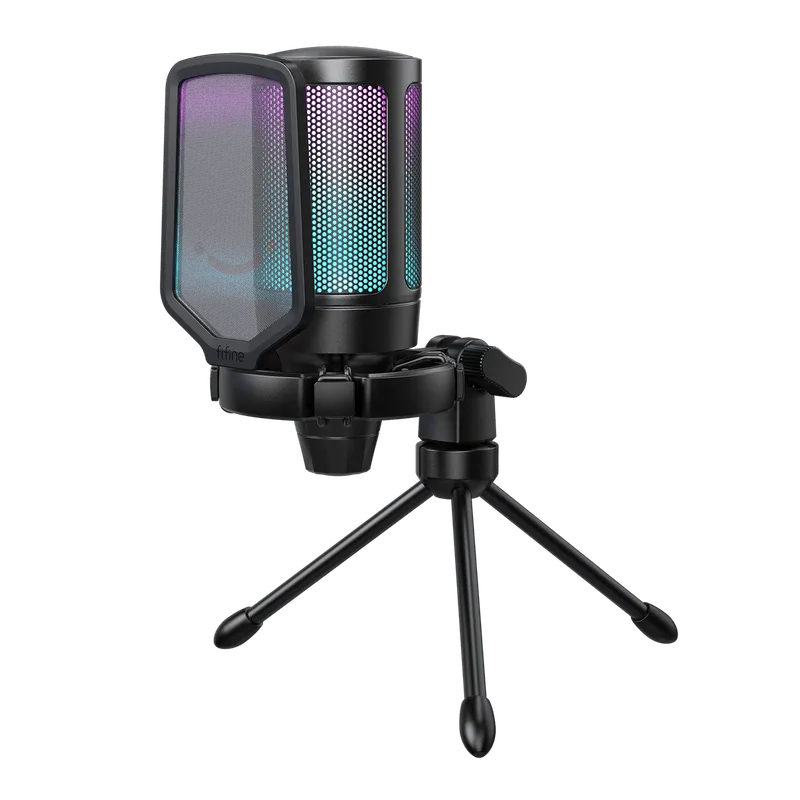
At $34.99, the Fifine AmpliGame A6V costs less than a third of the next-cheapest mic in this roundup and still ships with a tripod stand, pop filter, and built-in shock mount — no accessory purchases needed to get it desk-ready. A 16mm cardioid condenser capsule and 70dB signal-to-noise ratio deliver clear enough voice capture for Discord calls and casual streaming without a dedicated audio setup, and it picked up an iF Design Award for its build.
A quick-mute touch button and physical gain dial cover the fundamentals most beginners actually use, without requiring software to access basic controls.
The real limitation is its 60Hz–18kHz frequency response, narrower than every other mic here, which trims some low-end body and top-end detail compared to the Wave:3 or MV7+. It’s also fixed-cardioid only, with no pattern switching for co-streaming or interviews — the QuadCast S or Blue Yeti are the picks if that flexibility matters. For a first microphone or a backup unit, though, it does the job at under $35.
FAQ
Do I need an XLR microphone to start streaming?
No. Four of the five mics here are USB-only and work with a direct plug-and-play connection to any PC. The Shure MV7+‘s XLR option exists for streamers who plan to add a mixer or audio interface later — if that’s not on your roadmap, a USB mic like the Wave:3 or QuadCast S covers everything most streams need.
What’s the practical difference between a dynamic and condenser mic for streaming?
Dynamic mics like the MV7+ reject far more background noise (PC fans, keyboard clatter, room echo) but need the speaker to sit closer to the capsule. Condensers like the Wave:3, QuadCast S, Blue Yeti, and A6V are more sensitive and forgiving of distance, but pick up more of whatever else is happening in the room unless you’re in a treated space or using a noise gate.
Is 24-bit/96kHz audio actually noticeable over 16-bit/48kHz for streaming?
For live streaming straight into OBS, the difference is minimal — most platforms compress audio well below either ceiling anyway. It matters more if you’re recording separately and editing VODs or clips afterward, where the Wave:3’s higher resolution gives more headroom during post-production.
Which of these mics works best for co-streaming or interviews?
The HyperX QuadCast S and Logitech Creators Blue Yeti both offer omnidirectional and stereo polar patterns alongside cardioid, letting one mic pick up multiple people around a desk. The Wave:3, MV7+, and A6V are cardioid-only and are built for single-speaker use.
Is the Fifine AmpliGame A6V good enough for a serious streaming setup?
It’s a legitimate budget pick for Discord calls, casual streaming, or a backup mic, but its narrower frequency response and single fixed pattern make it a step down from the Wave:3 or QuadCast S for anyone building a dedicated streaming setup. Pair it with our best gaming headsets under $100 guide for a full audio setup under $150.
The Bottom Line
The Shure MV7+ is the best overall pick at $299 for anyone who wants a microphone that scales from USB plug-and-play into a full XLR mixer setup without a repurchase. Streamers who want strong software features without XLR should get the Elgato Wave:3 at $149.99. For maximum polar pattern flexibility and RGB, the HyperX QuadCast S and Logitech Creators Blue Yeti both deliver four patterns at $124.99 and $89.99 respectively. Anyone starting out or needing a reliable backup mic gets real value from the Fifine AmpliGame A6V at $34.99.