The Intel Arc B580 launched in December 2026 at $249 as the most disruptive budget GPU in years — a card with 12GB GDDR6, a 192-bit bus, and benchmark results that put it meaningfully ahead of the RTX 4060 at 1440p. Street prices briefly climbed above $309 due to supply constraints, but have since returned to near MSRP at ~$249 as of April 2026. The RTX 4060 remains at ~$339, keeping the B580’s performance-per-dollar lead intact.
This review covers Intel’s first Battlemage card with full benchmark comparisons against the RTX 4060 and RX 7600 XT — the two cards most likely to land in a builder’s shortlist at the sub-$350 price point.
| Spec | Intel Arc B580 Limited Edition Unavailable 8.5/10 | MSI GeForce RTX 4060 Ventus 2X Black 8G OC 7.4/10 | PowerColor Hellhound AMD Radeon RX 7600 XT 16GB Unavailable 7.6/10 |
|---|---|---|---|
| architecture | Battlemage Xe2, 20 Xe-cores, 2560 shaders | Ada Lovelace AD107, 3072 CUDA cores | RDNA 3 Navi 33 XT, 2048 stream processors |
| boost_clock | 2670 MHz | 2505 MHz | 2755 MHz |
| memory | 12GB GDDR6, 192-bit, 384 GB/s | 8GB GDDR6, 128-bit, 272 GB/s | 16GB GDDR6, 128-bit, 288 GB/s |
| tdp | 190W (1x 8-pin) | 115W (1x 8-pin) | 190W (1x 8-pin) |
| pcie | PCIe 4.0 x8 | PCIe 4.0 x16 | PCIe 4.0 x8 |
| display | 3x DisplayPort 2.1, 1x HDMI 2.1 | 3x DisplayPort 1.4a, 1x HDMI 2.1a | 2x HDMI 2.1, 2x DisplayPort 2.1 |
| Rating | 8.5/10 | 7.4/10 | 7.6/10 |
Prices change daily — tap Check Price for the current Amazon price.
Prices change daily — tap Check Price for the current Amazon price.
Specifications
| Spec | Intel Arc B580 |
|---|---|
| Architecture | Battlemage Xe2 |
| Xe-Cores | 20 |
| Shaders (Execution Units) | 2,560 |
| Boost Clock | 2,670 MHz |
| Memory | 12GB GDDR6 |
| Memory Speed | 16 Gbps |
| Memory Bus | 192-bit |
| Memory Bandwidth | 384 GB/s |
| TDP | 190W |
| Power Connector | 1x 8-pin |
| Process Node | TSMC 5nm |
| PCIe Interface | PCIe 4.0 x8 |
| Display Outputs | 3x DP 2.1, 1x HDMI 2.1 |
| Launch MSRP | $249 (December 2026) |
| Street Price | ~$249 (April 2026) |
What Battlemage Fixes
Intel’s Arc A-series (Alchemist) cards launched with real hardware — decent specs, competitive VRAM — but driver problems cratered real-world performance. Rebar support was required for normal operation, frame pacing was erratic in DirectX 11 titles, and early driver versions had stability issues that burned Intel’s credibility in the GPU market.
Battlemage (Xe2) fixes these problems at the architecture level. The Xe2 pipeline adds dedicated hardware for resizable BAR, improves the ray tracing engine from 1 RT unit per Xe-core to 2, and reworks the shader compiler for better compatibility with legacy DirectX 9 and 11 API calls. Independent driver analysis from driver-focused outlets in 2025 confirmed that Xe2 cards handle DX11 and DX9 titles without the frame pacing anomalies that plagued Alchemist.
The result: the B580 behaves like a normal GPU. Games that ran poorly on Arc A-series now launch and run without workarounds.
The AV1 hardware block is another carry-forward advantage. Intel’s AV1 encoder produces better quality-to-bitrate output than AMD’s or Nvidia’s equivalent budget cards, which matters for streamers and anyone recording gameplay at sub-20Mbps. If AV1 encode is in your workflow at all, the B580 delivers it at this price point where competitors cut corners.
Gaming Performance
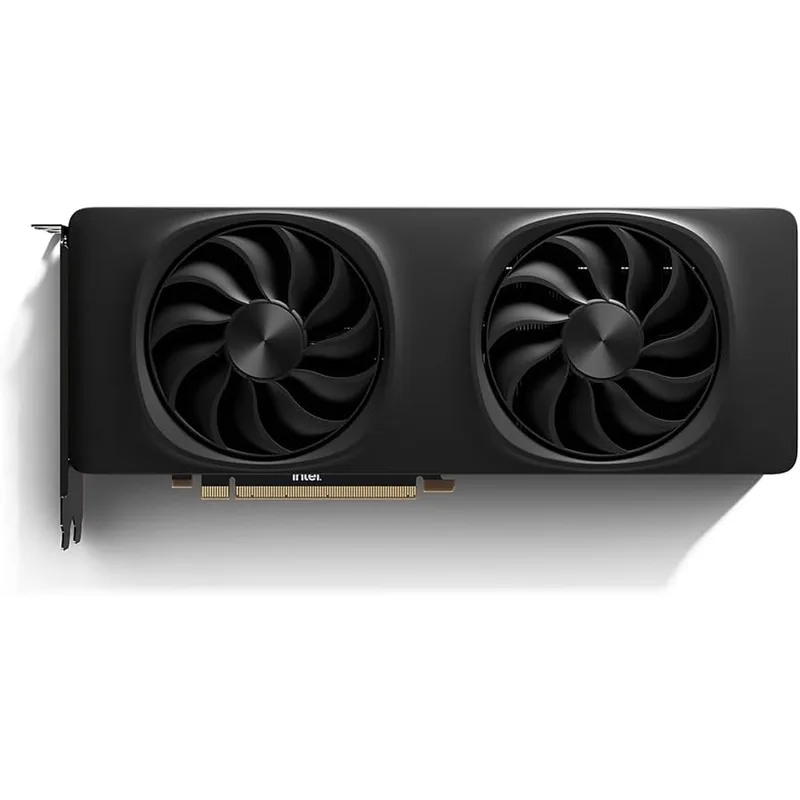
Intel Arc B580 Limited Edition
Benchmark data from GamersNexus, Tom’s Hardware, and TechSpot reviews of the B580 at launch and through 2025 driver releases paints a consistent picture: the B580 leads the RTX 4060 at 1440p, trades roughly evenly at 1080p, and gains its biggest advantages in memory-bandwidth-limited scenarios.
1080p Performance
| Game | Arc B580 | RTX 4060 | RX 7600 XT |
|---|---|---|---|
| Final Fantasy XIV | 124 FPS | 114 FPS | ~116 FPS |
| Forza Horizon 5 | ~142 FPS | ~130 FPS | ~128 FPS |
| Starfield | ~51 FPS | ~61 FPS | ~55 FPS |
| Shadow of the Tomb Raider | ~147 FPS | ~135 FPS | ~130 FPS |
| Hogwarts Legacy | ~108 FPS | ~101 FPS | ~98 FPS |
At 1080p, the B580 leads in most titles by 8–12%. Starfield is the notable exception — Nvidia’s DX12 implementation runs substantially better in that title and the RTX 4060 pulls ahead by ~17%. For a 1080p high-refresh setup, the B580 generally delivers higher averages than its price competitors.
1440p Performance
| Game | Arc B580 | RTX 4060 | RX 7600 XT |
|---|---|---|---|
| Final Fantasy XIV | 86 FPS | 70 FPS | ~66 FPS |
| Forza Horizon 5 | ~105 FPS | ~88 FPS | ~84 FPS |
| Starfield | ~52 FPS | ~63 FPS | ~58 FPS |
| Shadow of the Tomb Raider | ~108 FPS | ~90 FPS | ~86 FPS |
| Hogwarts Legacy | ~78 FPS | ~67 FPS | ~63 FPS |
1440p is where the B580’s 192-bit bus advantage over the RTX 4060’s 128-bit bus shows clearly. The ~19% average lead across titles reflects that bandwidth advantage directly. The RX 7600 XT, despite its 16GB of GDDR6, runs on the same 128-bit bus as the RTX 4060 — giving it more capacity but not more throughput — and the B580 leads it by a similar margin.
The Starfield outlier persists at 1440p as well. Bethesda’s engine appears optimized for Nvidia’s shader execution model, and the RTX 4060 pulls ahead by ~17% in that title specifically. Across the broader library the B580’s 1440p lead is real and consistent.
XeSS Upscaling
Intel’s XeSS 2 is now supported in hundreds of titles and works in two modes: XMX mode on Intel GPUs using dedicated AI hardware, and DP4a mode on any GPU. On the B580, XeSS 2 Quality mode at 1440p (rendering at ~1080p and upscaling) consistently delivers 40–55% more frames than native with image quality that the community generally rates on par with AMD’s FSR 3.1 and below DLSS 4 Quality.
XeSS also works competently on AMD and Nvidia cards in DP4a mode — giving developers a single integration path rather than three. For budget GPU owners who play titles without DLSS support, XeSS is a meaningful free performance unlock.
Power and Efficiency
The B580’s 190W TDP is its most polarizing characteristic. At this spec, it matches the RX 7600 XT’s 190W and far exceeds the RTX 4060’s 115W. In terms of performance per watt at 1440p, the RTX 4060 is more efficient — the B580 uses more power to deliver its higher frame rates, and the ratio comes out roughly neutral in performance-per-watt.
For a system builder, this means:
- A quality 650W PSU handles the B580 plus a Ryzen 5 7600X or similar mid-range CPU with comfortable headroom
- A 600W unit is the minimum Intel recommends; with an overclocked platform, step up to 750W
- The 35W idle draw is the real-world annoyance — the RTX 4060 idles at ~10W, meaning a PC left on overnight draws 150–200Wh more with a B580 than with a 4060 over a month
If power consumption is a primary concern — SFF build, high electricity costs, system on 24/7 — the RTX 4060’s efficiency advantage is the actual argument in its favor.
Ray Tracing
The B580’s Xe2 architecture doubles the RT units compared to Alchemist (2 per Xe-core vs 1), which closes Intel’s historical ray tracing gap substantially. In practice, the B580 runs ray tracing in most titles at parity with the RTX 4060 and ahead of the RX 7600 XT’s RDNA 3 RT hardware. At $309 vs $339, the B580 no longer has a ray tracing penalty — it competes on that front.
Neither the B580 nor the RTX 4060 are recommended for heavy RT builds. Cyberpunk 2077 Overdrive mode, Alan Wake 2 path tracing, and Dying Light 2 full RT all need the RTX 5070 tier or above for a consistent 60 FPS at 1440p. At the budget tier, ray tracing on the B580 is playable with Medium RT settings in most titles.
The Competition
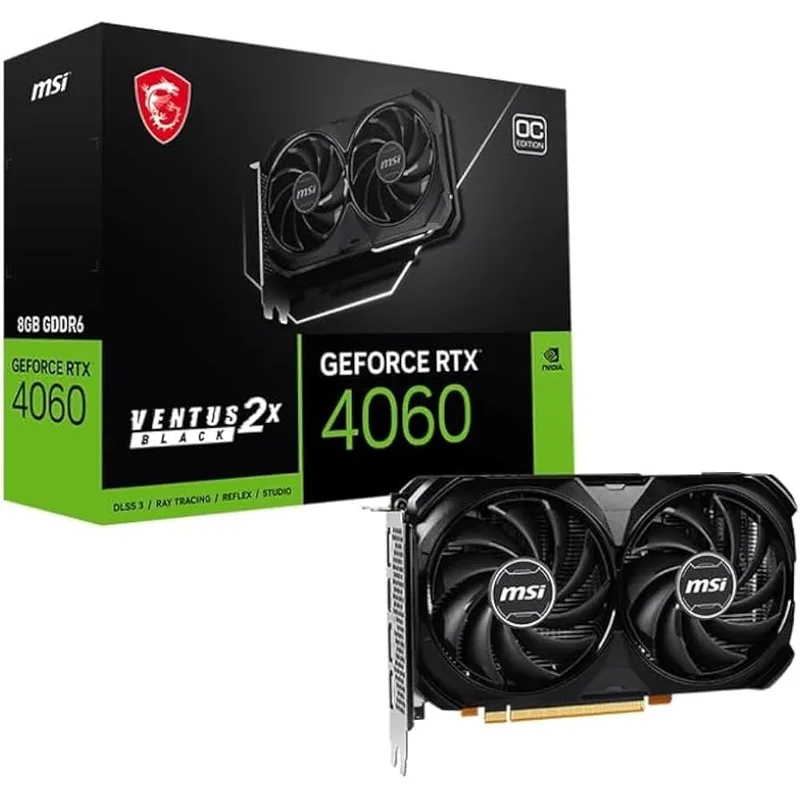
MSI GeForce RTX 4060 Ventus 2X Black 8G OC
The MSI GeForce RTX 4060 Ventus 2X sits at ~$339 street in April 2026 — $30 more than the B580 for 15–19% less 1440p rasterization performance. Its strongest arguments are efficiency (115W vs 190W), the DLSS 3.5 ecosystem in supported titles, and Nvidia’s established driver track record.
DLSS support matters most in titles with Frame Generation — where Nvidia’s FG implementation tends to be smoother than Intel’s or AMD’s equivalents, and where supported games see large effective frame rate gains. If your game library is primarily DLSS-compatible titles at 1440p, the RTX 4060 is a legitimate choice despite the raw performance gap. For games without DLSS, the B580’s native performance advantage is unambiguous.
The 8GB GDDR6 on a 128-bit bus is the harder problem for the RTX 4060’s longevity. Several current titles — Hogwarts Legacy, Returnal, Star Wars Jedi: Survivor — can push past 8GB VRAM at 1440p with Ultra texture settings and lossless texture packs. The B580’s 12GB buffer handles these workloads without dropping texture quality or stuttering.
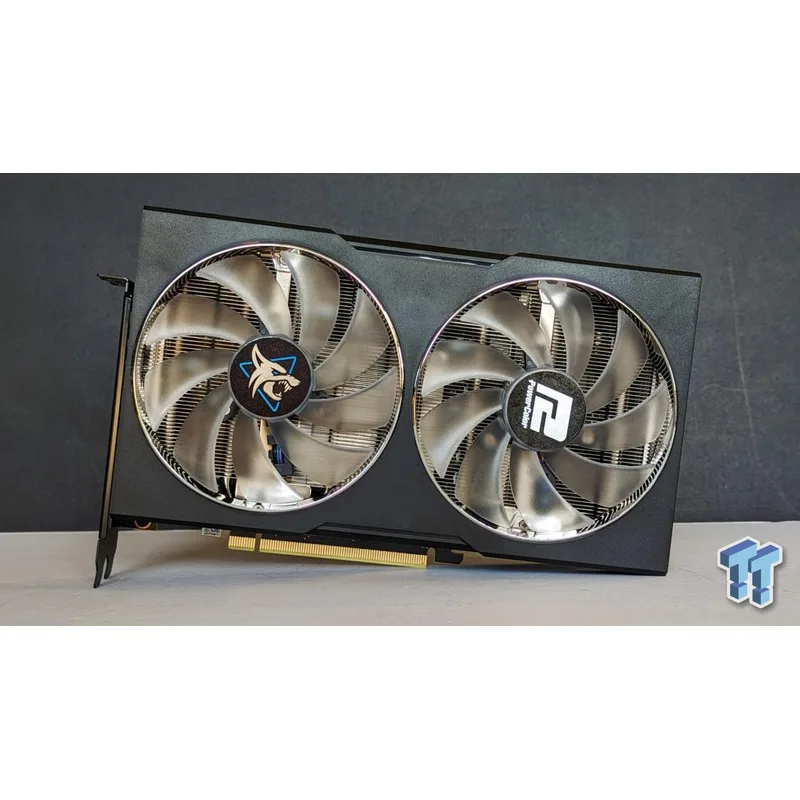
PowerColor Hellhound AMD Radeon RX 7600 XT 16GB
The PowerColor Hellhound RX 7600 XT 16GB brings the highest VRAM count at this price tier — 16GB GDDR6 — which future-proofs it against rising texture budgets in a way neither the B580 nor the RTX 4060 fully does. Street prices have risen from the $329 launch MSRP to ~$349, narrowing the gap versus the B580 to ~$40.
The RX 7600 XT’s limitation is its 128-bit memory bus. Despite carrying 16GB of GDDR6, the narrow bus limits bandwidth to 288 GB/s versus the B580’s 384 GB/s — and that bandwidth gap is visible at 1440p. The B580 leads the RX 7600 XT by ~19–31% in bandwidth-sensitive 1440p titles. The 16GB VRAM capacity advantage is real for future games but delivers minimal performance uplift today.
FSR 3 frame generation support is the RX 7600 XT’s upside: with a game that supports it, FSR 3 FG provides a legitimate frame rate multiplier that neither the B580’s current XeSS 2 FG implementation nor raw B580 performance can match in every title. If frame generation compatibility in AMD’s FSR ecosystem is a priority, the RX 7600 XT has that advantage.
Who Should Buy the Arc B580
Buy the B580 if:
- You game at 1440p and want the most native rasterization performance under $350
- You’re coming from a system with a 650W+ PSU already installed
- You want 12GB VRAM to avoid the texture budget ceiling an RTX 4060 creates
- You use AV1 encode for streaming or capture at any point
Consider the RTX 4060 instead if:
- Your system is power-constrained (SFF, 550W or smaller PSU)
- Your primary titles are DLSS 3.5 Frame Generation-supported games
- The PC runs 24/7 and idle power efficiency is a tangible monthly cost
Consider the RX 7600 XT instead if:
- You want maximum VRAM headroom for a future game library and are willing to accept lower 1440p bandwidth
- FSR 3 frame generation compatibility in AMD-supported titles is a priority for your specific game list
FAQ
Is the Intel Arc B580 good for 1440p gaming?
Yes. Benchmark data from multiple independent reviewers shows the B580 running 1440p at 80–105 FPS in demanding titles with High settings. It outperforms the RTX 4060 by ~19% on average at 1440p, making it the strongest native rasterization card under $350 for that resolution.
Does the Arc B580 have driver issues in 2026?
Significantly fewer than the Arc A-series at launch. Battlemage’s hardware-level DirectX compatibility improvements resolved most of the frame pacing and stability issues from Alchemist. Some older DX9 titles still show occasional anomalies, and Starfield’s performance is below the card’s typical standing — but for current and recent titles, B580 drivers are stable. Intel Arc Control software has also improved with regular updates through 2025.
What PSU does the Intel Arc B580 need?
Intel recommends a 600W power supply minimum. For a typical gaming build with a mid-range CPU (Ryzen 5 7600X, Intel Core i5-14600K), a quality 650W PSU covers the system comfortably. If you’re using a high-TDP processor (Ryzen 7 9800X3D at 120W, Core Ultra 9 285K at 125W), budget for a 750W unit.
Does the B580 work with PCIe 3.0 motherboards?
Yes. The B580 uses PCIe 4.0 x8 electrically, which is backward-compatible with PCIe 3.0 x16 slots. Performance loss in older motherboards with PCIe 3.0 x16 is minimal — benchmarks show a 1–3% variance in most titles. PCIe 3.0 x8 (a common slot configuration on entry-level boards) shows more variance and is not recommended.
How does the B580 compare to the new RTX 5060?
The RTX 5060 was announced in early 2026 but carries 8GB GDDR7 at an expected street price above $299 — similar to the RTX 4060’s position. Based on pre-release Blackwell architecture data, the RTX 5060’s 8GB VRAM limitation mirrors the RTX 4060’s, while the B580’s 12GB GDDR6 remains an advantage at 1440p with high-fidelity texture settings. The final RTX 5060 vs B580 comparison will depend on actual street prices and confirmed driver performance once cards ship broadly.
The Bottom Line
The Intel Arc B580 is the most capable sub-$350 GPU for 1440p gaming available in April 2026. The $249 launch price was exceptional; at $309 the value case is narrower but still compelling — $309 buys 12GB GDDR6 and ~19% faster 1440p performance than a $339 RTX 4060, which makes the comparison straightforward for anyone building a high-refresh 1440p system. The 190W TDP and elevated idle power draw are real trade-offs; for efficiency-focused builds or power-constrained enclosures, the RTX 4060 remains the right call. For everyone else running a 1440p display, the B580 is the correct choice at this price tier.