The flagship CPU space in 2026 has gotten more interesting than Intel would like. AMD’s Ryzen 9 9950X launched in mid-2024, but street prices have settled to around $529 as of early April 2026 — and with Intel’s Core Ultra 9 285K sitting at $559, the price gap has flipped in AMD’s favor. Add the arrival of the Ryzen 9 9950X3D with 3D V-Cache on top, and Intel’s flagship has a harder time justifying its position. Here’s a direct comparison across gaming, productivity, and power draw to help you decide which chip belongs in your next build.
| Spec | AMD Ryzen 9 9950X 9.2/10 | Intel Core Ultra 9 285K 8.6/10 |
|---|---|---|
| Architecture | Zen 5 | Arrow Lake (Lion Cove P-cores + Skymont E-cores) |
| Cores | 16 cores / 32 threads | 24 cores (8P+16E) / 24 threads |
| Boost Clock | 5.7 GHz | 5.7 GHz |
| Cache | 64MB L3 | 36MB L3 |
| Socket | AM5 | LGA1851 |
| TDP | 170W | 125W base / 250W max turbo |
| Rating | 9.2/10 | 8.6/10 |
Prices change daily — tap Check Price for the current Amazon price.
Prices change daily — tap Check Price for the current Amazon price.
Quick Picks
- Best for most workloads — AMD Ryzen 9 9950X ($529): Wins Blender, HandBrake, Photoshop, and gaming by meaningful margins at a lower price. Check price on Amazon
- Best for single-threaded tasks — Intel Core Ultra 9 285K ($559): The 6.2% single-threaded edge is real and shows up in compilation latency. Check price on Amazon
Who These CPUs Are For
These are both enthusiast-tier chips aimed at power users who need more than a mid-range CPU can deliver. If you’re building a primary workstation that also doubles as a gaming rig, both are valid — but the use-case split is clear.
The Ryzen 9 9950X makes the most sense if you spend real hours in Blender, DaVinci Resolve, or HandBrake. It also holds a slight gaming edge over the 285K, and the AM5 platform gives you a defined upgrade path to Zen 6. The fact that it costs $30 less while outperforming the 285K in most real-world workloads is the story of this comparison.
The Core Ultra 9 285K has its place if your software is explicitly optimized for Intel’s architecture and you need that single-threaded headroom. Certain compile workflows, particularly those relying on AVX-512 instruction sets aligned to Intel’s implementation, can favor the 285K. The built-in iGPU is also a legitimate perk for server-adjacent builds or systems where a discrete GPU isn’t always present.
What these CPUs are not: gaming-first processors. If gaming is your primary use case, the AMD Ryzen 7 9800X3D with its 3D V-Cache architecture beats both chips by 20-49% in CPU-bound titles. Save your money and buy that instead.
AMD Ryzen 9 9950X
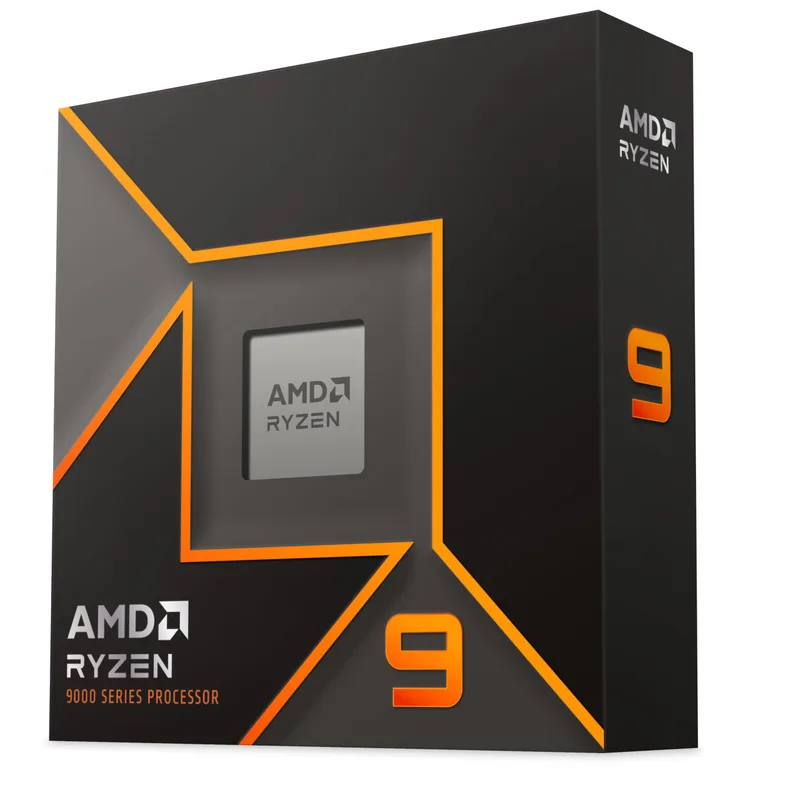
The Ryzen 9 9950X is AMD’s 16-core flagship on the Zen 5 architecture. It launched at $699 and has since settled to ~$529, which puts it squarely in the range where its performance becomes genuinely compelling relative to Intel.
Productivity Performance
The 9950X’s Zen 5 cores carry a meaningful IPC advantage in workloads that stress instruction throughput. In Blender, AMD leads across all three standard scenes (Monster, Junkyard, Classroom) by 6-10% over the 285K. HandBrake x265 encoding follows the same pattern. Photoshop’s benchmark shows a 17% AMD lead — a gap large enough to matter in a daily creative workflow. Corona 10 gives AMD another 8% advantage.
The 285K does edge the 9950X in Cinebench 2026 multi-core by 3.3% and POV-Ray multi by 14.4%. Both are legitimate benchmarks, but they don’t represent the full breadth of creative production workloads.
Gaming Performance
At 1440p, both CPUs are largely GPU-limited in the vast majority of titles. Where the CPU is the bottleneck, the 9950X averages 4.54% higher FPS. In Cyberpunk 2077’s CPU-bound scenarios, the 9950X extends that to a 21% advantage. For a non-X3D chip, that’s a real result.
Power and Cooling
The 9950X carries a 170W TDP, which climbs under sustained all-core loads. In Prime95 Small FFTs (AVX-intensive), it draws 231W — that’s high, but the 285K draws 325W in the same test, 40.7% more. For a cooler recommendation, a 280mm AIO or a tower cooler in the class of the Noctua NH-D15 will handle it without throttling.
Platform Notes
AM5 runs DDR5 exclusively (no DDR4 support), and an X670E or B650 motherboard is required. AMD has committed to AM5 platform support through 2027 and beyond, with Zen 6 CPUs slotting into the same socket. If you’re building a system you intend to use for 4-5 years, that upgrade path has real value.
Intel Core Ultra 9 285K

The Core Ultra 9 285K represents Intel’s Arrow Lake flagship — 24 cores split between 8 performance P-cores and 16 efficiency E-cores, all on the LGA1851 socket. It launched at $589 and currently sits around $559.
Productivity Performance
The 285K’s 6.2% single-threaded advantage is consistent across individual single-threaded benchmarks. For workloads like database compilation or sequential code execution where per-core speed matters more than total core count, this advantage translates to measurably faster results.
In multi-threaded work, the picture is mixed. Cinebench 2026’s multi-core benchmark gives Intel a 3.3% edge, and POV-Ray’s multi-core result hands Intel a 14.4% lead. But those results diverge from Blender, HandBrake, and Photoshop — all of which favor AMD by significant margins. Cinebench and POV-Ray are clean synthetic loads; the Adobe and Blender results represent actual software rendering pipelines.
Gaming Performance
At 1440p and above, the 285K is within the margin of error compared to the 9950X in most titles. Both are competent gaming CPUs that will eliminate CPU bottlenecks in any GPU-limited scenario. Where the 285K loses ground is in the handful of titles where the CPU is clearly the limiter — specifically open-world games like Cyberpunk 2077 where AMD’s IPC advantage shows.
The integrated Intel GPU (Xe-LP) is not for gaming — it handles 4K desktop output and video decoding, and it’s a useful diagnostic tool if you ever need to boot without a discrete GPU.
Power and Cooling
Intel markets the 285K at a 125W base processor power, but that number is largely theoretical. Under sustained all-core Blender rendering or Prime95, the chip hits 250-325W depending on the workload. A 240mm AIO is the absolute minimum; a 360mm AIO or a top-tier air cooler like the Noctua NH-D15 is more appropriate for sustained workloads.
Platform Notes
LGA1851 requires a Z890 motherboard and DDR5 memory — same DDR5 requirement as AM5. Intel has not announced a confirmed successor architecture for LGA1851, which creates uncertainty about platform longevity beyond Arrow Lake Refresh. By contrast, AMD’s AM5 roadmap is publicly committed to future Zen generations.
Head-to-Head Summary
| Benchmark | Ryzen 9 9950X | Core Ultra 9 285K | Winner |
|---|---|---|---|
| Single-threaded (avg) | — | +6.2% | Intel |
| Cinebench 2026 Multi | — | +3.3% | Intel |
| POV-Ray Multi | — | +14.4% | Intel |
| Blender (avg 3 scenes) | +6-10% | — | AMD |
| HandBrake x265 | +6-10% | — | AMD |
| Photoshop | +17% | — | AMD |
| Corona 10 | +8% | — | AMD |
| Gaming avg (1440p) | +4.5% | — | AMD |
| Prime95 power draw | 231W | 325W | AMD |
| Street price | $529 | $559 | AMD |
AMD wins 7 of 10 categories, including both the performance crown in real-world workloads and the price-per-performance metric.
FAQ
Does the Ryzen 9 9950X require a new motherboard? Yes — it runs on AM5, which means a B650, X670, or X870 series motherboard. If you’re upgrading from an AM4 platform (Ryzen 3000/5000 series), you’ll need a new board and DDR5 RAM. AMD’s AM5 socket itself is forward-compatible with future Zen 6 CPUs.
Does the Core Ultra 9 285K support DDR4? No — Arrow Lake’s LGA1851 platform is DDR5-only, same as AM5. Unlike Intel’s Alder and Raptor Lake generations, there’s no DDR4 option on Z890 motherboards.
Which CPU is better for streaming while gaming? The 285K’s 24-core design (8P + 16E) gives it a theoretical multitasking edge — the E-cores can absorb streaming encoder workloads while P-cores handle the game. In practice, the 9950X’s 16 high-IPC Zen 5 cores handle this scenario equally well, and its lower power draw under mixed loads keeps temps more manageable.
Is the Ryzen 9 9950X3D worth waiting for instead? If your budget can stretch to it, yes — the 9950X3D adds 3D V-Cache to the 9950X’s 16 Zen 5 cores, dramatically improving gaming performance while retaining strong multi-threaded productivity results. It’s a different class of chip. For pure workstation builds where gaming isn’t a priority, the standard 9950X at $529 is harder to argue against.
What cooler should I use with either of these CPUs? Both chips need serious cooling. For the 9950X, a 280mm or 360mm AIO, or a top-tier tower cooler like the Noctua NH-D15, is appropriate. The 285K has the same requirement despite its lower 125W base TDP — sustained workloads will push it to 250W+, which demands equivalent cooling capacity.
The Bottom Line
The AMD Ryzen 9 9950X wins this comparison. At $529 vs the 285K’s $559, it delivers better performance in Blender, HandBrake, Photoshop, and gaming while drawing significantly less power under load. The Core Ultra 9 285K makes sense in narrow single-threaded-heavy workflows and for builders who specifically need Intel’s iGPU or platform ecosystem — but for most workstation and creator builds in 2026, the 9950X is the smarter buy.