Affiliate disclosure: PCBuildRanked earns a commission on qualifying Amazon purchases at no extra cost to you.
The 4K GPU market in April 2026 rewards careful shopping. NVIDIA’s Blackwell lineup delivered generational performance gains, but prices remain well above MSRP due to tariffs and constrained supply — the RTX 5090 that launched at $1,999 still trades at $3,299+. AMD’s RX 9070 XT changed the conversation: RDNA 4 architecture that genuinely closed the ray tracing gap, rasterization that matches the RTX 5070 Ti, and at $769 it’s the strongest value challenge NVIDIA has faced in years. These are the five best graphics cards for 4K gaming right now.
| Spec | MSI GeForce RTX 5090 32G Gaming Trio OC Unavailable 9.5/10 | NVIDIA GeForce RTX 5080 Founders Edition 8.8/10 | Gigabyte GeForce RTX 5070 Ti Gaming OC 16G Unavailable 8.5/10 | Sapphire Pulse AMD Radeon RX 9070 XT Gaming 16GB 8.7/10 | MSI GeForce RTX 5070 12G Ventus 2X OC 8/10 |
|---|---|---|---|---|---|
| architecture | Blackwell (GB202) | Blackwell (GB203) | Blackwell (GB203) | RDNA 4 (Navi 48) | Blackwell (GB205) |
| vram | 32GB GDDR7 | 16GB GDDR7 | 16GB GDDR7 | 16GB GDDR6 | 12GB GDDR7 |
| memory_bus | 512-bit | 256-bit | 256-bit | 256-bit | 192-bit |
| cuda_cores | 21,760 | 10,752 | 8,960 | — | 6,144 |
| boost_clock | 2497 MHz | 2617 MHz | 2588 MHz | 2970 MHz | 2452 MHz |
| tdp | 575W | 360W | 300W | 304W | 250W |
| Rating | 9.5/10 | 8.8/10 | 8.5/10 | 8.7/10 | 8/10 |
Prices change daily — tap Check Price for the current Amazon price.
Prices change daily — tap Check Price for the current Amazon price.
Quick Picks
- Best Overall: MSI RTX 5090 Gaming Trio OC — Fastest GPU on the market. Nothing else close at 4K. Street price is painful.
- Editor’s Pick: NVIDIA RTX 5080 Founders Edition — 85% of RTX 5090 performance at $1,249. The anchor pick for serious 4K builds.
- Best Value: Sapphire Pulse RX 9070 XT — Matches RTX 5070 Ti rasterization at $769. Standard 8-pin power, no adapter drama.
Buying Guide: What You Need to Know Before Picking a 4K GPU
How Much VRAM Do You Actually Need at 4K?
At 4K ultra settings, modern titles routinely consume 12-18GB of VRAM. The RTX 5070’s 12GB handles most games without issue but shows pressure with 4K ultra texture packs in titles like Hogwarts Legacy and Starfield. Every other card on this list carries 16GB, which handles all current titles at 4K without VRAM-related frame time spikes. For long-term builds, 16GB is the safer floor.
For a deeper breakdown, see our VRAM guide.
DLSS 4 vs FSR 4: The Gap Narrowed, But It’s Still Real
DLSS 4’s Multi Frame Generation generates up to three additional frames per rendered frame using dedicated AI hardware — in practice, an RTX 5070 can deliver frame rates that rival cards with larger raw rasterization leads. AMD’s FSR 4 is a genuine upgrade from FSR 3 and works across all hardware including NVIDIA, but it lacks dedicated hardware acceleration and falls short of DLSS 4 MFG in motion quality at the same multiplier.
If your game library is DLSS-optimized, Blackwell cards benefit disproportionately. If you mostly play FSR-supported titles and skip heavy ray tracing, the RX 9070 XT’s value case gets stronger.
PSU Requirements
| GPU | TDP | Minimum PSU |
|---|---|---|
| RTX 5090 | 575W | 1000W |
| RTX 5080 | 360W | 850W |
| RTX 5070 Ti | 300W | 750W |
| RX 9070 XT | 304W | 700W |
| RTX 5070 | 250W | 650W |
The NVIDIA Blackwell cards (5090, 5080, 5070 Ti, 5070) all use the 12VHPWR (16-pin) connector. If your PSU lacks a native 16-pin cable, use only the adapter bundled with the card — third-party adapters have caused cable melt incidents. The RX 9070 XT uses standard dual 8-pin PCIe connectors, no adapter required.
The Supply Situation as of April 2026
Every card on this list is purchasable at retail, but premiums above MSRP remain. The RTX 5090 still trades at $3,299+. The RTX 5080 has come down to around $1,249 from earlier $1,400+ highs. The RX 9070 XT sits at $769 at most retailers, with promotional bundles occasionally bringing it to $699. Set alerts on CamelCamelCamel or TrackaLacker for the specific listings below if you’re waiting for drops.
Detailed Reviews
1. MSI GeForce RTX 5090 32G Gaming Trio OC
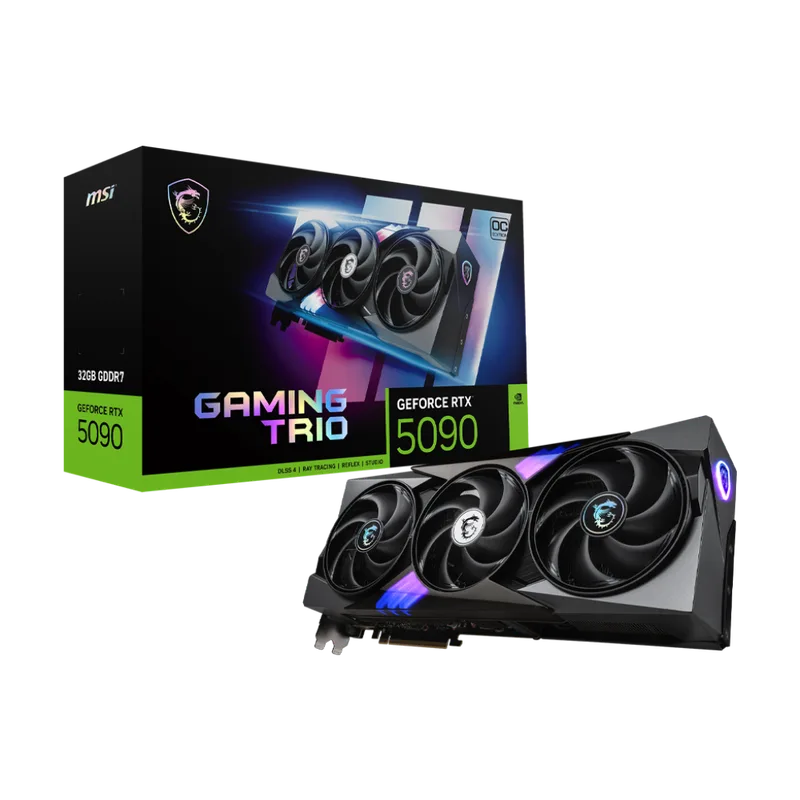
MSI GeForce RTX 5090 32G Gaming Trio OC
The MSI RTX 5090 32G Gaming Trio OC uses NVIDIA’s full GB202 die — 21,760 CUDA cores, 32GB GDDR7 across a 512-bit bus, and 1,792 GB/s of memory bandwidth. Nothing in the discrete GPU market touches it.
At 4K ultra, the RTX 5090 is 40-60% faster in rasterization than the RTX 4090. In Cyberpunk 2077 at 4K with Ray Tracing Overdrive and no DLSS, it averages in the high 70s fps — a figure the RTX 4090 couldn’t hit even with DLSS enabled. With DLSS 4 Multi Frame Generation, it clears 100 fps in essentially every current game at 4K native settings.
MSI’s Gaming Trio OC uses three TORX 5.0 fans across a substantial heatsink. Temperatures stay controlled under sustained load, but the 575W TDP sets the baseline for your entire power budget. Plan for a 1000W PSU minimum, 1200W if you’re pairing it with a power-hungry CPU.
The honest case against it: the street price is not $1,999. Most models sell for $3,299-$3,999. At those figures, this GPU alone costs more than a complete RTX 5080-based gaming PC. Buy it if you need the absolute fastest and price is secondary — otherwise, the RTX 5080 delivers 85% of the performance without the supply lottery. Read our full RTX 5090 review for detailed benchmarks and AIB card recommendations.
2. NVIDIA GeForce RTX 5080 Founders Edition
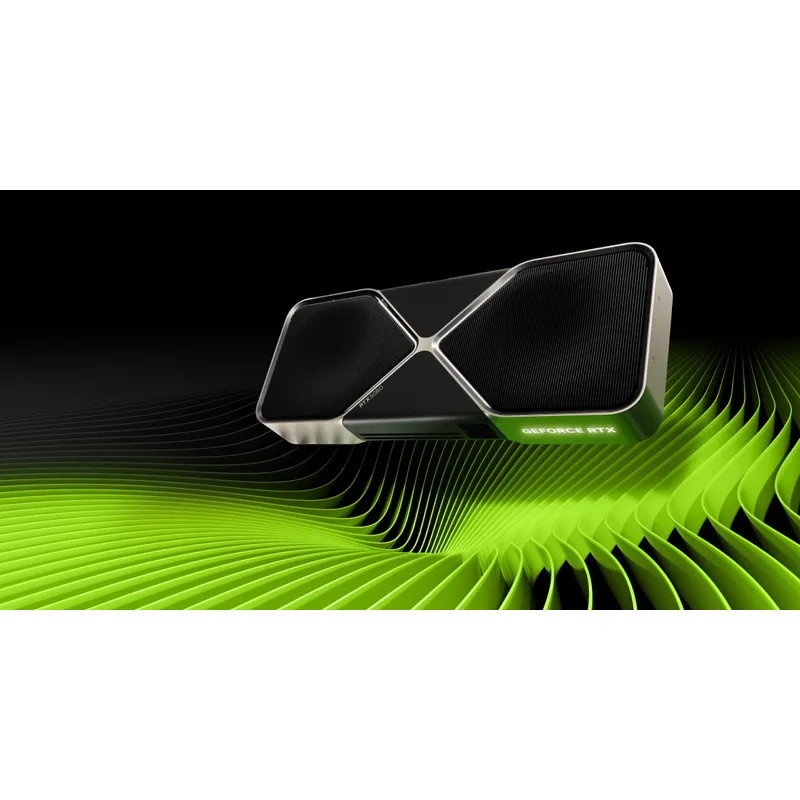
The NVIDIA RTX 5080 Founders Edition is the most balanced choice for serious 4K gaming. The GB203 die delivers 10,752 CUDA cores and 16GB of GDDR7. At $1,249 — down from $1,400+ earlier this year — it’s finally approaching a price where the performance-per-dollar calculation makes sense.
At 4K ultra, the RTX 5080 runs roughly 15-20% faster than the RTX 4090 in rasterization. Baldur’s Gate 3 and Total War: Warhammer III hold 4K/60 at maximum settings without DLSS. With DLSS 4 Quality mode it pushes past 100 fps in most titles at 4K. The 360W TDP is substantially more manageable than the 5090’s — an 850W PSU handles it alongside a high-end CPU without headroom concerns.
NVIDIA’s Founders Edition is a dual-slot design, compact and efficient, but it runs slightly warmer than triple-fan AIB alternatives. If thermals or acoustics matter more to you, the ASUS TUF RTX 5080 or Gigabyte RTX 5080 Gaming OC run cooler at comparable prices.
At $1,249, the RTX 5080 remains 25% above MSRP. But it’s the most capable sub-$1,500 GPU available and the natural anchor for anyone building a high-end 4K rig today.
3. Gigabyte GeForce RTX 5070 Ti Gaming OC 16G
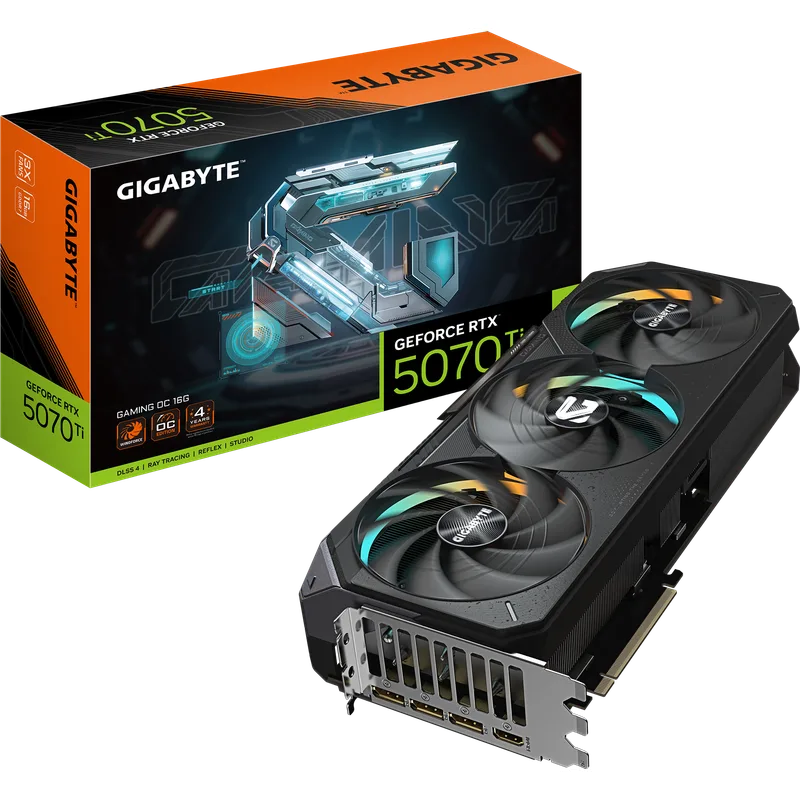
Gigabyte GeForce RTX 5070 Ti Gaming OC 16G
The Gigabyte RTX 5070 Ti Gaming OC is the practical choice for serious 4K gaming without crossing $1,100. Sharing the GB203 die as the RTX 5080 with fewer active CUDA cores (8,960 vs 10,752) and a lower boost clock, it trades 10-15% of rasterization performance for a $150 discount over the 5080.
That gap narrows with DLSS 4. Both the RTX 5070 Ti and RTX 5080 support Multi Frame Generation, and with DLSS Quality + Frame Generation enabled the perceived performance difference at 4K is small. In F1 24, Resident Evil 4 Remake, and Star Wars Outlaws at 4K, the 5070 Ti holds 4K/60 ultra without upscaling.
The RTX 5070 Ti falls behind more noticeably in ray-traced workloads. Cyberpunk 2077 Overdrive at 4K shows about an 18% gap versus the 5080 without DLSS — meaningful if that’s a core part of your library. With DLSS enabled, the frame rate gap compresses significantly.
Gigabyte’s WINDFORCE cooling uses three alternate-spinning 80mm fans and keeps the GPU under 80°C at stock speeds. It’s audible under sustained load compared to quieter options like the ASUS TUF, but performance-wise it sits at the top of the “most GPU per dollar” chart among Blackwell cards once you move past the RX 9070 XT.
4. Sapphire Pulse AMD Radeon RX 9070 XT Gaming 16GB
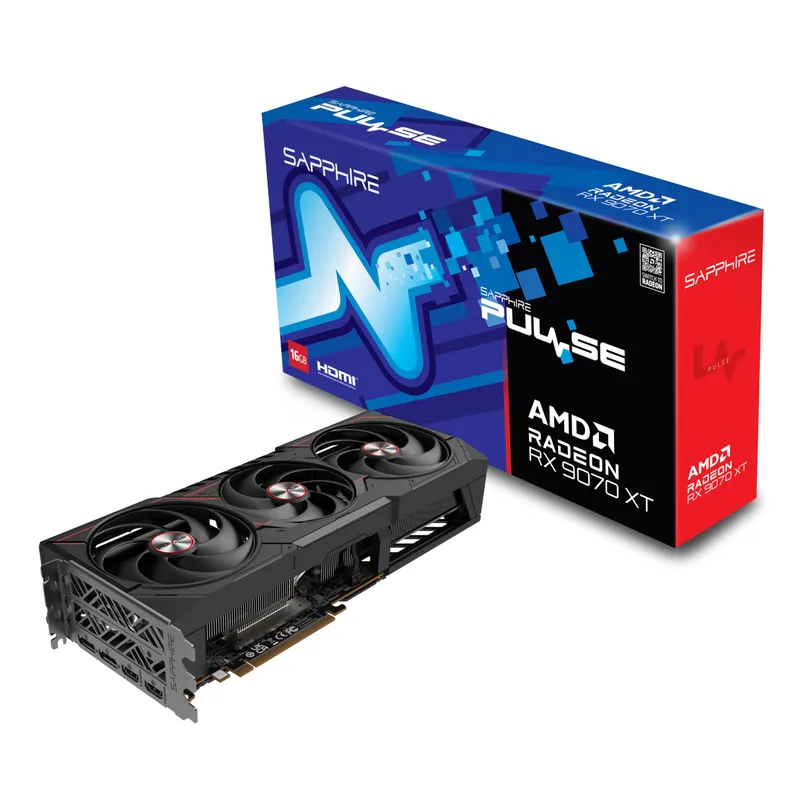
The Sapphire Pulse RX 9070 XT is the most compelling value in the 4K GPU market right now. At $769, it goes head-to-head with the RTX 5070 Ti — a card that costs $331 more — and lands within single-digit percentage points depending on the title.
In rasterization at 4K, the RX 9070 XT and RTX 5070 Ti alternate leads by game: within 6% of each other in F1 24, Cyberpunk 2077 (no RT), Resident Evil 4, Starfield, Total War: Warhammer III, and Dragon’s Dogma 2 per GamersNexus head-to-head analysis. At this price delta, the RX 9070 XT is the obvious purchase if ray tracing isn’t a priority.
RDNA 4 made real progress on ray tracing. The RX 9070 XT’s RT hardware is a genuine step forward from RDNA 3, and the gap to RTX 5070 Ti has narrowed to roughly 15-25% depending on implementation. Cyberpunk Overdrive and Alan Wake 2 Path Tracing still favor NVIDIA significantly, but this is no longer the embarrassing RT gap that RDNA 3 carried.
Sapphire’s Pulse is one of the better RX 9070 XT coolers — dual-fan, compact, and noticeably quieter at load than the XFX Swift or ASRock Challenger. Standard dual 8-pin connectors mean no 12VHPWR adapter required. Promotional bundles occasionally bring the effective price to $699.
5. MSI GeForce RTX 5070 12G Ventus 2X OC
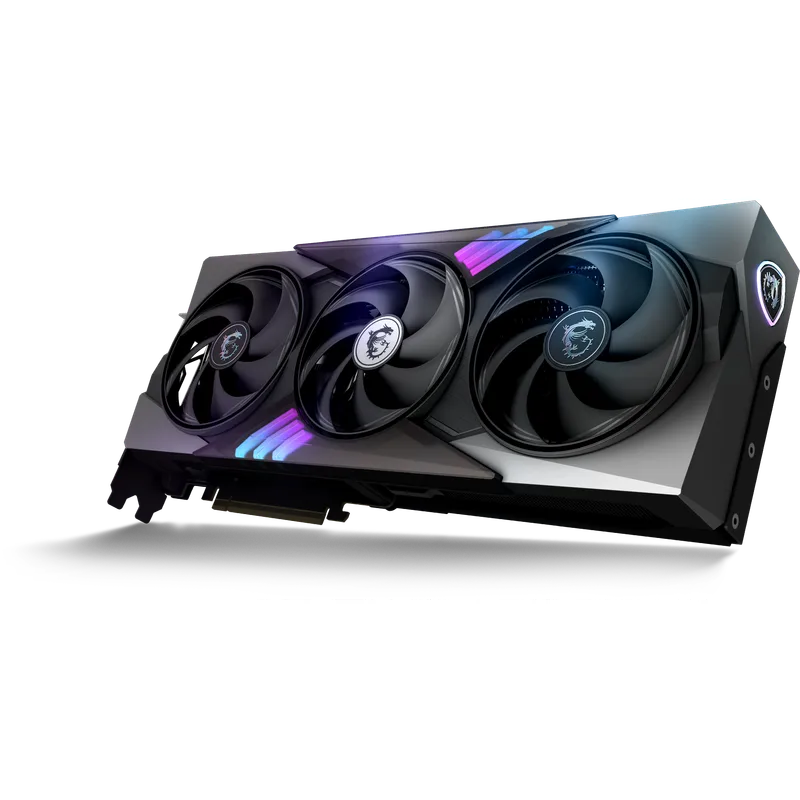
The MSI RTX 5070 12G Ventus 2X OC is the entry point for 4K gaming on Blackwell at $599 — and it delivers, with caveats. The GB205 die runs 6,144 CUDA cores across a 192-bit bus with 12GB of GDDR7, producing 672 GB/s of bandwidth. The 250W TDP is the lowest on this list by a meaningful margin.
At 4K, the RTX 5070 needs DLSS to sustain consistent 60+ fps in demanding titles. With DLSS 4 Quality mode enabled, it handles Hogwarts Legacy, Cyberpunk 2077, and Star Wars Outlaws at 4K High-Ultra settings without issue. Lighter titles and esports games are solid at 4K without upscaling. The 12GB VRAM limitation surfaces specifically with 4K ultra texture packs — frame times spike in Hogwarts Legacy or Starfield when the VRAM buffer fills at maximum settings.
DLSS 4 Multi Frame Generation is central to this card’s 4K case: Frame Generation with DLSS Quality converts 45 rendered fps into smooth 90+ displayed fps. There is a latency trade-off compared to native rendering, though Reflex 2 mitigates most of it in supported titles.
MSI’s Ventus 2X is a dual-fan design — adequate for 250W, but warmer and louder under load than the triple-fan models above it. It’s compact enough for builds where larger cards wouldn’t fit, which is a real advantage in smaller cases.
At $599, the RTX 5070 is the accessible Blackwell option for 4K gaming. Understand that “4K gaming” here means DLSS is part of the equation from the start — not an optional enhancement.
FAQ
Is the RX 9070 XT actually good at 4K, or do you need an RTX card?
The RX 9070 XT is a legitimate 4K GPU. It averages within 6% of the RTX 5070 Ti in rasterization across most titles and sustains 60+ fps in demanding games at 4K high settings. Where it falls short is in ray-traced workloads (15-25% behind RTX 5070 Ti) and AI upscaling — FSR 4 is excellent but DLSS 4 Multi Frame Generation still leads. For rasterization-focused gaming, the RX 9070 XT at $769 vs the RTX 5070 Ti at $1,100 is the obvious pick.
Do I need a 1000W PSU for 4K gaming?
Only for the RTX 5090, which draws 575W under load. The RTX 5080 runs fine on an 850W PSU. The RTX 5070 Ti needs 750W, the RX 9070 XT 700W, and the RTX 5070 only 650W. If you have a quality 750W PSU from a previous build, the RTX 5070 Ti or RX 9070 XT drop right in without an upgrade.
Is 12GB VRAM enough for 4K gaming in 2026?
For most games at 4K high/ultra settings, yes. At maximum settings with ultra texture packs in Hogwarts Legacy, Starfield, or Forza Horizon 5, the RTX 5070’s 12GB shows pressure with occasional frame time spikes. The 16GB cards on this list handle all current titles at 4K without VRAM-related stutters and provide more headroom into 2027.
Should I wait for mid-range Blackwell cards like the RTX 5060 Ti for 4K?
Mid-range Blackwell cards are designed for 1440p, not 4K. The RTX 5070 at $599 is the realistic entry floor for 4K gaming in 2026. Anything below that tier requires heavy upscaling to approach 4K/60 in demanding titles. If budget is the constraint, see our best GPUs for 1440p gaming for better value options at that resolution.
What PCIe connector do these GPUs require?
The NVIDIA Blackwell cards (RTX 5090, 5080, 5070 Ti, 5070) all use the 12VHPWR (16-pin) connector. Use only the adapter bundled with the card if your PSU lacks a native 16-pin cable. The Radeon RX 9070 XT uses standard 8-pin PCIe connectors with no adapter required.
The Bottom Line
The Sapphire Pulse RX 9070 XT at $769 is the value call — rasterization that matches the RTX 5070 Ti, 16GB GDDR6, and no adapter drama. For outright 4K performance at a more defensible price, the NVIDIA RTX 5080 at $1,249 is the cleaner pick: 85% of RTX 5090 capability at a price that’s finally coming down from earlier highs. And if you’re building for 4K/60 on a tighter budget, the MSI RTX 5070 at $599 gets you there with DLSS 4 handling the heavy lifting.