The Samsung 9100 Pro just hit its lowest price since launch during Prime Day 2026 — the 2TB dropped to $399 after spending most of 2026 above $550, and for the first time the math genuinely tilts toward Gen5 for everyday builders. The WD Black SN850X, still the most reliable Gen4 gaming SSD at 7,300 MB/s, has been squeezed by the ongoing NAND shortage into a price point where it no longer enjoys the obvious value lead it held through 2025. This comparison breaks down exactly when Gen5 speed is worth having — and when the SN850X still makes more sense.
Quick Picks
- Best overall right now: Samsung 9100 Pro 2TB — Prime Day pricing closed the gap to Gen4, and 14,700 MB/s is a genuine upgrade for creative workloads on Gen5-capable boards.
- Best for pure gaming: WD Black SN850X 2TB — Community benchmarks consistently show 1–2 second load time differences vs Gen5 in DirectStorage titles. The SN850X costs $11 less and works in any M.2 slot.
- Best budget Gen5 entry: Samsung 9100 Pro 1TB — $207 gets the same 14,700 MB/s read ceiling as the 2TB, but the write speed drops to 10,500 MB/s.
Gen4 vs Gen5: What Actually Changes
The raw numbers look staggering — the Samsung 9100 Pro’s 14,700 MB/s sequential reads are exactly double the SN850X’s 7,300 MB/s. Whether those numbers translate to your daily experience depends entirely on workload.
Gaming: No current game engine streams assets from NVMe at anywhere near Gen4 speeds. DirectStorage titles on Windows 11 parallelize NVMe reads more aggressively than legacy DX11 games, but even in the most storage-intensive open-world titles, the load time difference between a Gen4 and Gen5 drive is 1–3 seconds on map transitions per community benchmarks from sources including GamersNexus and Hardware Unboxed. For a gaming-only build, Gen5 speed is invisible in practice.
Content creation: This is where the 9100 Pro separates itself. Editing uncompressed 4K ProRes or RED footage, capturing game footage at high bitrates, or running Blender scenes with heavy disk swap activity — all benefit from the headroom Gen5 provides. Cutting the time to write a 50GB render export from 13 seconds to 6 seconds is a real workflow improvement.
Platform compatibility: The SN850X runs at full Gen4 speeds in any M.2 slot from Z370 onward. The 9100 Pro needs a PCIe 5.0 x4 M.2 slot to hit its rated throughput. Most Z890, X870E, and B850 boards include at least one Gen5 M.2 slot, but older Z790 and B650 boards typically offer Gen5 only on the primary CPU x16 slot — not M.2. Check your specific board’s spec sheet before buying Gen5.
The NAND shortage context: Both drives are significantly more expensive than they were in early 2025. AI and datacenter demand absorbed NAND production, pushing Gen4 drives like the SN850X up to prices that used to buy Gen5 performance. The Samsung 9100 Pro’s Prime Day cut to $399 brings Gen5 into serious consideration for the first time at typical builder price points.
Detailed Reviews
Samsung 9100 Pro 2TB — Best Overall
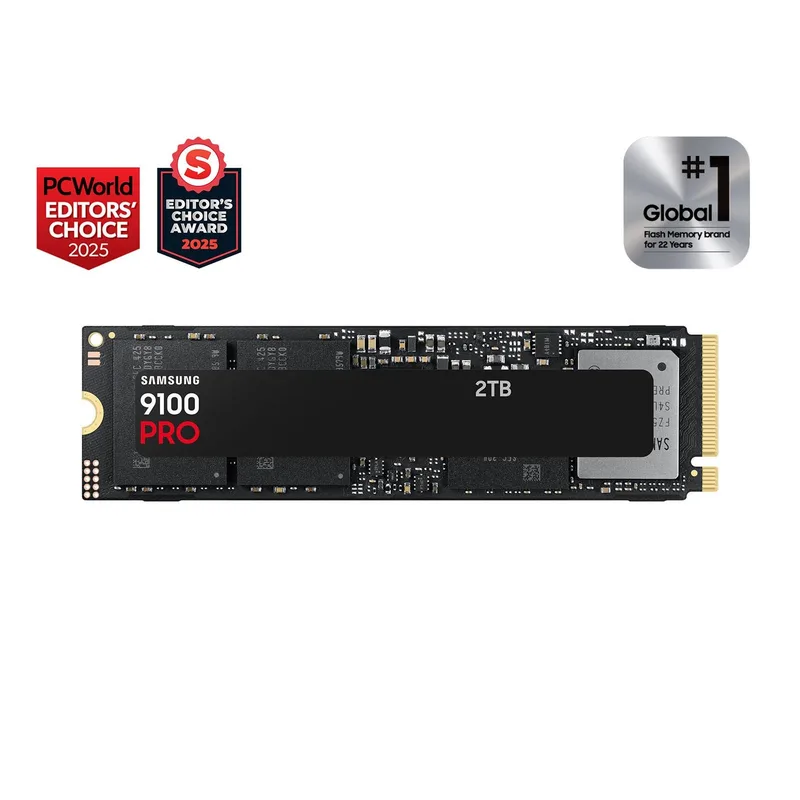
The Samsung 9100 Pro 2TB sat above $550 for most of 2026 until Prime Day deals pushed it as low as $350 — its lowest price since launch — before stabilizing post-sale at $399, within $11 of the WD Black SN850X 2TB. At that price delta, the calculation changes. Samsung’s Elpis-B controller paired with 8th-gen V-NAND delivers 14,700 MB/s sequential reads and 13,400 MB/s sequential writes per Samsung’s spec sheet, with 2.7 million random read IOPS.
For video editors, the 9100 Pro 2TB’s sustained write performance is the headline advantage. Where Gen4 drives throttle after saturating the SLC cache, the 9100 Pro’s Gen5 bandwidth headroom maintains high throughput longer during extended writes — a meaningful difference when dumping 100GB+ of footage from a mirrorless camera or capturing raw game clips.
Endurance is rated at 1,200 TBW, matching the SN850X 2TB exactly. The primary caveat remains platform dependency. On a board with only Gen4 M.2 slots, the 9100 Pro runs at Gen4 speeds and loses every advantage over the SN850X. Confirm your motherboard’s secondary M.2 slots support PCIe 5.0 x4 — not just the primary slot — before pulling the trigger. A heatsink is also strongly advised for sustained write workloads; Gen5 controllers run noticeably hotter than Gen4.
WD Black SN850X 2TB — Best for Gaming
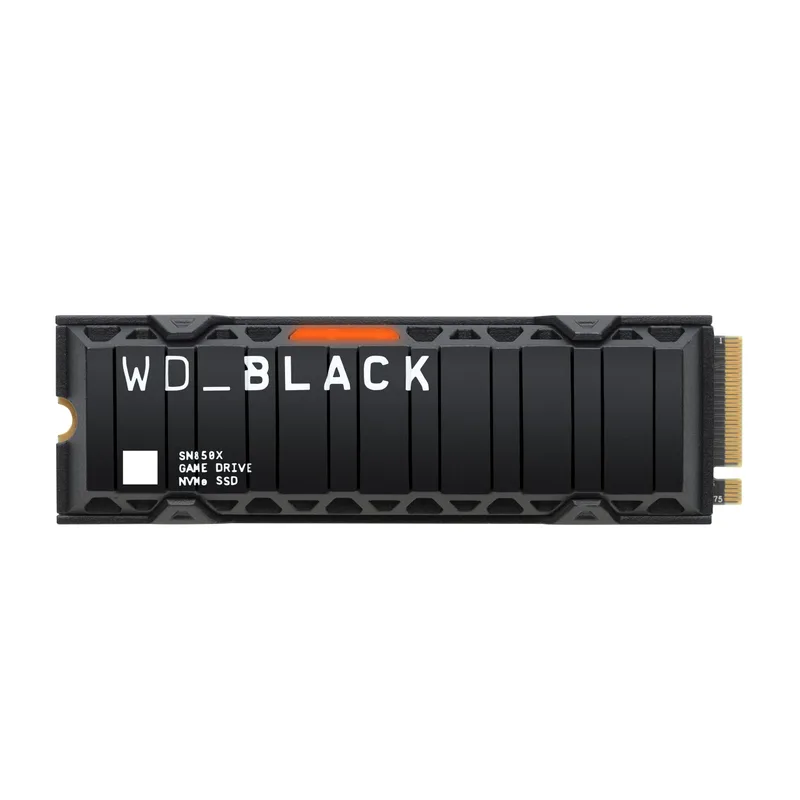
WD Black SN850X 2TB
The SN850X launched as WD’s flagship Gen4 drive and has remained one of the most consistent performers in its class. At 7,300 MB/s sequential reads and 6,300 MB/s writes per WD’s spec sheet, it’s fast enough that no current game engine can meaningfully saturate it — and that has been the core argument for Gen4 throughout 2026.
According to community benchmarks and coverage from Tom’s Hardware and GamersNexus, the SN850X delivers load times within 1–2 seconds of Gen5 drives in DirectStorage-enabled titles. The throughput gap only becomes visible in workloads that push sustained sequential speeds — exactly the pattern that distinguishes professional content workflows from gaming.
What’s changed in 2026 is pricing. The NAND shortage elevated the no-heatsink 2TB to around $388, which now sits within $11 of the Samsung 9100 Pro 2TB at Prime Day pricing. For a gaming-only build on any platform, the SN850X still makes sense — it works in every slot, runs cooler, and delivers identical gaming experiences. But the commanding value lead that defined Gen4’s position for three years has largely evaporated.
Samsung 9100 Pro 1TB — Best Budget Gen5
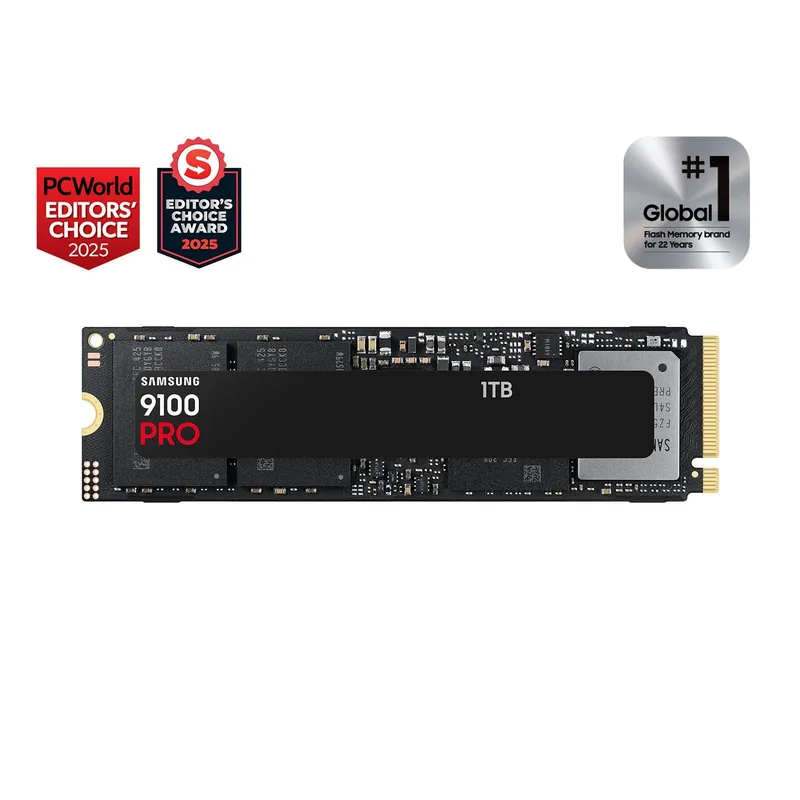
The Samsung 9100 Pro 1TB gets you the same 14,700 MB/s sequential read speed as the 2TB for $192 less. The trade-off is sequential write throughput — Samsung rates the 1TB at 10,500 MB/s versus 13,400 MB/s on the 2TB — and endurance at 600 TBW rather than 1,200 TBW.
For a gaming build with a Gen5-capable board and plans for a separate secondary drive, the 1TB 9100 Pro at $207 is the most efficient entry point into PCIe 5.0 NVMe. For a content creation workstation, the write speed difference is more significant: capturing high-bitrate footage to a 1TB 9100 Pro will hit the SLC cache faster and sustain at lower throughput once it’s full.
Capacity is the bigger consideration for most users. Modern AAA titles regularly exceed 80–100GB each, and a 1TB primary drive fills quickly with three or four major releases installed. If budget allows $399 for the 2TB, the doubled endurance and 28% higher write throughput favor the larger model.
WD Black SN8100 2TB — Best WD Gen5 Option
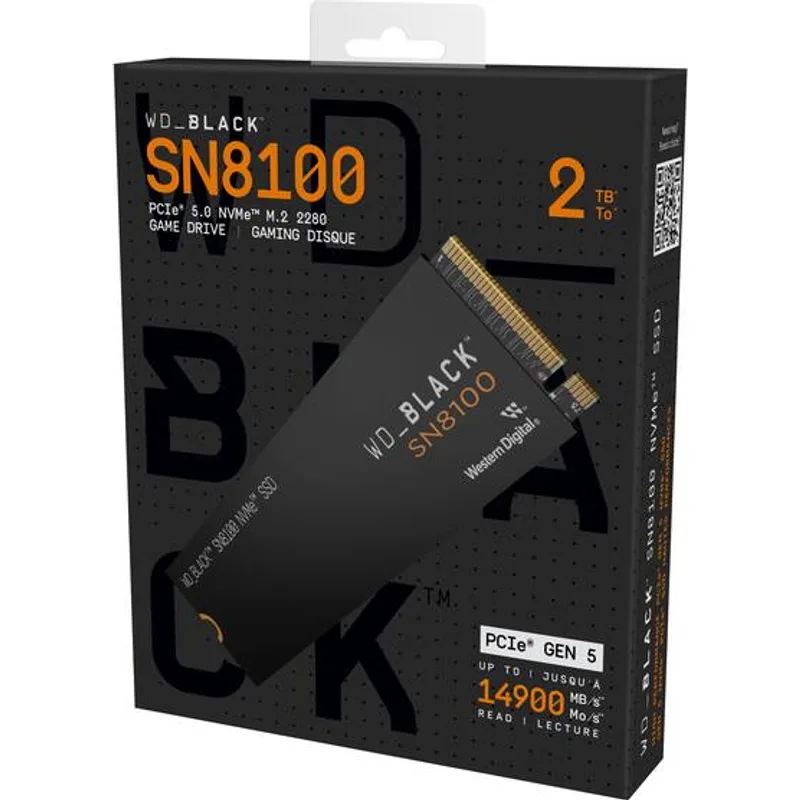
If you specifically want Gen5 from Western Digital, the SN8100 2TB delivers 14,900 MB/s reads and 14,000 MB/s writes per WD’s spec sheet — marginal improvements over the Samsung 9100 Pro’s 14,700/13,400 MB/s. The SN8100’s distinguishing hardware feature is its single-sided PCB design, which allows installation in M.2 slots with physical clearance restrictions found in some compact ITX cases and certain boards where the slot sits directly under a GPU.
Endurance is rated at 1,400 TBW, 16% higher than the 9100 Pro 2TB’s 1,200 TBW — a minor but real advantage for sustained professional write workloads over a multi-year lifespan. At $440, it’s $41 more than the 9100 Pro 2TB at Prime Day pricing for near-identical throughput.
For most desktop builds, the Samsung 9100 Pro 2TB at $399 is the sharper buy. The SN8100 earns its premium specifically in builds where single-sided PCB clearance is an actual hardware requirement or where the extra 200 TBW endurance justifies the cost for high-write professional workloads.
WD Black SN850X 4TB — Best High-Capacity Gen4
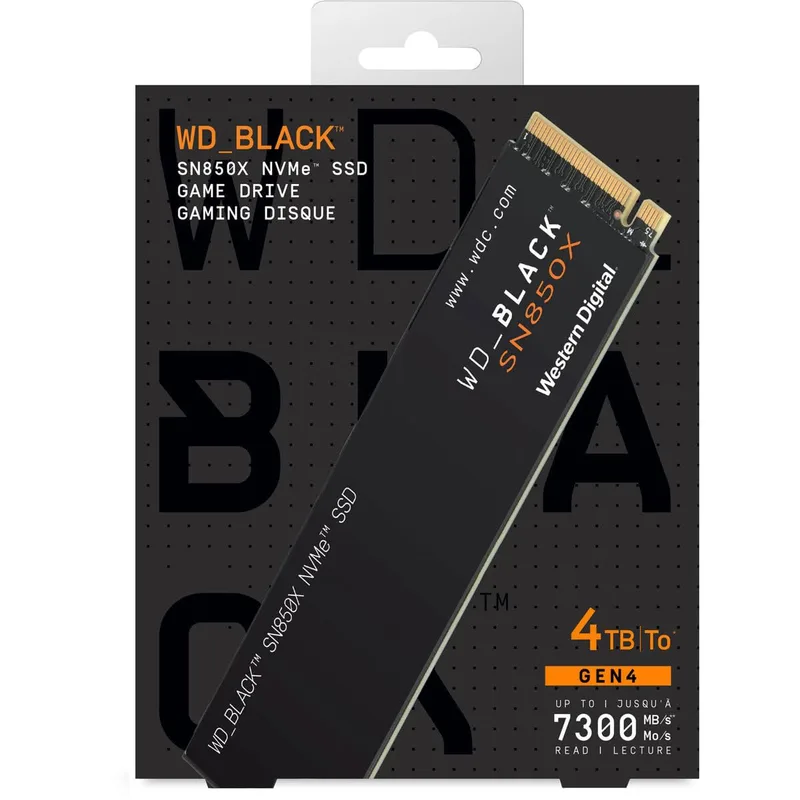
The SN850X 4TB is one of the few M.2 2280 Gen4 drives that consolidates a large game library and OS onto a single NVMe slot. At $729 and 2,400 TBW rated endurance, it targets builds where a secondary 2.5-inch SATA drive isn’t practical — compact ITX cases, rigs with only two M.2 slots used for boot and dedicated secondary storage, or builds where simplicity is the priority.
Performance is identical to the 2TB: 7,300/6,300 MB/s with the same SLC cache architecture. The capacity is the purchase rationale, not speed. The 2,400 TBW rating means the drive is rated to outlast most gaming PC upgrade cycles under typical use patterns.
The value check at this tier: the Samsung 9100 Pro 4TB runs approximately $779–$797, only $50–$68 more for Gen5 performance at the same capacity. If your board has a Gen5 M.2 slot available, the 9100 Pro 4TB is worth the small premium. If you’re on an older board with Gen4-only secondary slots, the SN850X 4TB at full speed is the practical choice.
| Spec | Samsung 9100 Pro 2TB 9.3/10 | WD Black SN850X 2TB Unavailable 9/10 | Samsung 9100 Pro 1TB 8.7/10 | WD Black SN8100 2TB 8.8/10 | WD Black SN850X 4TB 8.5/10 |
|---|---|---|---|---|---|
| Interface | PCIe 5.0 x4 NVMe 2.0 | PCIe 4.0 x4 NVMe | PCIe 5.0 x4 NVMe 2.0 | PCIe 5.0 x4 NVMe 2.0 | PCIe 4.0 x4 NVMe |
| Sequential Read | 14,700 MB/s | 7,300 MB/s | 14,700 MB/s | 14,900 MB/s | 7,300 MB/s |
| Sequential Write | 13,400 MB/s | 6,300 MB/s | 10,500 MB/s | 14,000 MB/s | 6,300 MB/s |
| Form Factor | M.2 2280 | M.2 2280 | M.2 2280 | M.2 2280 | M.2 2280 |
| Endurance | 1,200 TBW | 1,200 TBW | 600 TBW | 1,400 TBW | 2,400 TBW |
| Warranty | 5 years | 5 years | 5 years | 5 years | 5 years |
| Rating | 9.3/10 | 9/10 | 8.7/10 | 8.8/10 | 8.5/10 |
Prices change daily — tap Check Price for the current Amazon price.
Prices change daily — tap Check Price for the current Amazon price.
FAQ
Does the Samsung 9100 Pro improve gaming load times over the WD Black SN850X?
Marginally, and not in a way most players will notice. According to community benchmarks across DirectStorage titles, the load time difference between Gen4 and Gen5 NVMe drives is 1–3 seconds on typical map transitions. For gaming-only builds, the speed gap doesn’t justify paying more — especially when the price difference has narrowed to near-zero at current market pricing.
Can I run the Samsung 9100 Pro in a PCIe 4.0 M.2 slot?
Yes, but it will run at Gen4 speeds — around 7,000 MB/s — rather than the rated 14,700 MB/s. Installed in a Gen4 slot, the 9100 Pro performs identically to a budget Gen4 drive at a Gen5 price. Only install the 9100 Pro in a board with a confirmed PCIe 5.0 x4 M.2 slot.
Does the WD Black SN850X need a heatsink?
It ships without one and runs within safe temperature ranges in most mid-tower builds with reasonable airflow. If your case restricts M.2 slot airflow, or you’re doing extended sequential writes (backing up large files, video capture), a third-party M.2 heatsink ($10–$15) or a motherboard with integrated M.2 thermal pads prevents occasional throttling.
Which drive is better for video editing?
The Samsung 9100 Pro 2TB for workloads that involve large sequential reads and writes — capturing high-bitrate footage, reading and writing ProRes or RAW files, or running a fast scratch disk for DaVinci Resolve or Premiere. The SN850X’s Gen4 ceiling becomes a real bottleneck when routinely moving 50–100GB files.
Is the WD Black SN8100 worth buying over the Samsung 9100 Pro 2TB?
For most desktop builds, no. The Samsung 9100 Pro 2TB at $399 is $41 cheaper with nearly equivalent performance. The SN8100 earns its premium in two specific scenarios: builds requiring a single-sided PCB for physical clearance, and professional workloads where 1,400 TBW versus 1,200 TBW endurance is a meaningful factor.
The Bottom Line
The Samsung 9100 Pro 2TB’s post-Prime Day price of $399 — down from above $550 earlier in 2026 — is the most significant shift in this comparison — at $11 more than the WD Black SN850X 2TB, Gen5 is now accessible to any builder with a PCIe 5.0-capable board. For gaming-only builds, the WD Black SN850X 2TB remains the logical pick: identical gaming performance, universal platform compatibility, and $11 less. For content creation builds on Z890, X870E, or B850 boards, the Samsung 9100 Pro 2TB is worth every cent of the small premium — sustained write throughput and Gen5 headroom genuinely improve creative workflows. If WD’s ecosystem matters, the SN8100 2TB is the answer, with its single-sided PCB advantage making it uniquely practical for compact builds.