The 2TB NVMe SSD market in mid-2026 sits at an uncomfortable crossroads: NAND shortage pricing driven by AI datacenter demand has pushed Gen4 flagship drives like the Samsung 990 EVO Plus to $325 — a price that barely existed two years ago — while a new wave of PCIe Gen5 drives delivers twice the sequential speed for prices starting at $225. The good news is that genuine value still exists across the stack if you match the drive to your actual workload.
| Spec | WD Black SN8100 2TB 9.4/10 | Samsung 9100 PRO 2TB 9.2/10 | Crucial T705 2TB 8.7/10 | Samsung 990 EVO Plus 2TB 8.3/10 | SK Hynix Platinum P41 2TB Unavailable 8.8/10 |
|---|---|---|---|---|---|
| interface | PCIe 5.0 x4 NVMe 2.0 | PCIe 5.0 x4 NVMe 2.0 | PCIe 5.0 x4 NVMe 2.0 | PCIe 4.0 x4 / PCIe 5.0 x2 NVMe 2.0 | PCIe 4.0 x4 NVMe 1.4 |
| sequential_read | 14,900 MB/s | 14,800 MB/s | 14,500 MB/s | 7,250 MB/s | 7,000 MB/s |
| sequential_write | 14,000 MB/s | 13,400 MB/s | 12,700 MB/s | 6,300 MB/s | 6,500 MB/s |
| form_factor | M.2 2280 | M.2 2280 | M.2 2280 | M.2 2280 | M.2 2280 |
| endurance | 1,200 TBW | 1,200 TBW | 1,200 TBW | 1,200 TBW | 1,200 TBW |
| warranty | 5 years | 5 years | 5 years | 5 years | 5 years |
| Rating | 9.4/10 | 9.2/10 | 8.7/10 | 8.3/10 | 8.8/10 |
Prices change daily — tap Check Price for the current Amazon price.
Prices change daily — tap Check Price for the current Amazon price.
Quick Picks
- Fastest Gen5: WD Black SN8100 2TB — 14,900/14,000 MB/s sequential, Tom’s Hardware Editor’s Choice, $440
- Best Value Gen5: Crucial T705 2TB — 14,500/12,700 MB/s for $225, $215 less than the Samsung 9100 PRO
- Best Budget (Gen4 DRAM-cached): SK Hynix Platinum P41 2TB — 7,000/6,500 MB/s with full DRAM cache at $159
Buying Guide: Gen5 vs Gen4, DRAM vs DRAM-less
Does PCIe Gen5 matter for gaming?
For game load times and general desktop use, the honest answer is no. Titles like Cyberpunk 2077 and Alan Wake 2 load from the fastest Gen5 SSD roughly 2–5% faster than from a Gen4 drive with DRAM cache. The speed difference becomes meaningful in three specific scenarios: large file transfers (video editing timelines, RAW photo imports), data science workloads with random I/O, and professional workstations reading large datasets.
If your primary use is gaming, the SK Hynix Platinum P41 or Samsung 990 EVO Plus deliver the same in-game experience as a $489 Samsung 9100 PRO for significantly less money.
DRAM cache vs DRAM-less (HMB)
Every drive on this list either has discrete DRAM or uses Host Memory Buffer (HMB) technology. The Samsung 990 EVO Plus is the only DRAM-less drive here, relying on your system RAM as a substitute cache via HMB. In practice:
- DRAM-cached drives (WD SN8100, Samsung 9100 PRO, Crucial T705, SK Hynix P41): Lower latency under sustained mixed workloads. Better for workstations that perform many small random reads.
- HMB drives (Samsung 990 EVO Plus): Slightly higher latency at queue depth 1 in synthetic benchmarks, but virtually indistinguishable in gaming or media consumption. Lower cost.
PCIe Gen5 thermal requirements
Gen5 drives generate substantially more heat during sustained writes than Gen4. The WD SN8100 pulls 7W during active writes; a Gen4 drive like the P41 pulls roughly 4W. Without a board-mounted M.2 heatsink, Gen5 drives in enclosed cases or slim builds will thermal throttle. Plan for a heatsink if your motherboard does not include one.
The 2026 NAND shortage context
NAND flash prices began spiking in late 2025 as AI infrastructure demand absorbed supply intended for consumer SSDs. By June 2026, the Samsung 990 EVO Plus 2TB sits at $325 — nearly triple its $113 Prime Day 2025 price. The Gen5 Crucial T705 at $225 now costs less than that Gen4 drive, which is an unusual inversion. If you were planning to wait for prices to stabilize, analyst forecasts project continued pressure through Q4 2027 — the prudent move is to buy based on current pricing rather than hoping for a return to 2025 lows.
Detailed Reviews
1. WD Black SN8100 2TB — Best Overall Gen5
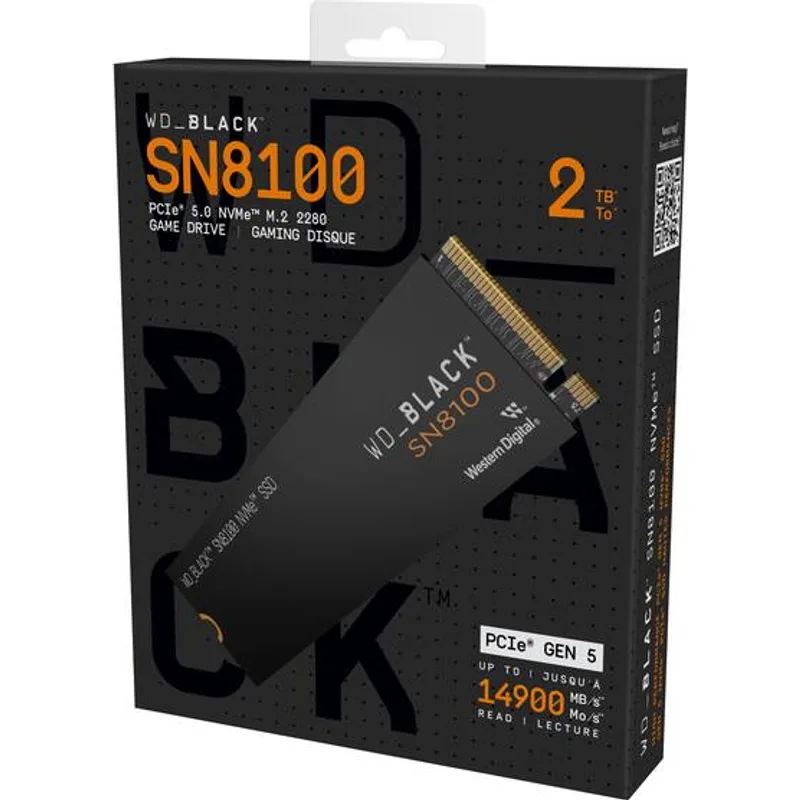
The WD Black SN8100 uses Silicon Motion’s SM2508 controller paired with Kioxia BiCS8 218-layer TLC NAND. The combination produces 14,900 MB/s sequential reads and 14,000 MB/s writes — the fastest rated specs of any consumer SSD in 2026, confirmed by Tom’s Hardware’s Editor’s Choice award and StorageReview’s “elite performance” designation.
What separates the SN8100 from other Gen5 drives is low-queue-depth responsiveness. In single-threaded workloads that represent most desktop tasks, it shows less variance than Phison E26-based competitors. The Phoronix Linux benchmarks confirm it approaches Intel Optane territory in workstation I/O patterns — a category where no consumer SSD has competed before.
The 2TB model carries a 1,200 TBW rating and 5-year warranty. At 6.5W active read / 7.0W active write, thermal management matters — SanDisk sells a heatsink variant separately. The $440 price is a 57% premium over the Crucial T705 for 2.8% higher peak sequential read throughput. Justify that premium only if you’re in media production, game development, or data science where queue depth varies significantly.
M.2 slot requirement: PCIe 5.0 x4 slot. Compatible with PCIe 4.0 slots but will cap at Gen4 speeds (~7.5 GB/s max).
2. Samsung 9100 PRO 2TB — The Cooler Gen5 Alternative
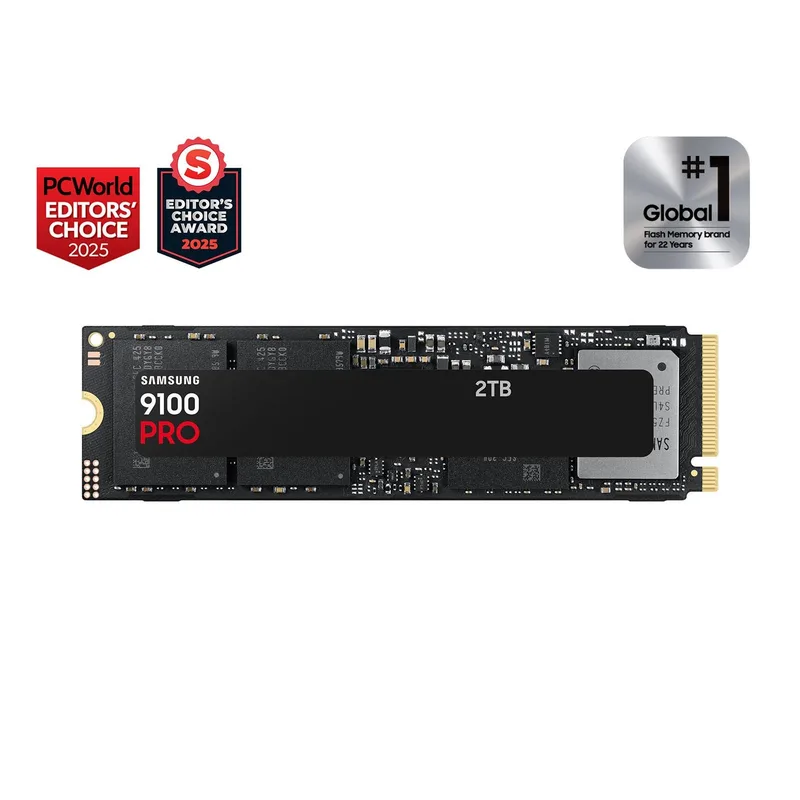
Samsung 9100 PRO 2TB
The Samsung 9100 PRO is Samsung’s answer to the Phison E26 generation, built around an in-house controller paired with Samsung’s own 236-layer V-NAND TLC. At 14,800/13,400 MB/s, it trails the SN8100 by less than 1% in sequential reads but delivers one measurable advantage: it runs cooler under sustained write workloads.
Dong Knows Tech’s review highlights that the 9100 PRO’s thermal performance is “one of the coolest among its peers” — a meaningful differentiator in builds without active M.2 cooling. If your motherboard M.2 slot is partially obscured by GPU clearance or lacks a heatsink pad, the 9100 PRO is the safer Gen5 choice for sustained transfers.
The 2TB model includes 2GB DRAM cache (1GB per TB) and carries 1,200 TBW / 5-year warranty. At $489 — $49 more than the SN8100 — the price-to-performance math is unfavorable unless Samsung’s lower thermal profile is specifically required for your build. MSRP was $299 at launch; NAND shortage pricing has pushed the street price 63% above that figure.
M.2 slot requirement: PCIe 5.0 x4 slot. PCIe 4.0 backward-compatible with reduced maximum throughput.
3. Crucial T705 2TB — Best Value PCIe Gen5
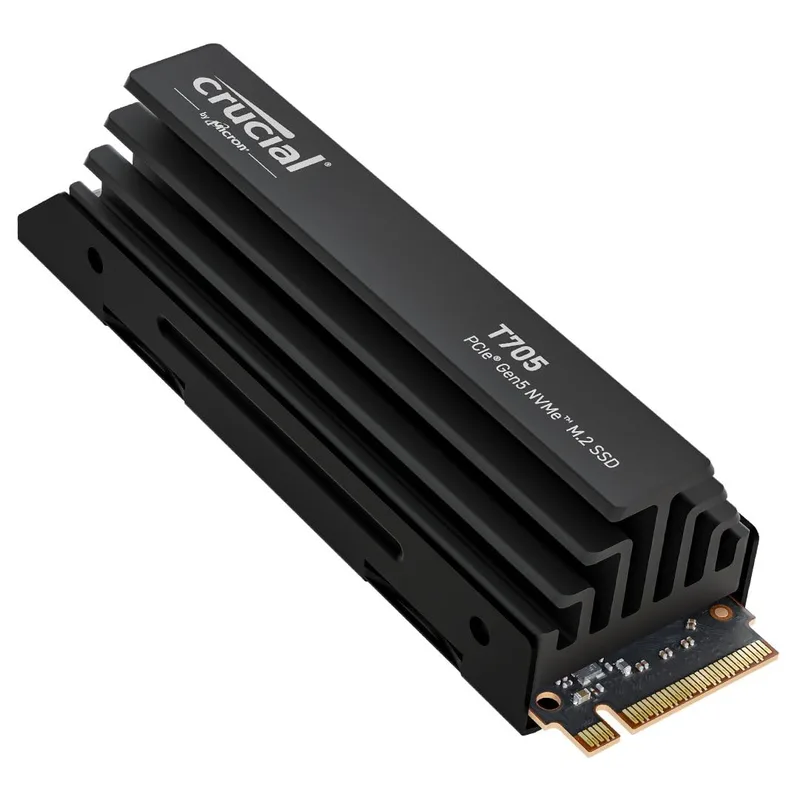
The Crucial T705 makes the case that PCIe Gen5 doesn’t have to cost Gen5 flagship money. At $225, it’s $215 cheaper than the Samsung 9100 PRO and $264 less than the WD SN8100, yet it still delivers 14,500/12,700 MB/s — fast enough to fully saturate any PCIe 5.0 x4 slot.
The platform is Phison’s PS5026-E26 controller with Micron 232-layer TLC NAND. The T705 was actually reviewed by Tom’s Hardware as “the fastest SSD on the planet” upon launch in 2026, and it remains competitive in 2026 despite newer drives. The E26 controller runs hotter than Samsung’s in-house design — plan for motherboard heatsink coverage or the heatsink variant (~$245).
Endurance is 1,200 TBW with a 5-year warranty. The double-sided PCB accommodates 2TB of NAND in a standard 2280 form factor but will not fit in M.2 slots with height-limiting brackets on ultra-slim ITX boards. For standard ATX and mATX builds, this limitation is irrelevant.
The T705 2TB is the correct choice for any creator-focused build where Gen5 speeds matter but the SN8100 premium cannot be justified.
4. Samsung 990 EVO Plus 2TB — Gen4 Speed, Broad Compatibility
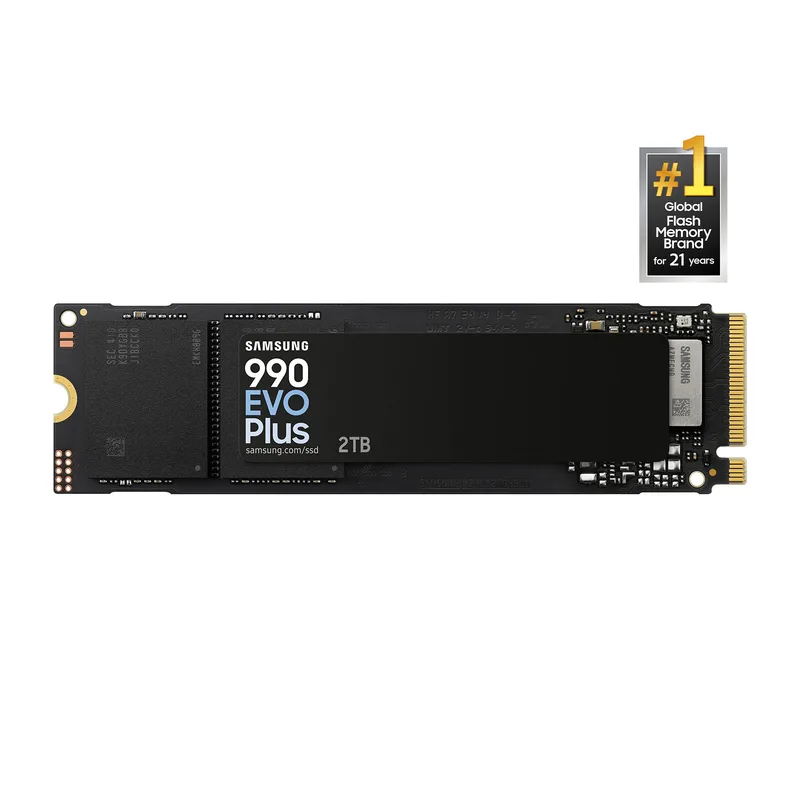
Samsung 990 EVO Plus 2TB
The Samsung 990 EVO Plus runs on Samsung’s Piccolo controller, a four-channel DRAM-less design using HMB technology. The unusual Gen4 x4 / Gen5 x2 hybrid configuration means the drive operates at up to 7,250 MB/s read on a PCIe 4.0 slot and can hit that same bandwidth from a PCIe 5.0 slot using only two lanes — preserving the other two lanes for future bifurcation scenarios.
Sequential write performance improved 50% over the original 990 EVO, reaching 6,300 MB/s. Random read performance reaches 1,000K IOPS, competitive with DRAM-cached Gen4 drives in most game-load benchmarks. KitGuru, StorageReview, and Dong Knows Tech all confirm the 990 EVO Plus delivers solid, consistent real-world performance with notably low heat output for a drive in this performance bracket.
The pricing is the honest problem: at $325 in June 2026, it costs $100 more than the SK Hynix Platinum P41, which includes full DRAM cache and higher random IOPS. The 990 EVO Plus makes sense for users who already own the drive through a promotional bundle or who specifically need the dual-protocol Gen4x4/Gen5x2 flexibility — for straight purchases, the P41 offers more per dollar.
Compatibility note: The Gen5 x2 mode requires a PCIe 5.0 motherboard to activate. On PCIe 4.0 boards, the drive runs standard Gen4 x4 mode.
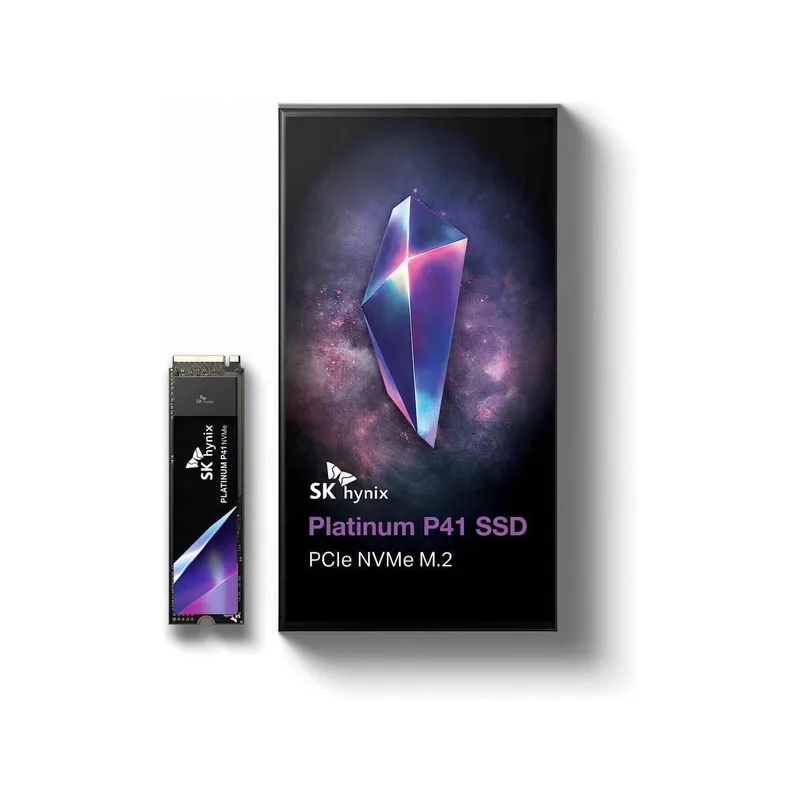
5. SK Hynix Platinum P41 2TB — Best Budget 2TB NVMe
SK Hynix Platinum P41 2TB
The SK Hynix Platinum P41 is the definitive answer for anyone who needs 2TB of NVMe storage at the lowest price that doesn’t compromise on cache architecture. At $159, it undercuts every other drive on this list while including full discrete DRAM — a feature the $325 Samsung 990 EVO Plus lacks.
SK Hynix’s proprietary Aries controller pairs with 176-layer TLC NAND to produce 7,000/6,500 MB/s sequential speeds and 1,400K/1,300K random IOPS. The random IOPS figure is particularly strong for a Gen4 drive — it outperforms the 990 EVO Plus HMB design at queue depths above 8, which matters for Blender rendering, HandBrake encoding, and database workloads.
The single-sided PCB is a practical advantage in ITX builds and certain laptops where double-sided drives (Crucial T705, Samsung 9100 PRO) physically cannot mount. Tom’s Hardware has listed the P41 among their top recommended drives since 2022 and it has held that position through 2026 because nothing at this price tier matches its combination of DRAM cache, random I/O, and form factor flexibility.
The P41 is not the choice if you’re editing 4K RAW files from multiple camera angles simultaneously or running large AI inference workloads locally. It is the correct choice for gaming, general desktop use, and workloads that fit within PCIe 4.0’s sequential bandwidth ceiling.
FAQ
Do I need PCIe Gen5 for gaming in 2026?
No. Modern games do not queue enough I/O to saturate Gen5’s bandwidth advantage over a DRAM-cached Gen4 drive. DirectStorage titles see the largest differential, but real-world load time improvements remain in the 2–5% range between a $159 Gen4 DRAM-cached drive and a $489 Gen5 flagship. For pure gaming, spend the savings on GPU VRAM or faster RAM.
Can I use a Gen5 SSD in a Gen4 motherboard?
Yes. All PCIe 5.0 SSDs are backward-compatible with PCIe 4.0 slots. The drive will cap at PCIe 4.0 x4 bandwidth (~7.5 GB/s maximum), which means you lose the Gen5 performance advantage entirely. Buy a Gen4 drive instead if your board only has PCIe 4.0 M.2 slots.
What does TBW mean and should I worry about it?
TBW (terabytes written) is the manufacturer’s endurance rating — the total amount of data the drive is warranted to write over its lifetime. All five drives on this list are rated 1,200 TBW for the 2TB capacity. A typical user writing 50GB/day would exhaust 1,200 TBW in roughly 65 years. Unless you’re running a write-intensive server workload, endurance is not a differentiating factor among these drives.
Should I buy now or wait for NAND prices to drop?
Current analyst projections suggest NAND prices will remain elevated through Q4 2027 due to continued AI infrastructure demand. If you need 2TB of fast NVMe storage now, buy based on current value — particularly the Crucial T705 at $225 or SK Hynix P41 at $159. Waiting for 2025-era pricing is likely to be a multi-year wait.
Which 2TB NVMe SSD runs the coolest?
The Samsung 9100 PRO runs the coolest among Gen5 drives under sustained write workloads. For Gen4, the SK Hynix Platinum P41 runs cool at around 4W peak active power. If your build lacks M.2 heatsink coverage, these are the safer thermal choices compared to Phison E26-based drives like the Crucial T705.
The Bottom Line
For Gen5 performance at a reasonable price, the Crucial T705 2TB at $225 is the clearest value on this list — it matches the WD SN8100 and Samsung 9100 PRO within a few percent while costing up to $264 less. If budget is the priority and Gen5 isn’t required, the SK Hynix Platinum P41 2TB at $159 remains the strongest Gen4 2TB option, offering full DRAM cache and class-leading random IOPS for pure gaming and desktop use. The WD Black SN8100 2TB earns the top slot for creators and workstation users who will actually saturate Gen5 bandwidth in production workflows.