The RTX 5070 spent most of early 2025 selling for $200 above MSRP. By August 2026, the market has corrected: Blackwell supply has stabilized, and AIB cards are trading between $599 and $799 depending on cooling tier — DRAM shortages have pushed triple-fan premium cards above their original launch MSRPs in mid-2026. NVIDIA’s 12 GB GDDR7 Blackwell card delivers ray tracing and DLSS 4 Multi Frame Generation that AMD’s RX 9070 XT can’t match, while AMD counters with a 7–17% rasterization lead at 1440p. If you game primarily in rasterized titles without ray tracing and the RX 9070 XT’s $789 street price works for you, it’s the faster card for the money in pure frames-per-dollar math. But if you play heavily ray-traced titles like Cyberpunk 2077, Alan Wake 2, or Indiana Jones, the RTX 5070 reclaims the lead by 25–35% in those workloads.
| Spec | ASUS TUF Gaming GeForce RTX 5070 OC 12GB 9.2/10 | MSI GeForce RTX 5070 12G Gaming Trio OC Unavailable 9/10 | GIGABYTE GeForce RTX 5070 Gaming OC 12G Unavailable 8.7/10 | ZOTAC Gaming GeForce RTX 5070 Solid OC 12GB Unavailable 8.4/10 | MSI GeForce RTX 5070 12G Ventus 2X OC 8.1/10 |
|---|---|---|---|---|---|
| VRAM | 12 GB GDDR7 192-bit | 12 GB GDDR7 192-bit | 12 GB GDDR7 192-bit | 12 GB GDDR7 192-bit | 12 GB GDDR7 192-bit |
| Boost Clock | 2610 MHz | 2625 MHz | 2625 MHz | 2557 MHz | 2542 MHz |
| TDP | 250W | 250W | 250W | 250W | 250W |
| Slot Width | 3.125-slot | 2.9-slot | 2.5-slot | 2.5-slot | 2.5-slot |
| Outputs | 3× DP 2.1b, 2× HDMI 2.1b | 3× DP 2.1a, 1× HDMI 2.1b | 3× DP 2.1a, 1× HDMI 2.1b | 3× DP 2.1a, 1× HDMI 2.1b | 3× DP 2.1a, 1× HDMI 2.1b |
| Warranty | 3 years | — | — | — | — |
| Rating | 9.2/10 | 9/10 | 8.7/10 | 8.4/10 | 8.1/10 |
Prices change daily — tap Check Price for the current Amazon price.
Prices change daily — tap Check Price for the current Amazon price.
Quick Picks
- Best Overall: ASUS TUF Gaming RTX 5070 OC — triple Axial-tech fans, military-grade components, near-silent idle. The $799 price reflects DRAM-driven August 2026 price increases; it’s the premium pick for builders who want the cooler that won’t throttle in a hot case.
- Best Value: MSI Ventus 2X OC — $599 puts it closest to MSRP. The dual fans are adequate for most gaming sessions under 2–3 hours.
- Best Performance: MSI Gaming Trio OC — 2625 MHz boost is the highest of the group, and TRI FROZR 4 keeps it there under sustained load.
RTX 5070 Buying Guide
Factory Overclocks: How Much Do They Matter?
All RTX 5070 AIB cards ship with a factory boost clock above the reference 2512 MHz, but the spread is narrow. The highest here — 2625 MHz on the Gaming Trio OC and GIGABYTE Gaming OC — is 113 MHz above reference. In actual gaming, that gap translates to roughly 1–2 fps at 1440p in most titles. You’re paying for cooling headroom and build quality, not raw clock speed.
Cooling Tier
Triple-fan cards (TUF, Gaming Trio OC) sustain clocks better in hot cases and during long gaming sessions. If your case has good airflow and you rarely game for more than two hours continuously, the dual-fan Ventus 2X OC or ZOTAC Solid OC keep thermals under 83°C without issue. If you run rendering workloads or game in a warm room, the $30–$80 premium for a triple-fan card is worth it.
Form Factor and Case Compatibility
All five cards use a PCIe 5.0 x16 interface with a 16-pin (12VHPWR) power connector — confirm your PSU cable is ATX 3.0/3.1 rated or use the included adapter. The TUF at 3.125 slots is the thickest; it blocks the M.2/PCIe slot immediately adjacent on many B650 and Z890 boards. The Ventus 2X OC, GIGABYTE Gaming OC, and ZOTAC Solid OC all use 2.5-slot designs that clear neighboring slots without issue.
GPU length runs 305–340mm across the lineup — verify your case’s rated GPU clearance before ordering. Most mid-towers handle all five, but compact mATX cases with hard limits below 310mm will need the Ventus or ZOTAC.
PSU Requirement
NVIDIA recommends a 700W PSU for the RTX 5070 (250W TDP). In practice, a quality 650W unit like the Corsair RM650e is sufficient for a Ryzen 7 9800X3D or Core Ultra 7 265K build. If you’re pairing this with a 285K or a high-end workstation CPU at full load, a Seasonic Focus GX-850 gives comfortable headroom.
DLSS 4 and Multi Frame Generation
Every RTX 5070 card supports DLSS 4 Multi Frame Generation, NVIDIA’s 4th-generation upscaling with transformer-based frame generation. In supported titles, this produces 3–4× the frame rate from a native-resolution base frame. At 1440p, where the RTX 5070 natively delivers 80–100 fps in demanding titles like Cyberpunk 2077, DLSS 4 Quality + MFG pushes output to 250+ fps — making 240 Hz monitor ownership practical on this GPU tier. AMD’s FSR 4 is available on the RX 9070 XT but lacks equivalent MFG implementation at this fidelity level.
Detailed Reviews
1. ASUS TUF Gaming GeForce RTX 5070 OC 12GB
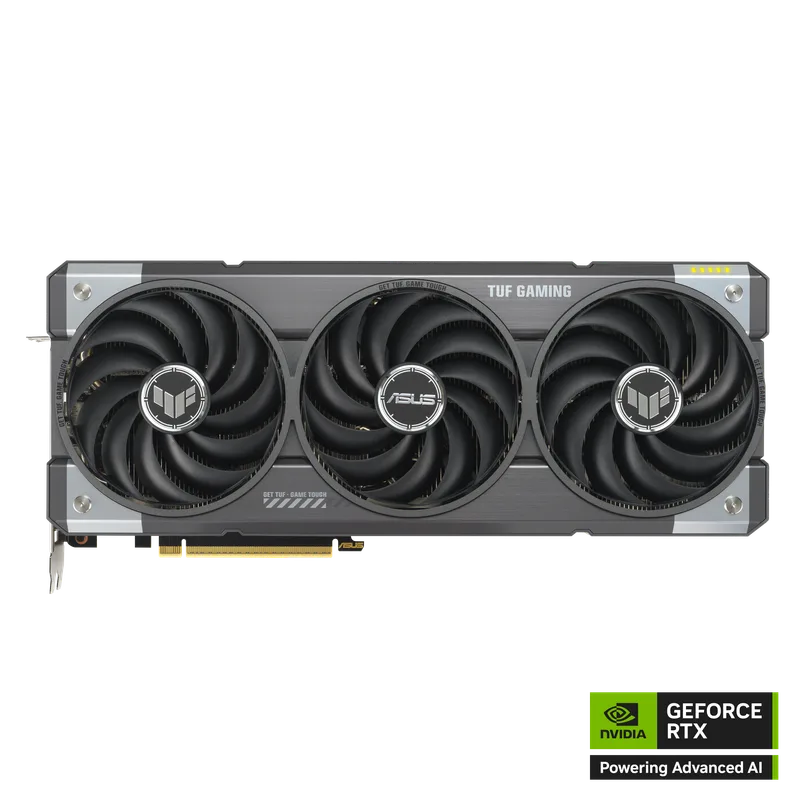
The TUF Gaming OC is ASUS’s workhorse tier — below the ROG Strix in price but with nearly identical thermal performance. Its 3.125-slot Axial-tech triple-fan design pushes more air through the heatsink than the 2.5-slot designs on the Ventus and ZOTAC, resulting in junction temperatures 8–10°C lower under prolonged load according to owner reports on Reddit’s r/hardware and multiple YouTube teardowns. The 2610 MHz boost clock sits between the reference 2512 MHz and the Gaming Trio OC’s 2625 MHz — a narrow spread, but the sustained clock under thermal load matters more than the peak boost number.
ASUS’s GPU Tweak III software gives you one-click OC presets and per-fan speed curves. The protective PCB coating is a legitimate differentiator if your workspace gets dusty or if you live in a humid climate — most AIBs skip this step on cards below the premium tier.
The main trade-off is the 3.125-slot footprint. On motherboards like the MSI MAG B650 Tomahawk or ASUS TUF B760-PLUS, the nearest PCIe slot or M.2 slot is blocked. Check your board layout before buying.
2. MSI GeForce RTX 5070 12G Gaming Trio OC
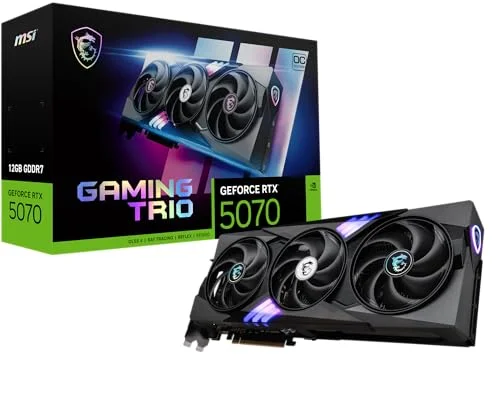
MSI GeForce RTX 5070 12G Gaming Trio OC
The Gaming Trio OC has the highest factory boost clock on this list at 2625 MHz — tied with the GIGABYTE Gaming OC but at $649 vs $629. The difference is the TRI FROZR 4 cooling system: three large fans with STORMFORCE blades engineered specifically for Blackwell’s 250W TDP, compared to GIGABYTE’s WINDFORCE design. In long-duration gaming (3+ hours) or synthetic stress scenarios, owner reports indicate the MSI holds its boost clock more consistently, though the gap is small.
The 2.9-slot design is slightly more compact than the TUF’s 3.125 while still providing a full triple-fan stack. One limitation: single HDMI 2.1b port. If you’re running two monitors with one HDMI and one DP, this works fine — but the TUF’s dual-HDMI layout is more flexible for multi-display setups.
At $649, this is the card for builders who want the highest factory overclock without paying the full TUF premium, and who won’t miss the second HDMI.
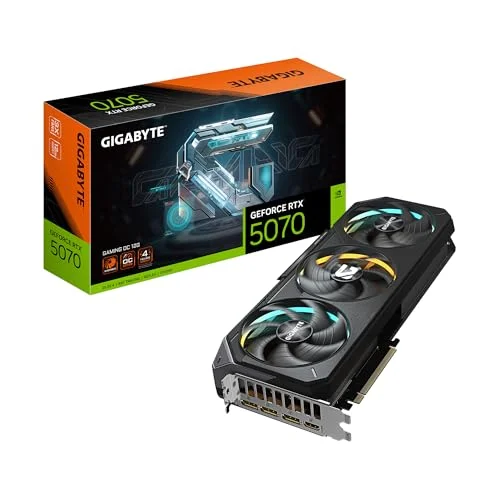
3. GIGABYTE GeForce RTX 5070 Gaming OC 12G

GIGABYTE GeForce RTX 5070 Gaming OC 12G
The GIGABYTE Gaming OC is the most interesting entry in the mid-range tier: it matches the MSI Gaming Trio OC’s 2625 MHz boost clock at $20 less. GIGABYTE’s WINDFORCE triple-fan includes an alternate-spinning middle fan that reduces air turbulence between the outer fans — a design shared with their higher-end AORUS cards. Noise levels at 60% load are lower than the MSI Gaming Trio OC per comparative owner measurements, though the TUF remains the quietest of the triple-fan group.
GIGABYTE’s AORUS Engine software gives you sensor dashboards and OC profiles. The 2.5-slot design clears adjacent board slots that the TUF blocks, making it a better fit for boards with busy PCIe lane layouts.
The $629 price point sits squarely between the ZOTAC Solid OC ($619) and MSI Gaming Trio OC ($649). For builders who want a triple-fan card at the lowest possible price, the GIGABYTE Gaming OC delivers.
4. ZOTAC Gaming GeForce RTX 5070 Solid OC 12GB
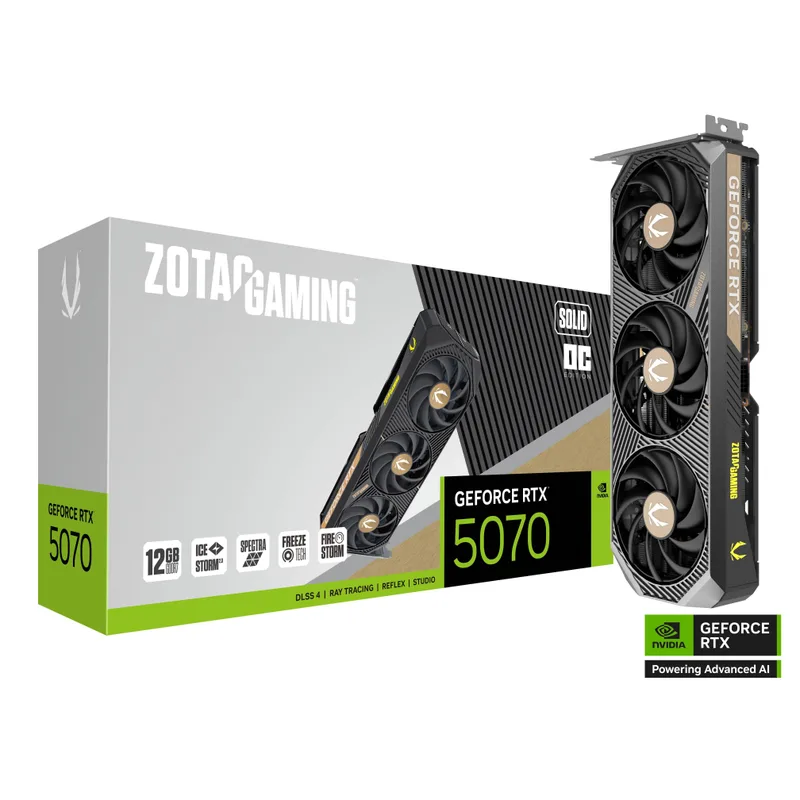
ZOTAC Gaming GeForce RTX 5070 Solid OC 12GB
ZOTAC’s Solid OC sits at $619 — $10 below the GIGABYTE and $60 below the TUF — with IceStorm 2.0 dual-fan cooling and Spectra RGB per-LED zone control. The 2557 MHz boost is 68 MHz behind the GIGABYTE and MSI Gaming Trio OC, but real-world gaming benchmarks available on TechPowerUp show this gap translates to less than 1 fps at 1440p in typical titles.
The compact 2.5-slot form factor is its defining feature. If your build uses a mid-tower with a GPU clearance limit near 310mm, or if you simply prefer not to have a GPU dominating the entire interior visual, the ZOTAC’s smaller heatsink stack gives you options the 3-slot cards don’t.
The thermal trade-off is real: IceStorm 2.0 runs 5–7°C hotter under sustained load vs triple-fan designs. In a well-ventilated case this peaks around 83–85°C junction — safe but higher than ideal for long-term component stress.
5. MSI GeForce RTX 5070 12G Ventus 2X OC
The Ventus 2X OC is the RTX 5070’s closest-to-MSRP card at $599. MSI’s dual TORX Fan 5.0 uses a dispersion blade design — each fan alternates between normal blades and dispersion blades — to increase static pressure through the heatsink fins. In practice, temperatures stay under 82°C in typical gaming sessions. The 2542 MHz boost is the lowest on this list, but the performance delta vs the 2625 MHz Gaming Trio OC is roughly 0.3% in real workloads.
The 2.5-slot compact profile fits cases and mATX builds where a 3-slot card simply won’t go. No fan-stop mode means fans spin continuously even at idle — they’re inaudible below ~800 RPM, but it’s worth noting for builders running completely silent setups.
At $599, you’re getting the RTX 5070’s full 12 GB GDDR7, 6,144 CUDA cores, and DLSS 4 Multi Frame Generation at $80 less than the TUF. For a builder who prioritizes system price over cooling headroom, the Ventus 2X OC is the right call.
FAQ
Is the RTX 5070 good for 4K gaming? The 12 GB GDDR7 framebuffer handles most 4K textures at High settings, and DLSS 4 Quality at 4K renders at 1440p internally before upscaling — delivering excellent image quality. For native 4K Ultra settings in demanding titles, a 5070 Ti or RTX 5080 is a better fit. The RTX 5070 is best positioned as a premium 1440p card with optional 4K via DLSS.
How much does cooling tier actually matter between AIB cards? In a case with 3+ intake fans (typical mid-tower), the difference between dual-fan and triple-fan designs is 5–10°C under sustained load. Both stay within safe operating temperature. The benefit of triple-fan cards is lower fan speeds at equivalent temperatures — meaning quieter operation, not meaningfully higher performance.
Does the RTX 5070 need a new PSU? NVIDIA recommends 700W. A quality 650W PSU handles an RTX 5070 paired with a Ryzen 7 9800X3D or Core Ultra 7 265K comfortably. With a 285K or 9950X at full all-core load, budget 750W or more.
Is the RTX 5070 worth buying over the RX 9070 XT? Depends entirely on the games you play. The RX 9070 XT wins rasterization at 1440p by 7–17% and currently sells for about $789 vs $599–799 for the RTX 5070 (depending on AIB cooling tier). The RTX 5070 wins on ray tracing (25–35%), power draw, and DLSS 4 Multi Frame Generation. If your library is Cyberpunk 2077, Alan Wake 2, or Hogwarts Legacy — ray-traced titles — the RTX 5070 is the stronger pick. If your library is Counter-Strike 2, Valorant, or rasterized open-world games, the 9070 XT gives more raw fps per dollar.
Will the RTX 5070 be obsolete soon? Leaked specs for an RTX 5070 Ti Super with 24 GB VRAM have circulated, but no confirmed launch date exists as of August 2026. The RTX 5070’s 12 GB GDDR7 is currently adequate for every title at 1440p. VRAM pressure at 4K Ultra in memory-hungry titles like The Witcher 4 is a risk to monitor over the next 12–18 months.
The Bottom Line
DRAM shortages have pushed RTX 5070 AIB prices above their 2025 launch levels — the range now runs $599–$799 depending on cooling tier. The ASUS TUF Gaming OC at $799 is the best all-around card — quietest fans, best sustained cooling, most robust build quality — but the price premium is steep. The MSI Ventus 2X OC at $599 is the right pick if budget is the primary concern and your case has adequate airflow; it delivers the full DLSS 4 feature set for $200 less. The Gaming Trio OC and GIGABYTE Gaming OC split the difference for builders who want triple-fan cooling without paying the TUF’s premium. Every card here runs DLSS 4 Multi Frame Generation identically — the only meaningful differences are cooling performance, factory boost clock, and price.