Corsair and Seasonic are the two most-cited PSU brands among PC builders in 2026, and for good reason — both manufacture (or source) units that consistently pass rigorous third-party lab testing. The real decision is whether you pay for Seasonic’s 10-year warranty and in-house manufacturing or Corsair’s lower prices and optional iCUE monitoring, and whether 850W or 1000W is the right ceiling for your GPU.
| Spec | Corsair RM850x ATX 3.1 9.2/10 | Seasonic Focus GX-850 ATX 3.1 9/10 | Corsair RM1000x ATX 3.1 9.1/10 | Seasonic Focus GX-1000 ATX 3.1 8.9/10 | Corsair HX1000i ATX 3.1 9.4/10 |
|---|---|---|---|---|---|
| wattage | 850W | 850W | 1000W | 1000W | 1000W |
| efficiency | Cybenetics Gold (~90%) | Cybenetics Platinum (~91%) | Cybenetics Gold (~90%) | Cybenetics Gold (~91%) | 80 Plus Platinum / Cybenetics Platinum (~93%) |
| standard | ATX 3.1 / PCIe 5.1 | ATX 3.1 / PCIe 5.1 | ATX 3.1 / PCIe 5.1 | ATX 3.1 / PCIe 5.1 | ATX 3.1 / PCIe 5.1 |
| connector | Native 12V-2x6 | Native 12V-2x6 | Native 12V-2x6 | Native 12V-2x6 | Native 12V-2x6 |
| modular | Fully modular | Fully modular | Fully modular | Fully modular | Fully modular |
| warranty | 7 years | 10 years | 7 years | 10 years | 10 years |
| Rating | 9.2/10 | 9/10 | 9.1/10 | 8.9/10 | 9.4/10 |
Prices change daily — tap Check Price for the current Amazon price.
Prices change daily — tap Check Price for the current Amazon price.
Quick Picks
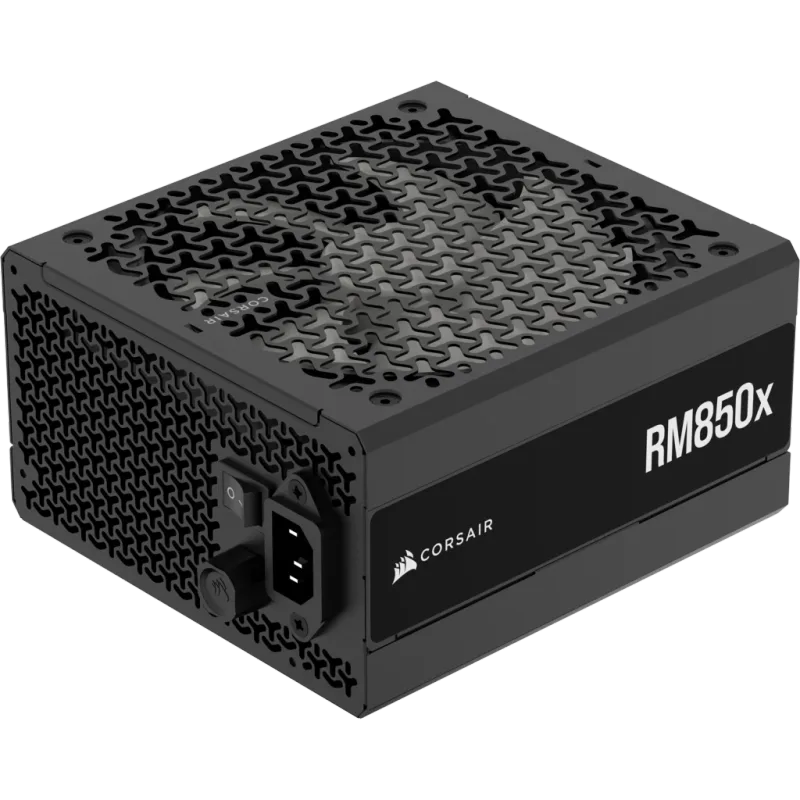
- Best 850W overall: Corsair RM850x ATX 3.1 — $130, native 12V-2x6, tight voltage regulation, zero-RPM fan mode. The better pick if price matters more than warranty length.
- Best 850W for long-term builds: Seasonic Focus GX-850 ATX 3.1 — $140, 10-year warranty, Seasonic’s own manufacturing. Worth $10 more if you plan to keep the system 5+ years.
- Best premium 1000W: Corsair HX1000i — $220, Platinum efficiency, iCUE monitoring, fluid dynamic bearing fan. The only pick here if you run an RTX 5090 in a high-ambient temperature environment.
Buying Guide: Corsair vs Seasonic in 2026
Who Makes What
Seasonic is a PSU manufacturer — they design, build, and test their own units in-house at factories in Taiwan and China. Corsair is primarily a brand that contracts PSU production to OEM partners; the RM series is manufactured by Channel Well Technology (CWT), while the HXi line uses a Great Wall platform. This distinction matters because Seasonic has direct quality control over every component choice, which is part of why their 10-year warranty carries credibility.
That said, Corsair’s CWT-based RM units perform extremely well in third-party tests. Cybenetics Labs data for the RM850x shows voltage regulation within 0.5–1.2% on the +12V rail at loads from 20% to 100%, which meets or exceeds what most users will ever need.
Wattage Recommendations by GPU
| GPU | Recommended PSU Wattage |
|---|---|
| RTX 5060 / RX 9060 XT | 650W |
| RTX 5060 Ti / RX 9070 | 750W |
| RTX 5070 / RX 9070 XT | 750W–850W |
| RTX 5070 Ti / RTX 5080 | 850W–1000W |
| RTX 5090 | 1000W–1200W |
An RTX 5080 has a 360W TDP. Paired with a Ryzen 9 9800X3D at 120W TDP and full storage, you’re looking at approximately 550–600W system draw under gaming load. An 850W unit gives you 250W of headroom, which is sufficient. A 1000W unit gives you 400W of headroom — useful only if you’re overclocking hard or running workstation software that saturates both CPU and GPU simultaneously.
ATX 3.1 and the 12V-2x6 Connector
Every PSU in this comparison is ATX 3.1 compliant with a native 12V-2x6 cable. This matters because RTX 50-series and RX 9000-series GPUs draw power in brief transient spikes up to 2× the rated TDP. ATX 3.1 compliance means the PSU is rated to handle those spikes without triggering overcurrent protection shutdowns. The “native” qualifier means the 12V-2x6 cable is wired directly to the PSU transformer, not routed through an adapter pigtail from two 8-pin connectors — which is where connector melt incidents occurred with early RTX 4090 installations.
Efficiency: Gold vs Platinum
Corsair’s RM line (RM850x, RM1000x) carries Cybenetics Gold certification at roughly 90% efficiency at 50% load. Seasonic’s Focus GX line in ATX 3.1 form is Cybenetics Platinum certified at ~91%. The Corsair HX1000i is also Cybenetics Platinum at ~93%. The practical difference between Platinum (~91–93%) and Gold (~90%) is roughly 1–3 percentage points. At 600W average draw for 8 hours a day, that gap translates to $4–10 per year in electricity savings at $0.15/kWh US average — real but not the primary reason to choose between these units.
Warranty: The Biggest Real Difference
Corsair’s RM line ships with a 7-year warranty. Seasonic’s Focus GX ships with a 10-year warranty. The HX1000i from Corsair matches Seasonic with 10 years. If you’re building a system you intend to run for 7+ years without swapping the PSU, Seasonic’s longer coverage carries real monetary value — a PSU failure at year 8 would cost $140–190 to replace.
Detailed Reviews
1. Corsair RM850x ATX 3.1 — Best 850W Value
The Corsair RM850x is the 2024/2025 revision of Corsair’s mainstream 850W unit, updated to full ATX 3.1 compliance with a native 12V-2x6 cable. The CWT platform it’s built on has a long track record in third-party PSU reviews — Cybenetics’ 2025 report on this unit showed +12V rail deviation of 1.0% from full load to 20% load, which is tighter than most competing Gold units at this price.
The zero-RPM fan mode activates below approximately 42% load (~357W). At a typical mid-range gaming draw of 250–350W, the PSU runs completely silent. Fan spin-up is gradual rather than sudden, so you won’t notice it engage during load transitions in game.
The 140mm chassis is compact enough to fit in almost every mid-tower and most mATX cases without routing issues. The cable set includes 4 SATA power cables, 4 PCIe 8-pin cables (plus the 12V-2x6), and 4 peripheral connectors — adequate for multi-drive builds.
At $130, this is approximately $10–15 cheaper than the Seasonic Focus GX-850 with identical wattage and efficiency class. The trade-off is 3 fewer years of warranty coverage. For a gaming PC with a typical 4–5 year GPU upgrade cycle, the 7-year warranty covers two full GPU generations with time to spare.
Best for: Ryzen 7 9800X3D or Core Ultra 7 265K builds with an RTX 5070 or RTX 5070 Ti, where 850W gives 200–300W of comfortable headroom.
2. Seasonic Focus GX-850 ATX 3.1 — Best Warranty at 850W
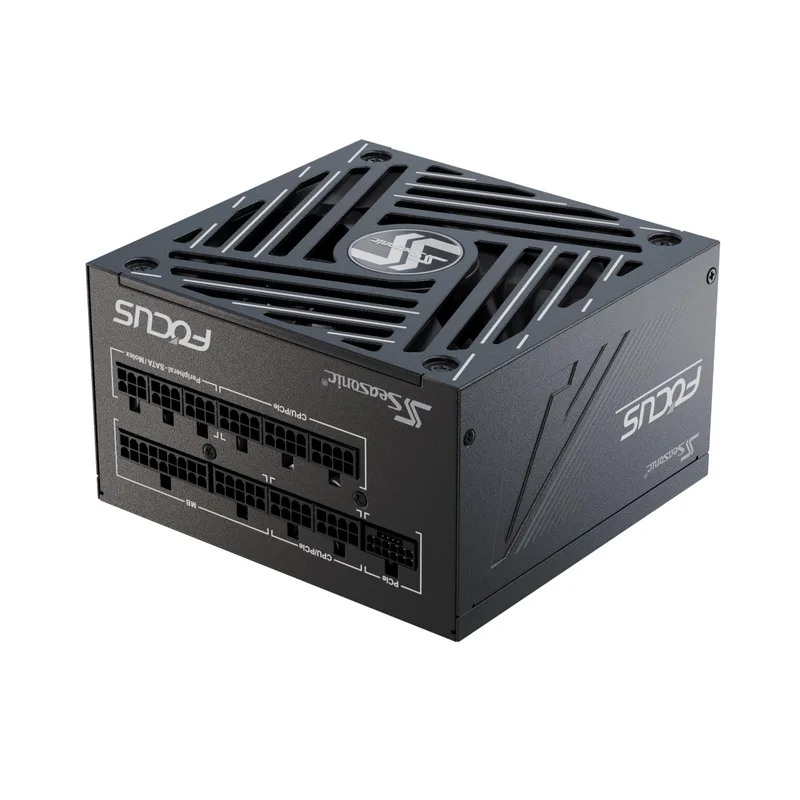
The Seasonic Focus GX-850 is the ATX 3.1 / PCIe 5.1 iteration of Seasonic’s Focus GX platform, featuring Seasonic’s OptiSink heatsink design and Cybenetics Platinum certification. Where the older Focus GX platform ran warm at high ambient temperatures, the updated design adds improved copper trace routing and a larger heatsink surface area that measurably reduces component temperatures at 100% load according to Hardware Busters’ thermal testing of the V4 platform.
The 10-year warranty is backed by Seasonic’s own manufacturing — they’re not relying on a third-party OEM to honor warranty claims on their behalf. Seasonic’s direct ownership of the manufacturing process also means component selection is their own decision rather than a contracted specification sheet.
At $140, it’s $10 more than the RM850x. Whether that premium is worth it depends entirely on how long you plan to keep the build. For a system targeting 3–4 years before a full rebuild, the RM850x is the rational choice. For a workstation or dedicated gaming rig you’re building to last a decade, the Seasonic’s 10-year coverage is directly relevant.
One notable spec: Seasonic’s Focus GX 850W ATX 3.1 is rated Cybenetics Platinum (~91%), one tier above the Corsair RM850x’s Cybenetics Gold (~90%). In practice, that 1% difference equates to about 8–9W at a 900W load — not meaningful in a gaming context but occasionally relevant in 24/7 rendering workstations.
Best for: Long-term builds where the PSU is planned to outlive two or three GPU generations without replacement.
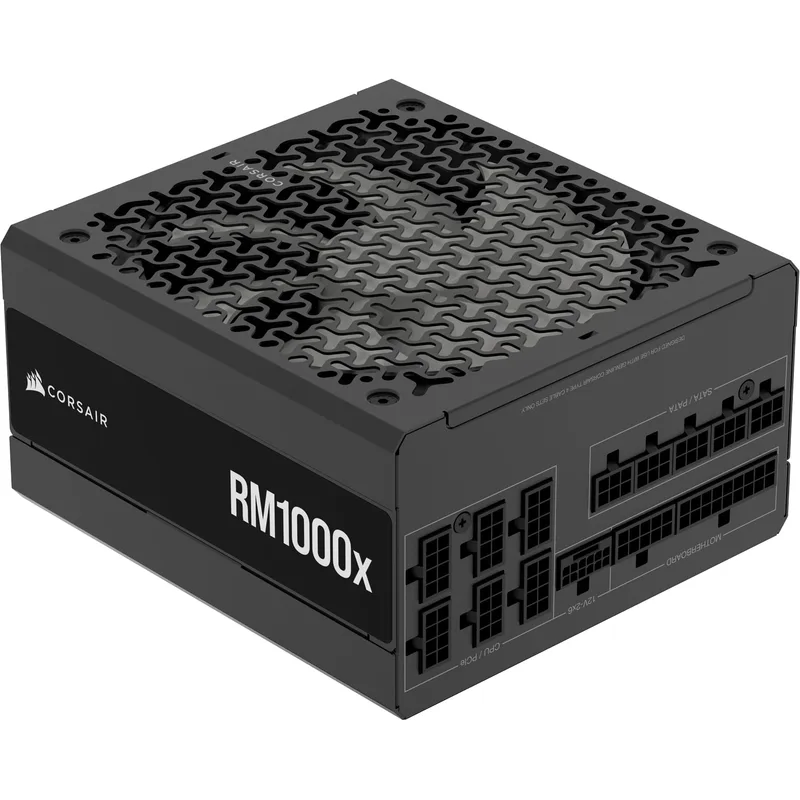
3. Corsair RM1000x ATX 3.1 — Best 1000W for RTX 5080 Builds
The Corsair RM1000x scales the same CWT platform up to 1000W while maintaining the identical 140mm chassis depth as the 850W model. That dimensional consistency matters — builders who upgrade from an 850W to a 1000W Corsair unit don’t face case compatibility issues.
1000W is the correct ceiling for an RTX 5080 build. The RTX 5080 has a 360W TDP and documented transient peaks above 500W in brief spikes per Gamers Nexus power analysis. ATX 3.1 compliance means the RM1000x is rated to absorb those spikes, but having 1000W total output means the rest of the system — CPU, storage, fans — has ample power budget even while the GPU is spiking.
The $160 price point sits $30 above the 850W model. For RTX 5070 Ti builds (300W TDP), 850W is sufficient and saves $30. For RTX 5080 builds (360W TDP), the move to 1000W is justified on headroom alone. For RTX 5090 builds (575W TDP), consider stepping to a 1200W unit — a 1000W PSU running a 5090 at full load operates with dangerously little overhead.
Best for: RTX 5080 gaming builds with a Ryzen 9 9950X3D or Core Ultra 9 285K, where total system draw can reach 600–700W under real gaming conditions.
4. Seasonic Focus GX-1000 ATX 3.1 — Best Warranty at 1000W
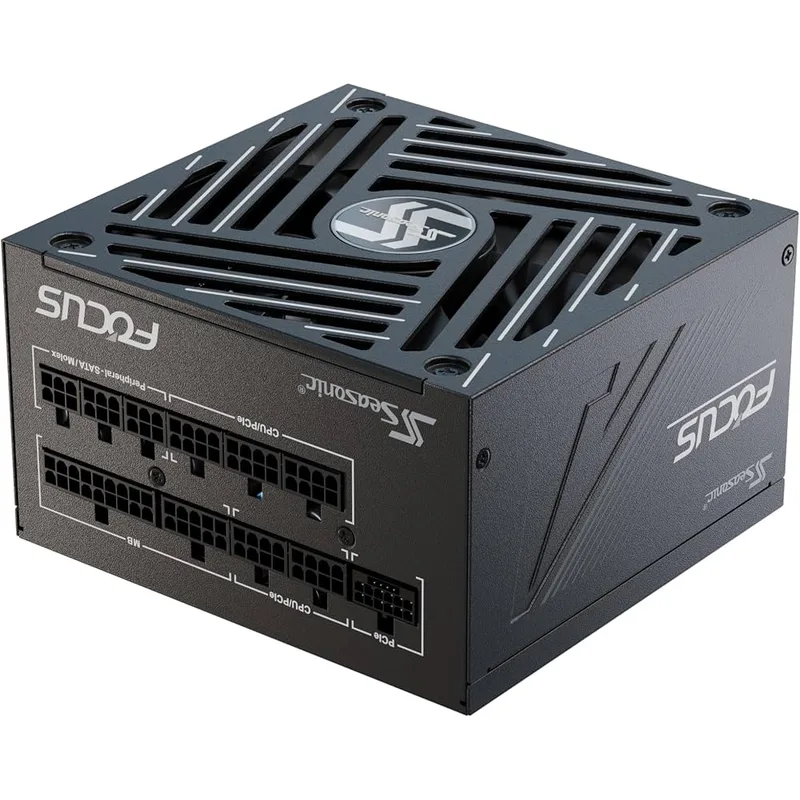
The Seasonic Focus GX-1000 is the 1000W variant of the same Focus GX platform reviewed above, carrying the same 10-year warranty and OptiSink thermal improvements. Seasonic explicitly lists RTX 5090 and RX 9000 series compatibility in the product listing, and the native 12V-2x6 cable meets ATX 3.1 transient specification without any adapter in the power path.
At $190, this is $30 more than the Corsair RM1000x. The price gap is entirely attributable to the warranty and Seasonic’s in-house manufacturing premium — efficiency ratings are similar (Cybenetics Gold ~91% vs ~90%), wattage is identical, and the cable kit is comparable.
The Focus GX-1000 makes the most sense for workstation builds or professional editing rigs where the PSU is running 10–12 hours daily and the 10-year coverage offsets the risk of having a critical component fail outside the Corsair 7-year window. For pure gaming systems where the machine is on 4–6 hours per day, the Corsair RM1000x at $160 is the more efficient spend.
Best for: Workstation and professional builds with an RTX 5090 or dual-GPU configurations where long-term reliability carries more weight than upfront cost.
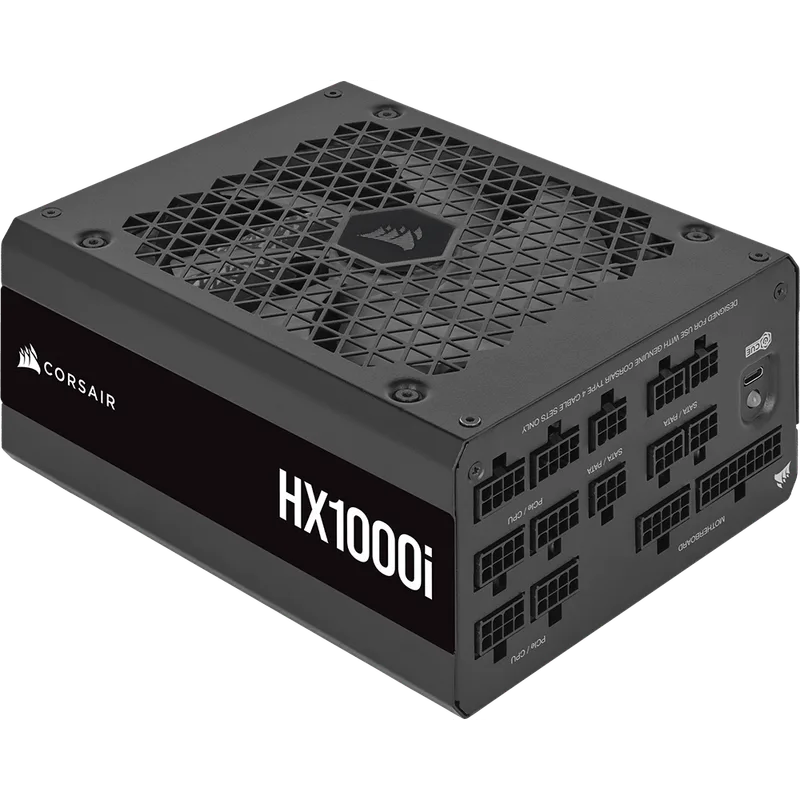
5. Corsair HX1000i ATX 3.1 — Best Platinum PSU 2026
The Corsair HX1000i is the only Platinum-rated option in this comparison, combining 80 Plus Platinum efficiency (~93% at 50% load), iCUE software monitoring, and a fluid dynamic bearing (FDB) fan instead of the sleeve bearing units found in Gold-tier PSUs. The FDB fan is rated to last longer at sustained high-load and high-temperature operation — relevant for systems that run AI inference, video encoding, or other sustained GPU workloads.
iCUE integration is the differentiated feature. Within Corsair’s software, you can monitor real-time wattage draw per rail, +12V voltage, fan speed, and PSU temperature. For builders who tune their system or run benchmarks, having in-PSU measurement removes the need for a separate wall meter. For average gaming use, it’s a convenience rather than a necessity.
At $220, the HX1000i is $60 above the RM1000x and $30 above the Seasonic Focus GX-1000. Recovering that premium through electricity savings requires over 5 years at the efficiency differential — realistic for a 10-year system but not for a machine you’ll rebuild in 3 years. The 10-year warranty matches Seasonic, and the FDB fan and iCUE monitoring are genuinely useful for the right buyer profile.
Best for: High-ambient-temperature workstations running RTX 5090 builds, silent computing enthusiasts, or builders who want software power monitoring without a separate external meter.
Comparison Table
FAQ
Q: Does it matter which brand manufactures the PSU — Corsair or Seasonic?
It matters somewhat. Seasonic manufactures its own units and holds direct quality control over component selection, heat treatment, and tolerances. Corsair’s RM line is manufactured by Channel Well Technology (CWT), a reputable OEM that also supplies units to other well-regarded brands. Both platforms pass Cybenetics lab certification and deliver reliable voltage regulation in real-world use. The main practical difference is that Seasonic’s in-house manufacturing underpins their 10-year warranty credibility.
Q: Is 850W enough for an RTX 5080 build?
It depends on the CPU. An RTX 5080 (360W TDP) paired with a Ryzen 7 9800X3D (120W TDP) draws approximately 530–580W under gaming load with storage included. An 850W PSU covers that with 270–320W of headroom — sufficient. Paired with a Core Ultra 9 285K at 250W TDP under full load, total draw can approach 700W, which leaves only 150W of margin. In that case, 1000W is the safer choice.
Q: Should I care about Platinum efficiency vs Gold at the gaming tier?
At typical gaming loads of 300–500W system draw, the difference between Gold (~90%) and Platinum (~93%) efficiency is 3 percentage points. At 400W draw for 8 hours a day at $0.15/kWh, Platinum saves approximately $5–8 per year. That does not justify a $60 premium over Gold for a pure gaming build. Platinum makes sense for workstations or rendering machines running 1,000+ watt loads for 10+ hours daily.
Q: What is the 12V-2x6 connector and why does it matter?
The 12V-2x6 (also called 12VHPWR Gen2) is the power connector used by RTX 4000-series and RTX 5000-series GPUs with TDPs above 225W. Early RTX 4090 installations saw connector melt incidents attributed to improperly seated 8-pin-to-12VHPWR adapter cables. A “native” 12V-2x6 connector is wired directly from the PSU’s transformer without an adapter in the power path, eliminating that failure point. Every PSU in this comparison includes a native 12V-2x6 cable.
Q: What’s the difference between the Corsair RM and HX series?
The RM series (Gold) is Corsair’s mainstream line — fully modular, Cybenetics Gold efficiency, 7-year warranty, no digital monitoring. The HX series (Platinum) adds Platinum efficiency, iCUE software monitoring, a fluid dynamic bearing fan, and a 10-year warranty. The HX line runs quieter under sustained load and provides real-time voltage and wattage data via iCUE. The premium is roughly $60 at 1000W — justified for professional or long-term builds, overkill for standard gaming machines.
The Bottom Line
At 850W, the Corsair RM850x at $130 is the pragmatic choice for most gaming builds — tight voltage regulation, native 12V-2x6, and zero-RPM fan mode at a price $10 below the competition. The Seasonic Focus GX-850 at $140 earns that premium through a 10-year warranty backed by in-house manufacturing, making it the better call for systems designed to last a decade.
At 1000W, the Corsair RM1000x at $160 is the correct unit for RTX 5080 builds on a budget, while the Seasonic Focus GX-1000 at $190 serves workstations and professional rigs where the 3-year warranty extension is worth real money. The Corsair HX1000i at $220 is the premium pick for builders who want Platinum efficiency, iCUE monitoring, and a FDB fan — niche but genuinely differentiated from everything else in this tier.