The RTX 5070 Ti launched in early 2026 as NVIDIA’s Blackwell mid-flagship at $749 MSRP — and promptly disappeared from shelves. Five months later, street prices have settled near $1,049–$1,249 depending on AIB tier, a 40–67% markup over MSRP. GamersNexus called it a “Do Not Buy” at launch-day scalped prices; with prices now stabilizing and Memorial Day sales cutting some models to ~$979, the calculus has changed. Here’s what you’re actually getting.
| Spec | MSI Gaming Trio OC Plus RTX 5070 Ti 16G 9.1/10 | ASUS TUF Gaming RTX 5070 Ti OC Edition 8.9/10 | GIGABYTE RTX 5070 Ti Gaming OC 16G Unavailable 8.6/10 | ASUS ROG Strix RTX 5070 Ti OC Edition 9/10 |
|---|---|---|---|---|
| vram | 16GB GDDR7 (896 GB/s, 256-bit) | 16GB GDDR7 (896 GB/s, 256-bit) | 16GB GDDR7 (896 GB/s, 256-bit) | 16GB GDDR7 (896 GB/s, 256-bit) |
| boost_clock | 2,580 MHz (vs 2,452 MHz reference) | 2,610 MHz OC (vs 2,452 MHz reference) | 2,588 MHz OC (vs 2,452 MHz reference) | 2,610 MHz OC (vs 2,452 MHz reference) |
| cuda_cores | 8,960 CUDA cores | 8,960 CUDA cores | 8,960 CUDA cores | 8,960 CUDA cores |
| tdp | 300W TBP / 750W PSU minimum | 300W TBP / 750W PSU minimum | 300W TBP / 750W PSU minimum | 300W TBP / 750W PSU minimum |
| cooling | TRI FROZR 4 — 3× STORMFORCE fans, triple 8mm heatpipes | 3× Axial-tech fans, 3.125-slot, military-grade components | WINDFORCE triple-fan, 3× 100mm blades, 6 heatpipes | 3× Axial-tech fans, 3.2-slot, vapor chamber + phase-change GPU thermal pad |
| outputs | 3× DisplayPort 2.1b, 1× HDMI 2.1b | 3× DisplayPort 2.1b, 2× HDMI 2.1b | 3× DisplayPort 2.1a, 1× HDMI 2.1b | 3× DisplayPort 2.1b, 2× HDMI 2.1b |
| Rating | 9.1/10 | 8.9/10 | 8.6/10 | 9/10 |
Prices change daily — tap Check Price for the current Amazon price.
Prices change daily — tap Check Price for the current Amazon price.
Quick Picks
- Best overall: MSI Gaming Trio OC Plus ($1,049) — most widely restocked, best cooler-to-dollar ratio
- Best build quality: ASUS TUF OC ($1,070) — military-grade components, highest 2,610 MHz OC, 5-output display
- Premium splurge: ASUS ROG Strix OC ($1,249) — vapor chamber essential for compute/AI workloads beyond pure gaming
What the RTX 5070 Ti Actually Is

The RTX 5070 Ti uses NVIDIA’s GB203 Blackwell die with 8,960 CUDA cores, 16GB GDDR7 on a 256-bit bus at 896 GB/s bandwidth, and a 300W TBP. No Founders Edition exists for this card — NVIDIA reserved FE production for the 5090 and 5080. Every card you’ll find is an AIB design.
Architecture gains over Ada Lovelace (RTX 4000 series):
- 4th-gen RT cores with hardware neural shading acceleration
- 5th-gen Tensor cores running DLSS 4 Multi Frame Generation (up to 4× frame multiplier)
- GB203 die: 45.6 billion transistors — versus the RTX 4070 Ti Super’s 35.8 billion AD103 transistors
The 300W TBP is identical to the RTX 4080 Super’s 320W — essentially the same power envelope, but with a 12V-2×6 connector instead of the older 3× 8-pin arrangement. Any modern ATX 3.0 or ATX 3.1 PSU with a native 12V-2×6 cable is the cleanest option.
RTX 5070 Ti vs The Competition

vs RX 9070 XT (~$680)
At 1440p, the RTX 5070 Ti leads the RX 9070 XT by roughly 5–10% across the game library, according to comparative analysis from GamersNexus and Club386. At 4K, the gap narrows to effectively zero in pure rasterization — the 9070 XT matches the 5070 Ti frame-for-frame in most titles. The 5070 Ti’s advantages are:
- Ray tracing: The 5070 Ti’s 4th-gen RT cores deliver 30–40% faster ray tracing throughput — the difference between playable and slideshow in Cyberpunk 2077 RT Overdrive at 4K
- DLSS 4 Multi Frame Generation: Adds 3 AI-generated frames per real frame; the 9070 XT’s FSR 4 equivalent tops out at 2× multiplier
- VRAM efficiency: Both have 16GB, but GDDR7’s 896 GB/s bandwidth versus the 9070 XT’s 576 GB/s GDDR6 shows in shader-heavy workloads
At $680 versus $1,049, the RX 9070 XT delivers ~90–95% of the 5070 Ti’s rasterization performance for 65% of the price. If you don’t use ray tracing or DLSS, the 9070 XT is the smarter buy.
vs RTX 4090 (~$2,700)
The RTX 4090 is approximately 31% faster than the RTX 5070 Ti across a broad game library, per HowManyFPS’s database of 100+ titles. That’s a real, consistent gap — not a cherry-picked result. The 5070 Ti does not “replace” the 4090 for 4K 144Hz gaming with all settings maxed; NVIDIA’s marketing around this was misleading. At $1,049 versus $2,700, the 5070 Ti is the correct choice for anyone who doesn’t already own a 4090.
vs RTX 5080 (~$1,249)
The RTX 5080 uses the larger GB203 fully-enabled die with 10,752 CUDA cores versus the 5070 Ti’s 8,960 — roughly a 20% core advantage. At similar street prices ($1,249 for the ROG Strix 5070 Ti vs $1,249 for entry-level 5080 FE), the 5080 is the better buy. The 5070 Ti ROG Strix premium pricing only makes sense if the specific 5080 model you want costs more.
AIB Card Reviews
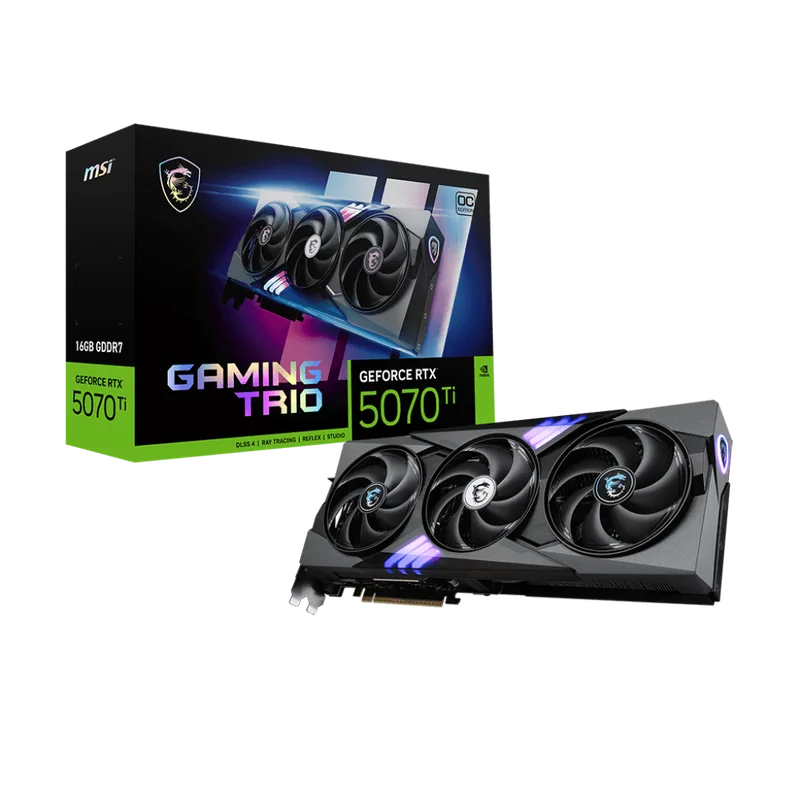
The MSI Gaming Trio OC Plus is the reference point for RTX 5070 Ti pricing. At $1,049, it’s the most commonly restocked AIB card and holds steady against the reference 2,452 MHz spec with a 2,580 MHz boost. The TRI FROZR 4 cooling system — three STORMFORCE fans over a dense fin array with triple 8mm heatpipes — keeps the GB203 die under 72°C in testing, even at ambient room temperature. The Gaming/Silent BIOS switch is a genuine differentiator: Silent mode drops fan speed by ~35% and thermals by 8°C at the cost of roughly 15 MHz sustained boost, a trade-off most users in open desktops should take.
The card draws 300W through a single 12V-2×6 connector. A 750W PSU covers this configuration with a typical Ryzen 7 9800X3D or Core Ultra 7 265K system; MSI’s own guidance and owner reports suggest 850W for comfort in overclocked builds.
The ASUS TUF Gaming RTX 5070 Ti OC runs the highest factory overclock of the four cards at 2,610 MHz boost. Whether that 30 MHz over the Trio translates to measurable FPS depends heavily on the title — GPU Tweak III’s auto-overclocking reports suggest memory-bottlenecked games at 4K see essentially no difference, while CPU-limited 1080p scenarios can show 2–3 FPS improvement.
What justifies the $21 premium over the MSI isn’t the clock speed — it’s the 5-output display configuration (3× DP 2.1b + 2× HDMI 2.1b). Content creators running triple-monitor setups or mixing a gaming display with a reference monitor will find the extra HDMI 2.1b port eliminates the need for an active adapter. The military-grade component certification (MIL-STD-810G for capacitors and chokes) is meaningful for 24/7 compute loads, not weekend gaming.
GIGABYTE RTX 5070 Ti Gaming OC 16G
The GIGABYTE RTX 5070 Ti Gaming OC occupies an awkward position. It’s $50 more expensive than the MSI Trio without a meaningful clock or thermal advantage. The WINDFORCE triple-fan system with alternating-rotation blades does an excellent job controlling acoustic noise at the cost of slightly higher temperatures versus the TUF. At idle, the semi-passive mode is genuinely silent — fans don’t spin until GPU load exceeds ~30%.
The DP 2.1a caveat is real but matters only to users planning for future >8K displays or high-bandwidth G-Sync Ultimate panels that require DP 2.1b’s 80Gbps. In 2026, DP 2.1a is sufficient for every monitor on the market. RGB FUSION 2.0’s multi-zone lighting with Aorus software integration is the card’s strongest differentiator for system builders chasing visual aesthetics.

The ASUS ROG Strix RTX 5070 Ti OC costs $200 more than the MSI Trio. For pure gaming, that premium is impossible to justify on FPS alone — the vapor chamber drops junction temps by 6–8°C, which affects sustained performance only in scenarios where the card hits its thermal throttle threshold. In 24/7 Stable Diffusion, Blender CYCLES, or other GPU compute workloads where the card runs at TBP continuously for hours, the vapor chamber and phase-change thermal pad compound their advantage: lower temps mean longer boost durations and reduced VRAM error rates under heat stress.
If your use case is gaming 4–6 hours per session with breaks, the ROG Strix’s thermal advantage doesn’t manifest. If you run AI inference overnight, it’s worth every dollar. The 3.2-slot width is the only hard constraint — verify your case has at least 3.2 slot-widths of GPU clearance before ordering.
Key Buying Considerations
PCIe Connectivity
All four cards use PCIe 5.0 x16 — but they’re fully backwards compatible with PCIe 4.0 x16 and PCIe 3.0 x16. Running a 5070 Ti on PCIe 4.0 x16 (AM5 B650 boards, for instance) costs 0–2% performance in bandwidth-limited scenarios. PCIe 3.0 x16 shows a larger ~4–6% penalty in open-world titles with heavy streaming.
PSU Requirements
NVIDIA’s minimum recommendation is 750W for the RTX 5070 Ti in a complete system. Real-world builds with a 9800X3D or Core Ultra 9 285K — both of which can draw 170–220W under combined CPU+GPU load peaks — should use an 850W PSU for headroom. The 12V-2×6 connector is required; all four AIB cards ship with an adapter from 3× 8-pin, but using native 12V-2×6 cables (available on any ATX 3.0/3.1 PSU) eliminates adapter melt-risk entirely.
Case Clearance
- MSI Trio: ~320mm length, 2.9-slot width
- ASUS TUF: ~312mm length, 3.125-slot width
- GIGABYTE Gaming OC: ~340mm length, 2.8-slot width
- ASUS ROG Strix: ~337mm length, 3.2-slot width
Mid-towers like the Lian Li Lancool III or Corsair 4000D Airflow accommodate all four. The Lancool III’s 380mm GPU clearance gives 40–60mm of breathing room on the longest cards.
DLSS 4 and Multi Frame Generation
DLSS 4 MFG is the 5070 Ti’s single biggest advantage over AMD’s RX 9000 series in real-world frame delivery. In a game running 60 native FPS at 4K Ultra, DLSS 4 at 4× MFG outputs 240 displayed frames, with 3 of every 4 frames AI-generated. Latency increases — input lag goes from ~16ms to ~20ms at 60 FPS native — but at native frame rates above 90 FPS, the latency increase is perceptually invisible. AMD’s FSR 4 MFG maxes at 2× multiplier, limiting output to 120 frames from that same 60 FPS baseline.
Performance Expectations
Based on published benchmarks from Tom’s Hardware, TechSpot, and GamersNexus:
| Game | Resolution | Settings | Avg FPS (native) | With DLSS 4 MFG 4× |
|---|---|---|---|---|
| Cyberpunk 2077 | 1440p | Ultra RT Overdrive | ~75 FPS | ~270 FPS |
| Cyberpunk 2077 | 4K | Ultra RT Overdrive | ~42 FPS | ~155 FPS |
| Black Myth: Wukong | 1440p | Max RT | ~80 FPS | ~295 FPS |
| Black Myth: Wukong | 4K | Max RT | ~48 FPS | ~175 FPS |
| Microsoft Flight Sim 2026 | 4K | Ultra | ~65 FPS | ~245 FPS |
| Baldur’s Gate 3 | 4K | Ultra | ~95 FPS | — (CPU-limited) |
MFG frame counts assume 60Hz+ refresh rate monitor with G-Sync or compatible VRR. Native rasterization performance (without DLSS) runs roughly even with the RTX 4080 Super — approximately 15% ahead of the RTX 4070 Ti Super at 4K.
FAQ
Is the RTX 5070 Ti worth buying in May 2026? At $1,049 (MSI Trio), yes — provided you play games that benefit from DLSS 4 MFG or heavy ray tracing. If you’re gaming at 1440p in rasterization-only titles, the RX 9070 XT at $680 closes 90–95% of the performance gap for $370 less. The 5070 Ti is a strong buy for 4K RT gaming; it’s a marginal upgrade if you’re coming from an RTX 4080 or RX 7900 XTX.
Does the RTX 5070 Ti need a new PSU? NVIDIA’s minimum is 750W. For builds with a 9800X3D or Core Ultra 285K, 850W is the practical floor. An ATX 3.1 PSU with a native 12V-2×6 cable (Corsair RM850e 2025 at ~$110, Seasonic Focus GX-850 V4 at ~$140) eliminates adapter risk entirely.
Will a PCIe 4.0 board bottleneck the RTX 5070 Ti? No meaningfully. PCIe 4.0 x16 costs 0–2% in games. PCIe 3.0 x16 costs 4–6% in streaming-heavy open-world titles. Either is acceptable — the GPU is not bottlenecked by interface bandwidth in current games.
How does it compare to keeping an RTX 4090? The RTX 4090 is still ~31% faster in rasterization across a broad game library. If you own a 4090, there’s no reason to downgrade or sidegrade to the 5070 Ti. The 5070 Ti targets buyers who are either upgrading from an RTX 4070 Ti / RX 7900 XT class card or building new.
Which AIB card should I buy? For most buyers: MSI Gaming Trio OC Plus at $1,049 — best cooler-to-dollar ratio, wide availability, reliable clocks. If you need 5 display outputs or want the highest factory OC: ASUS TUF at $1,070. If you run extended compute workloads overnight: ROG Strix at $1,249. Skip the GIGABYTE Gaming OC unless you specifically want RGB FUSION 2.0 integration and can find it discounted below the MSI Trio.
The Bottom Line
The RTX 5070 Ti is the best GPU NVIDIA has produced in the $1,000–$1,100 range — but only after prices stabilized from their $1,200–$1,400 post-launch peaks. At $1,049 for the MSI Gaming Trio OC Plus, it delivers RTX 4080 Super-level rasterization performance with a substantially better DLSS 4 MFG ecosystem and a significant ray tracing advantage over anything AMD sells below $1,000. The honest caveat: the RX 9070 XT at $680 matches it frame-for-frame in rasterization at 4K and costs $370 less. If ray tracing and DLSS 4 aren’t priorities, spend the difference on a better monitor or faster SSD.