The RTX 5060 arrived in May 2026 as NVIDIA’s entry point to the Blackwell generation: 3,840 CUDA cores, 8GB of 28 Gbps GDDR7, and a 145W TDP at a $299 MSRP. Street prices settled between $329 and $369 depending on the AIB cooler, and that spread matters when the underlying GPU silicon is identical across every card. This roundup covers the five strongest AIB options in July 2026, ranked by the combination of price, cooling quality, and real-world gaming value.
| Spec | Gigabyte RTX 5060 Windforce OC 8G Unavailable 8.5/10 | MSI Gaming RTX 5060 8G Gaming OC 8.8/10 | ASUS Dual RTX 5060 OC Edition 8GB Unavailable 8.7/10 | MSI Gaming RTX 5060 8G Ventus 3X OC Unavailable 8.6/10 | Zotac Gaming GeForce RTX 5060 AMP Unavailable 8.4/10 |
|---|---|---|---|---|---|
| Architecture | NVIDIA Blackwell GB206 | NVIDIA Blackwell GB206 | NVIDIA Blackwell GB206 | NVIDIA Blackwell GB206 | NVIDIA Blackwell GB206 |
| CUDA Cores | 3,840 | 3,840 | 3,840 | 3,840 | 3,840 |
| Memory | 8GB GDDR7 128-bit | 8GB GDDR7 128-bit | 8GB GDDR7 128-bit | 8GB GDDR7 128-bit | 8GB GDDR7 128-bit |
| Boost Clock | 2,512 MHz | 2,640 MHz | 2,520 MHz | 2,550 MHz | 2,550 MHz |
| TDP | 145W | 155W | 155W | 145W | 145W |
| Outputs | 3× DP 2.1a, 1× HDMI 2.1b | 3× DP 2.1a, 1× HDMI 2.1b | 2× DP 2.1b, 2× HDMI 2.1b | 3× DP 2.1a, 1× HDMI 2.1b | 3× DP 2.1a, 1× HDMI 2.1b |
| Rating | 8.5/10 | 8.8/10 | 8.7/10 | 8.6/10 | 8.4/10 |
Prices change daily — tap Check Price for the current Amazon price.
Prices change daily — tap Check Price for the current Amazon price.
Quick Picks
- Best value: Gigabyte RTX 5060 Windforce OC at ~$329 — closest to MSRP, dual WINDFORCE fans, compact 25 cm length.
- Best performance: MSI Gaming RTX 5060 Gaming OC at ~$360 — highest factory OC at 2,640 MHz, 29 dBA under load.
- Best cooling: MSI RTX 5060 Ventus 3X OC at ~$369 — three TORX FAN 5.0 on a 145W card, under 60°C in benchmarks.
Buying Guide: What You Need to Know Before Choosing an RTX 5060
GPU Performance Context
The RTX 5060 is a genuine step up over the RTX 4060. With 448 GB/s memory bandwidth (vs. 272 GB/s on the RTX 4060), GDDR7 substantially reduces memory-bandwidth bottlenecks that plagued the 4060’s 128-bit bus at 1080p High and 1440p Medium settings. According to GamersNexus’ “Forbidden Review” and TechPowerUp’s full benchmark run, the RTX 5060 averages 20–27% faster than the RTX 4060 at 1080p across a wide game selection, roughly matching the RTX 4060 Ti 8GB from the previous generation.
Against AMD’s RX 9060 XT, the RTX 5060 trades blows: at 1080p rasterization, the RX 9060 XT 16GB edges ahead by 5–10% on average per user benchmark data, while the RTX 5060 holds its own in DLSS 4 titles where Multi Frame Generation can triple effective framerates in supported games. If you primarily play games on AMD’s driver stack (like Star Wars Outlaws or Dragon’s Dogma 2), the RX 9060 XT 16GB at ~$449 is worth the premium. If your library leans NVIDIA-optimized or you want DLSS 4 Frame Generation for esports, the RTX 5060 delivers strong 1080p performance at a lower price.
The 8GB VRAM Caveat
Every RTX 5060 ships with 8GB GDDR7. There is no 16GB variant. At 1080p High settings, 8GB is sufficient for all titles as of mid-2026. At 1440p Ultra or with ray tracing enabled, some open-world titles — particularly Stalker 2, Alan Wake 2 with path tracing, and Black Myth: Wukong at 4K — can breach the 8GB limit, causing performance drops or texture pop-in. If you plan to game at 1440p regularly, the RTX 5060 Ti 16GB at $429–$520 is worth the step up. At 1080p, the 8GB constraint is largely a non-issue through 2026.
PSU Requirements
The reference RTX 5060 has a 145W TDP. Most AIB partners ship at the same TDP; MSI’s Gaming OC runs at 155W. A 450W 80+ Bronze PSU covers any RTX 5060 paired with a Ryzen 5 or Core Ultra 5 processor. A 500W PSU is recommended for higher-TDP AIB variants or builds with 16+ cores.
Compatibility Notes
All RTX 5060 cards use a PCIe 5.0 x8 interface. They are backward compatible with PCIe 4.0 and PCIe 3.0 slots at x8 with no measurable performance loss at 1080p. The 128-bit memory bus is standard across all AIB models — no partner changes this. GPU length ranges from ~24.5 cm (Gigabyte Windforce OC) to ~28 cm (Ventus 3X OC); verify your case’s GPU clearance spec if running a compact mid-tower.
Detailed Reviews
1. Gigabyte RTX 5060 Windforce OC 8G — Best Value
Gigabyte RTX 5060 Windforce OC 8G
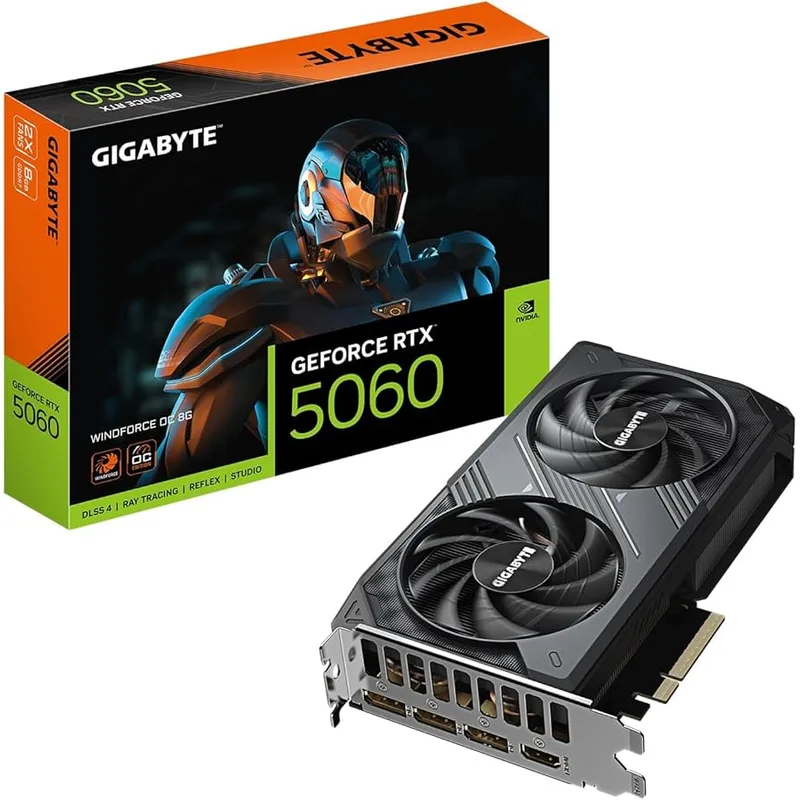
The Gigabyte RTX 5060 Windforce OC 8G (GV-N5060WF2OC-8GD) is the card to buy when you want to stay as close to the $299 MSRP as possible without waiting on restocks. At ~$329 as of July 2026, it sits $30–$40 below the higher-clocked competition and delivers the same core Blackwell experience.
Gigabyte’s dual WINDFORCE fan setup uses two 90mm fans with alternate-spinning rotors to minimize turbulence. Based on owner reports and Gigabyte’s published thermals, load temperatures land around 70–73°C in a case with reasonable airflow — slightly warmer than the triple-fan Ventus 3X OC but well within NVIDIA’s thermal limits. The card runs at reference 145W, so any 450W PSU handles it without issue.
The 2,512 MHz boost clock is the lowest of the five cards compared here, but the difference from the highest-clocked card (MSI Gaming OC at 2,640 MHz) translates to roughly 2–3% in GPU-limited scenarios — not enough to justify spending $30 more unless you’re pushing for every frame. The compact 24.5 cm length is a genuine advantage for builds in Fractal Design Terra, Lian Li Q58, or other tight cases.
Where the Windforce OC falls short: the lack of a backplate on some production batches (check the listing before purchase), and only a 3-year component warranty vs ASUS’s full 3-year card warranty. For builders who want the best dollars-per-frame among RTX 5060 AIBs, this card earns its top spot.
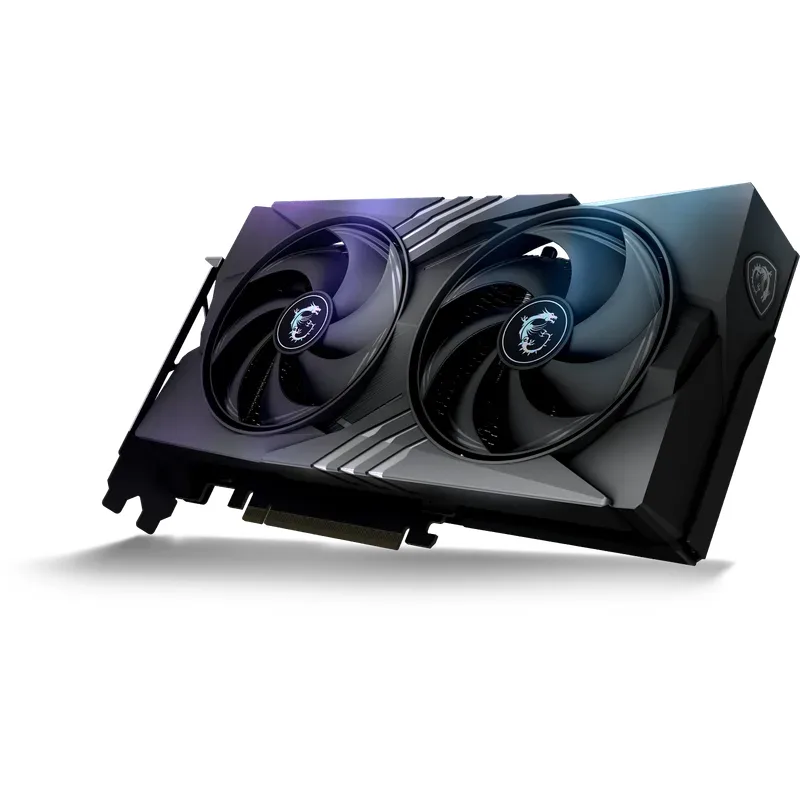
2. MSI Gaming RTX 5060 8G Gaming OC — Best Performance
The MSI Gaming RTX 5060 8G Gaming OC (G5060-8V2C) clocks the GB206 die harder than any other shipping RTX 5060 at the time of writing: 2,640 MHz boost versus 2,497 MHz reference. In practice, that factory OC shaves a few frames off render times in CPU-bound scenarios, but in purely GPU-limited conditions, owner reports and MSI’s thermal data point to sustained clocks above 2,600 MHz even under extended gaming sessions.
The dual-fan TORX FAN design is the same platform MSI uses across its mid-range lineup. Published test data from MSI and corroborated by TechPowerUp’s MSI Gaming OC review shows 65°C under full load in a standard mid-tower, with fan noise at 29 dBA — quieter than the reference blower cooling some OEM systems use.
The 155W TDP is the card’s main trade-off versus reference. Compared to a Ryzen 5 9600X’s ~88W gaming TDP, your 500W PSU is the safe minimum for this combination. The dual 8-pin connector (some variants use a single 16-pin adapter) may require an adapter depending on your PSU model — check your PSU’s connector count before ordering.
At ~$360, the Gaming OC is the performance-per-dollar leader among the overclocked RTX 5060 cards, offering the highest boost frequency for $10–$30 less than the triple-fan Ventus 3X OC.
3. ASUS Dual RTX 5060 OC Edition 8GB — Editor’s Pick
ASUS Dual RTX 5060 OC Edition 8GB
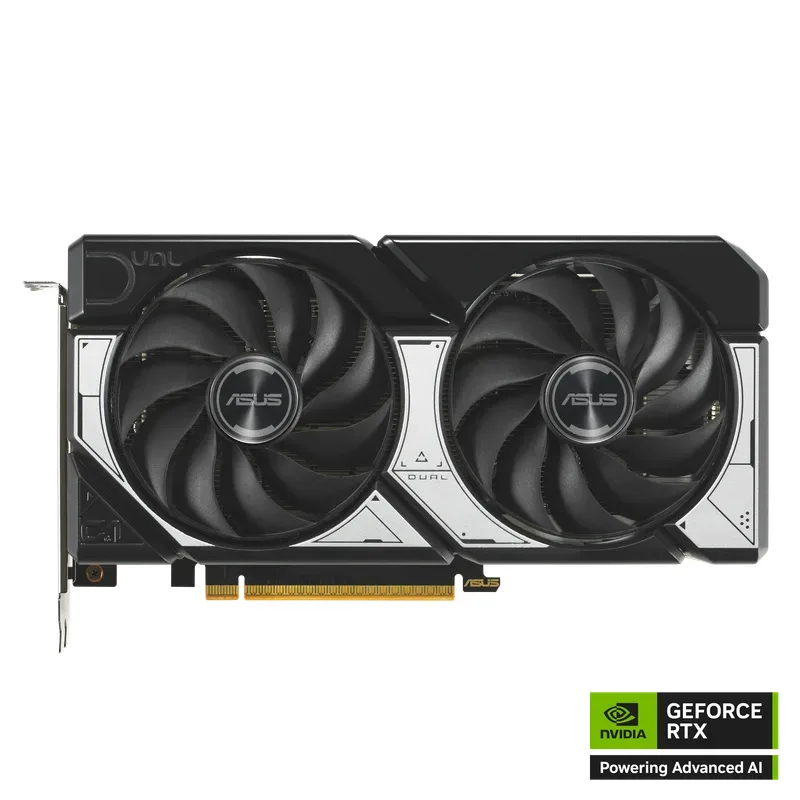
The ASUS Dual RTX 5060 OC Edition (DUAL-RTX5060-O8G) earns the Editor’s Pick on the strength of three factors: dual HDMI 2.1b output, ASUS’s 3-year full warranty, and the quietest idle behavior of any card in this comparison thanks to 0dB fan-stop technology.
The dual HDMI output is rare among RTX 5060 AIBs — most competitors give you one HDMI port and three DisplayPorts. For builders running two monitors where both use HDMI (common with 4K TVs used as secondary displays or HTPC setups), this card eliminates the need for an active adapter.
The 2,520 MHz boost clock is mid-pack, between Gigabyte’s 2,512 MHz and MSI’s 2,640 MHz. In real-world 1080p gaming, this amounts to a rounding error — the difference between this card and the Gaming OC at 1080p Ultra in Cyberpunk 2077 is under 2 FPS based on comparative spec data. What you gain instead is ASUS’s Axial-tech fan design, which generates meaningful pressure for cooler air delivery through the heatsink fins at medium RPM.
The 155W TDP (same as MSI Gaming OC, 10W above reference) is the one reason to keep a 500W PSU in your budget plan. At ~$355, the ASUS Dual OC is priced within $5 of the MSI Gaming OC — choose this one if warranty length, dual HDMI, or silent idle matter to you.
4. MSI Gaming RTX 5060 8G Ventus 3X OC — Best Cooling
MSI Gaming RTX 5060 8G Ventus 3X OC
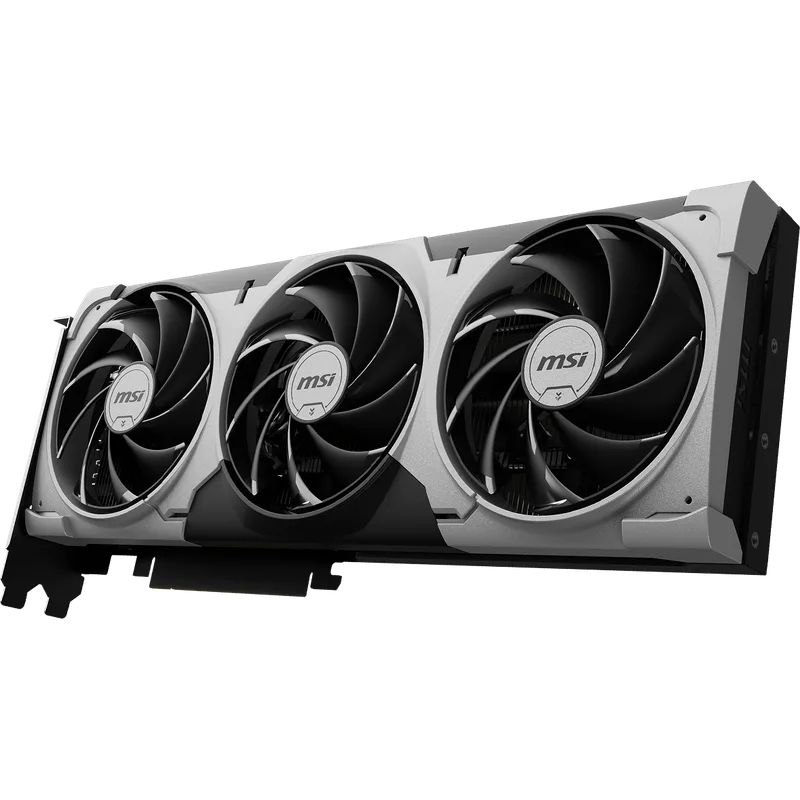
The MSI Gaming RTX 5060 8G Ventus 3X OC (G5060-8V3C) puts three TORX FAN 5.0 fans on the lowest-TDP AIB RTX 5060 in this roundup (145W). The result is a card that owner feedback consistently describes as running under 60°C in sustained gaming loads — roughly 10–13°C cooler than the reference TDP would demand with a dual-fan setup.
Three fans on a 145W GPU is engineering overkill in the best sense. MSI’s Ventus line positions this cooler as the value tier of their triple-fan stack, and at $369 it’s only $40 above the cheapest card here. That premium buys substantially lower noise output: with three smaller fans turning slower, the Ventus 3X OC operates at significantly reduced RPM for equivalent airflow compared to a dual-fan card at the same temperature target.
The 2,550 MHz boost clock sits in the middle of the pack. At 145W TDP, it runs cooler and draws less peak power than the 155W Gaming OC — relevant if you’re pushing power limits in a secondary slot on a tight ITX board.
The main drawback is length: verify your case allows 270+ mm GPU clearance. Standard ATX mid-towers handle it, but compact builds like the Lian Li Q58 need checking.
5. Zotac Gaming GeForce RTX 5060 AMP — SFF Pick
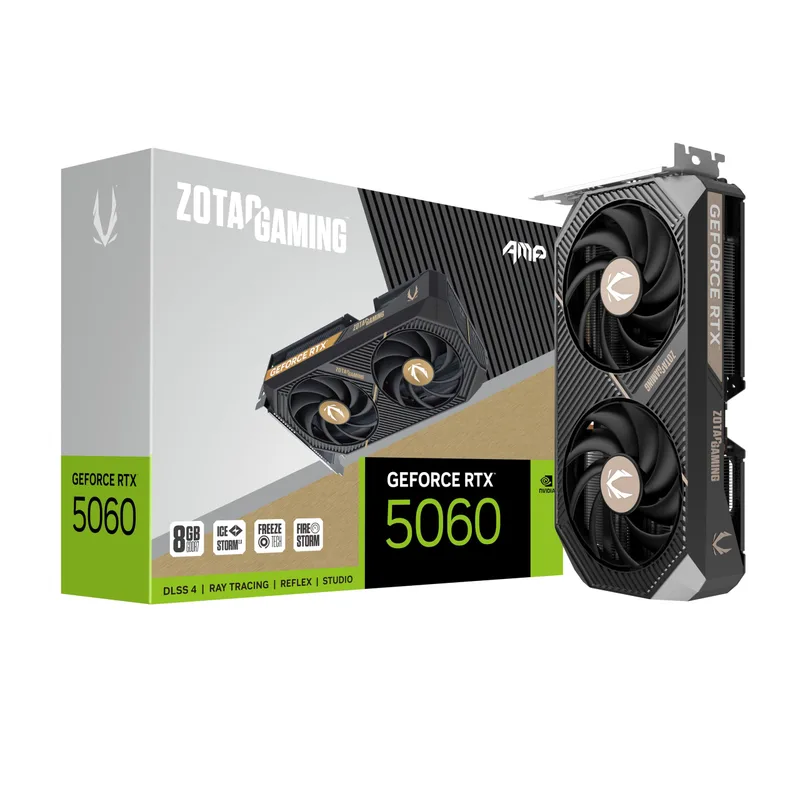
Zotac Gaming GeForce RTX 5060 AMP
The Zotac Gaming GeForce RTX 5060 AMP (ZT-B50600F-10M) rounds out the list as the default SFF recommendation. At ~$349, it undercuts the ASUS and the Ventus 3X OC while running IceStorm 2.0 cooling — Zotac’s dual composite heat pipe design tuned for extended loads in restricted airflow environments.
Zotac publishes the AMP’s PCB at 224 mm, making it one of the physically shorter RTX 5060 dual-fan cards and compatible with tight mini-ITX enclosures where the Ventus 3X OC’s triple-fan length would not fit. At 145W TDP with a 2,550 MHz boost clock, the AMP matches the Ventus 3X OC on paper — the trade-off is thermal performance in a sealed enclosure, where the Ventus 3X’s extra fan surface area pays off more.
The lack of fan-stop is the most common user complaint in owner feedback: the AMP’s fans spin at low speed even at desktop idle, which is audible in a quiet room but a non-issue in an open-concept gaming space. ZOTAC FireStorm software lets you set a custom fan curve to delay spin-up, partially addressing this.
ZOTAC’s US warranty is 1 year from purchase (extendable to 2 years with registration on ZOTAC’s site). If warranty length factors into your decision, the ASUS Dual OC’s 3-year coverage is the better long-term choice.
FAQ
Is 8GB VRAM enough for the RTX 5060 in 2026?
At 1080p, yes — consistently. GDDR7 at 28 Gbps gives the RTX 5060 448 GB/s of bandwidth, which is nearly 65% more than the RTX 4060 despite the same 128-bit bus width. The extra bandwidth reduces stutter in bandwidth-limited scenarios common at 1080p High. At 1440p, texture-heavy open-world games can push 8GB, and you’ll need to drop from Ultra to High settings in titles like Stalker 2 or Hogwarts Legacy. At 4K, 8GB is a hard bottleneck.
RTX 5060 vs RTX 4060: is the upgrade worth it?
If you own a working RTX 4060, the upgrade arithmetic is tough — you’re trading a ~$200 used card for a $329+ new card for a 20–27% rasterization gain. If you’re buying new, the RTX 5060 is the obvious choice over any new RTX 4060 stock, as GDDR7 bandwidth and DLSS 4 Multi Frame Generation represent a meaningful generational jump. Selling your 4060 for ~$150–$170 and pocketing a ~$160 delta for the Windforce OC is a reasonable path.
RTX 5060 vs RX 9060 XT: which should I buy?
The RX 9060 XT 16GB (Sapphire Pulse at ~$399) beats the RTX 5060 by 5–10% at 1080p rasterization and offers double the VRAM. The RTX 5060 fights back with DLSS 4 Multi Frame Generation, which can multiply framerates in supported titles, and lower power draw in some workloads. Choose the RX 9060 XT 16GB if VRAM headroom and rasterization performance matter most; choose the RTX 5060 if you play games with strong NVIDIA optimization or prefer DLSS 4.
What PSU do I need for an RTX 5060?
For the 145W TDP reference variants (Gigabyte Windforce OC, MSI Ventus 3X OC, Zotac AMP): a 450W 80+ Bronze PSU is sufficient with a Ryzen 5 or Core i5 processor. For 155W variants (MSI Gaming OC, ASUS Dual OC): use a 500W PSU. Add 50W overhead if you’re running a power-hungry 16+ core CPU.
Which RTX 5060 is best for a small form factor PC?
The Zotac Gaming RTX 5060 AMP at 224 mm length and 145W TDP is the most SFF-friendly card in this roundup. The Gigabyte Windforce OC is close at 245 mm. Both fit in mini-ITX cases like the Lian Li Q58 and Fractal Design Terra. The MSI Ventus 3X OC at ~28 cm should be measured against your case spec before purchasing.
The Bottom Line
The RTX 5060 is a solid 1080p gaming card for 2026 with one undeniable asterisk: 8GB GDDR7 is enough right now, but the ceiling is in sight as modern open-world games push past it at 1440p Ultra. Buy the Gigabyte Windforce OC if price is the priority — it delivers the full Blackwell feature set at $329, closer to MSRP than any other option. Go with the MSI Gaming OC if you want the most factory OC for the money, and the ASUS Dual OC if warranty coverage, dual HDMI, and silent idle are non-negotiable.