Nvidia’s Blackwell lineup put the RTX 5060 Ti and RTX 5070 uncomfortably close on paper — both are 1440p cards, both ship with GDDR7, and both lean on DLSS 4 Multi-Frame Generation to pad their frame rates. But the RTX 5070’s larger GB205 die and wider 192-bit bus produce a real rasterization gap, not just a ray-tracing party trick, which raises the obvious question for anyone shopping this tier in 2026: is the RTX 5060 Ti’s bigger 16GB frame buffer worth trading away 30% or more of the RTX 5070’s raw speed?
| Spec | ASUS Dual GeForce RTX 5060 Ti 16GB OC 8.6/10 | ZOTAC Gaming GeForce RTX 5070 Solid OC 12GB 8.8/10 |
|---|---|---|
| Architecture | Blackwell (GB206) | Blackwell (GB205) |
| VRAM | 16GB GDDR7 | 12GB GDDR7 |
| Memory Bus | 128-bit | 192-bit |
| Boost Clock | 2692 MHz | 2557 MHz |
| TDP | 180W | 250W |
| Recommended PSU | 600W | — |
| Rating | 8.6/10 | 8.8/10 |
Prices change daily — tap Check Price for the current Amazon price.
Prices change daily — tap Check Price for the current Amazon price.
Quick Picks
- Best if you’re VRAM-constrained or building a tighter case: The ASUS Dual GeForce RTX 5060 Ti 16GB OC trades speed for a larger frame buffer and a smaller power footprint.
- Best for straight 1440p performance: The ZOTAC Gaming GeForce RTX 5070 Solid OC is the clear pick when frame rate matters more than frame buffer size.
Where the Gap Actually Comes From
The RTX 5070 isn’t just clocked higher — it’s built on Nvidia’s larger GB205 die, versus the RTX 5060 Ti’s smaller GB206 silicon. That difference shows up everywhere: roughly 33% more CUDA cores, a wider 192-bit memory bus against the RTX 5060 Ti’s 128-bit bus, and 50% more memory bandwidth. The RTX 5070 also fills pixels around 63% faster and maps textures about 30% faster, which is why the rasterization gap holds steady across resolutions instead of only showing up in edge cases.
The RTX 5060 Ti’s answer is VRAM. At 16GB, it carries a full 4GB more than the RTX 5070’s 12GB, despite being the slower card overall. That’s a real advantage in titles with large texture packs or when running heavy texture mods, but it doesn’t close the compute gap — a card can have plenty of VRAM headroom and still run out of GPU horsepower first.
Power draw follows the same pattern. The RTX 5060 Ti’s 180W TDP pairs with a 600W recommended PSU, while the RTX 5070’s 250W TDP pushes that to 650W. If you’re budgeting a full build rather than just a GPU, that’s a real difference in what power supply you need to buy alongside it.
Detailed Reviews
ASUS Dual GeForce RTX 5060 Ti 16GB OC
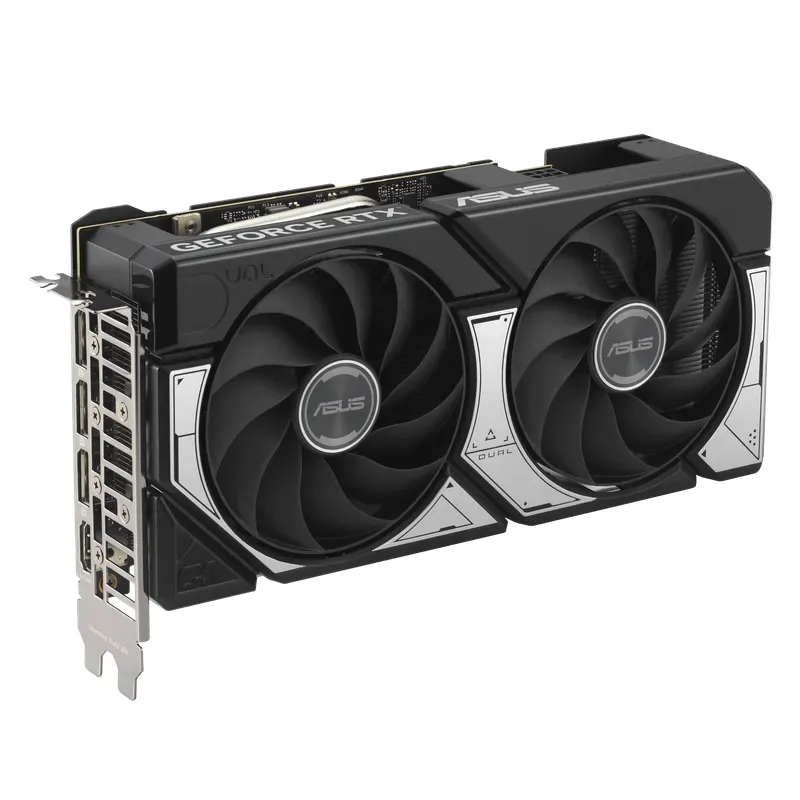
The ASUS Dual RTX 5060 Ti 16GB OC is the more budget-conscious half of this comparison, and its case for existing comes down almost entirely to VRAM. At 16GB, it out-frame-buffers the RTX 5070 by a third, which is enough to matter in a handful of VRAM-hungry titles and texture-mod-heavy setups even though the RTX 5070 wins on raw speed everywhere else.
Its 128-bit memory bus and GB206 die cap how much of that VRAM it can actually put to work — this is a 1080p-to-1440p card, not a card that competes with the RTX 5070 at higher settings or ray tracing loads. The compact dual-fan cooler and 180W TDP make it the easier card to drop into an existing mid-tower or mATX build without a PSU upgrade.
ZOTAC Gaming GeForce RTX 5070 Solid OC 12GB
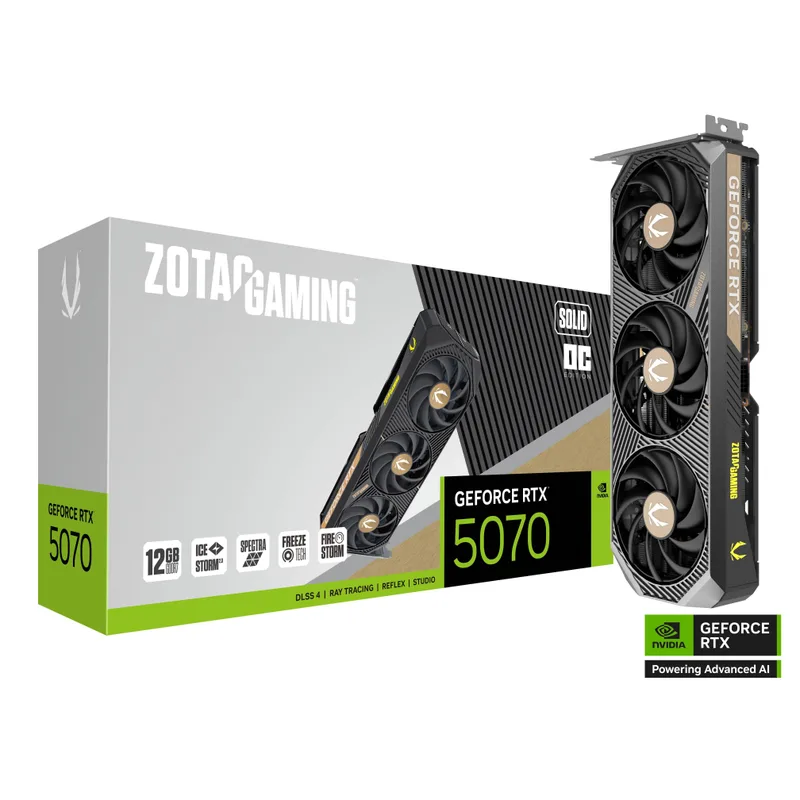
The ZOTAC RTX 5070 Solid OC is the straightforward performance pick. Its GB205 die and 192-bit bus translate into a 30-35% rasterization lead over the RTX 5060 Ti at 1440p, and that lead grows to 40-47% once ray tracing is enabled — the RTX 5070’s fourth-gen RT cores and larger die pull further ahead as scenes get more demanding.
The tradeoff is VRAM headroom relative to its price tier: 12GB is only a modest step up from cards a full tier below it, and in the most texture-heavy modern titles it can become the limiting factor before the GPU core runs out of steam. It also asks for a 650W-class PSU rather than the RTX 5060 Ti’s 600W, worth factoring in if you’re speccing a full build rather than dropping the card into an existing rig.
FAQ
Is the RTX 5070 worth the jump over the RTX 5060 Ti for 1440p gaming? If your budget stretches to it, yes — the RTX 5070 is 30-35% faster in native rasterization at 1440p and pulls further ahead in ray-traced titles, which is a bigger gap than a generational refresh usually delivers.
Does the RTX 5060 Ti’s extra VRAM ever matter more than the RTX 5070’s speed? In specific cases — heavily texture-modded games, some content-creation workloads, or titles that exceed 12GB at max settings — yes. For typical 1440p gaming, the RTX 5070’s compute advantage matters more often than the RTX 5060 Ti’s larger frame buffer.
Can the RTX 5060 Ti handle 4K gaming? Not comfortably at native settings. Both cards are built for 1440p; the RTX 5070 can stretch into entry-level 4K with DLSS 4 upscaling in less demanding titles, but the RTX 5060 Ti is better kept to 1080p-1440p.
Do I need a different PSU for the RTX 5070 versus the RTX 5060 Ti? Likely, if you’re near the recommended minimum already. The RTX 5060 Ti asks for a 600W PSU at 180W TDP, while the RTX 5070’s 250W TDP bumps that to 650W — a real consideration when budgeting a new build.
Does either card support DLSS 4 Multi-Frame Generation? Yes, both support the full DLSS 4 feature set, including Multi-Frame Generation, since they share the same Blackwell architecture generation.
The Bottom Line
For most 1440p builds, the ZOTAC Gaming GeForce RTX 5070 Solid OC is the better buy. Its 30-35% rasterization lead over the RTX 5060 Ti — and a wider 40-47% gap with ray tracing on — is a bigger jump than the tier difference suggests, and it’s the card that will still feel comfortable at 1440p as new titles get heavier. The ASUS Dual GeForce RTX 5060 Ti 16GB OC stays relevant for tighter power budgets, smaller cases, or builds where the extra 4GB of VRAM matters more than the RTX 5070’s speed advantage.