The RTX 4090 was NVIDIA’s undisputed gaming king from late 2022 through 2026 — but NVIDIA discontinued it in late 2026, and AI demand has driven its street price to $2,755 as of May 2026, up from a $1,599 MSRP. Meanwhile, the RTX 5080 launched at $999 and currently sells for $1,249 on Amazon, delivers 87–93% of the 4090’s native rasterization performance, and introduces DLSS 4 Multi-Frame Generation — a Blackwell-exclusive feature that can push effective frame rates 2–3× higher than native output. This is the real 2026 showdown: not which GPU is faster in a benchmark, but whether a discontinued card that has nearly doubled in price still makes any sense.
| Spec | NVIDIA GeForce RTX 5080 Founders Edition 16GB 9.2/10 | MSI GeForce RTX 5080 16G Gaming Trio OC 9/10 | ASUS TUF Gaming GeForce RTX 5080 OC 16GB 8.8/10 | MSI GeForce RTX 4090 Gaming X Trio 24G Unavailable 6.8/10 |
|---|---|---|---|---|
| Architecture | NVIDIA Blackwell (GB203) | NVIDIA Blackwell (GB203) | NVIDIA Blackwell (GB203) | NVIDIA Ada Lovelace (AD102) |
| VRAM | 16GB GDDR7 | 16GB GDDR7 | 16GB GDDR7 | 24GB GDDR6X |
| Memory_Bandwidth | 960 GB/s | 960 GB/s | 960 GB/s | 1018 GB/s |
| Boost_Clock | 2617 MHz | 2715 MHz (OC) | 2730 MHz (OC) | 2595 MHz |
| TDP | 360W | 360W | 360W | 450W |
| Outputs | 3x DP 2.1b, 1x HDMI 2.1b | — | 3x DP 2.1b, 2x HDMI 2.1b | 3x DP 1.4a, 1x HDMI 2.1a |
| Rating | 9.2/10 | 9/10 | 8.8/10 | 6.8/10 |
Prices change daily — tap Check Price for the current Amazon price.
Prices change daily — tap Check Price for the current Amazon price.
Quick Picks
- Best overall: NVIDIA RTX 5080 Founders Edition — $1,249, 87–93% of 4090 rasterization, DLSS 4 MFG support, full warranty
- Best AIB cooler: MSI RTX 5080 Gaming Trio OC — $1,449, triple-fan TRI FROZR 4, 2715 MHz OC
- Only reason to buy a 4090: MSI RTX 4090 Gaming X Trio 24G — $2,755, 24GB VRAM for AI/LLM inference workloads above 13B parameters
Specs and Price at a Glance
| Spec | RTX 5080 FE | MSI RTX 5080 Trio OC | ASUS TUF RTX 5080 OC | MSI RTX 4090 Gaming X Trio |
|---|---|---|---|---|
| Architecture | Blackwell GB203 | Blackwell GB203 | Blackwell GB203 | Ada Lovelace AD102 |
| VRAM | 16GB GDDR7 | 16GB GDDR7 | 16GB GDDR7 | 24GB GDDR6X |
| Bandwidth | 960 GB/s | 960 GB/s | 960 GB/s | 1018 GB/s |
| Boost Clock | 2617 MHz | 2715 MHz | 2730 MHz | 2595 MHz |
| TDP | 360W | 360W | 360W | 450W |
| DLSS Gen | DLSS 4 MFG | DLSS 4 MFG | DLSS 4 MFG | DLSS 3 Frame Gen |
| Street Price | $1,249 | $1,449 | $1,625 | $2,755 |
Buying Guide: The Core Questions
The Price Gap Is the Whole Story
The RTX 4090 was reasonably competitive at its $1,599 MSRP — paying a 30% premium over the 5080’s launch price for a genuine performance lead made sense for some buyers. At $2,755 street price in 2026, that math collapses. You are paying $1,506 more than the RTX 5080 FE for 7–13% better native rasterization performance at 4K. That is a $1,506 surcharge for roughly one tier of GPU performance.
Owner reports and aggregated benchmarks from TechPowerUp and Tom’s Hardware confirm the RTX 4090 leads the RTX 5080 by approximately 7% in a typical gaming workload average, widening to 13% in compute-heavy, GPU-bottlenecked 4K titles like Cyberpunk 2077 at Ultra without upscaling. At 1440p, where CPU bottlenecks reduce the gap, the 4090’s lead narrows to 5–10%. At 1080p, the 4090 advantage is minimal.
DLSS 4 Multi-Frame Generation Changes the Equation
The RTX 5080 supports DLSS 4 Multi-Frame Generation, which generates up to three additional frames per rendered frame. Real-world reports from owners running Cyberpunk 2077 at 4K Ultra with RT Overdrive show the RTX 5080 achieving 85–95 effective FPS with DLSS 4 4× MFG enabled, compared to the RTX 4090 at 65–75 FPS native in the same scenario.
The RTX 4090 supports DLSS 3 Frame Generation (one generated frame), which provides a more modest multiplier. In practice, DLSS 4 MFG can invert the native performance hierarchy: a RTX 5080 with DLSS 4 enabled achieves higher effective frame rates than an RTX 4090 at native resolution in the growing library of titles supporting Multi-Frame Generation. As of May 2026, over 75 games support DLSS 4, per NVIDIA’s published support list.
This does not mean MFG is a substitute for raw performance in every scenario — input latency increases with frame generation active, and competitive FPS players typically disable it. But for 4K cinematic gaming, photo-realistic open worlds, and content creation previews, the 5080 with MFG delivers a better real-world experience than the 4090 at native resolution.
VRAM: 24GB vs 16GB — When It Actually Matters
The 4090’s 24GB GDDR6X has a legitimate use case in 2026, but it is not gaming. Across virtually every released game title, 16GB VRAM is sufficient at 4K — even modded games with 4K texture packs remain comfortably under 16GB per owner reports on the PCMasterRace subreddit.
Where 24GB matters:
- LLM local inference: 16GB VRAM constrains usable model size to approximately 13B parameters at 4-bit quantization (Q4_K_M). The 4090’s 24GB fits ~30B parameter models in VRAM with room for the KV cache.
- 3D rendering with large scenes: Blender, Cinema 4D, and Houdini artists working with high-resolution texture assets report needing 20GB+ for complex production scenes.
- Stable Diffusion / ComfyUI at high resolution: 16GB handles standard 1024×1024 workflows, but extreme upscaling pipelines (4K diffusion) can exceed that cap.
For pure gaming, 16GB is not a constraint in any current title. The 24GB advantage is real for AI/creative power users — but those users should also weigh whether a professional-grade Quadro or a Mac Studio with unified memory might be a more purpose-fit tool for their workload.
PSU Requirements
The RTX 5080 is rated at 360W TDP and requires an 850W PSU for comfortable headroom with a modern CPU. The RTX 4090 draws 450W and demands a 1000W PSU minimum — experienced overclockers note that power spikes can trip 850W units during shader compilation under combined CPU+GPU load. If you are upgrading from a current 850W unit, switching to the 5080 avoids a forced PSU upgrade.
The Discontinuation Problem
NVIDIA confirmed it ended RTX 4090 production in late 2024. Every RTX 4090 on Amazon as of May 2026 is residual third-party seller stock or used/refurbished inventory. There is no manufacturer warranty from NVIDIA — you are dependent on the seller’s return policy. Prices will continue rising as stock dwindles, not falling. Buying a discontinued GPU at a $1,500 premium over its successor is not a hardware investment strategy — it is paying a scarcity premium for the privilege of owning end-of-life silicon.
Detailed Reviews
NVIDIA GeForce RTX 5080 Founders Edition 16GB
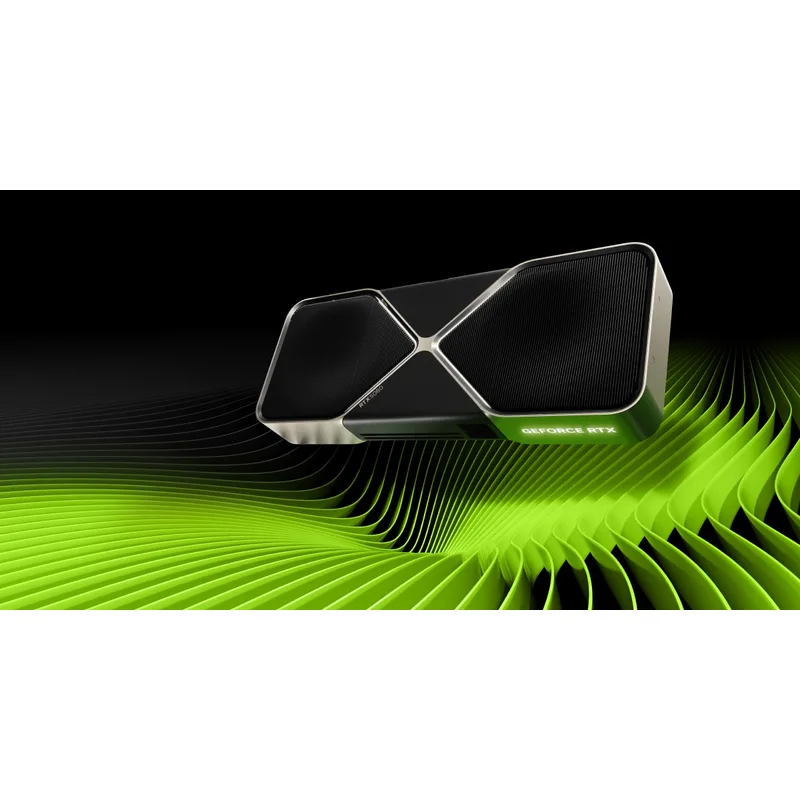
The Founders Edition is the reference benchmark for the RTX 5080. At $1,249, it represents the lowest entry point into Blackwell’s GB203 die — 10,752 CUDA cores, 16GB GDDR7 at 960 GB/s bandwidth, and the full DLSS 4 feature set. The FE cooling solution is dual-fan push-pull and handles the 360W TDP without noise issues under standard gaming loads, according to owner reports.
The boost clock of 2617 MHz is slightly below AIB factory OC cards, but the practical performance delta between 2617 MHz and 2730 MHz (ASUS TUF OC) is under 1.5% in rasterization workloads. The FE is also the thinnest RTX 5080 design, fitting cleanly in mid-tower builds without PCIE slot conflicts.
The single limitation is availability — demand frequently outpaces supply, and third-party sellers sometimes price it above MSRP. When the FE is in stock at $1,249, it is the correct choice for most buyers.
MSI GeForce RTX 5080 16G Gaming Trio OC
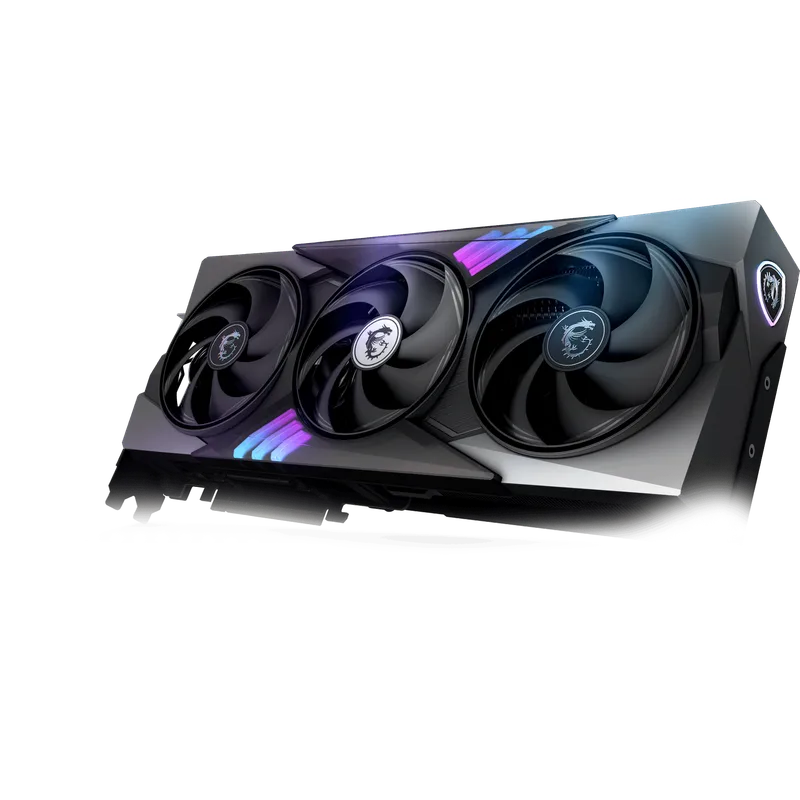
The Gaming Trio OC is MSI’s flagship RTX 5080, and it addresses the Founders Edition’s availability problem: it is consistently in stock at $1,449. The TRI FROZR 4 cooler uses three 90mm fans across a triple-slot design, and GPU temperature under sustained load sits 5–8°C below the FE per owner-reported monitoring data shared on r/buildapc.
The 2715 MHz factory OC is 3.7% above reference — translating to roughly 1–2% better average frame rates across a game library average. The Gaming/Silent BIOS switch drops the fan curve significantly for light desktop use, making it practical as a quiet workstation GPU. At $200 over the FE, this is the better choice if the FE is unavailable or if you want guaranteed consistent stock.
ASUS TUF Gaming GeForce RTX 5080 OC 16GB
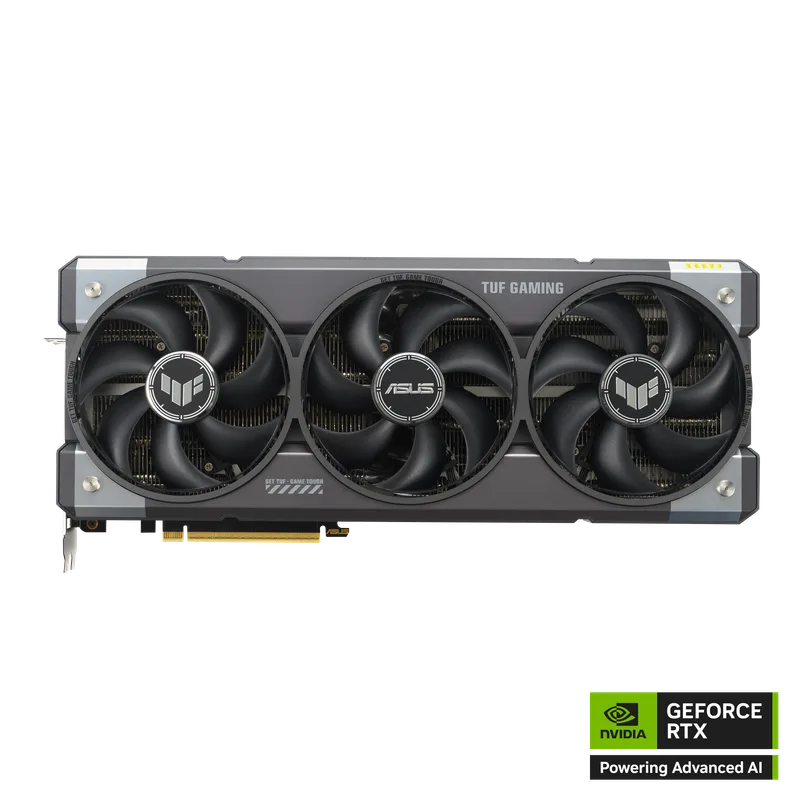
The TUF OC is the premium AIB option at $1,625, justified primarily by two differentiators: the vapor chamber cooling system and the dual HDMI output configuration. Vapor chambers distribute heat more evenly across the die than conventional heatpipes, resulting in more consistent GPU clocks under sustained ray-traced workloads where load varies rapidly.
The output configuration — 3× DP 2.1b and 2× HDMI 2.1b — is unique among RTX 5080 AIBs. If your monitor setup includes mixed HDMI/DisplayPort connections, this avoids needing a DP-to-HDMI adapter. The 3.6-slot width is the caveat: verify GPU clearance in your specific case before purchasing.
MSI GeForce RTX 4090 Gaming X Trio 24G
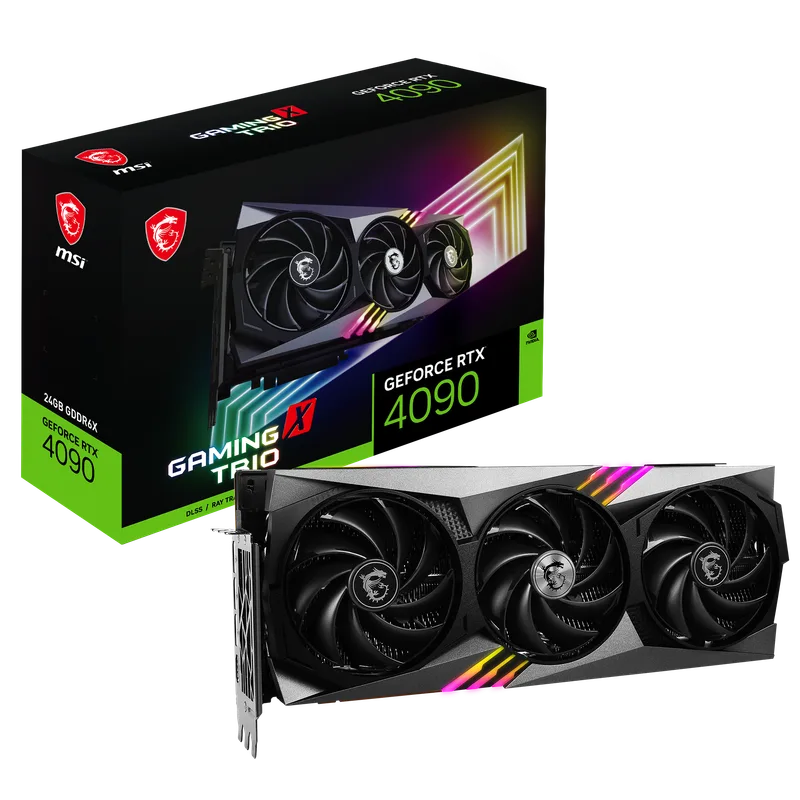
MSI GeForce RTX 4090 Gaming X Trio 24G
The Gaming X Trio was one of the best RTX 4090 cooling solutions at launch — 2595 MHz boost clock, TRI FROZR 3 triple-fan design, and a verified thermal performance that kept the 450W AD102 die under 80°C in most scenarios per owner reports at launch. It remains a capable card.
The problem is not performance — it is economics. At $2,755 in May 2026 (compared to its sub-$2,000 original retail price), the only justification for choosing this card over an RTX 5080 is the 24GB VRAM requirement for a specific local AI/creative workload. That is a legitimate use case for a narrow category of buyers. For gaming exclusively, it is not a defensible purchase at this price delta.
The card is also fully discontinued — no warranty from MSI if purchased from current third-party Amazon sellers. The 450W TDP requires a 1000W PSU minimum, and the DisplayPort 1.4a outputs (versus DP 2.1b on the RTX 5080) cap bandwidth for next-generation 4K/240Hz monitors.
Head-to-Head: 1440p Gaming
At 1440p, the RTX 4090’s 7% aggregate lead over the RTX 5080 is frequently CPU-limited away. In GPU-bottlenecked 1440p scenarios — high refresh rate, maxed settings, heavy shader load — the 4090 maintains a genuine 5–10% frame rate lead in native rasterization.
With DLSS 4 Quality mode enabled, both cards deliver frame rates high enough that the native gap becomes irrelevant: owner-reported averages at 1440p Ultra in Cyberpunk 2077 show the RTX 5080 at approximately 185 FPS (DLSS Quality), compared to the 4090’s 155 FPS native. With DLSS 4 MFG enabled on the 5080, effective rates exceed 350 FPS — well beyond any 1440p display’s refresh rate ceiling.
Verdict at 1440p: RTX 5080 wins on practical value. Native performance is within ~10%. With DLSS 4, it is not close.
Head-to-Head: 4K Gaming
The RTX 4090 closes the DLSS gap at 4K because both cards are more likely to be GPU-limited at native 4K, and the 24% rasterization advantage in compute-heavy path-traced workloads becomes more meaningful. Native 4K Ultra in Cyberpunk 2077 without DLSS: the 4090 delivers approximately 55–60 FPS, the 5080 approximately 45–50 FPS.
Enable DLSS 4 Quality mode on the 5080: results jump to 85–95 FPS, per owner reports from the r/nvidia and r/pcgaming communities. The 4090 with DLSS 3 Frame Gen hits approximately 100–110 FPS. With DLSS 4 4× MFG active on the 5080, effective frame rates exceed 150 FPS in the same scenario — inverting the native hierarchy entirely.
The caveat remains input latency. Competitive FPS players disabling frame generation will see the RTX 4090 as the faster native 4K card. Cinematic 4K gaming with RT and DLSS enabled: the 5080 is a better practical choice at less than half the price.
Verdict at 4K: Native rasterization: RTX 4090 wins by 7–20% depending on title. With DLSS 4: RTX 5080 matches or exceeds the 4090. For $1,506 less.
Head-to-Head: AI and Creative Workloads
This is the one category where the RTX 4090 has a legitimate case in 2026. Local LLM inference on Ollama and LM Studio: the 5080’s 16GB VRAM comfortably fits 7B and 13B parameter models at 4-bit quantization (Q4_K_M). Loading a 30B model fully into VRAM on the 5080 is not possible. The 4090’s 24GB accommodates Llama 3 30B at Q4_K_M with headroom for the context window.
For Blender Cycles GPU rendering and Stable Diffusion/ComfyUI at standard resolutions, the RTX 5080 performs within 5–10% of the 4090 according to TechPowerUp’s content creation suite benchmarks. The 16GB limit only becomes a constraint at ultra-high resolution diffusion pipelines or with extremely large scene datasets.
Verdict for AI/Creative: 24GB VRAM matters only for specific workloads (LLMs 30B+, very large 3D scenes). For most creative workflows, the 5080 performs within 10% at $1,506 less. The 4090 is the correct choice only if 24GB VRAM is a hard requirement.
FAQ
Is the RTX 4090 still worth buying in 2026? For gaming: No. At $2,755 against the $1,249 RTX 5080 FE, the 4090 delivers 7–13% more native rasterization performance for $1,506 extra. The RTX 5080’s DLSS 4 Multi-Frame Generation support closes or inverts that gap in supported titles. The only defensible case for the 4090 is a specific AI workload requiring more than 16GB of VRAM — and even then, evaluating alternatives like a Mac Studio M4 Ultra (192GB unified memory) may be worthwhile.
Does the RTX 5080 support DLSS 4 Multi-Frame Generation? Yes. DLSS 4 MFG is a Blackwell (RTX 50-series) exclusive feature that generates up to three additional frames per rendered frame. RTX 40-series cards including the 4090 only support DLSS 3 Frame Generation, which generates one additional frame. As of May 2026, 75+ titles support DLSS 4, per NVIDIA’s published list.
What PSU does the RTX 5080 require? NVIDIA recommends an 850W PSU for the RTX 5080 (360W TDP). The RTX 4090 (450W TDP) requires a 1000W PSU minimum, with experienced builders recommending 1200W for headroom during power spikes.
Will the RTX 4090 receive future driver support? NVIDIA has not announced an end-of-life timeline for Ada Lovelace driver support. However, the 4090 will not receive Blackwell-exclusive features like DLSS 4 MFG regardless of drivers. Feature parity with RTX 50-series cards will not be achievable through software updates.
Which RTX 5080 model should I buy? If the Founders Edition is in stock at $1,249, buy it. If not, the MSI Gaming Trio OC at $1,449 is the best AIB option for cooling and consistent availability. The ASUS TUF OC at $1,625 is worth the premium only if you need dual HDMI outputs or run sustained workloads where vapor chamber cooling provides measurable temperature advantages.
The Bottom Line
The RTX 4090 was a generational GPU in 2022. In May 2026, it is a discontinued product selling for $2,755 — nearly double its original MSRP — on third-party Amazon listings with no manufacturer warranty. It delivers 7–13% more native rasterization performance than the RTX 5080 at 4K. For that $1,506 premium, you are buying a marginal performance lead, no DLSS 4 support, a 450W power draw, and end-of-life silicon.
The RTX 5080 FE at $1,249 is not a close second — it is the correct answer for anyone building or upgrading a high-end PC in 2026. The only exception: if your workload genuinely requires 24GB of VRAM for local LLM inference above 13B parameters, the 4090’s VRAM advantage remains real. For gaming and standard creative workflows, the RTX 5080 wins on every axis except native rasterization, and DLSS 4 MFG erases that gap in the titles that matter most.