AMD’s 3D V-Cache lineup got crowded fast in 2026 — the 9800X3D, the 9950X3D, the 9850X3D refresh, and even a dual-cache 9950X3D2 have all shipped inside a year, and AMD has now confirmed its next-gen Zen 6 “Olympic Ridge” desktop chips will keep the same AM5 socket. That makes the 9950X3D-vs-9800X3D question more relevant than ever: if you’re building or upgrading on AM5 today, is the sizable price premium and double the core count of the 9950X3D actually worth it over AMD’s reigning gaming champion, or does the 9800X3D still make more sense for most builds?
| Spec | AMD Ryzen 7 9800X3D 9.5/10 | AMD Ryzen 9 9950X3D 9.4/10 |
|---|---|---|
| Architecture | Zen 5, single CCD | Zen 5, dual CCD (one V-Cache, one standard) |
| Cores | 8 cores / 16 threads | 16 cores / 32 threads |
| Clocks | 4.7 GHz base / 5.25 GHz boost | 4.3 GHz base / 5.7 GHz boost |
| Cache | 104MB total (64MB 3D V-Cache) | 128MB total (3D V-Cache on one CCD) |
| Socket | AM5 | AM5 |
| TDP | 120W | 170W |
| Rating | 9.5/10 | 9.4/10 |
Prices change daily — tap Check Price for the current Amazon price.
Prices change daily — tap Check Price for the current Amazon price.
Quick Picks
- Best for most gaming builds: The AMD Ryzen 7 9800X3D trails the 9950X3D by only 3-5% in gaming while running cooler, quieter, and cheaper.
- Best if you also render, encode, or stream heavily: The AMD Ryzen 9 9950X3D turns a gaming PC into a real workstation without giving up gaming performance.
Who Should Upgrade
If your PC’s only job is gaming, the case for the 9950X3D is thin. Independent testing puts the two chips within 3-5% of each other across a broad game library — some titles favor the 9950X3D’s slightly higher clocks and single-core edge, others land closer to a tie, and in a few the 9800X3D actually pulls ahead. That’s a rounding error next to the 9950X3D’s much higher power draw and street price.
The upgrade starts to make sense the moment your workload isn’t just games. If you also edit video, render in Blender, compile large codebases, or run a dedicated encoder while gaming, the 9950X3D’s 16 cores and 32 threads give you real headroom the 9800X3D simply doesn’t have. You get a chip that games like the 9800X3D but doesn’t choke the moment you switch to a heavily threaded task.
Don’t buy the 9950X3D expecting a gaming upgrade — buy it because you need the extra cores for something other than gaming, and don’t want to give up the 9800X3D’s gaming performance to get them.
AMD Ryzen 7 9800X3D
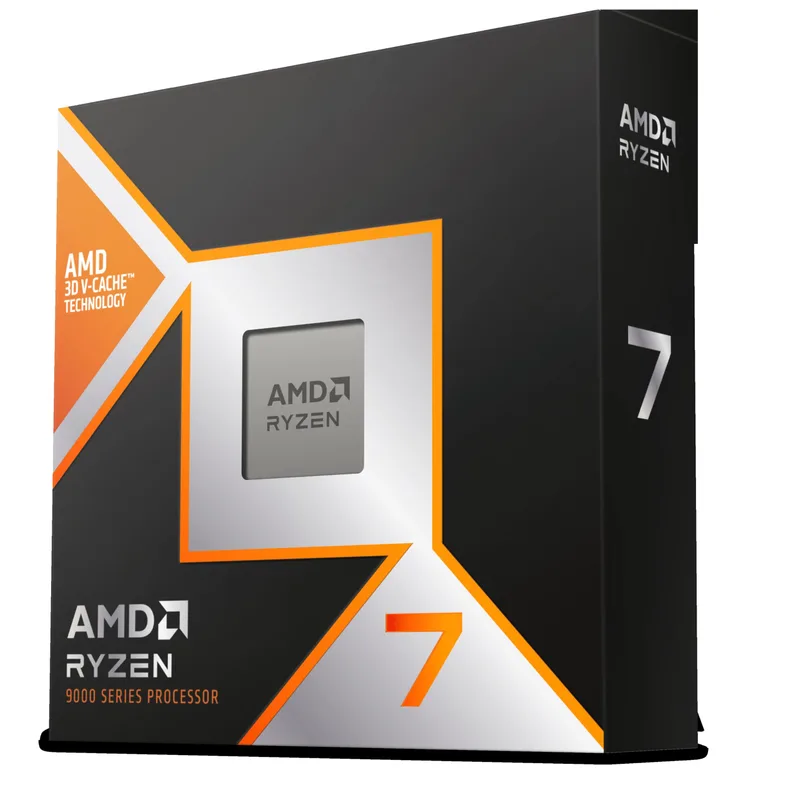
The 9800X3D has been AMD’s gaming flagship since launch, and nothing released since has dislodged it from that role for pure gaming builds. Its single-CCD design puts all 64MB of 3D V-Cache under all 8 cores, which is exactly why it doesn’t suffer the cross-CCD scheduling quirks that show up on AMD’s higher-core-count X3D chips.
Gaming Performance
Across a broad game test suite, the 9800X3D lands within 3-5% of the 9950X3D on average — in some titles it’s essentially tied, and the gap rarely reaches double digits either direction. For a chip with half the cores and a lower price, that’s the whole story: you are not giving up meaningful gaming performance by choosing the cheaper option.
Power and Efficiency
This is where the 9800X3D pulls ahead decisively. Independent power testing shows it averaging 79.4W under gaming load against the 9950X3D’s 120.9W — a 52% difference. Expressed as FPS-per-watt, the 9800X3D hits 2.46 versus the 9950X3D’s 1.61, a 53% efficiency advantage. That translates directly into less heat, less fan noise, and an easier cooler pick.
Platform Notes
The 9800X3D runs on AM5 and needs a B650, X670, or X870-series board. It’s DDR5-only, officially rated at DDR5-5600 with DDR5-6000 achievable via EXPO overclocking on most boards. AMD’s confirmed Zen 6 “Olympic Ridge” desktop launch on AM5 means this socket has a defined upgrade path well past this chip’s lifespan.
AMD Ryzen 9 9950X3D
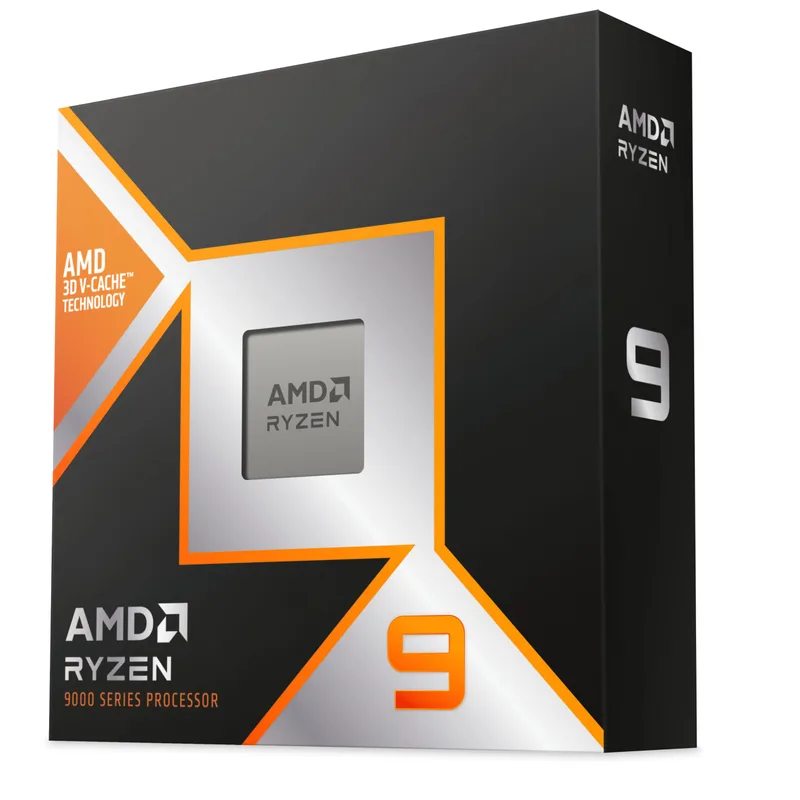
The 9950X3D takes AMD’s 3D V-Cache formula and bolts it onto a 16-core productivity chip. Only one of its two CCDs carries the 3D V-Cache stack — the other runs at higher clocks without it — so Windows’ scheduler has to route cache-sensitive game threads to the right half of the chip. AMD’s newer 9950X3D2 (Dual Edition) addresses that single-CCD limitation by stacking V-Cache on both CCDs, but it launched at a steep premium and reviewers have flagged it as a niche buy rather than a mainstream recommendation.
Gaming and Productivity
In gaming, the 9950X3D essentially ties the 9800X3D, with a slight edge from its 5% single-core clock advantage showing up in a handful of titles. Where it separates itself is multi-threaded work: rendering, encoding, and compiling scale across all 16 cores, territory the 8-core 9800X3D can’t compete in. If your PC does double duty as a gaming rig and a Blender or Premiere workstation, this is the chip that does both without a performance penalty in either direction.
Power and Cooling
The tradeoff for those extra cores is power. The 9950X3D draws 120.9W under gaming load — 52% more than the 9800X3D — and that climbs further under sustained all-core productivity workloads. A 280mm AIO is the practical minimum; a 360mm AIO or a high-end tower cooler gives more thermal headroom for long render jobs.
Platform Notes
Same AM5 socket, same DDR5 requirement, same forward path to Zen 6 “Olympic Ridge” chips. The 9950X3D has also been showing up scarce in stock at retail recently, so availability is worth checking before committing to it over the readily-stocked 9800X3D.
FAQ
Is the AMD Ryzen 9 9950X3D worth it over the 9800X3D for gaming only? Not really. The gap is 3-5% in most titles, which won’t be noticeable during actual play. The 9950X3D’s premium buys you extra cores, not extra frames.
Does the 9950X3D run hotter than the 9800X3D? Yes. It draws roughly 52% more power under gaming load and more still under sustained multi-threaded work, so it needs a larger cooler to stay quiet and avoid thermal throttling.
Can I put the 9800X3D and 9950X3D in the same motherboard? Yes — both are AM5 chips and will run in any B650, X670, or X870-series board with a current BIOS. No platform change is required either direction.
Will Zen 6 make either of these chips obsolete soon? AMD has confirmed its next Zen 6 “Olympic Ridge” desktop CPUs will also use the AM5 socket, so neither chip becomes a dead-end platform. Zen 6 will simply slot into the same boards when it arrives.
What about the 9950X3D2 (Dual Edition)? It stacks 3D V-Cache on both CCDs instead of one, fixing the 9950X3D’s single-CCD scheduling quirk. It launched at a significant premium over the standard 9950X3D, and early reviews have called it a hard sell outside of niche workloads — most buyers are better served by the standard 9950X3D or the 9800X3D.
The Bottom Line
For most gamers, the AMD Ryzen 7 9800X3D is still the smarter buy. It trails the 9950X3D by only 3-5% in games while drawing roughly half the power and costing meaningfully less. The AMD Ryzen 9 9950X3D only earns its premium if your PC also handles heavy multi-threaded work — rendering, encoding, or compiling — where its extra 8 cores do real work the 9800X3D can’t match, without sacrificing the gaming performance you’d otherwise be trading away.