The Zen 5 mid-range has been overshadowed in 2026 by the X3D chips, but AMD confirmed its next-generation Zen 6 desktop processors will stay on the AM5 socket, which means a Ryzen 5 9600X or Ryzen 7 9700X bought today sits on a board with a defined upgrade path. That makes the cheaper-versus-faster question a platform decision as much as a CPU one. Aggregated gaming comparisons put the two chips about 1% apart across 100+ games, so the real question is whether you need the 9700X’s two extra cores for anything besides frame rate.
| Spec | AMD Ryzen 5 9600X 8.6/10 | AMD Ryzen 7 9700X 8.3/10 |
|---|---|---|
| Architecture | Zen 5, single CCD | Zen 5, single CCD |
| Cores | 6 cores / 12 threads | 8 cores / 16 threads |
| Clocks | 3.9 GHz base / 5.4 GHz boost | 3.8 GHz base / 5.5 GHz boost |
| Cache | 38MB total (32MB L3 + 6MB L2) | 40MB total (32MB L3 + 8MB L2) |
| TDP | 65W | 65W |
| Socket | AM5 | AM5 |
| Rating | 8.6/10 | 8.3/10 |
Prices change daily — tap Check Price for the current Amazon price.
Prices change daily — tap Check Price for the current Amazon price.
Quick Picks
- Best for most gaming builds: the Ryzen 5 9600X. Same 32MB L3 cache, same 65W TDP and a gaming result within about 1% of its bigger sibling.
- Best if you stream, edit or compile on the same machine: the Ryzen 7 9700X. Eight cores and 16 threads are the reason to pay extra, not the frame rate.
What Actually Differs
Both chips are Zen 5 parts on a single compute die, both are rated at 65W and both use the AM5 socket with DDR5 memory. The spec sheet differences are narrow: the 9700X has 8 cores and 16 threads against the 9600X’s 6 and 12, a 5.5 GHz boost clock against 5.4 GHz, and 8MB of L2 cache against 6MB. The 32MB L3 pool is identical.
That last point explains the gaming result. Games lean on L3 cache and per-core speed far more than core count, and on those two measures the chips are nearly equal. Once a game is GPU-bound, which is the usual case at 1440p and 4K with a mid-range or better graphics card, neither CPU is the limit.
Where the extra cores show is in work that scales across threads: Blender renders, video encoding, software compiles, and running a game alongside a streaming encoder, browser tabs and voice chat. For deeper per-chip numbers see our Ryzen 7 9700X review and Ryzen 5 9600X review.
Buying Guide: Choosing Between Them
Pick on workload, not on benchmark averages. If the PC is for gaming and general use, the 9600X leaves budget for the part that does move frame rates: the graphics card. Putting the difference toward a faster GPU raises FPS far more than two extra CPU cores will.
Consider the 9700X for mixed use. Streaming from the same PC, editing video on weekends or running virtual machines are the cases where 12 threads start to feel tight and 16 do not.
Consider neither if you want maximum gaming speed. The Ryzen 7 9800X3D with 3D V-Cache is a different class for cache-sensitive games. See our best CPUs for gaming roundup for the full ladder.
Cooling and boards. Neither chip ships with a cooler, so budget for an air cooler from our best budget air CPU coolers list. Any B650, X670 or X870 board works; our budget AM5 motherboards guide covers cheap options, and best motherboards for the Ryzen 7 9700X covers higher-end pairings. Both need DDR5, which remains expensive through the 2026 memory shortage, so the platform cost is dominated by RAM rather than the CPU gap.
AMD Ryzen 5 9600X
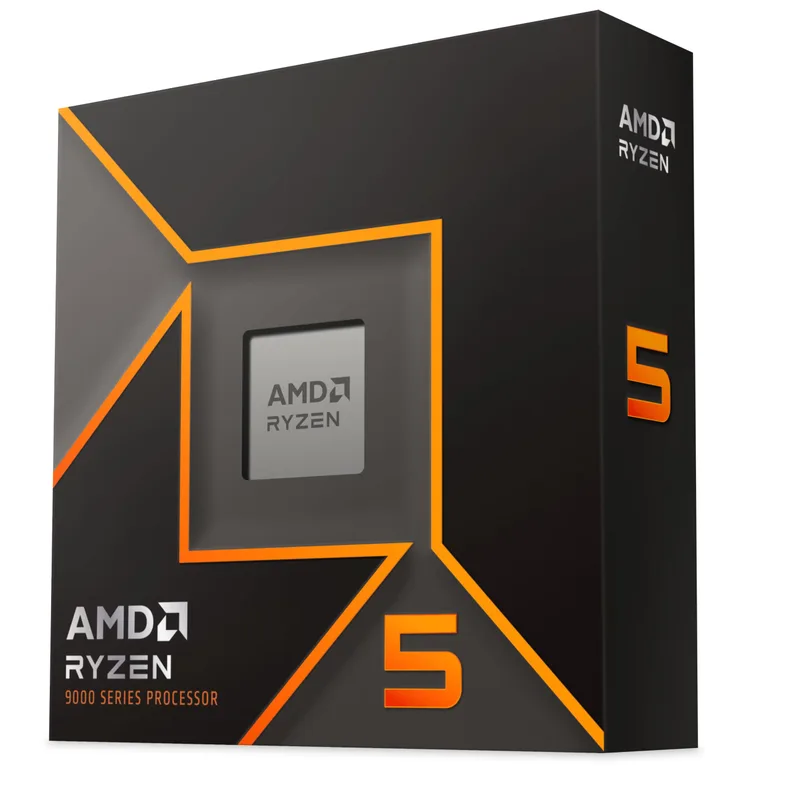
The 9600X is the chip to buy if the machine is mostly for games. It matches the 9700X on L3 cache and TDP, and gaming comparisons across a large game library show the two within about 1% of each other on average. At 1440p and 4K that gap shrinks further because the GPU, not the CPU, sets the frame rate.
Six cores and 12 threads is enough for current games, including titles that run a handful of heavy threads, plus light background apps. It starts to feel limited if you add a 1080p stream encode or heavy multitasking on top. Because the 65W rating keeps heat modest, a basic tower cooler is a reasonable match, and the saved money goes further on a better GPU.
AMD Ryzen 7 9700X
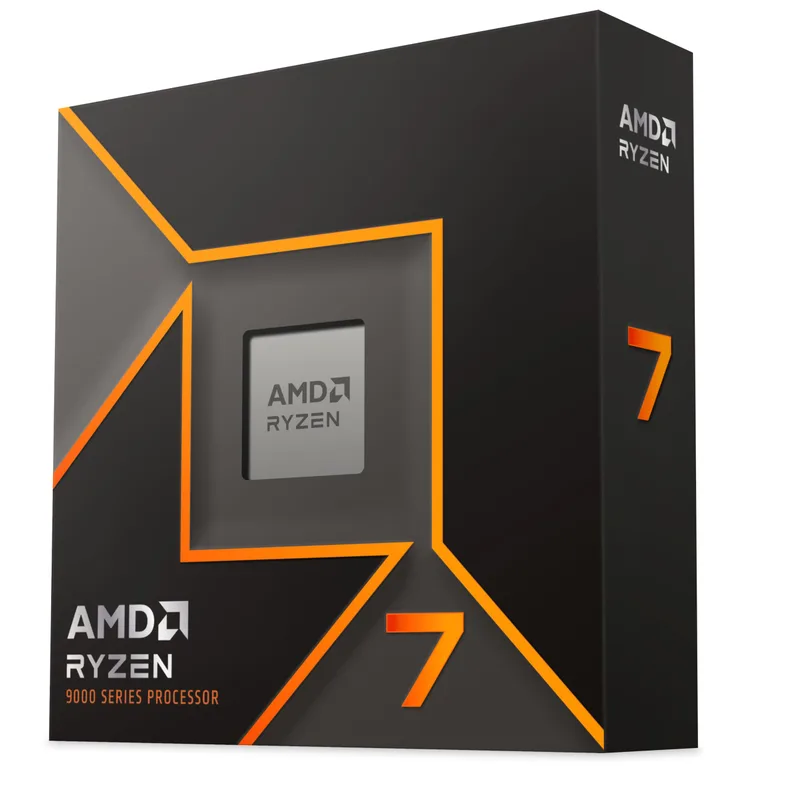
The 9700X earns its slot on thread count. Eight cores and 16 threads give more headroom for Blender, DaVinci Resolve exports and compile jobs, and for gaming with capture software running. Its 5.5 GHz boost and larger L2 also give it a small edge in lightly threaded work.
It is not a gaming upgrade in any meaningful sense, and owners who bought it purely for frame rates have little to show for the premium. If gaming is the only goal, a step up to an X3D chip delivers more than a step from the 9600X to the 9700X. For multitasking builds it remains a sensible, efficient 65W pick that does not demand a big cooler.
FAQ
Is the Ryzen 7 9700X worth it over the Ryzen 5 9600X for gaming?
Usually not. Aggregated comparisons across 100+ games put the 9700X about 1% ahead, which is below what you can notice during play. The price difference is better spent on the graphics card.
Do the 9700X and 9600X use the same motherboard?
Yes. Both are AM5 chips and work in any B650, X670 or X870 board with a current BIOS. They also both require DDR5 memory.
Do either of these CPUs come with a cooler?
No. Both ship without a cooler, so you need to buy one. A mid-range tower air cooler is enough for either chip at their 65W rating.
Is six cores enough for gaming in 2026?
For gaming alone, yes. The 9600X’s six cores and 32MB of L3 cache keep it within about 1% of the eight-core 9700X on average. Heavier multitasking is where eight cores begin to matter.
Should I wait for Zen 6?
AMD has confirmed Zen 6 desktop chips will use the AM5 socket, so buying a board and DDR5 now does not lock you out. You can start with a 9600X and drop in a newer chip on the same board later.
The Bottom Line
The Ryzen 5 9600X is the better buy for most people. It tracks the 9700X within about 1% in games, shares its 32MB L3 cache and 65W rating, and frees up budget for a faster GPU. The Ryzen 7 9700X is worth the extra money only if your PC also streams, renders, encodes or compiles, where its eight cores and 16 threads do real work the 9600X cannot match.