ASUS launched the ROG Swift OLED PG32UCDM Gen 3 at CES 2026 and unveiled a new Tandem WOLED model this summer — but the PG27AQDM, its 27-inch 240Hz WOLED, has remained on sale unchanged since its 2023 debut. Now priced at $799 while 360Hz and 480Hz OLED alternatives have arrived at $699, the PG27AQDM faces its toughest market yet. It’s still an exceptional display — but “exceptional” is no longer enough to justify the premium.
| Spec | ASUS ROG Swift OLED PG27AQDM Unavailable 8.2/10 | Alienware AW2725DF 9/10 | LG UltraGear 27GX790A-B Unavailable 8.8/10 |
|---|---|---|---|
| panel | 27-inch WOLED (W-OLED) | 27-inch QD-OLED (Samsung) | 27-inch WOLED (W-OLED) |
| resolution | 2560×1440 (QHD) | 2560×1440 (QHD) | 2560×1440 (QHD) |
| refresh_rate | 240Hz (DP 1.4 with DSC) | 360Hz | 480Hz |
| response_time | 0.03ms GtG | 0.03ms GtG | 0.03ms GtG |
| color_gamut | 99% DCI-P3, True 10-bit | 99.3% DCI-P3 | 98.5% DCI-P3 |
| connectivity | 1× DP 1.4, 2× HDMI 2.0, 4× USB 3.2 Gen 1 | 2× DP 1.4, 1× HDMI 2.0, 1× USB-C, 4× USB 3.2 Gen 1 | 1× DP 2.1, 2× HDMI 2.1, 4× USB 3.0 |
| Rating | 8.2/10 | 9/10 | 8.8/10 |
Prices change daily — tap Check Price for the current Amazon price.
Prices change daily — tap Check Price for the current Amazon price.
Our Verdict
The ASUS ROG Swift OLED PG27AQDM is one of the best-built 27-inch gaming monitors available, with a WOLED panel that produces richer blacks and more accurate color than any IPS or VA panel at any price. The problem is 2026 pricing. The Alienware AW2725DF delivers 360Hz QD-OLED for $699. The LG 27GX790A-B delivers 480Hz WOLED — the same panel family as the ASUS — also at $699. Paying $799 for 240Hz on hardware that has been superseded at lower prices requires a specific set of preferences: ROG brand loyalty, the micro-texture anti-glare coating, or finding the PG27AQDM on sale below $700.
Score: 8.2/10 — Excellent display, weakening value.
Who This Monitor Is For
The PG27AQDM still makes sense for three types of buyers:
- Content creators and HDR enthusiasts — 99% DCI-P3 true 10-bit with DisplayHDR True Black 400 at this price point is still correct for color-accurate work. QD-OLED panels have slightly different color volume characteristics that some creators prefer to avoid.
- Buyers who prioritize glare reduction — ASUS’s Anti-Glare Micro-Texture Coating is measurably better at eliminating specular reflections than the glossy surfaces on the Alienware and LG competitors. In office or mixed-lighting setups, this is not a minor point.
- ROG ecosystem users — ASUS OLED Protection with its automated pixel refresh cycles and 3-year warranty coverage is the most comprehensive burn-in mitigation in this category, and it’s baked into the ROG software stack.
If none of those apply to you, the AW2725DF at $699 is the smarter buy.
Panel Quality: Where the PG27AQDM Still Leads
The WOLED panel in the PG27AQDM produces per-pixel light output — each pixel generates its own light and shuts off completely when displaying black. The result is an infinite contrast ratio in practice: in a dark room with a black background, the monitor appears off. No blooming, no IPS glow, no VA ghosting.
Color coverage reaches 99% DCI-P3 with true 10-bit depth and no dithering. Color accuracy out of the box (Delta E under 2 across the P3 gamut) makes it usable for photo editing without calibration hardware, though the 27-inch size limits its appeal for serious print work.
The Anti-Glare Micro-Texture Coating deserves more attention than it typically gets in monitor reviews. Standard OLED panels use glossy or semi-glossy coatings that reflect room lighting as distinct specular highlights — the monitor surface becomes a mirror in bright rooms. ASUS’s micro-texture approach scatters reflected light diffusely, eliminating the hard specular reflection without adding the color desaturation of traditional matte coatings. In side-by-side comparisons with the AW2725DF (which uses a glossy coating), the PG27AQDM is noticeably more usable near windows.
Peak brightness in SDR tops out at approximately 250 nits full-screen. This is a WOLED limitation shared with the LG 27GX790A-B, not an ASUS-specific problem. QD-OLED panels like the AW2725DF reach ~450 nits in small highlight windows, which produces more impactful HDR in well-lit spaces. For dark-room gaming, the brightness difference is irrelevant — both technologies hit 0.0 nits in black areas.
Motion Clarity at 240Hz
The 0.03ms pixel response means that motion artifacts — trailing, overshoot, smearing — don’t exist at any refresh rate setting. At 240Hz, every frame renders and displays cleanly. There are no persistence-based motion blur issues of the kind that plague LCD panels even at 360Hz.
The question in 2026 is whether 240Hz is enough. Competitive gaming in CS2 and Valorant at 300+ fps makes 240Hz feel like a ceiling. At 240fps, the PG27AQDM is smooth. At 280fps, frames start getting dropped. At 320fps — which a high-end system produces easily in these titles — you’re leaving motion clarity on the table that the AW2725DF (360Hz) and LG 27GX790A-B (480Hz) would capture.
For single-player games, 240Hz is more than sufficient. AAA titles rarely exceed 120-144fps at QHD on current hardware. The 240Hz gap only materializes in competitive titles where frames-per-second outpaces the display ceiling.
Connectivity: The Weakest Link in 2026
The PG27AQDM’s rear I/O panel shows its 2023 origins. One DisplayPort 1.4 (using DSC compression to hit 240Hz at 1440p), two HDMI 2.0 ports, and four USB 3.2 Gen 1 downstream ports. No USB-C. No HDMI 2.1.
The HDMI 2.0 limitation is the most consequential. A PlayStation 5 or Xbox Series X connected via HDMI 2.0 tops out at 1440p@120Hz — not 240Hz. Console users considering this monitor for cross-device setups will find the second HDMI port is essentially the same as the first, both capped at 120Hz for 1440p input.
The LG 27GX790A-B includes HDMI 2.1 (two ports) and DisplayPort 2.1, supporting 1440p at 480Hz without DSC. The AW2725DF adds USB-C for laptop connectivity and two DisplayPort 1.4 outputs. Neither of these connectivity advantages are dealbreakers for dedicated PC gamers who run a single cable from GPU to monitor — but they matter for hybrid setups.
Design and Build
ROG hardware has a consistent aesthetic: dark brushed metal, red accents, and an adjustable stand that covers the full range of ergonomic positioning. The PG27AQDM’s stand supports height adjustment, tilt, swivel, and pivot (90° portrait mode for vertical content or coding).
The rear of the panel includes ROG OLED Protection hardware and software. Pixel Refresh runs a cleaning cycle when the monitor is idle. Pixel Cleaning performs a deeper maintenance cycle on demand. Pixel shift moves the image microscopically to prevent static element burn-in. Compared to the Alienware AW2725DF’s manual-only approach, the automated maintenance in the ROG stack is meaningfully more convenient for users who leave static HUDs or overlays on screen for hours.
Build quality is excellent. The PG27AQDM feels substantially constructed — the stand is rigid, the panel has no flex, and the bezels are thin enough on three sides to be unobtrusive. This is $799 build quality that matches the asking price.
Value in August 2026
Three years after launch, the PG27AQDM’s market position has changed. At launch in 2023, it was the best 27-inch OLED available. No viable alternatives existed at the same price point.
By August 2026:
- Alienware AW2725DF (360Hz QD-OLED): $699 — 50% faster refresh rate, QD-OLED’s brightness advantage, same 0.03ms response, $100 less
- LG UltraGear 27GX790A-B (480Hz WOLED): $699 — double the refresh rate on the same WOLED panel family, DP 2.1 and HDMI 2.1, $100 less
The PG27AQDM is not a bad monitor. It remains an excellent monitor. The issue is that the price-to-performance ratio has inverted relative to 2023. Buyers who find the PG27AQDM at $649 or less are getting a strong deal. At $799, the alternatives are harder to argue against.
Detailed Reviews
ASUS ROG Swift OLED PG27AQDM
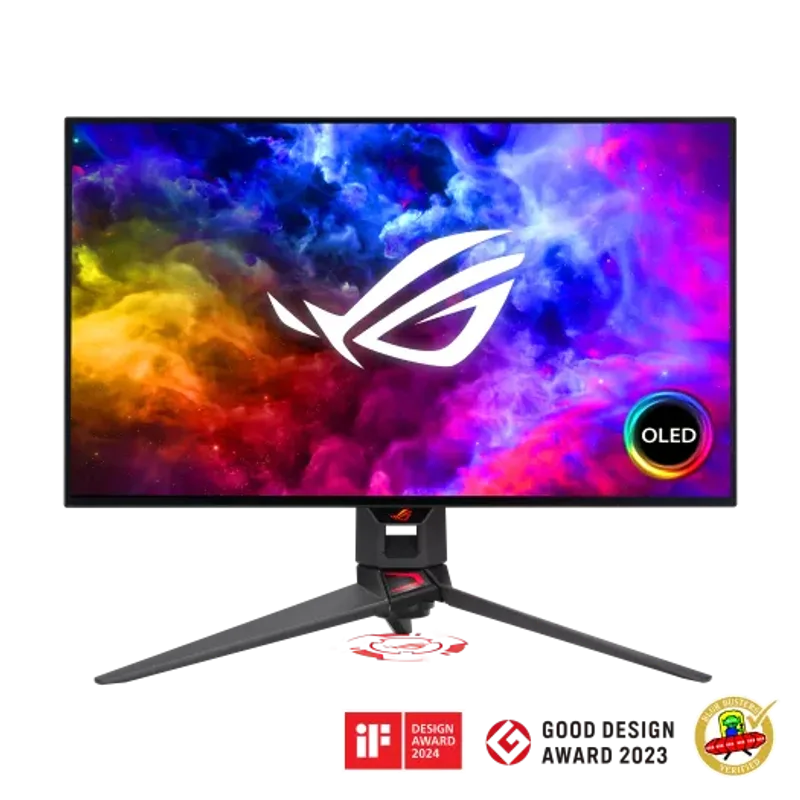
ASUS ROG Swift OLED PG27AQDM
The PG27AQDM remains the choice for buyers who want the anti-glare micro-texture coating, the ASUS OLED Protection ecosystem, and true 10-bit 99% DCI-P3 color in a 27-inch form factor. Its 240Hz ceiling and dated connectivity keep it from scoring higher in August 2026, but the underlying display quality hasn’t aged.
Look for it at $699 or below — at that price, the value calculation improves significantly. At $799, the AW2725DF is the more rational buy for most users.
Alienware AW2725DF
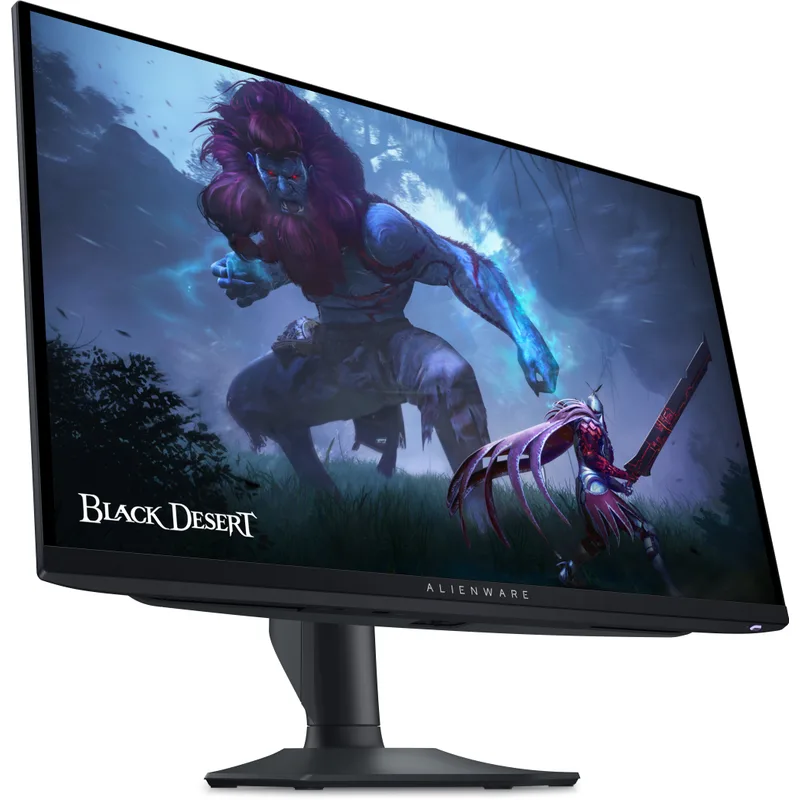
The Alienware AW2725DF is the superior all-around monitor for most PC gamers at the $699 price point. The Samsung QD-OLED panel’s 360Hz refresh rate captures competitive fps headroom that the ASUS cannot, and the peak brightness advantage in HDR makes QD-OLED the better choice for content that benefits from bright highlights.
The glossy coating is a genuine tradeoff — in offices or bright environments, the AW2725DF is noticeably harder to place than the PG27AQDM. For dedicated gaming rooms, this is a non-issue.
Dell’s 3-year Advanced Exchange warranty (in-home next-day replacement) is the best service offering in this category, beating ASUS’s standard 3-year on the PG27AQDM.
Read our full Alienware AW2725DF review for the complete spec breakdown and gaming performance analysis.
LG UltraGear 27GX790A-B
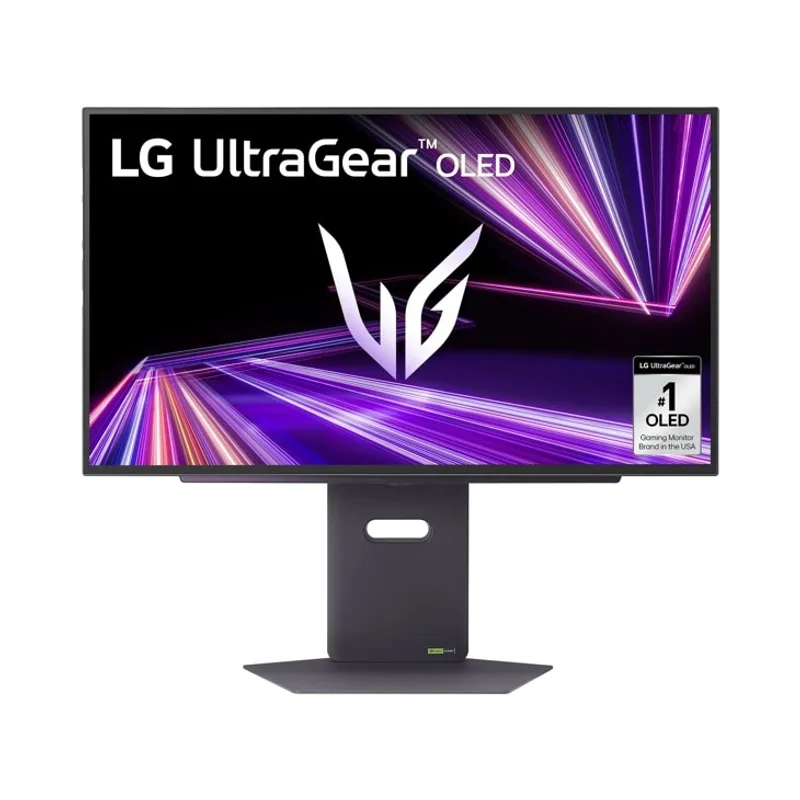
LG UltraGear 27GX790A-B
The LG UltraGear 27GX790A-B is the most spec-forward option at $699. 480Hz WOLED — double the PG27AQDM’s refresh rate on the same panel technology — with DisplayPort 2.1 and HDMI 2.1 connectivity that both competitors lack. If maximum motion clarity at 1440p is the priority, the 27GX790A-B is the correct answer.
The tradeoffs are subtle but real. LG’s WOLED panel sits at the same ~250-275 nits full-screen SDR peak as the ASUS — neither matches QD-OLED’s brightness in highlight areas. And the FreeSync flickering issue acknowledged by LG affects some GPU/driver combinations, requiring a specific menu setting that reduces VRR range as a workaround.
For competitive gamers running CS2 or Valorant at 400+ fps, the LG is the correct purchase at this price point.
FAQ
Is the ASUS ROG Swift OLED PG27AQDM still worth buying in 2026?
At $799 full price, it’s hard to recommend over the Alienware AW2725DF or LG 27GX790A-B, both of which are faster and $100 cheaper. If you find it at $649 or below — or specifically want the micro-texture anti-glare coating and ASUS OLED Protection — it’s still an excellent display.
What’s the difference between WOLED and QD-OLED?
WOLED uses a white OLED subpixel emitter with RGB color filters — it’s the same technology as LG OLED TVs. QD-OLED (used by the AW2725DF) uses blue OLED with quantum dot color conversion for red and green. QD-OLED achieves higher peak brightness in small highlight windows (~450 nits vs ~250 nits). WOLED tends to have more accurate color out of the box, while QD-OLED is more impactful for HDR in bright rooms.
Does the PG27AQDM have HDMI 2.1?
No. The PG27AQDM includes two HDMI 2.0 ports, capping console input at 1440p@120Hz. PlayStation 5 and Xbox Series X users won’t get 240Hz via HDMI. The LG 27GX790A-B includes two HDMI 2.1 ports for full-bandwidth console connectivity.
Will the PG27AQDM burn in with regular gaming use?
OLED burn-in from gaming is rare with normal use patterns (varied content, reasonable brightness, auto-sleep enabled). ASUS OLED Protection’s automated Pixel Refresh cycles and pixel shift reduce static HUD risk. Leaving a bright static HUD for 8+ hours daily over years is the actual risk scenario, not regular gaming sessions.
What GPU do you need to run 240Hz at 1440p?
Any GPU capable of 240+ fps in your target title will saturate the PG27AQDM’s refresh rate. In competitive titles like CS2 and Valorant, an RTX 5070 or RX 9070 XT reaches this at 1440p on medium settings. In AAA titles at max settings, 240fps at 1440p requires higher-end hardware — expect 120-165fps from mid-range cards in demanding games.
The Bottom Line
The ASUS ROG Swift OLED PG27AQDM is a three-year-old flagship that still performs like one in display quality and build — but the value calculus has shifted against it. At $799, it’s $100 more expensive than both the Alienware AW2725DF (360Hz QD-OLED) and the LG UltraGear 27GX790A-B (480Hz WOLED), both of which deliver faster refresh rates and modern connectivity. If you prioritize anti-glare coatings, OLED burn-in protection, or strict color accuracy, the PG27AQDM remains the correct choice. For everyone else, the AW2725DF is the sharper buy at $699.