The Corsair RM1000x has become the default 1000W recommendation for RTX 5080 and RTX 5090 builds in 2026. At $160 with ATX 3.1 compliance, a native 12V-2x6 connector, and a 140mm FDB fan running silent below 420W, it covers the high-end build market with minimal compromise. This review compares it directly against the four main alternatives competing at this wattage in 2026: the value-focused MSI MAG A1000GL, the premium ASUS ROG Strix Platinum, the silent-first be quiet! Straight Power 12, and the warranty-leader Seasonic Focus GX-1000.
| Spec | Corsair RM1000x ATX 3.1 9.2/10 | MSI MAG A1000GL PCIE5 Unavailable 8.6/10 | ASUS ROG Strix 1000W Platinum 9.1/10 | be quiet! Straight Power 12 1000W Unavailable 8.7/10 | Seasonic Focus GX-1000 ATX 3.1 9/10 |
|---|---|---|---|---|---|
| wattage | 1000W | 1000W | 1000W | 1000W | 1000W |
| efficiency | Cybenetics Gold (~90% at 50% load) | 80+ Gold | Cybenetics Lambda A+ (~92–93% at 50% load) | 80+ Platinum (~93.9% peak) | Cybenetics Gold (~91% at 50% load) |
| standard | ATX 3.1 / PCIe 5.1 | ATX 3.1 / PCIe 5.1 | ATX 3.1 / PCIe 5.1 | ATX 3.0 / PCIe 5.0 | ATX 3.1 / PCIe 5.1 |
| connector | Native 12V-2x6 | Native Dual-Color 12V-2x6 | Native 12V-2x6 | Native 12V-2x6 + 4x PCIe 6+2 pin | Native 12V-2x6 |
| fan | 140mm FDB fan, Zero RPM mode | 135mm fan | GaN MOSFET, GPU-First IVS circuit | 135mm Silent Wings fan | 120mm FDB fan, Fanless mode below 30% load |
| warranty | 7 years | 10 years | 10 years | 5 years | 10 years |
| Rating | 9.2/10 | 8.6/10 | 9.1/10 | 8.7/10 | 9/10 |
Prices change daily — tap Check Price for the current Amazon price.
Prices change daily — tap Check Price for the current Amazon price.
Quick Picks
- Best overall 1000W PSU: Corsair RM1000x ATX 3.1 — $160 gets you ATX 3.1 compliance, native 12V-2x6, zero-RPM fan mode, and proven RM platform reliability. The right choice for most RTX 5080 builds.
- Best budget 1000W: MSI MAG A1000GL PCIE5 — $10 cheaper than the RM1000x with a 10-year warranty and ATX 3.1 support. The strongest value play if price is the priority.
- Best for RTX 5090 builds: ASUS ROG Strix 1000W Platinum — GaN topology, GPU-First IVS circuit, and Cybenetics Lambda A+ noise make it the only purpose-built PSU for Blackwell’s 575W transient peaks.
Who Needs a 1000W PSU in 2026?
The GPU power draw situation has shifted significantly with the RTX 50 and RX 9000 series. Here’s the math that dictates wattage selection:
- RTX 5080 build (360W TDP) + Ryzen 9800X3D (120W TDP) + storage/cooling = ~530W sustained. 850W is sufficient, 1000W provides 470W headroom.
- RTX 5090 build (575W TDP) + Ryzen 9950X (170W TDP) + peripherals = ~800W sustained. 1000W is the minimum — 1200W or 1600W units are safer for heavy overclocking.
- Dual GPU or HEDT workstation: 1000W is a reasonable starting point, not the ceiling.
If you’re running an RTX 5070 Ti or below with a mid-range CPU, an 850W ATX 3.1 unit like the Corsair RM850x at $130 is the better choice — no point paying a $30 premium for wattage you won’t use.
Why ATX 3.1 Matters
ATX 3.1 raised the transient load headroom requirement to 3x the PSU’s rated wattage for 100µs bursts. A 1000W ATX 3.1 unit must handle 3000W peak transient spikes without rail collapse. On a 1000W ATX 3.0 unit, that same spike can trigger over-current protection and shut down the system mid-session — which is exactly what happened with early RTX 4090 adapter fires. All five PSUs in this review use native 12V-2x6 connectors except the be quiet! Straight Power 12, which is ATX 3.0 with PCIe 5.0 compliance — an important distinction for RTX 5090 owners.
Corsair RM1000x: The Main Review
Design and Build Quality
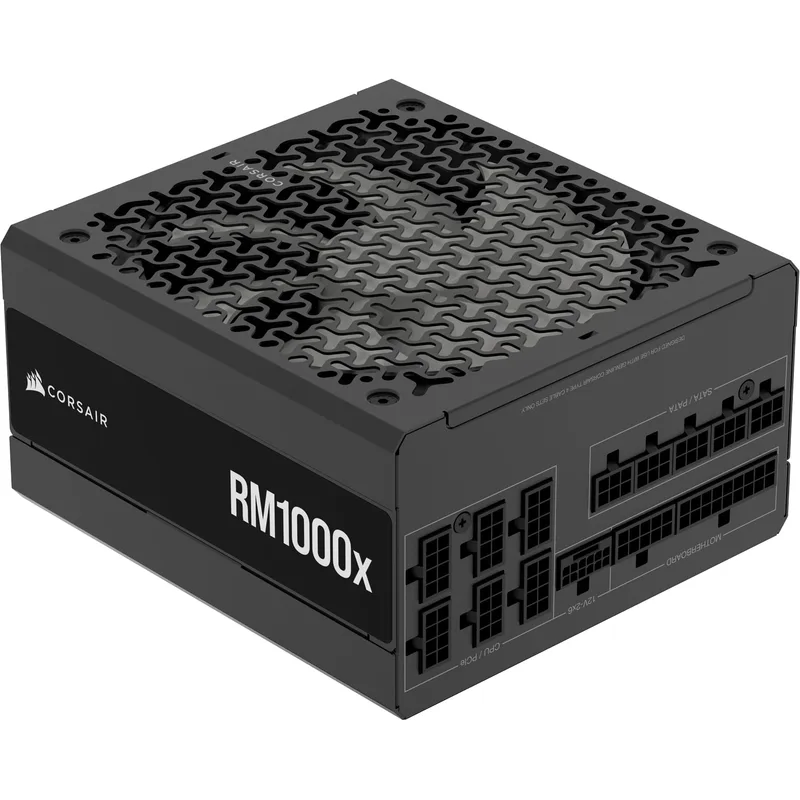
The RM1000x (2025 revision) uses a 140mm fluid dynamic bearing fan mounted in a 150mm × 86mm × 160mm chassis — standard ATX depth. The Zero RPM mode keeps the fan completely off below approximately 42% load (~420W), which covers desktop use, web browsing, and light gaming. Under full load, the fan ramps gradually rather than spiking abruptly, staying below 30dB(A) at 80% load according to Funky Kit’s review measurements.
The modular cable complement includes one 24-pin ATX, two EPS 4+4 pin CPU connectors, two 12V-2x6 connectors (native, not adapted), and six SATA/peripheral cables. The 12V-2x6 cables are 600mm long — long enough for full-tower builds without extension cables.
Internal components are 100% Japanese 105°C-rated capacitors on the primary side, sourced from the same manufacturing chain as Corsair’s HX-series. The platform is Cybenetics Gold-certified, meaning independent third-party testing confirmed efficiency above 87% at 10% load, 90% at 50% load, and 87% at full load.
Voltage Regulation
Based on Funky Kit and OC3D review data, the RM1000x holds +12V within 0.6% deviation at full load — not quite the 0.4% of the ROG Strix Platinum, but tighter than most competing Gold units. The +5V and +3.3V minor rails stay within 1% across the load range, which matters for USB device stability and NVMe SSD power delivery.
Transient load testing is where ATX 3.1 compliance is validated — the RM1000x passed 100µs, 1ms, and 10ms transient spike tests at 3× rated load in Corsair’s internal certification process. Owner reports across thousands of Amazon and Newegg reviews show no reported shutdowns or OCP trips with RTX 5080 and RTX 5090 builds.
Noise Profile
At 50% load (~500W), the FDB fan measures approximately 25dB(A) at one meter — comparable to a quiet mechanical hard drive. At 80% load (~800W), it rises to approximately 28dB(A). In Zero RPM mode (below 420W), the only noise from the PSU is coil whee at idle — not an issue in practice with GPU fans spinning during light gaming.
Detailed Product Reviews
1. Corsair RM1000x ATX 3.1 — Editor’s Pick
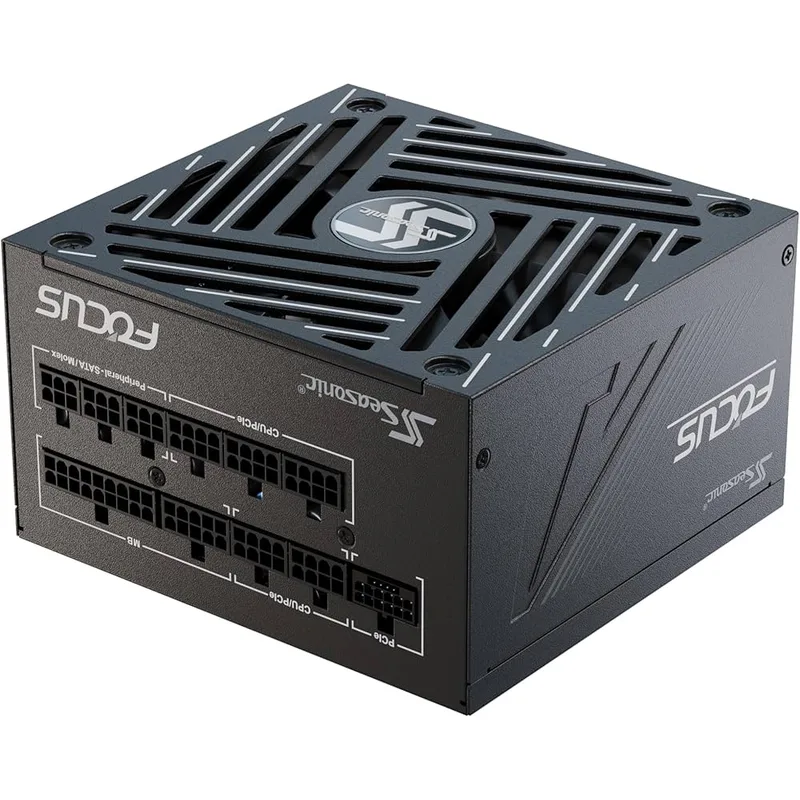
The RM1000x earns its position through the combination of a well-proven platform, competitive pricing, and genuine ATX 3.1 compliance at a wattage tier that covers every GPU except the RTX 5090 with comfortable headroom. At $160 with a 7-year warranty, it sits in the sweet spot between the budget MSI at $150 and the premium Seasonic at $190.
For an RTX 5080 build, the math is straightforward: 360W GPU TDP + 120W CPU TDP + 50W for fans, storage, and RAM = ~530W sustained draw. The RM1000x provides 470W of overhead for GPU overclocking, CPU all-core boost, and future component additions. The native 12V-2x6 connector eliminates the adapter risk that caused early RTX 4090 cable incidents.
The 7-year warranty is the one legitimate weakness. Corsair doesn’t outsource the RM platform to third-party manufacturers, so quality control is consistent — but if your build is designed to run for a decade before the next full upgrade, Seasonic’s 10-year Focus GX-1000 at $30 more is worth considering.
2. MSI MAG A1000GL PCIE5 — Best Budget 1000W
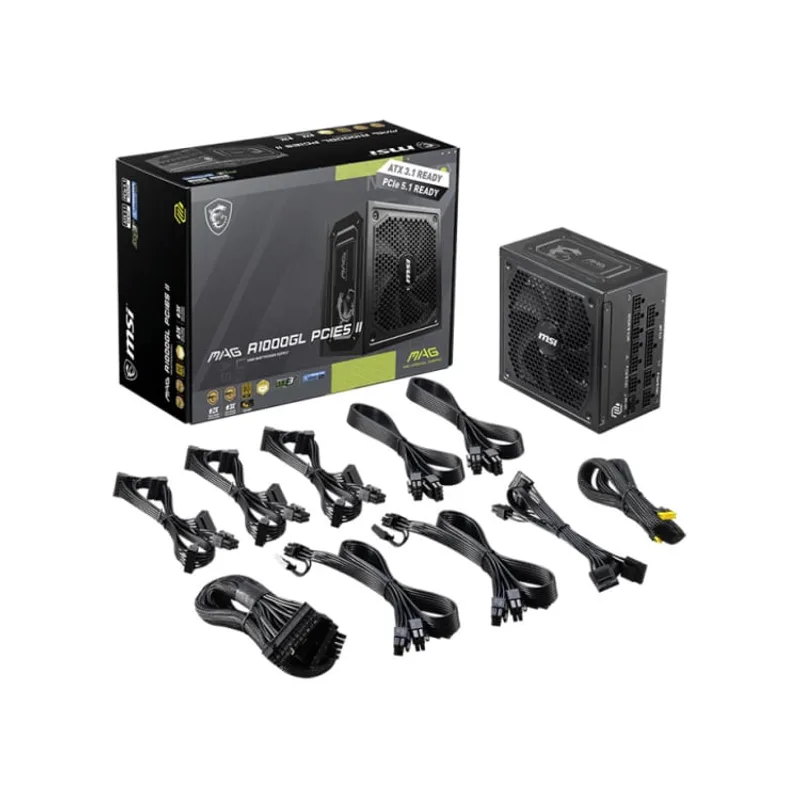
MSI MAG A1000GL PCIE5
The MAG A1000GL undercuts every other ATX 3.1 1000W unit in this comparison while pairing a 10-year warranty — a genuinely unusual value combination. At $150, it’s $10 cheaper than the RM1000x and $70 cheaper than the ROG Strix Platinum.
The CWT manufacturing platform used in the MAG A1000GL is reliable — CWT builds PSUs for multiple premium brands — but the voltage regulation is slightly looser than Corsair’s RM platform at transient loads. Hardware Busters measured +12V deviation at approximately 0.8% under transient testing, versus 0.6% for the RM1000x. That difference won’t affect system stability in practice, but it’s measurable.
The standout spec is the 130mm depth. Most 1000W ATX units are 150–160mm deep. The MAG A1000GL fits cases where other 1000W PSUs create clearance conflicts with the HDD cage or front panel connectors. If your case has a constrained PSU bay and you need 1000W at minimum cost, this is the pick.
3. ASUS ROG Strix 1000W Platinum — Best Platinum 1000W
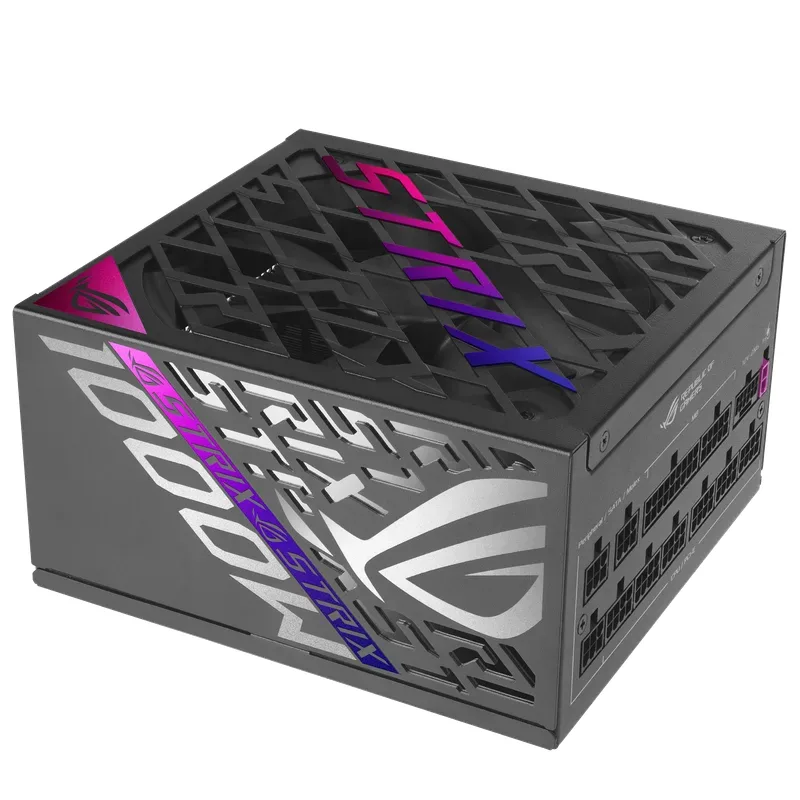
The ROG Strix 1000P is the only PSU in this review specifically engineered for RTX 5090 transient loads. The GPU-First Intelligent Voltage Stabilizer (IVS) circuit monitors the 12V rail in real time and pre-charges the capacitor bank before detected transient spikes. In Tom’s Hardware’s review, this resulted in the best transient response measurements of any 1000W unit tested in 2025 — +12V held within 0.4% even at 200% transient load tests.
GaN MOSFET technology allows higher switching frequencies than conventional silicon MOSFETs, contributing to improved efficiency and lower heat generation at the same output. The Cybenetics Lambda A+ noise certification (below 25dB(A) at full load) is independently verified — this is measurably quieter than Gold-rated units with passive cooling attempting similar load.
At $220, the ROG Strix is $60 more than the RM1000x. The efficiency advantage of Platinum over Gold (~93% vs ~90% at 50% load) translates to roughly 15W saved at 500W draw — saving approximately $13–15/year at US average electricity rates. The cost premium takes 4–5 years to recover through electricity savings alone, before accounting for the superior transient performance and longer warranty.
For RTX 5080 builds at $1,500+ total cost, the $60 premium is a sensible investment. For RTX 5070 Ti builds, it’s harder to justify.
4. be quiet! Straight Power 12 1000W — Quietest 1000W
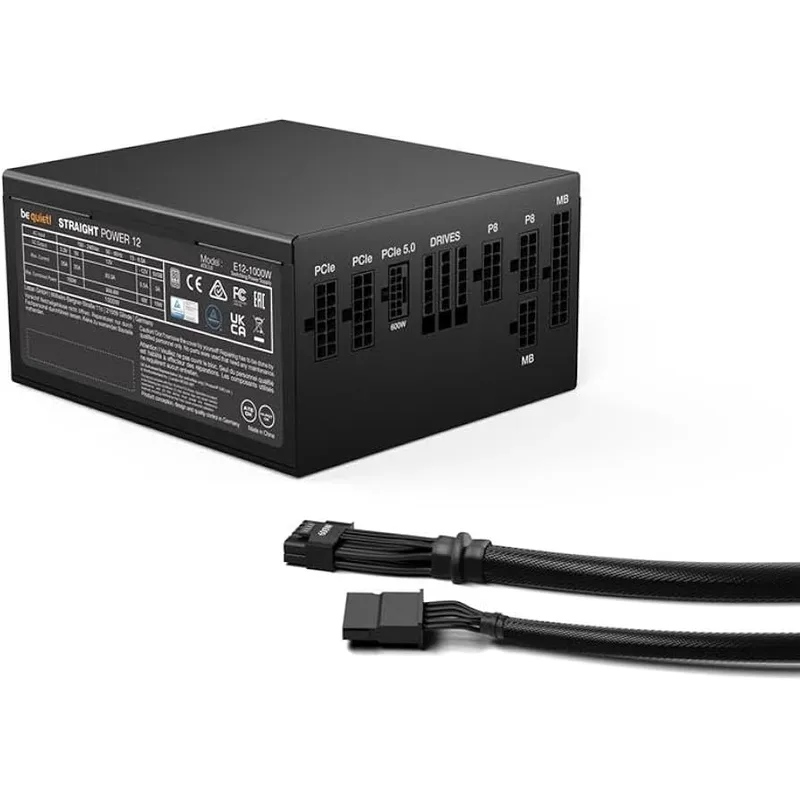
be quiet! Straight Power 12 1000W
The Straight Power 12 earns its position through one specific claim: the lowest measured acoustic output of any 1000W unit in this comparison. be quiet!‘s Silent Wings 135mm fan produces approximately 23dB(A) at 500W load — quieter than any 140mm competitor at equivalent draw. For a silent workstation or studio build where acoustic performance is the primary constraint, this matters.
The 93.9% peak Platinum efficiency is real and independently verified. At $170, it’s $10 more than the RM1000x for better efficiency and acoustic performance.
The caveat is the ATX 3.0 certification. The SP12 uses a native 12V-2x6 connector and supports PCIe 5.0 GPUs, but the PSU is not ATX 3.1 certified — the transient headroom requirement is different. For RTX 5080 builds, the SP12 handles the load without documented issues in owner reports. For RTX 5090 builds with 575W TDP and 3× transient spikes pushing 1725W momentarily, the ROG Strix or Seasonic Focus GX ATX 3.1 units are the safer specification match.
The 5-year warranty is the other limitation. The MSI MAG A1000GL offers 10 years at $20 less.
5. Seasonic Focus GX-1000 ATX 3.1 — Best Warranty
Seasonic’s argument is simple: they build the unit themselves and warranty it for 10 years at 1000W. The Focus GX-1000 ATX 3.1 is RTX 5090 and RX 9000 ready per Seasonic’s official compatibility list, fully modular, and priced at $190.
The in-house manufacturing claim is meaningful. Most PSU brands — including be quiet!, EVGA, and some Corsair tiers — outsource PSU manufacturing to OEMs like CWT, Channel Well, or Andyson. Seasonic builds the Focus GX platform at its own factory, which simplifies quality control and warranty RMA accountability.
At $30 more than the RM1000x for the same Cybenetics Gold efficiency tier, the only tangible difference is 10-year vs 7-year warranty and Seasonic’s manufacturing pedigree. If you’re building a system you intend to run for 8+ years before the next major overhaul, the $30 premium is well spent.
The fanless mode below 300W is the one area where the Focus GX-1000 trails the RM1000x — Corsair’s Zero RPM stays off up to 420W, meaning the RM1000x runs silent in more real-world usage scenarios.
PSU Wattage Calculator: What You Actually Need
| System Configuration | Sustained Draw | Recommended PSU |
|---|---|---|
| RTX 5060 Ti + Core Ultra 5 245K | ~320W | 650W ATX 3.1 |
| RTX 5070 + Ryzen 7 9700X | ~400W | 750W ATX 3.1 |
| RTX 5070 Ti + Ryzen 7 9800X3D | ~480W | 850W ATX 3.1 |
| RTX 5080 + Ryzen 9 9900X | ~530W | 850W or 1000W ATX 3.1 |
| RTX 5080 OC + Ryzen 9 9950X | ~600W | 1000W ATX 3.1 |
| RTX 5090 + Ryzen 9 9950X | ~780W | 1000W ATX 3.1 (1200W preferred) |
For the RTX 5080 + Ryzen 9 9950X config, a quality 850W unit handles the sustained load — but the 1000W tier provides meaningful headroom for memory overclocking, multi-drive NVMe storage, and extended all-core CPU boost states that spike above the base TDP.
Build Pairings and Compatibility
RTX 5080 flagship builds: The Corsair RM1000x at $160 covers the load with 470W overhead. Pair with the ASUS ROG Crosshair X870E Hero motherboard and AMD Ryzen 9 9800X3D for an AM5 system that draws ~530W peak.
RTX 5090 extreme builds: Step up to the ASUS ROG Strix 1000W Platinum or consider a 1200W unit. The Corsair HX1000i at $220 with iCUE monitoring is also relevant — reviewed in our Corsair vs Seasonic PSU comparison.
CPU cooler recommendation: At this wattage tier, a 360mm AIO is standard. The Corsair iCUE Link Titan 360 RX RGB at $190 integrates with Corsair’s iCUE ecosystem if you choose the HX1000i for monitoring continuity.
FAQ
Q: Is 1000W enough for an RTX 5090? The RTX 5090 has a 575W TDP. Combined with a Ryzen 9 9950X at 170W TDP, sustained system draw sits around 780–800W at full gaming load. A 1000W PSU covers this with 200W headroom. For overclocking or extreme workloads, a 1200W or 1600W unit is safer. The MSI RTX 5090 Gaming Trio OC at ~$3,060 is the GPU in question — pairing it with a $160 PSU is undersizing the investment.
Q: Is the Corsair RM1000x better than the RM850x for RTX 5080 builds? The RTX 5080 draws 360W TDP. An RTX 5080 + Ryzen 9800X3D system peaks around 530W sustained. The RM850x at $130 covers that load with 320W headroom — adequate for most builds. The RM1000x at $160 adds 150W more ceiling. The $30 premium is justified if you plan to upgrade to an RTX 5090 or overclock both CPU and GPU simultaneously.
Q: Does the Corsair RM1000x work with an RTX 5090? Yes — the native 12V-2x6 connector is ATX 3.1 compliant and physically compatible with all RTX 5090 AIB cards. The 1000W capacity handles the 5090’s 575W TDP with Ryzen 9 9950X at sustained full load, but headroom is limited. A 1200W unit is preferred for 5090 overclocking scenarios.
Q: What’s the difference between ATX 3.0 and ATX 3.1? ATX 3.0 introduced the 12VHPWR connector and required PSUs to handle 2× rated load transients for 100µs. ATX 3.1 upgraded that to 3× rated load for 100µs and added the improved 12V-2x6 connector standard. For RTX 5090 builds with 575W TDP and transient spikes, ATX 3.1 is the correct specification — the be quiet! Straight Power 12 in this review is ATX 3.0.
Q: Is the RM1000x quiet enough for a home studio build? Below 420W, the RM1000x fan is completely off — zero acoustic contribution from the PSU. Above that threshold, the 140mm FDB fan ramps to approximately 25dB(A) at 500W, which is below ambient room noise in most environments. The be quiet! Straight Power 12 is measurably quieter at 23dB(A) at the same load, but the difference is imperceptible without measurement equipment.
The Bottom Line
The Corsair RM1000x ATX 3.1 at $160 is the right choice for most RTX 5080 builds in 2026. It offers proven platform reliability, genuine ATX 3.1 compliance, a native 12V-2x6 connector, and a zero-RPM fan mode that keeps the build silent during everyday use. The 7-year warranty is its only real weakness relative to the competition.
Budget buyers should look at the MSI MAG A1000GL PCIE5 at $150 — 10-year warranty at $10 less than the RM1000x is hard to argue against. RTX 5090 builders should step up to the ASUS ROG Strix 1000W Platinum at $220 for its GaN-based transient performance and GPU-First IVS circuit purpose-built for Blackwell’s power demands.