ATX 3.1 has moved from “nice to have” to the default spec on new PSU purchases in 2026, and 850W has become the practical floor for anyone running an RTX 5070 Ti or faster GPU with headroom to spare. The Corsair RM850e (2025) sits at the center of that shift — a native 12V-2x6, Cybenetics Gold-certified 850W unit that KitGuru’s 2025 teardown scored 8/10 and street prices have settled around $119, undercutting Corsair’s own RM850x by roughly $15. This review checks whether that gap is worth taking, and how the RM850e stacks up against the MSI MAG A850GL, ASUS TUF Gaming 850W Gold, and Cooler Master MWE Gold 850 V3 — the other budget-to-midrange ATX 3.1 units competing for the same build.
| Spec | Corsair RM850e (2025) 9.1/10 | Corsair RM850x ATX 3.1 9.3/10 | MSI MAG A850GL PCIE5 8.7/10 | ASUS TUF Gaming 850W Gold 9/10 | Cooler Master MWE Gold 850 V3 8.6/10 |
|---|---|---|---|---|---|
| wattage | 850W | 850W | 850W | 850W | 850W |
| efficiency | Cybenetics Gold (~90%) | Cybenetics Gold (~90%) | 80+ Gold | 80+ Gold (~90%) | Cybenetics Platinum / 80+ Gold |
| standard | ATX 3.1 / PCIe 5.1 | ATX 3.1 / PCIe 5.1 | ATX 3.1 / PCIe 5.1 | ATX 3.1 / PCIe 5.1 | ATX 3.1 / PCIe 5.1 |
| connector | Native 12V-2x6 | Native 12V-2x6 | Native dual-color 12V-2x6 | Native 12V-2x6 | 90-degree angled 12V-2x6 |
| fan | 120mm rifle bearing, Zero RPM mode | 140mm FDB, Zero RPM mode | 100mm FDB | 120mm Axial-tech dual ball bearing | 120mm FDB, Zero RPM mode |
| warranty | 7 years | 10 years | 10 years | 10 years | 10 years |
| Rating | 9.1/10 | 9.3/10 | 8.7/10 | 9/10 | 8.6/10 |
Prices change daily — tap Check Price for the current Amazon price.
Prices change daily — tap Check Price for the current Amazon price.
Quick Picks
- Best value 850W PSU: Corsair RM850e (2025) — $119 gets you native 12V-2x6, Cybenetics Gold efficiency, and Corsair’s proven RM platform. The default recommendation for most 850W builds.
- Best if you want a longer warranty: Corsair RM850x ATX 3.1 — a 10-year warranty and larger 140mm fan for about $16 more than the RM850e.
- Cheapest ATX 3.1 850W: Cooler Master MWE Gold 850 V3 — $99.99 with dual Cybenetics Platinum/Gold certification, the lowest entry price in this comparison.
Who Needs 850W in 2026?
The math that decides whether 850W is enough hasn’t changed much, but GPU TDPs have crept upward:
- RTX 5070 Ti build (300W TDP) + Ryzen 7 9800X3D (120W TDP) + storage/fans = ~460W sustained. 750W is technically sufficient; 850W leaves comfortable headroom for GPU overclocking.
- RTX 5080 build (360W TDP) + Ryzen 9 9900X (120W TDP) = ~530W sustained. This is the sweet spot 850W was built for — roughly 300W of overhead.
- RTX 5090 build (575W TDP): 850W is undersized once you add a modern CPU. Step up to a 1000W unit like the RM1000x instead.
If your build tops out at an RTX 5070 or below, an 850W unit is still worth buying over a 750W for the extra overclocking and upgrade headroom — the price difference between 750W and 850W tiers within the same product line is typically under $15.
Why ATX 3.1 Matters Here
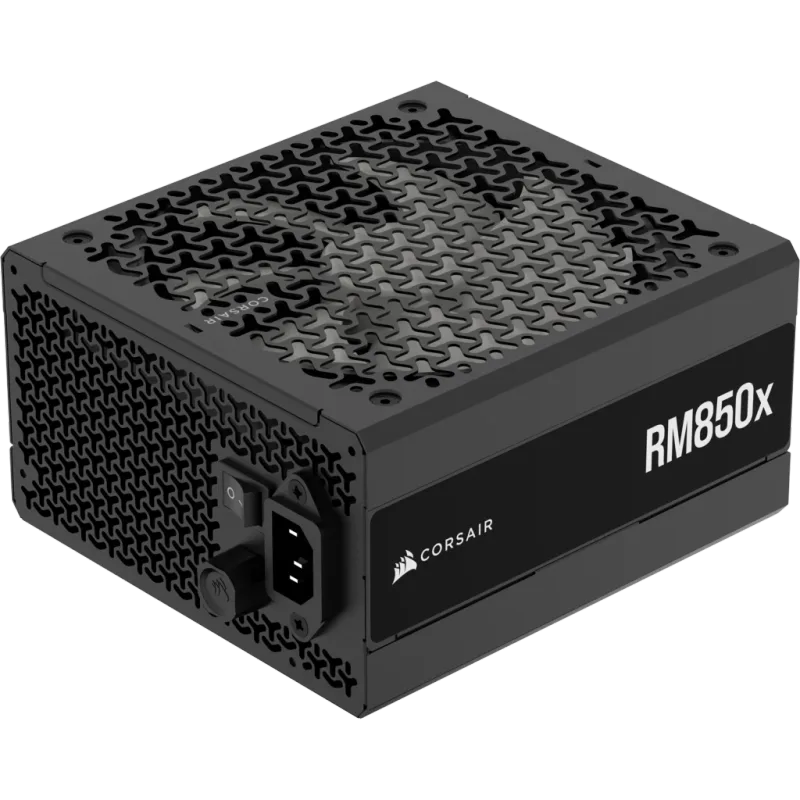
ATX 3.1 requires PSUs to survive transient spikes at 3x rated wattage for 100-microsecond bursts, using the revised 12V-2x6 connector with shorter sense pins that reduce the cable-melting risk seen on early 12VHPWR adapters. Every PSU in this comparison is ATX 3.1 compliant with a native 12V-2x6 cable — no adapter required for any current-generation RTX 50-series or RX 9000-series GPU.
Corsair RM850e: The Main Review
Design and Efficiency
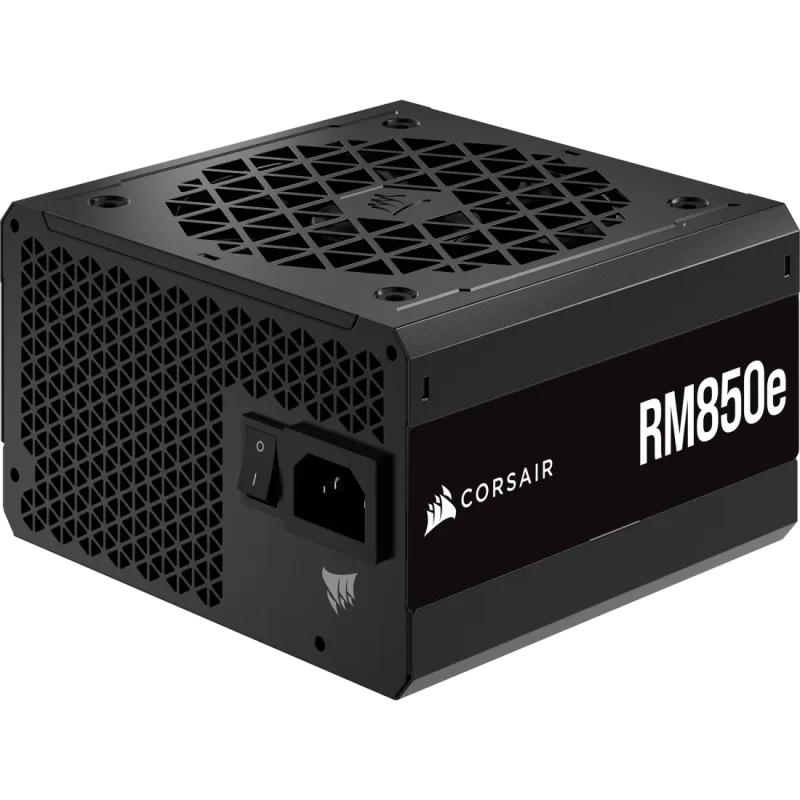
The RM850e (2025) uses a resonant LLC topology with DC-to-DC conversion and 105°C-rated capacitors, packed into a compact 140mm-deep chassis. Cybenetics certified it Gold for efficiency — up to roughly 90% at typical 50% load — and LAMBDA-A for acoustics, which KitGuru’s review notes keeps average noise output in the 20-25 dBA range. A 120mm rifle-bearing fan with zero-RPM mode holds the fan completely off below roughly 40% load, so desktop use and light gaming stay silent.
The chassis size is the RM850e’s practical selling point: at 140mm deep, it fits mid-tower and most mATX cases that reject the RM850x’s and Seasonic Focus GX-850’s 150-160mm bodies. If case clearance around the PSU shroud is tight, the RM850e solves that problem without stepping down to a 100mm-fan budget unit like the MSI MAG A850GL.
Where It Compromises
The RM850e’s 7-year warranty is the clearest trade-off against its RM850x sibling and against nearly every other 10-year-warrantied competitor in this roundup, including the cheaper MSI and Cooler Master units. Corsair reserves longer coverage for the RMx and HX lines. For a build you’ll keep five to seven years, that’s a non-issue; for a PSU you expect to outlast two GPU generations, it’s worth the roughly $15-16 step up to the RM850x.
The 120mm fan is also the smallest Corsair uses across its 850W lineup — the RM850x moves to a 140mm fan that can spin slower for equivalent airflow. In practice this only matters above roughly 60-70% sustained load, where the RM850e’s fan has to work harder than its Corsair sibling to dissipate the same heat.
Detailed Comparisons
1. Corsair RM850x ATX 3.1 — Best Step-Up Pick
The RM850x is the RM850e’s direct sibling built on the same RM platform with two upgrades: a 140mm FDB fan instead of 120mm, and a 10-year warranty instead of 7. At $134.99, it costs about $16 more for those two changes and nothing else — efficiency, connector spec, and Gold certification are functionally identical. If the warranty gap bothers you or you’re building a system meant to run a decade, the RM850x is the better buy. If not, that $16 is better spent elsewhere in the build.
2. MSI MAG A850GL PCIE5 — Cheapest ATX 3.1
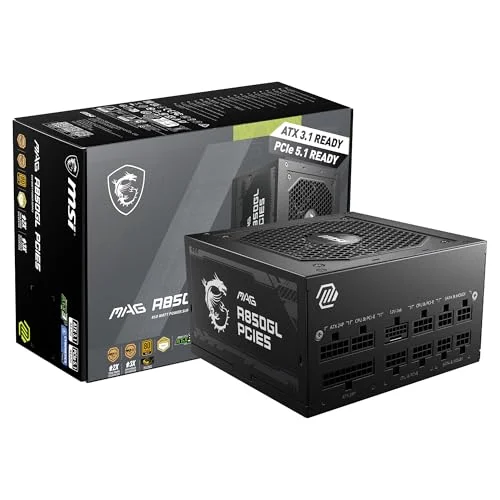
The MAG A850GL is the only PSU here cheaper than the RM850e, at $109.99 with a 10-year warranty — a genuinely strong warranty-to-price ratio. The trade-off is the 100mm fan, the smallest in this comparison, which runs audibly louder than the RM850e’s 120mm fan once load climbs past 60%. It also lacks Cybenetics dual-certification, so independent efficiency verification is thinner than what Corsair publishes for the RM850e. For a quiet, low-load build, the RM850e’s larger fan is the better pick; for pure budget with acceptable noise, the MSI wins on price and warranty.
3. ASUS TUF Gaming 850W Gold — Best for RGB Builds
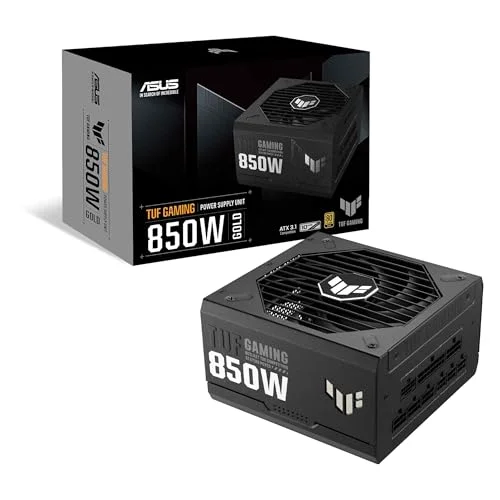
At $119.99, the TUF Gaming 850W Gold lands within a dollar of the RM850e and matches its Gold efficiency, but adds a 10-year warranty and a dual ball-bearing fan rated for 150,000 hours MTBF. What it gives up is the RM850e’s zero-RPM idle mode — the TUF’s fan spins at low speed even under light desktop loads rather than shutting off entirely. For builders who want the ASUS TUF aesthetic to match a TUF motherboard and GPU, it’s a reasonable swap; for silence-first builds, the RM850e’s true fan-off idle wins.
4. Cooler Master MWE Gold 850 V3 — Best Budget
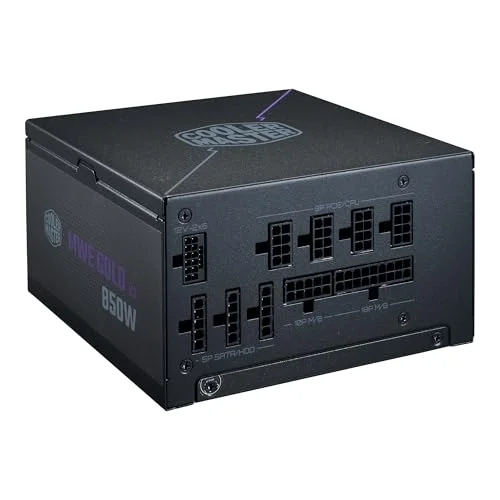
The MWE Gold 850 V3 undercuts the RM850e by about $19 while carrying dual Cybenetics Platinum and 80+ Gold certification — on paper, better efficiency than the RM850e’s single Gold rating, at a lower price. Tom’s Hardware flagged weaker cable quality compared to Corsair’s braided cables as the main compromise, along with a shorter reliability track record since the platform is newer than Corsair’s established RM series. If price is the only variable that matters, this is the cheapest ATX 3.1 850W unit worth buying; if you want Corsair’s longer field-proven history, stick with the RM850e.
FAQ
Is the Corsair RM850e (2025) worth it over the older 2023 ATX 3.0 version?
Yes. The 2025 revision adds full ATX 3.1 compliance and the updated 12V-2x6 connector with shorter sense pins, which reduces cable-melting risk versus the ATX 3.0 12VHPWR-adapter approach used on the 2023 model. If you’re buying new in 2026, confirm the listing specifies ATX 3.1 — both versions are still sold under similar names.
Is 850W enough for an RTX 5080?
Yes, comfortably. The RTX 5080’s 360W TDP plus a Ryzen 9 9900X-class CPU at 120W and typical storage/fan draw totals roughly 530W sustained, leaving about 300W of headroom on an 850W unit — enough for moderate GPU and CPU overclocking.
Should I buy the RM850e or the RM850x?
Buy the RM850e if price matters most — it’s functionally identical in efficiency and connector spec for about $16 less. Buy the RM850x if you want the 10-year warranty and slightly quieter 140mm fan under sustained heavy load, and don’t mind the extra cost or the 20mm-longer chassis.
Does the RM850e work with the RTX 5090?
The RM850e’s native 12V-2x6 connector is electrically compatible with any RTX 5090 card, but 850W is too tight for a 575W TDP GPU plus a modern CPU under sustained full load. For an RTX 5090 build, step up to a 1000W unit instead.
What’s the difference between 80+ Gold and Cybenetics Gold?
80+ Gold tests efficiency only, at three load points (20%, 50%, 100%) under a single ambient condition. Cybenetics testing is more thorough — it adds noise certification (the LAMBDA rating) and tests efficiency across a wider load range under stricter conditions. A PSU can be 80+ Gold without Cybenetics certification, which is why the MSI and ASUS units in this comparison list 80+ Gold only, while the RM850e and Cooler Master unit carry Cybenetics ratings.
The Bottom Line
The Corsair RM850e (2025) earns its spot as the default 850W recommendation in 2026: native ATX 3.1 12V-2x6 support, Cybenetics Gold efficiency, a genuinely silent zero-RPM idle mode, and a compact 140mm chassis, all for $119. The 7-year warranty is its one real shortfall against the competition.
If warranty length matters more than $16, step up to the Corsair RM850x. If price is the only variable, the Cooler Master MWE Gold 850 V3 at $99.99 undercuts everything here. For most 850W builds landing between an RTX 5070 Ti and RTX 5080, though, the RM850e is the one to buy first.