The air-vs-liquid debate never really settled — it just moved up in wattage. Noctua’s answer is still the NH-D15 chromax.black, a dual-tower air cooler that’s been a benchmark pick since its original release and remains rated for 225W of TDP. NZXT’s current 280mm entry is the Kraken Plus 280, built around NZXT’s Turbine pump and a 1.54-inch square LCD that the original plain “Kraken 280” listing has since been phased out in favor of. Both sides handle everything from a Ryzen 7 9700X to a Core Ultra 9 285K without drama — the real question is what you’re trading for the extra thermal ceiling an AIO offers.
| Spec | Noctua NH-D15 chromax.Black 9/10 | NZXT Kraken Plus 280 8.4/10 |
|---|---|---|
| Type | Dual-tower air cooler | 280mm AIO liquid cooler |
| Heatpipes | 6 | — |
| Fans | 2x NF-A15 HS-PWM 140mm | 2x F140P, up to 1700 RPM, 93.2 CFM |
| Max Noise | 24.6 dBA (19.2 dBA w/ LNA) | — |
| TDP Rating | 225W | — |
| Socket Support | LGA1851/1700/1200, AM5/AM4 | LGA1851/1700/1200/115X, AM5/AM4 |
| Rating | 9/10 | 8.4/10 |
Prices change daily — tap Check Price for the current Amazon price.
Prices change daily — tap Check Price for the current Amazon price.
Quick Picks
- Best if you want zero maintenance and dead silence: The Noctua NH-D15 chromax.Black tops out at 24.6 dBA and has no pump or coolant to eventually fail.
- Best if you’re running a 250W+ chip or want live temps on the case: The NZXT Kraken Plus 280 has more thermal headroom and a customizable LCD display.
Where the Difference Actually Shows Up
Noctua rates the NH-D15 chromax.black for 225W of TDP, and it holds that line thanks to six heatpipes and dual NF-A15 140mm fans spread across a widened dual-tower fin stack. Independent reviews have consistently found air coolers in this class land within a degree or two of a 280mm-360mm AIO at equivalent noise levels for chips drawing up to roughly 200W — the gap between the two cooling styles only opens up meaningfully once you’re past that mark. If your CPU tops out around 170-200W under an all-core load, which covers most current gaming builds, the NH-D15 keeps pace with a liquid loop while staying quieter.
The Kraken Plus 280 earns its keep at the top of that range and beyond. Its 321mm radiator and NZXT Turbine pump, spinning 1200-2800 RPM, push more surface area and more coolant flow than any air tower can match, and that headroom matters most once you’re running a power-hungry chip at sustained boost clocks or layering in a manual overclock. The tradeoff is noise: NZXT’s stock F140P fans climb to 1700 RPM and 30 dBA under full load, audibly louder than the NH-D15’s 24.6 dBA ceiling for that extra thermal capacity.
Mechanical risk is the other real divide. The NH-D15 is a passive heatsink with two fans — there’s no pump to wear out and no coolant loop that can develop a slow leak over years of use. The Kraken Plus 280 is a sealed AIO, and while pump failures and leaks are rare on modern closed loops, they’re not zero, and it’s a failure mode air cooling doesn’t have. What the AIO gives back for that risk is the 1.54-inch square LCD, which can show live CPU temps, GPU temps, or custom images — a feature no air cooler can replicate, and one that matters if you’re running an open-panel case where the cooler is visible.
Clearance is worth checking either way. The NH-D15 stands 165mm tall and 150mm wide, tall enough to interfere with high-profile RAM heatsinks or the top PCIe slot in some mATX boards — check your case’s cooler height limit and your RAM’s heatsink height before ordering. The Kraken Plus 280’s 321 x 140mm radiator needs a case with 280mm top or front mounting, which most mid-towers support but not every compact or SFF case does.
Detailed Reviews
Noctua NH-D15 chromax.Black
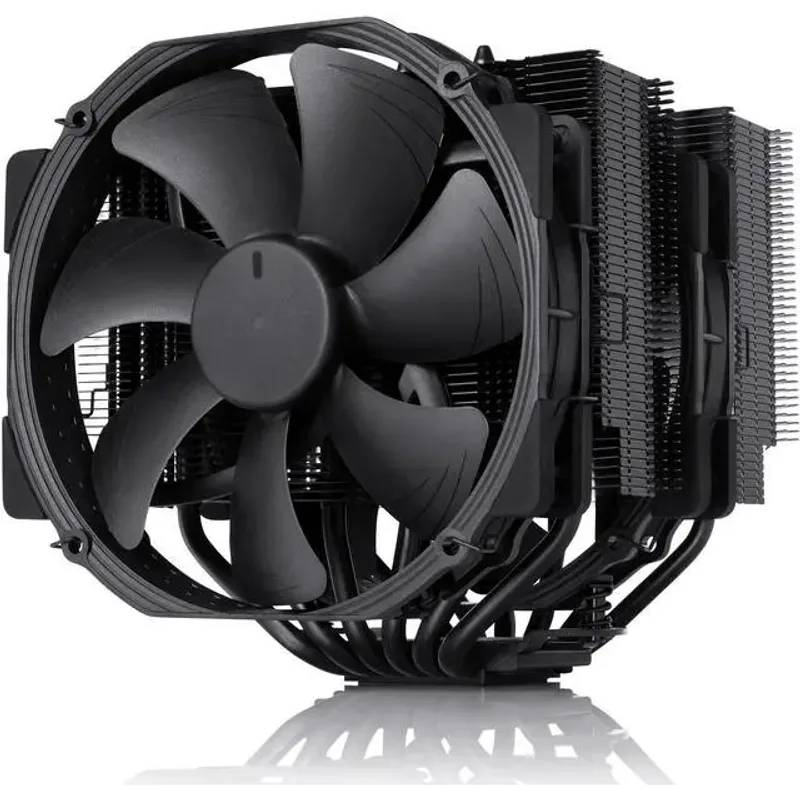
The NH-D15 chromax.black is the same six-heatpipe, dual-tower design Noctua has refined for years, now in an all-black finish with chromax fan covers instead of the original brown-and-tan color scheme. Its 225W TDP rating covers essentially every mainstream gaming CPU on the market today, and its NF-A15 HS-PWM fans are tuned to stay under 25 dBA even at full 1500 RPM — with the included Low-Noise Adapter dropping that further to 19.2 dBA for a build where quiet matters more than squeezing out the last degree of headroom.
Socket compatibility spans LGA1851, LGA1700, LGA1200 on the Intel side and AM5/AM4 on the AMD side, using Noctua’s SecuFirm2 mounting system, so the same cooler survives a CPU or socket upgrade without new hardware in most cases. The main thing to verify before buying is clearance: at 165mm tall, it can hit the underside of a side panel in shorter cases, and at 150mm wide it can shadow the first RAM slot on boards with tall memory heatsinks.
NZXT Kraken Plus 280
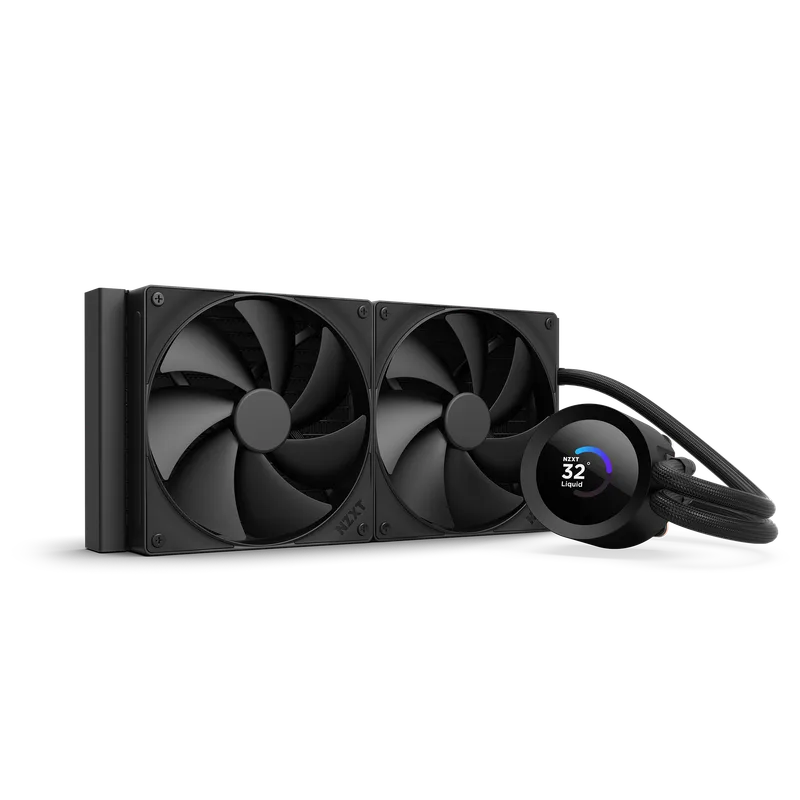
The Kraken Plus 280 is NZXT’s current standard-tier 280mm AIO, built around the company’s Turbine pump rather than the third-party Asetek pumps NZXT used in older Kraken generations. The pump spins 1200-2800 RPM and drives coolant through a 321 x 140 x 27mm aluminum radiator paired with two F140P fans rated for up to 93.2 CFM of airflow — enough to handle sustained loads from higher-TDP chips that would push an air cooler toward its ceiling.
The standout feature is the 1.54-inch square LCD on the pump housing, controllable through NZXT’s CAM software alongside fan curves and RGB lighting. That software layer is also the AIO’s one added point of friction compared to a fan-and-heatsink setup — it’s another app to install and keep updated, versus the NH-D15’s zero-software approach of plugging fans into motherboard headers. Socket support covers LGA1851/1700/1200/115X and AM5/AM4, matching the NH-D15’s breadth on the compatibility side.
FAQ
Is the NZXT Kraken Plus 280 actually cooler than the Noctua NH-D15? Only once you’re past roughly 200W of sustained CPU power draw. Below that, independent testing has repeatedly found air coolers in the NH-D15’s class land within a degree or two of a 280mm AIO at matched noise levels — the AIO’s advantage grows with wattage, not before it.
Which is quieter, the NH-D15 or the Kraken Plus 280? The NH-D15, by a clear margin — 24.6 dBA max (19.2 dBA with the Low-Noise Adapter) versus the Kraken Plus 280’s 30 dBA under full fan load.
Does the NH-D15 fit in a compact case? Check clearance first. At 165mm tall and 150mm wide, it can clash with a case’s side panel or a motherboard’s tall RAM heatsinks — measure before ordering, especially in mATX builds.
Do I need a 280mm AIO for a current flagship chip like the Ryzen 9 9950X3D? Not strictly. The NH-D15’s 225W TDP rating covers most flagship gaming CPUs at stock settings. An AIO like the Kraken Plus 280 earns its keep if you’re also manually overclocking or running sustained all-core workloads that push well past 200W.
Can either cooler fail over time? Both, in different ways. The NH-D15’s only wear part is its two fan bearings. The Kraken Plus 280 adds a pump and a sealed coolant loop, which carries a small but real risk of pump failure or a slow leak that an air cooler doesn’t have.
The Bottom Line
For most gaming builds under roughly 200W of sustained CPU draw, the Noctua NH-D15 chromax.Black is the better buy — it matches AIO-class cooling at a quieter noise floor, has no coolant loop to eventually fail, and its socket hardware carries across future CPU upgrades. The NZXT Kraken Plus 280 earns its place in builds running power-hungry chips past that threshold, manual overclocks, or cases where the 1.54-inch LCD display and a liquid-cooled look matter as much as the thermals.