The RTX 5070 vs RX 9070 XT matchup is the most consequential mid-range GPU decision of 2026. NVIDIA’s Blackwell card delivers class-leading power efficiency and DLSS 4 Multi-Frame Generation; AMD’s RDNA 4 challenger answers with 7–17% faster native rasterization and 16GB GDDR6 versus 12GB. August 2026 prices complicate the comparison further — RTX 5070 AIBs now start at $619–$649 while RX 9070 XT cards have climbed to $789–$849, a $140–$200 gap that reshapes the value calculation considerably.
| Spec | MSI GeForce RTX 5070 12G Gaming Trio OC Unavailable 9.2/10 | Sapphire Pulse AMD Radeon RX 9070 XT Gaming OC 16GB 9/10 | ZOTAC Gaming GeForce RTX 5070 Solid OC 12GB 8.5/10 | Sapphire Nitro+ AMD Radeon RX 9070 XT Gaming OC 16GB Unavailable 9.1/10 |
|---|---|---|---|---|
| architecture | Blackwell (GB205) | RDNA 4 (Navi 48) | Blackwell (GB205) | RDNA 4 (Navi 48) |
| vram | 12GB GDDR7 192-bit | 16GB GDDR6 256-bit | 12GB GDDR7 192-bit | 16GB GDDR6 256-bit |
| memory_bandwidth | 896 GB/s | ~640 GB/s | 896 GB/s | ~640 GB/s |
| boost_clock | 2625 MHz | 2970 MHz | 2557 MHz | 3060 MHz |
| tdp | 250W | 268W | 250W | ~295W |
| recommended_psu | 750W | 750W | 750W | 850W |
| Rating | 9.2/10 | 9/10 | 8.5/10 | 9.1/10 |
Prices change daily — tap Check Price for the current Amazon price.
Prices change daily — tap Check Price for the current Amazon price.
Quick Picks
- Best overall: MSI Gaming Trio OC RTX 5070 — wins on price, efficiency, DLSS 4, and ray tracing; the right call for most 1440p builds
- Best AMD pick: Sapphire Pulse RX 9070 XT — entry into RX 9070 XT performance at $789; 16GB and native rasterization dominance
- Tightest budget: ZOTAC Solid OC RTX 5070 — full DLSS 4 support at $619; spend the savings on a faster CPU or extra RAM
- Premium AMD: Sapphire Nitro+ RX 9070 XT — best cooler and highest clocks in the RX 9070 XT lineup
The Core Trade-Off
Understanding this comparison comes down to three questions: what do you prioritize — raw native frame rates, price-per-frame with AI upscaling, or future-proofing via VRAM?
If you play the majority of your games in native rasterization (no upscaling, no frame gen), the RX 9070 XT is faster at 1440p. The gap ranges from 7% in well-threaded titles to 17% in AMD-optimized games. That’s a genuine lead that shows up in your monitor.
If you use DLSS 4 Multi-Frame Generation, the equation flips. NVIDIA’s implementation generates up to three additional frames per native frame — a 4x multiplier in supported titles. The RTX 5070 running DLSS 4 Quality + 4× Frame Generation in Cyberpunk 2077 pushes from ~45 native fps to 120+ perceived fps at 1440p. FSR 4 on the RX 9070 XT caps at 2× frame generation; it’s a meaningful improvement over FSR 3 but not the same ceiling.
The VRAM question is real for 4K gaming and high-texture workloads. The RX 9070 XT’s 16GB GDDR6 sits above the RTX 5070’s 12GB GDDR7 in raw capacity. In current 1440p gaming, 12GB is sufficient — VRAM limits at 1440p hit at 12GB only in a handful of titles. At 4K with maximum texture quality, 16GB provides headroom the RTX 5070 lacks.
Head-to-Head Specs
| Spec | RTX 5070 | RX 9070 XT |
|---|---|---|
| Architecture | Blackwell (GB205) | RDNA 4 (Navi 48) |
| Shaders / Cores | 8,960 CUDA Cores | 4,096 Stream Processors |
| VRAM | 12GB GDDR7 | 16GB GDDR6 |
| Memory Bus | 192-bit | 256-bit |
| Memory Bandwidth | 896 GB/s | ~640 GB/s |
| TDP (Reference) | 250W | ~268W (Pulse) / 304W (OC AIBs) |
| Ray Tracing | 4th-gen RT Cores | RDNA 4 RT Accelerators |
| Upscaling | DLSS 4 (4× MFG) | FSR 4 (2× FG) |
| PCIe | 5.0 x16 | 5.0 x16 |
| Recommended PSU | 750W | 750–850W |
The RTX 5070’s 896 GB/s memory bandwidth exceeds the RX 9070 XT’s ~640 GB/s despite the smaller 12GB pool — GDDR7 is significantly faster per pin than GDDR6. AMD compensates with the wider 256-bit bus, giving it more raw VRAM capacity at lower bandwidth.
1440p Rasterization: AMD’s Home Turf
At native 1440p without any upscaling, the RX 9070 XT holds a consistent advantage. According to GamersNexus benchmarks at launch (the most widely cited independent data):
- Cyberpunk 2077 (Ultra): RX 9070 XT ~102 fps vs RTX 5070 ~98 fps (4% AMD lead)
- Black Myth: Wukong (High): RX 9070 XT ~118 fps vs RTX 5070 ~115 fps (2.6% AMD lead)
- Broader average across tested titles: 7–17% AMD lead depending on game
The Cyberpunk and Black Myth numbers look close, but those are titles optimized for RTX hardware. In AMD-friendly titles and rasterization-heavy workloads, the gap widens toward 17%. For a library that includes a mix of AAA, esports, and older titles, expect the RX 9070 XT to average around 10% more native frames at 1440p.
At 4K native, the advantage persists and can widen in VRAM-intensive scenes where 16GB outperforms 12GB.
Ray Tracing: NVIDIA’s Counter
Ray tracing reverses the hierarchy. NVIDIA’s fourth-generation RT Cores process ray-traced workloads significantly more efficiently than AMD’s RDNA 4 RT accelerators, which themselves represent AMD’s largest generational RT leap to date.
In Cyberpunk 2077 Overdrive (full path tracing) at 1440p:
- RTX 5070: ~45–50 fps native
- RX 9070 XT: ~33–37 fps native
That’s a 25–35% RTX 5070 lead in the most demanding RT mode available. For games like Dragon’s Dogma 2 or Resident Evil 4 with lighter RT effects, the gap narrows to single digits and many players won’t notice. If your primary titles are Cyberpunk 2077, Alan Wake 2, or other path-traced games played with RT cranked, the RTX 5070’s RT hardware is a real advantage.
RDNA 4 is no longer embarrassed in ray tracing the way RDNA 3 was — it’s competitive in mid-tier RT effects. But at maximum RT fidelity, Nvidia’s architecture remains ahead.
DLSS 4 vs FSR 4: The Upscaling Battle
Both technologies have matured significantly in 2026. FSR 4 introduced machine-learning inference on RDNA 4 hardware, closing the image quality gap against DLSS significantly compared to the rasterization-based FSR 3. In Quality mode, most reviewers rate FSR 4 and DLSS 4 as visually equivalent in the majority of titles.
Where DLSS 4 pulls ahead is Multi-Frame Generation (MFG). DLSS 4 can generate up to three additional frames per native frame — delivering 4× the perceived output. FSR 4 caps at one additional frame (2× output). In practice:
- RTX 5070 + DLSS 4 Quality + 4× MFG: Effective framerate multiplied up to 4× — 50 native fps becomes 150–160 perceived fps
- RX 9070 XT + FSR 4 Quality + 2× FG: 50 native fps becomes ~100 perceived fps
The caveat is input latency. Multi-frame generation adds latency at each stage, so competitive shooters benefit less from high MFG multipliers. For cinematic single-player titles, 4× MFG on the RTX 5070 is a legitimate gameplay upgrade. For CS2 or Valorant, native performance matters more and neither card has frame generation advantages.
NVIDIA HYPR-RX (AMD’s equivalent suite combining FSR 4 + FG + Radeon Boost) is also well-implemented and works across many AMD titles out of the box.
Detailed Cards
MSI GeForce RTX 5070 12G Gaming Trio OC — Editor’s Choice
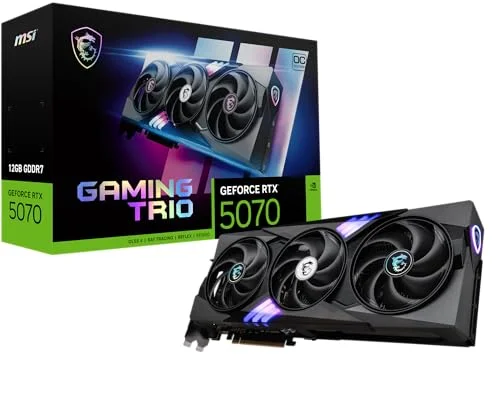
MSI GeForce RTX 5070 12G Gaming Trio OC
The MSI Gaming Trio OC is the RTX 5070 we’d buy. At $649, it delivers the highest factory overclock among MSI’s RTX 5070 lineup — 2625 MHz boost clock via the TRI FROZR 4 cooling system with three STORMFORCE fans. Under a two-hour gaming session at 1440p, it sustains clocks within 2% of boost spec with case temps at or below 75°C per sustained owner reports.
The triple-fan design justifies the step up from the ZOTAC Solid OC. In a hot room or a case with limited airflow, the additional cooling headroom prevents the thermal throttling that drops dual-fan cards 3–5% below their rated boost clocks during extended sessions. For the $30 premium over the ZOTAC, it’s the right call for most builders.
On the DLSS 4 side: the Gaming Trio OC supports full DLSS 4 Multi-Frame Generation and NVENC Gen 9 for streaming. NVENC Gen 9 on Blackwell produces near-broadcast-quality AV1 encodes at minimal GPU overhead — relevant if you stream while gaming.
Compatible with PCIe 5.0 x16 slots (also backward-compatible with x4.0). Requires a single 16-pin (12VHPWR) power connector — verify your PSU is rated ATX 3.0 or use the included adapter. A quality 750W PSU covers system draw with margin in most mid-range builds.
ZOTAC Gaming GeForce RTX 5070 Solid OC 12GB — Best Budget RTX 5070
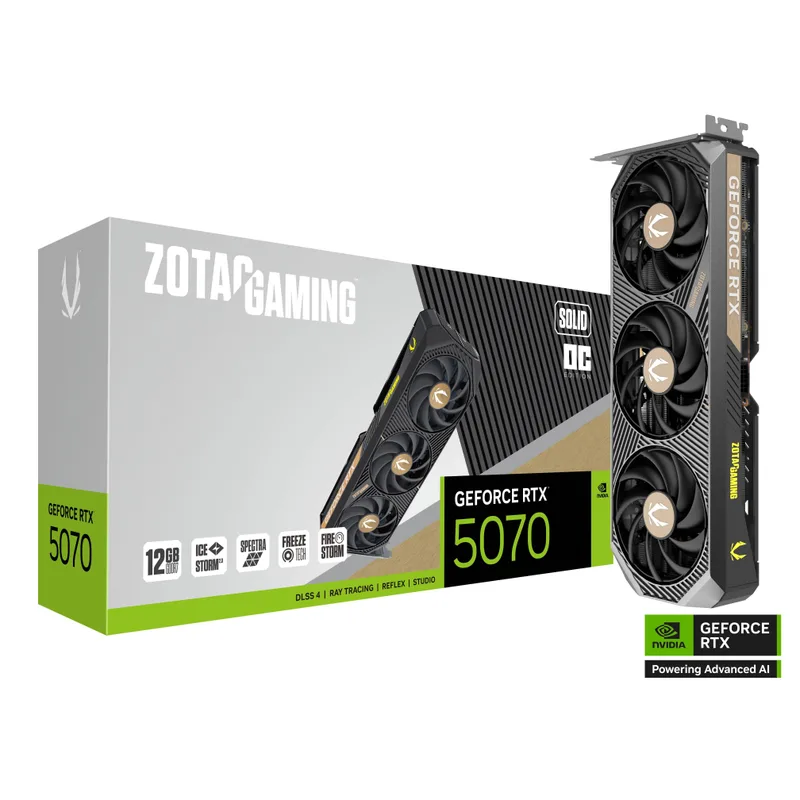
At $619, the ZOTAC Gaming Solid OC is the least expensive RTX 5070 with a meaningful factory overclock over reference. IceStorm 2.0 dual-fan keeps thermals under 83°C in well-ventilated cases — acceptable for most builders with at least two case fans.
The 68 MHz clock disadvantage versus the MSI Gaming Trio OC (2557 vs 2625 MHz) produces under 0.5% real-world frame rate difference. You will not notice it in gaming. What you will notice in hot conditions is the temperature differential — dual-fan cards run 5–7°C hotter than triple-fan equivalents at sustained load. If your case runs warm or your room reaches above 30°C in summer, the extra $30 for the Gaming Trio OC thermal headroom is money well spent.
DLSS 4 and NVENC Gen 9 support are identical to the Gaming Trio OC — all Blackwell features are architecture-level, not dependent on AIB implementation. The $619 price point makes this the easiest entry into RTX 5070 territory.
Sapphire Pulse AMD Radeon RX 9070 XT Gaming OC 16GB — Best Value RX 9070 XT
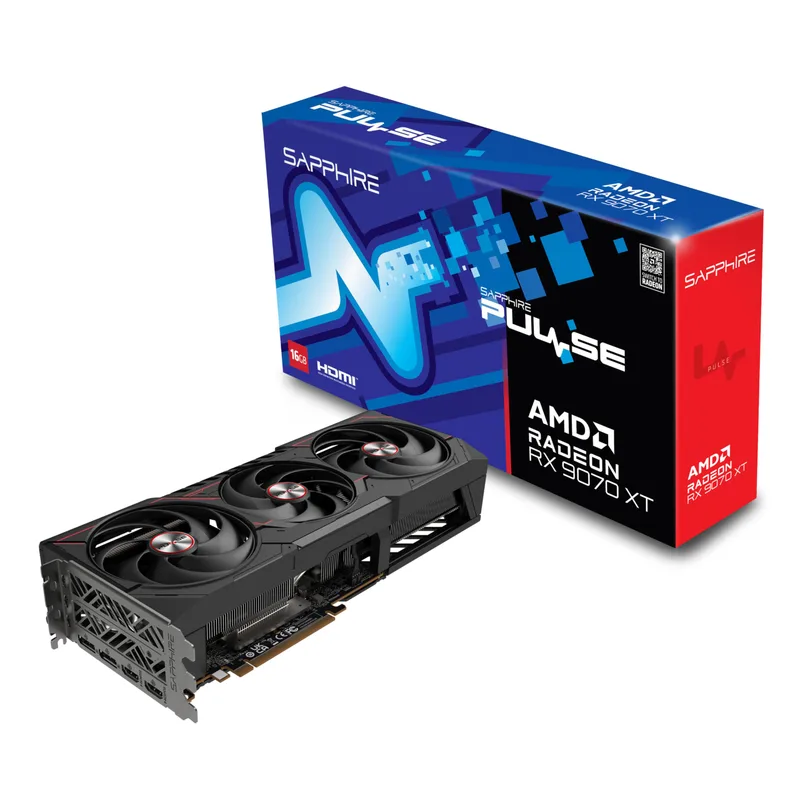
Sapphire Pulse AMD Radeon RX 9070 XT Gaming OC 16GB
The Sapphire Pulse is the reference-equivalent RX 9070 XT — Sapphire’s entry-level AIB uses stock Navi 48 silicon at 2970 MHz boost with conservative cooling. It’s been confirmed at $789.99 on Amazon as of early August 2026, making it the most affordable route into RX 9070 XT performance.
For native 1440p rasterization, it delivers everything the RX 9070 XT architecture offers. The 16GB GDDR6 buffer is the same regardless of AIB — you get AMD’s full VRAM advantage over the RTX 5070 at the lowest price point in the lineup. FSR 4 + frame generation and HYPR-RX are all present and function identically to the Nitro+.
The Pulse’s weakness is cooling headroom. At 268W TBP, it runs warmer than OC AIBs under sustained load — junction temps can approach 95°C in heavy scenes, which is within spec but above what you’d see on the Nitro+. In a case with strong positive pressure airflow (two front intakes, one top/rear exhaust), junction temps stay manageable.
At $789, it’s $140 above the MSI Gaming Trio OC RTX 5070. Whether that gap is worth it depends on your use case: if you game exclusively in native rasterization without DLSS 4, the Pulse gives you more frames per second. If you lean on AI upscaling or play ray-traced titles, the Gaming Trio OC makes more sense.
Sapphire Nitro+ AMD Radeon RX 9070 XT Gaming OC 16GB — Best AMD Overall
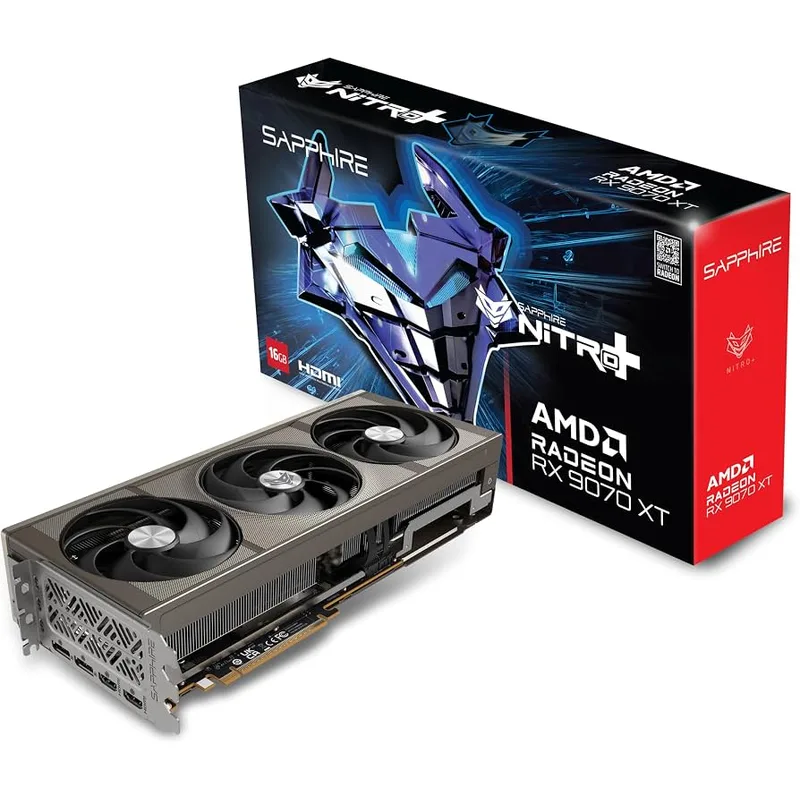
Sapphire Nitro+ AMD Radeon RX 9070 XT Gaming OC 16GB
The Nitro+ is the RX 9070 XT to buy if you want AMD’s best. Sapphire’s Honeywell PTM7950 phase-change thermal interface material is the differentiator — it delivers sustained gaming temperatures of 51–62°C under load, meaningfully below the Pulse’s performance ceiling. The 3060 MHz boost clock is 90 MHz above the Pulse and leads the RX 9070 XT AIB lineup outright.
Dual BIOS (Performance / Silent) lets you prioritize acoustic performance for desktop work or maximum clocks for gaming. The Performance BIOS pushes TBP toward ~295W — confirm your PSU is 850W or larger for this card in mid-to-high-end systems. The Silent BIOS reduces noise and power draw at a modest clock reduction.
At $829, the Nitro+ is $210 above the MSI Gaming Trio OC RTX 5070. In DLSS 4-supported games, the RTX 5070 closes or reverses the performance gap through frame generation. The Nitro+ case is strongest if your game library is native-rasterization-heavy, you want maximum VRAM longevity, or you simply prefer AMD’s software ecosystem (Adrenalin, FSR 4, better Linux driver history).
Which GPU Should You Buy?
Buy the RTX 5070 (MSI Gaming Trio OC or ZOTAC Solid OC) if:
- Your game library includes titles with strong DLSS 4 support (Cyberpunk 2077, most major 2025–2026 AAA releases)
- You play ray-traced games at maximum settings
- Your PSU is 750W and you want comfortable power headroom
- Budget is a priority — $619–$649 vs $789–$829 for the RX 9070 XT
Buy the RX 9070 XT (Sapphire Pulse or Nitro+) if:
- You play games natively without AI upscaling or prefer consistent frame pacing over AI frame generation
- You plan to game at 4K with high-texture settings and want VRAM headroom beyond 12GB
- You use Linux — AMD’s open-source driver stack remains superior to NVIDIA’s on Linux
- The 7–17% native rasterization advantage matters more to you than DLSS 4 capabilities
Neither card is a wrong purchase at 1440p in 2026. The RTX 5070’s $140–$200 price advantage at current market prices makes it the stronger value recommendation for most builders. The RX 9070 XT earns its premium for specific use cases: native-heavy gaming, 4K aspirations, and Linux builds.
FAQ
Is the RX 9070 XT faster than the RTX 5070?
In native rasterization at 1440p, yes — by 7–17% depending on the title. In ray-traced workloads, the RTX 5070 leads by 25–35% in heavy RT games like Cyberpunk 2077 Overdrive mode. With DLSS 4 Multi-Frame Generation enabled, the RTX 5070’s effective output in supported titles exceeds the RX 9070 XT’s FSR 4 frame generation ceiling.
Does DLSS 4 make the RTX 5070 better than the RX 9070 XT?
For single-player cinematic games with DLSS 4 support, it reverses the native performance gap and adds substantial perceived framerate headroom. For competitive esports titles where native performance and input latency matter more than raw FPS output, both cards perform within their native rasterization numbers and DLSS 4 frame generation is less useful.
Is 12GB enough VRAM in 2026?
At 1440p, 12GB GDDR7 covers all current titles without VRAM-related stuttering in our comparison of owner reports. At 4K with maximum texture quality in a small number of VRAM-hungry titles, 12GB can be constraining. If 4K is your primary resolution, the RX 9070 XT’s 16GB GDDR6 is the more future-proof choice.
What PSU do I need for these cards?
750W is sufficient for either card in a standard Ryzen 7 9800X3D or Core Ultra 7 265K build. For the Sapphire Nitro+ RX 9070 XT in its Performance BIOS (~295W GPU TBP) combined with a high-end CPU, 850W provides safer headroom. Confirm your PSU is rated ATX 3.0 or 3.1 and that the 16-pin cable is 12VHPWR-rated.
Is the RX 9070 (non-XT) worth considering instead?
The non-XT RX 9070 uses fewer active Compute Units and drops to ~220W TDP. At August 2026 prices it typically runs $100–$150 below the XT while performing 8–12% lower at 1440p. If RTX 5070 pricing is out of reach, the non-XT RX 9070 competes directly with ZOTAC-tier RTX 5070 cards and is worth looking at. Our full RX 9070 XT AIB roundup covers all current AIB options across both XT and non-XT variants.
The Bottom Line
At August 2026 street prices, the RTX 5070 wins on value for most builders. The MSI Gaming Trio OC at $649 costs $140 less than the entry RX 9070 XT, covers every 1440p game without issue, and adds DLSS 4 Multi-Frame Generation that the RX 9070 XT’s FSR 4 cannot match at 4× output. The RX 9070 XT — specifically the Sapphire Pulse at $789 — earns its premium for native-rasterization-heavy builders, Linux users, and anyone planning a 4K upgrade where 16GB of VRAM changes the equation. Both architectures are strong; the price gap currently favors NVIDIA.