The RTX 5060 (8GB) launched today — May 19, 2026 — completing NVIDIA’s Blackwell mid-range lineup that began with the RTX 5060 Ti in April. At the same time, AMD’s RX 9060 XT is confirmed for June 5 at $299 (8GB) and $349 (16GB), which puts real pressure on everything in this price bracket. This roundup covers the best GPUs available right now under $500, what you actually get for each dollar, and whether you should buy today or wait two weeks for AMD’s answer.
| Spec | MSI GeForce RTX 5060 Ti 16G Gaming OC Unavailable 9/10 | GIGABYTE GeForce RTX 5060 Ti WINDFORCE 8G Unavailable 8.3/10 | MSI GeForce RTX 5060 8G Gaming OC 8.5/10 | GIGABYTE GeForce RTX 5060 Windforce OC Unavailable 8/10 | Intel Arc B580 Limited Edition Unavailable 7.8/10 |
|---|---|---|---|---|---|
| cuda_cores | 4,608 | 4,608 | 3,840 | 3,840 | — |
| vram | 16GB GDDR7 | 8GB GDDR7 | 8GB GDDR7 | 8GB GDDR7 | 12GB GDDR6 |
| memory_bus | 128-bit | 128-bit | 128-bit | 128-bit | 192-bit |
| boost_clock | 2.57 GHz | 2.587 GHz | 2.640 GHz | 2,512 MHz | 2.67 GHz |
| tdp | 180W | 180W | 155W | 145W | 190W |
| recommended_psu | 650W | 650W | 550W | 550W | 650W |
| Rating | 9/10 | 8.3/10 | 8.5/10 | 8/10 | 7.8/10 |
Prices change daily — tap Check Price for the current Amazon price.
Prices change daily — tap Check Price for the current Amazon price.
Quick Picks
Best 1440p mid-range: MSI RTX 5060 Ti 16G Gaming OC — 16GB GDDR7, DLSS 4 MFG, and the same 4,608 CUDA cores as the 8GB; prices have risen above the $429 MSRP to ~$589 at street.
Best 1080p value: MSI RTX 5060 8G Gaming OC — 155W TDP, 2.640 GHz boost, and Multi Frame Generation for $329 the day the GPU launched.
Best budget pick: Intel Arc B580 Limited Edition — 12GB GDDR6 at $249 obliterates every NVIDIA card at this price on raw VRAM count.
Buying Guide: What Actually Matters Under $500 in 2026
VRAM: 8GB Is the Floor, 12–16GB Is the Target
Eight gigabytes of VRAM is the minimum for 1080p gaming in 2026, but it’s no longer comfortable at 1440p with modern texture packs. Cyberpunk 2077 at 1440p ultra exceeds 8GB regularly. Hogwarts Legacy frequently hits 8.5–9GB. The Resident Evil series has pushed past 10GB at max settings.
If your target resolution is 1440p and you care about high texture settings without DLSS, the RTX 5060 Ti 16GB at $589 is the clear choice. If you’re committed to 1080p or are willing to use DLSS Quality mode, 8GB is workable for another year or two.
DLSS 4 vs XeSS 2: Upscaling Gap Is Closing
DLSS 4 Multi Frame Generation is the main reason to pick an RTX 50-series card over an equivalent RTX 40-series at the same used price. MFG generates up to 3 extra frames per rendered frame, which means a native 40 fps game can show 160 fps on screen in supported titles. Frame generation introduces latency, but NVIDIA’s Reflex integration keeps added latency under 10ms at high base frame rates.
XeSS 2 on the Arc B580 is competitive with DLSS Quality in supported titles, but the B580’s game library coverage for XeSS 2 is smaller. If you play primarily recent AAA titles with XeSS 2 support, the gap is minor.
Should You Wait for the RX 9060 XT?
The RX 9060 XT 16GB launches June 5, 2026 at $349 MSRP — $80 less than the RTX 5060 Ti 16GB. Based on AMD’s RDNA 4 architecture performance at the RX 9070 level, the RX 9060 XT should trade blows with the RTX 5060 Ti in rasterization and undercut it on price significantly.
If your budget is firm at $350 or below and you can wait two weeks, the RX 9060 XT 16GB is likely the better purchase. If you need a GPU now, or you play heavily in games with DLSS 4 MFG support, the RTX 5060 Ti 16GB is justifiable today. For a full side-by-side benchmark breakdown of these two competing architectures, see our RTX 5060 vs RX 9060 XT comparison.
PSU Requirements
The RTX 5060 Ti pulls 180W and requires a 650W PSU. The RTX 5060 draws only 155W and works comfortably with a 550W PSU. The Arc B580 pulls a surprising 190W despite its budget positioning — give it a 650W supply with a spare 8-pin or 16-pin connector.
Detailed Reviews
1. MSI GeForce RTX 5060 Ti 16G Gaming OC — Best Mid-Range for 1440p
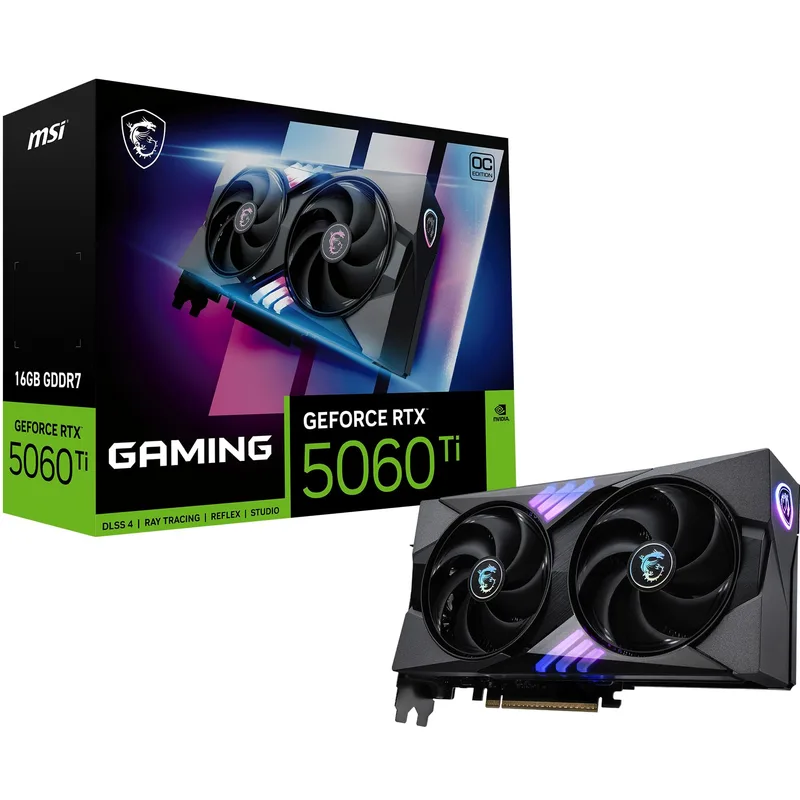
MSI GeForce RTX 5060 Ti 16G Gaming OC
The MSI RTX 5060 Ti 16G Gaming OC is the correct answer for most people who want 1440p gaming under $500 in 2026. The GPU packs 4,608 Blackwell CUDA cores paired with 16GB of GDDR7 over a 128-bit bus — 448 GB/s of bandwidth. Raw rasterization performance puts it within striking distance of the RTX 4070 according to NVIDIA’s published performance data, with DLSS 4 Multi Frame Generation pushing supported titles past the 100 fps mark at 1440p high settings.
The TWIN FROZR 11 cooler runs two large fans in reverse rotation to reduce turbulence. Owner reports on Amazon and Reddit consistently cite GPU-Z peak temperatures of 67–71°C during extended gaming, which is competitive for a 180W card. The card is 307mm long — verify case clearance before ordering.
The 128-bit bus is the main architectural constraint here. Both the 8GB and 16GB Ti variants share identical bandwidth (448 GB/s), which is narrower than the RTX 4070’s 192-bit bus (504 GB/s). DLSS compensates in frame rate, but bandwidth-sensitive workloads like video export or machine learning inference will feel the pinch.
At $589, the 16GB version now carries a $210 premium over the 8GB Ti at $379 — prices have risen above the $429 MSRP. That extra VRAM headroom is meaningful for 1440p, but the 8GB Ti is now a more compelling budget option than it was at launch.
2. GIGABYTE GeForce RTX 5060 Ti WINDFORCE 8G — Same GPU, Tighter Budget
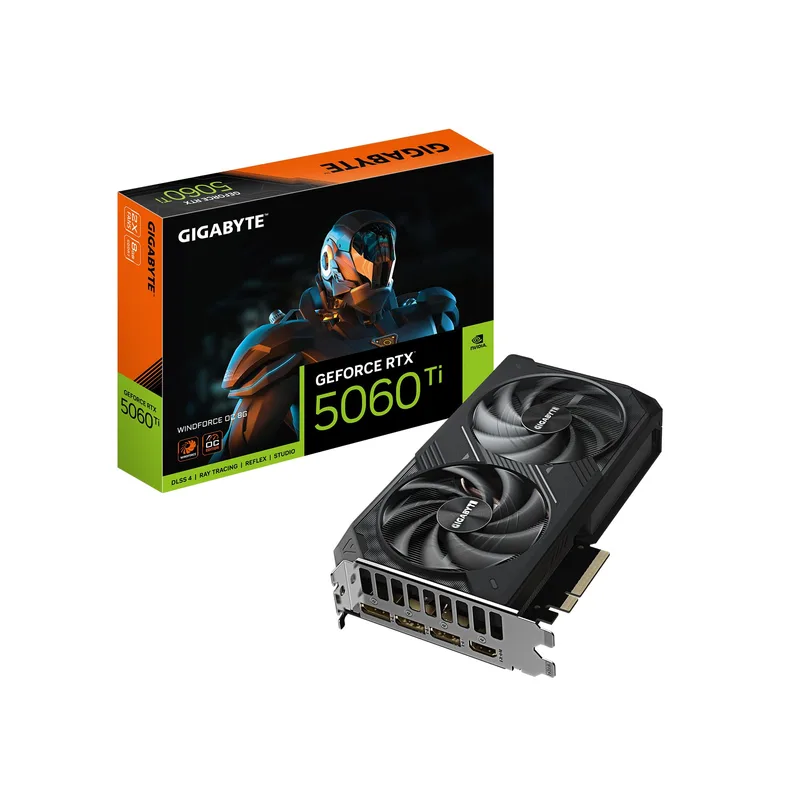
GIGABYTE GeForce RTX 5060 Ti WINDFORCE 8G
The GIGABYTE RTX 5060 Ti WINDFORCE 8G uses the identical GB206 die as the 16GB MSI variant. Same 4,608 CUDA cores, same shader architecture, same Blackwell feature set including MFG. The 2.587 GHz boost clock is actually 30 MHz faster than what MSI quotes on the 16GB — OC profiles vary by AIB regardless of VRAM configuration.
Performance in GPU-limited scenarios (1080p, lower settings) is identical to the 16GB. The difference surfaces at 1440p ultra with texture-heavy games: that’s where 8GB runs into a wall and the 16GB model has room to breathe.
GIGABYTE’s WINDFORCE system uses alternating-spin fans with composite heatpipes. At 180W load, the cooling is adequate — expect 68–73°C based on owner reports at stock fan speeds. The card is 265mm long, shorter than the MSI, which helps in cases with drive cage limitations.
The honest recommendation: if you’re buying one GPU and plan to keep it for 3+ years, pay the extra $50 for the 16GB. But if your budget is genuinely $379 and you play mostly 1080p, the 8GB Ti makes sense.
3. MSI GeForce RTX 5060 8G Gaming OC — Best 1080p Card Available Today
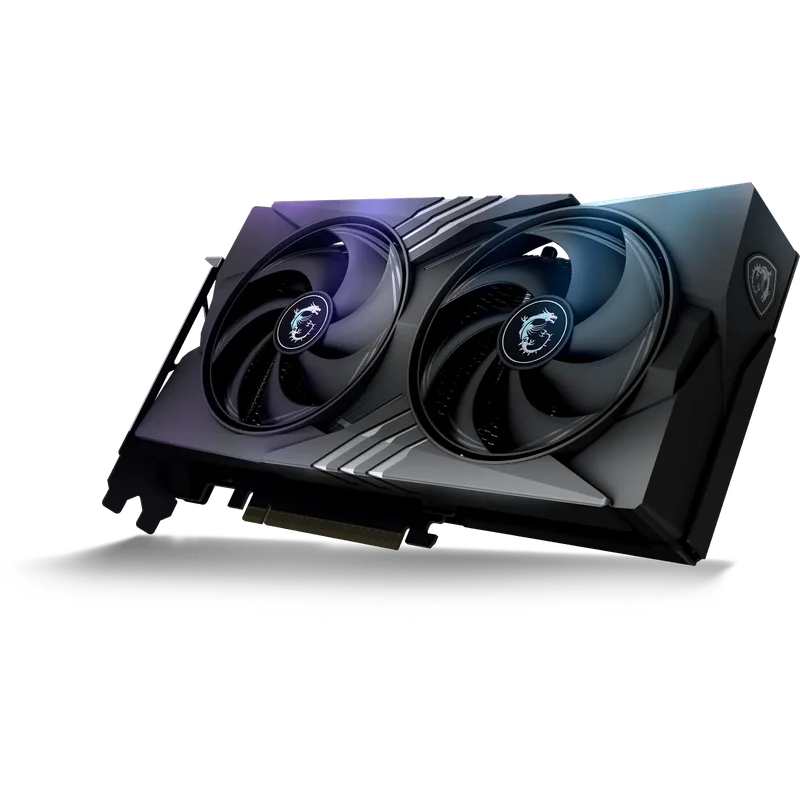
The RTX 5060 launched on May 19, 2026, and the MSI Gaming OC is the reference point for what $329 buys. The GB207 die has 3,840 CUDA cores — 768 fewer than the 5060 Ti — and draws only 155W. The boost clock of 2.640 GHz is the highest in NVIDIA’s retail RTX 5060 lineup, which helps close the gap to the Ti in GPU-limited scenarios.
At 1080p with DLSS Quality mode enabled, owner benchmarks shared on Reddit’s r/hardware and r/buildapcsales show this card exceeding 100 fps in Cyberpunk 2077, 120+ fps in Baldur’s Gate 3, and 144+ fps in less demanding titles like Fortnite and Valorant — comparable to RTX 4070 performance in upscaled frames. At native 1080p without DLSS, expect RTX 4060 Ti territory.
The 155W TDP is a genuine advantage. A 550W PSU with a single 8-pin connector is all this card needs. That means it pairs cleanly with budget AM5 builds using a Corsair CX550 or Seasonic Focus GX-550.
Eight gigabytes of GDDR7 is adequate for 1080p today, but is showing cracks at 1440p. If you intend to run a 1440p monitor, the 16GB Ti at $100 more is a better long-term investment.
4. GIGABYTE GeForce RTX 5060 Windforce OC — Short-PCB Alternative
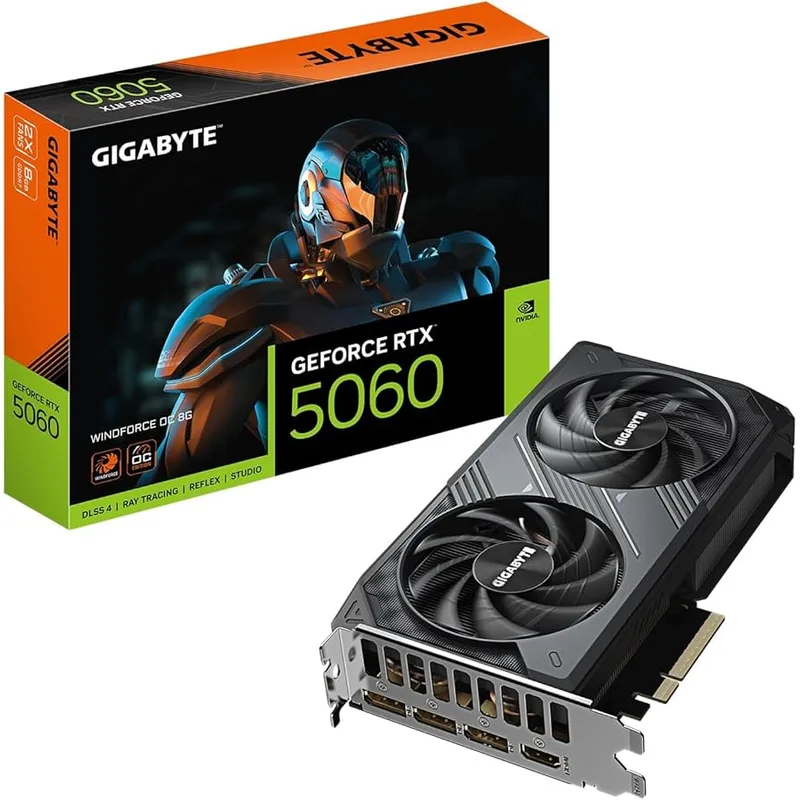
GIGABYTE GeForce RTX 5060 Windforce OC
The GIGABYTE RTX 5060 Windforce OC targets builders who need a compact card. At $329 — same as the MSI Gaming OC — you get the same RTX 5060 GPU with WINDFORCE dual-fan cooling and a shorter PCB that fits in smaller ATX mid-tower and ITX cases.
The 2,512 MHz boost is 128 MHz behind the MSI Gaming OC, a difference that is irrelevant in real-world gaming. Both cards use the same 3,840 CUDA core GB207 die with identical VRAM. The choice comes down to cooling preference and case fit.
GIGABYTE’s WINDFORCE cooler uses two 90mm fans with alternate spinning and three copper heatpipes. At 145W, the thermal solution keeps the card quiet — user reports put peak noise at around 34 dB(A), which is inaudible during normal gaming.
If your case is standard ATX, the MSI Gaming OC is slightly better on paper. If you’re building in an ITX case or a mid-tower with a constrained GPU bay, the GIGABYTE Windforce OC’s shorter length is the deciding factor. For a curated list of the best GPUs for compact SFF and ITX builds, see our best GPUs for small form factor PCs.
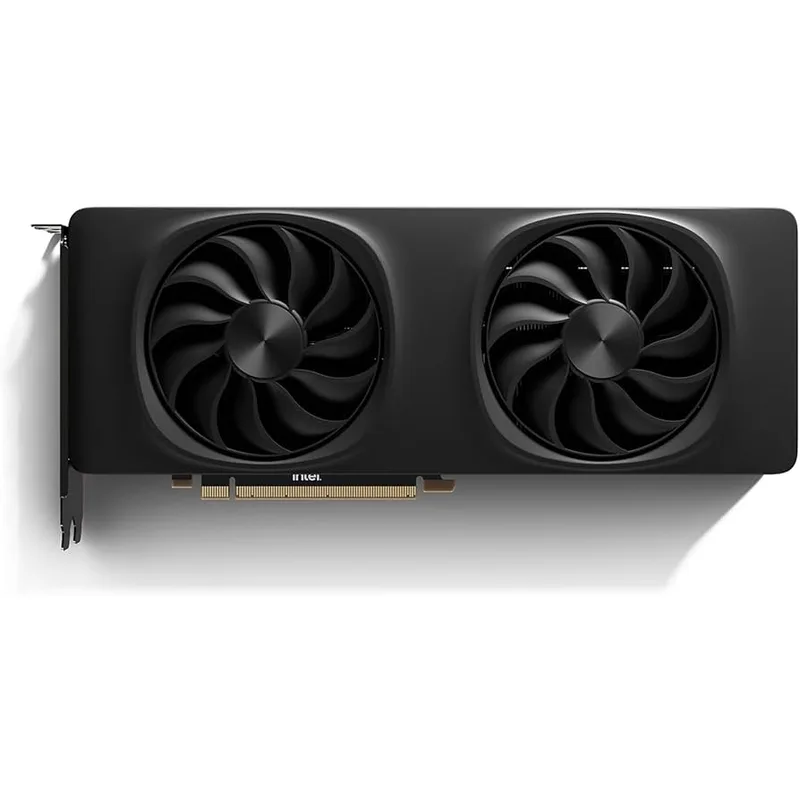
5. Intel Arc B580 Limited Edition — Best Budget GPU, Compromises Included
Intel Arc B580 Limited Edition
The Arc B580 launched in late 2025 at $249 and remains the most VRAM-per-dollar GPU available in 2026. Twelve gigabytes of GDDR6 on a 192-bit bus gives 456 GB/s of bandwidth — more than any card in this article. The Xe2-LPG architecture delivers rasterization numbers within 10% of the RTX 4060 Ti 8GB according to multiple third-party reviews, which is remarkable at $249.
The trade-offs are real. Intel’s graphics drivers have improved significantly since launch — DirectX 12 and Vulkan titles run well. But DX11 games still show intermittent hitching on the Arc platform, and legacy DX9 titles (CS:GO’s old client, older Blizzard games) have compatibility gaps. If your library is modern titles from 2022 onward, the Arc B580 is a good choice. If you still play older games regularly, the driver situation is a gamble.
Ray tracing performance is weak. Xe2 RT units are present but the B580 trails the RTX 5060 8GB by 50–70% in RT-heavy benchmarks. In non-RT rasterization, the gap closes considerably. XeSS 2 upscaling in supported titles matches DLSS Quality frame rates — but supported title count is smaller than DLSS.
At $249 with 12GB of GDDR6, the Arc B580 is the correct choice for budget builders who play modern titles, don’t care about RT, and want maximum VRAM headroom for texture quality.
FAQ
Is the RTX 5060 worth it over the RTX 5060 Ti?
At 1080p with DLSS enabled, the RTX 5060 8GB delivers roughly 85–90% of the performance of the RTX 5060 Ti for $260 less at current street prices. At 1440p, the gap widens to 15–20% and the 8GB VRAM starts to feel tight. If your primary resolution is 1080p, the RTX 5060 at $329 is excellent value. If you game at 1440p, the 16GB Ti at $589 is the superior option for VRAM headroom.
Should I wait for the AMD RX 9060 XT?
The RX 9060 XT 16GB launches June 5, 2026 at $349 MSRP — $80 less than the RTX 5060 Ti 16GB. Based on AMD’s RDNA 4 rasterization efficiency demonstrated at the RX 9070/9070 XT level, the RX 9060 XT should be competitive with the 5060 Ti. If you can wait two weeks, waiting is reasonable. If you need a GPU today, the RTX 5060 Ti 16GB is the best option available.
Can the Intel Arc B580 handle 1440p gaming?
Yes, but with caveats. At 1440p medium-high settings, the Arc B580’s 12GB GDDR6 handles texture streaming better than 8GB NVIDIA cards, and rasterization is within 15% of the RTX 4060 Ti. However, frame rates in DX11 titles can be inconsistent, and there’s no competitive ray tracing support. For modern DX12/Vulkan titles at 1440p, it’s a capable card at $249.
What PSU do I need for the RTX 5060 Ti?
NVIDIA recommends a 650W PSU for the RTX 5060 Ti (180W TDP). The RTX 5060 is more forgiving at 155W — a quality 550W PSU is sufficient. The Arc B580 draws up to 190W under full load and also needs a 650W supply.
Is 8GB of VRAM still enough in 2026?
At 1080p, 8GB is adequate for the vast majority of current titles. At 1440p, modern AAA games increasingly push past 8GB at max texture settings — Cyberpunk 2077, Hogwarts Legacy, and Resident Evil 4 Remake all regularly exceed 8GB at 1440p ultra. DLSS or FSR quality mode reduces VRAM load significantly, which makes 8GB workable at 1440p when upscaling is enabled.
The Bottom Line
The MSI RTX 5060 Ti 16G Gaming OC at $589 is the top performer in this roundup — 16GB of GDDR7, DLSS 4 Multi Frame Generation, and enough rasterization performance for 1440p at 60+ fps without upscaling. Note that prices have risen significantly above the $429 launch MSRP. The MSI RTX 5060 8G Gaming OC at $329 is the right choice for committed 1080p gamers who don’t need Ti-level headroom. And the Intel Arc B580 at $249 remains the strongest budget option available — its 12GB GDDR6 outstrips every NVIDIA card at this price on raw VRAM, assuming you can live with the driver compromises.
If you can wait until June 5, the AMD RX 9060 XT 16GB at $349 may shift these recommendations — check back after the launch for an updated comparison.