AMD launched the Radeon RX 9060 XT in mid-2025 with a pointed pitch: “fastest GPU under $350.” That framing hasn’t aged well. Ongoing GDDR6 and DRAM supply pressure through 2026 has pushed street prices on the 16GB card to roughly $429 — a $80 climb off MSRP — and reviewers who revisited the card this year, including a pointed GamersNexus follow-up piece, have called out AMD for leaning on a price point the card no longer actually hits at retail.
None of that changes what the silicon does. The RX 9060 XT 16GB still undercuts the RTX 5060 Ti by over $100 while landing within single digits of its rasterization performance, and its 16GB frame buffer holds up better than the RTX 5060’s 8GB in VRAM-hungry 1440p titles. This review covers the Sapphire Pulse Gaming OC as the representative 16GB card, compared against the RTX 5060 and RTX 5060 Ti using current third-party review data. For a side-by-side of individual AIB models, see our RTX 5060 vs RX 9060 XT comparison.
| Spec | Sapphire Pulse Radeon RX 9060 XT Gaming OC 16GB Unavailable 8.6/10 | Gigabyte RTX 5060 Windforce OC 8G Unavailable 7.8/10 | MSI Gaming RTX 5060 Ti 16G OC Unavailable 8.5/10 |
|---|---|---|---|
| Architecture | RDNA 4 Navi 44, 32 CUs, 2,048 stream processors | NVIDIA Blackwell GB206 | NVIDIA Blackwell GB206 |
| Boost_Clock | 3130 MHz (OC) | 2,512 MHz | — |
| Memory | 16GB GDDR6, 128-bit, 320 GB/s | 8GB GDDR7, 128-bit | 16GB GDDR7, 128-bit, 448 GB/s |
| TDP | 170W (OC BIOS) | 145W | 180W |
| PCIe | PCIe 5.0 x16 | — | PCIe 5.0 |
| Outputs | 2x DisplayPort 2.1a, 1x HDMI 2.1b | 3x DisplayPort 2.1a, 1x HDMI 2.1b | 3x DisplayPort 2.1a, 1x HDMI 2.1b |
| Rating | 8.6/10 | 7.8/10 | 8.5/10 |
Prices change daily — tap Check Price for the current Amazon price.
Prices change daily — tap Check Price for the current Amazon price.
Specifications
| Spec | AMD Radeon RX 9060 XT 16GB |
|---|---|
| Architecture | RDNA 4 (Navi 44) |
| Compute Units | 32 |
| Stream Processors | 2,048 |
| Boost Clock | 3130 MHz (Sapphire Pulse OC) |
| Memory | 16GB GDDR6 |
| Memory Bus | 128-bit |
| Memory Bandwidth | 320 GB/s |
| Reference TDP | 160W (170W on OC AIB cards) |
| Process Node | TSMC 4nm |
| PCIe Interface | PCIe 5.0 x16 |
| MSRP | $349 (16GB) |
| Street Price | ~$429 (September 2026) |
What RDNA 4 Brings to the Budget Tier
The RX 9060 XT uses the same Navi 44 die across both the 8GB and 16GB configurations, with 32 compute units and 2,048 stream processors. That’s a smaller chip than the RX 9070 XT’s Navi 48, but it inherits the same RDNA 4 improvements: third-generation ray tracing accelerators and second-generation AI accelerators that finally make FSR 4’s machine-learning upscaling possible on a sub-$450 card.
The 16GB variant reviewed here runs on a 128-bit memory bus at 320 GB/s — noticeably behind the RTX 5060 Ti’s 448 GB/s GDDR7 setup, but the larger 16GB frame buffer still matters more than raw bandwidth in the titles where 8GB cards start dropping textures. AMD confirmed a full PCIe 5.0 x16 interface on all RX 9060 XT variants, so bandwidth to the CPU isn’t a bottleneck even in older PCIe 4.0 boards.
Gaming Performance
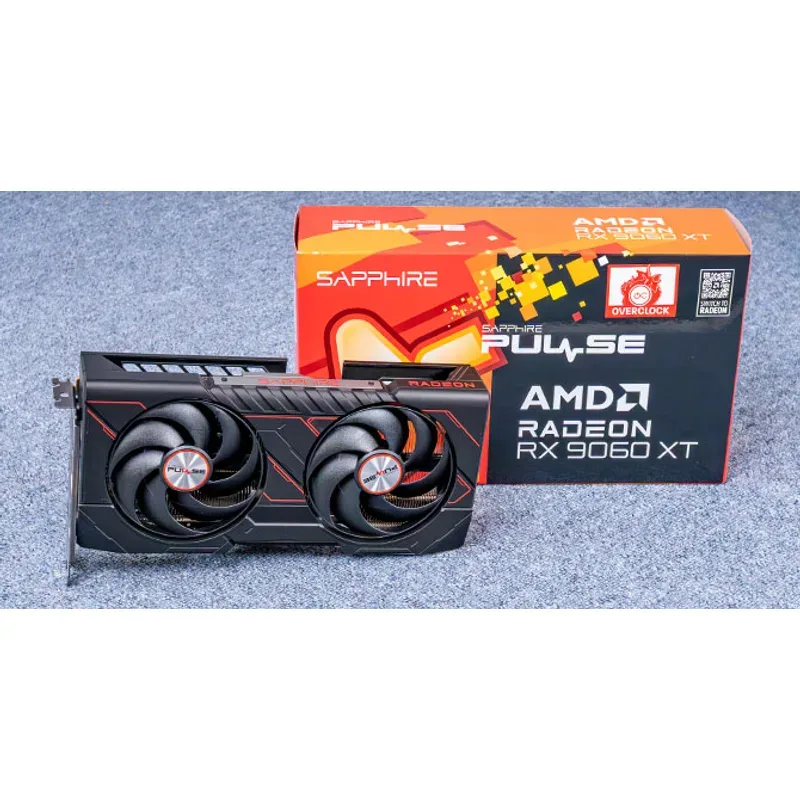
Sapphire Pulse Radeon RX 9060 XT Gaming OC 16GB
Based on TechSpot and Tom’s Hardware benchmark data comparing the RX 9060 XT 16GB against both Nvidia competitors:
1080p Rasterization
| Comparison | Result |
|---|---|
| RX 9060 XT vs RTX 5060 | 2-17% faster (typically ~10%) |
| RX 9060 XT vs RTX 5060 Ti | ~3% slower |
1440p Rasterization
| Comparison | Result |
|---|---|
| RX 9060 XT vs RTX 5060 | Same to 22% faster |
| RX 9060 XT vs RTX 5060 Ti | ~5% slower overall, but takes a ~4% lead at ultra settings |
The pattern holds across both resolutions: the RX 9060 XT clearly outruns the RTX 5060, and it stays close enough to the RTX 5060 Ti that the $110+ price gap is hard to justify on rasterization alone. At 1440p ultra specifically, the two trade blows depending on the title, which is a stronger showing than the 9060 XT’s launch reviews suggested.
Ray Tracing Performance
Ray tracing is where the RTX 5060 Ti pulls ahead. Nvidia’s Blackwell architecture leads the RX 9060 XT by roughly 8% at 1080p medium ray tracing settings and about 5% at 1080p ultra. That gap narrows and even flips at higher resolutions — the RX 9060 XT takes a 7% lead over the RTX 5060 Ti at 1440p ultra RT settings, likely helped by its larger VRAM buffer avoiding the memory pressure that RT effects add on top of textures.
Against the plain RTX 5060, the story is less favorable for AMD: the 9060 XT’s RT performance trails by a wider margin in heavily RT-dependent scenes, since the RTX 5060 packs the same third-generation RT cores as its Ti sibling. If ray tracing is a priority and you’re choosing between the RX 9060 XT and the base RTX 5060, the Nvidia card’s RT hardware advantage over an 8GB frame buffer is a real tradeoff to weigh against the AMD card’s extra VRAM.
Power and Efficiency
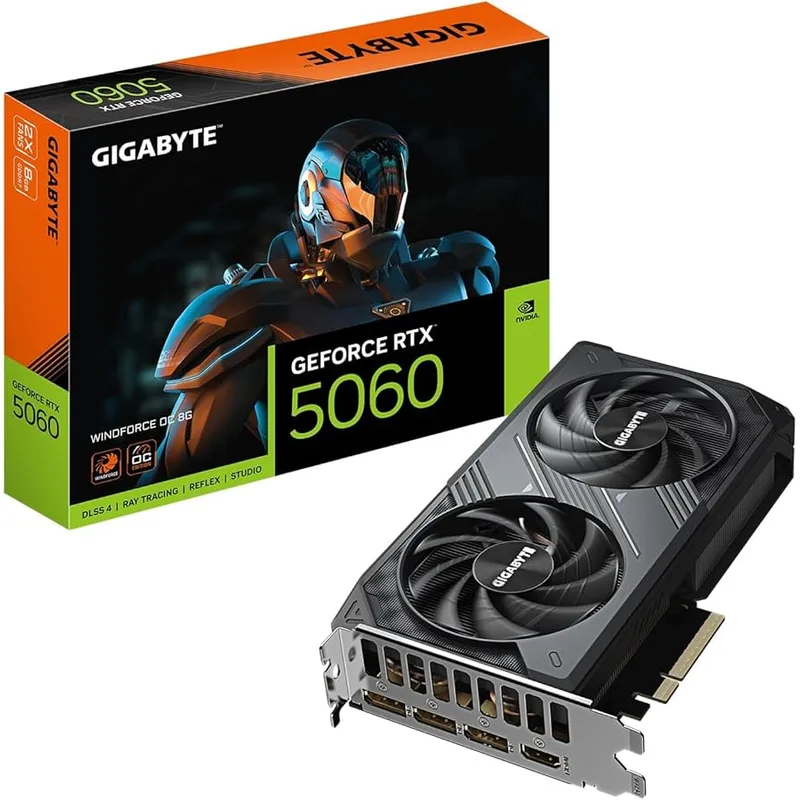
Gigabyte RTX 5060 Windforce OC 8G
AMD rates the reference RX 9060 XT 16GB at 160W TBP; the Sapphire Pulse OC card measures closer to 170W under sustained load. That sits below the RTX 5060 Ti’s 180W TGP but above the standard RTX 5060’s 145W. In practice, none of these three cards demand exotic cooling or huge PSUs — AMD recommends a 600W PSU for the RX 9060 XT, comfortable with any modern budget or mid-range system.
The Gigabyte RTX 5060 Windforce OC 8G is the efficiency leader here at 145W, which matters more for small-form-factor builds or systems already running a 500-550W PSU than for raw performance-per-dollar. If your case airflow or PSU headroom is tight, that’s the card to build around; if you have 600W+ to spare, the RX 9060 XT’s extra VRAM buys more headroom for future titles.
The Competition
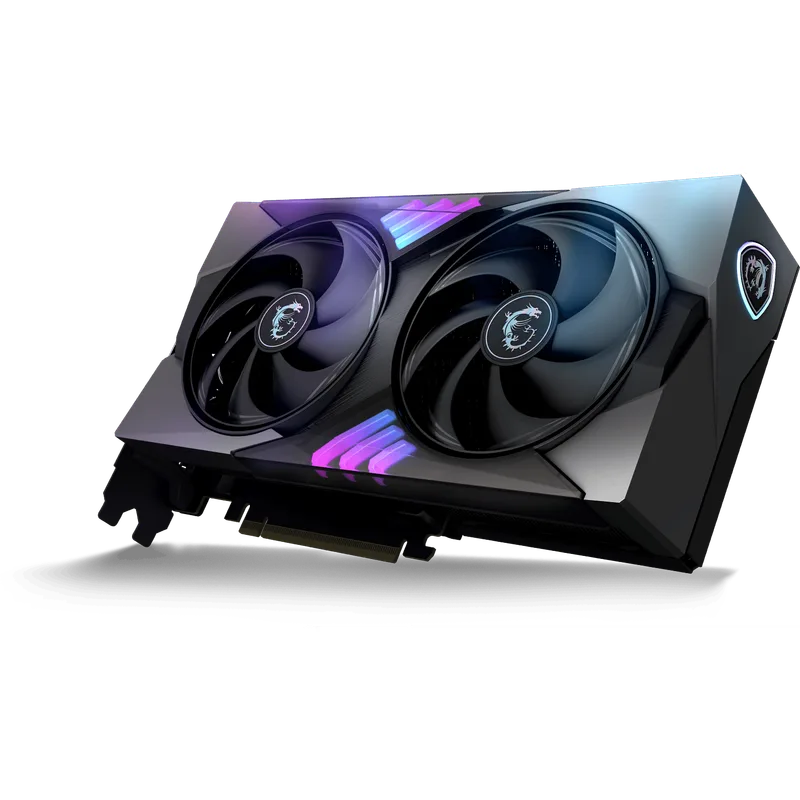
MSI Gaming RTX 5060 Ti 16G OC
The MSI Gaming RTX 5060 Ti 16G OC is the closer comparison once you match VRAM capacity. At $539 street, it costs over $100 more than the RX 9060 XT but only delivers about a 5% rasterization edge at 1080p and 1440p, per Tom’s Hardware’s benchmark suite. Where it earns its premium is ray tracing (a 5-8% lead at 1080p) and DLSS 4 Multi Frame Generation, which still outpaces FSR 4’s frame generation in supported titles. If ray tracing or DLSS 4 output quality matters more to you than saving $110, the RTX 5060 Ti is the stronger buy. For pure rasterization value at 16GB VRAM, the RX 9060 XT wins the math.
The Gigabyte RTX 5060 Windforce OC 8G undercuts both cards at $349, and for 1080p-only gaming without ray tracing, that’s a legitimate budget path onto Blackwell’s DLSS 4 stack. Its 8GB buffer is the limiting factor — several 2026 AAA titles already push past 8GB at 1440p with ultra textures, a wall the RX 9060 XT’s 16GB doesn’t hit.
Who Should Buy the RX 9060 XT
Buy the RX 9060 XT if:
- You game at 1080p or entry-level 1440p and want VRAM headroom for future AAA titles
- You’re comparing it against the RTX 5060 Ti and the price gap is $100+ in AMD’s favor
- FSR 4 image quality is acceptable to you and DLSS 4 Multi Frame Generation isn’t a priority
Consider the RTX 5060 instead if:
- Your budget caps out around $349 and you only play at 1080p
- Case size or PSU wattage is genuinely constrained
Consider the RTX 5060 Ti instead if:
- Ray tracing performance and DLSS 4 Multi Frame Generation matter more than saving $110
- You want matching 16GB VRAM with more memory bandwidth
FAQ
Is the RX 9060 XT still worth it at $429 instead of its $349 launch price?
It’s a weaker deal than at launch, but the comparison that matters is against the RTX 5060 Ti, not the original MSRP. At $429 versus the RTX 5060 Ti’s $539, the RX 9060 XT still delivers rasterization performance within single digits for over $100 less — that math holds even with the price increase.
Does the RX 9060 XT support FSR 4?
Yes. FSR 4 uses AMD’s RDNA 4 AI accelerators for machine-learning-based upscaling, closing most of the image-quality gap that separated earlier FSR versions from DLSS. It’s a meaningful upgrade over FSR 3.1 in supported titles.
What PSU does the RX 9060 XT need?
AMD recommends 600W for the 16GB card. With a typical budget or mid-range system (Ryzen 5 or Core i5-class CPU, one NVMe drive), a quality 600W unit leaves comfortable headroom.
Should I get the 8GB or 16GB RX 9060 XT?
The 16GB card, if the roughly $80 price difference fits your budget. The 8GB model is the same Navi 44 die at a lower price, but 8GB is already tight in several 2026 titles at 1440p ultra settings — the same limitation that affects the RTX 5060’s 8GB configuration.
How does the RX 9060 XT compare to the RX 9070?
The RX 9070 uses the larger Navi 48 die and delivers a meaningful step up in rasterization for roughly $200 more at current prices. The RX 9060 XT is the better choice if your budget caps around $400-450; the RX 9070 makes more sense once you’re building for 1440p high-refresh or light 4K.
The Bottom Line
The AMD Radeon RX 9060 XT 16GB no longer hits the $349 price AMD advertised at launch, but the value case against its closest Nvidia competitor hasn’t weakened. Landing within single digits of the RTX 5060 Ti’s rasterization performance for over $100 less, while carrying double the VRAM of the RTX 5060, makes it the sensible pick for 1080p and entry-level 1440p builds where ray tracing isn’t the priority.
The caveats are real: the RTX 5060 Ti still leads in ray tracing and DLSS 4 Multi Frame Generation, and the $429 street price stings compared to the launch pitch. But for budget builders prioritizing rasterization performance and VRAM headroom over ray tracing polish, the RX 9060 XT 16GB at ~$429 remains the strongest value in its price bracket.