The Alienware AW2725DF launched in March 2024 at $899.99 as one of the first 27-inch 360Hz QD-OLED monitors. In August 2026, street prices have settled into the $650–$750 range — and the competitive landscape has shifted. LG now offers 480Hz WOLED at roughly the same price, and Samsung sells a matte-coated 360Hz QD-OLED for $50 more. This review covers whether the AW2725DF remains the right pick, and for whom.
| Spec | Alienware AW2725DF 27" 360Hz QD-OLED Gaming Monitor 9.2/10 | LG 27GX790A-B 27" 480Hz WOLED Gaming Monitor Unavailable 9.5/10 | Samsung Odyssey OLED G6 G60SD 27" 360Hz QD-OLED 8.9/10 |
|---|---|---|---|
| panel | 26.7" QD-OLED (Samsung), glossy | 26.5" WOLED (LG), glossy | 27" QD-OLED (Samsung), matte anti-glare |
| resolution | 2560x1440 (QHD), 360Hz | 2560x1440 (QHD), 480Hz | 2560x1440 (QHD), 360Hz |
| response_time | 0.03ms (GtG) | 0.03ms (GtG) | 0.03ms (GtG) |
| hdr | DisplayHDR 400 True Black, ~1,000 nits peak | DisplayHDR True Black 400, ~800 nits peak | DisplayHDR 400 True Black, HDR10+ |
| color | 99.3% DCI-P3 | ~98.5% DCI-P3 | 99% DCI-P3 |
| connectivity | 2x DP 1.4, 1x HDMI 2.1, USB-C, 4x USB 3.2 Gen 1 | DP 2.1, 2x HDMI 2.1, USB hub | 2x DP 1.4, 1x HDMI 2.1 |
| Rating | 9.2/10 | 9.5/10 | 8.9/10 |
Prices change daily — tap Check Price for the current Amazon price.
Prices change daily — tap Check Price for the current Amazon price.
Specifications
| Spec | Alienware AW2725DF |
|---|---|
| Panel | 26.7” QD-OLED (Samsung) |
| Resolution | 2560×1440 (QHD) |
| Refresh Rate | 360Hz |
| Response Time | 0.03ms (GtG) |
| Variable Sync | AMD FreeSync Premium Pro, G-Sync Compatible |
| HDR | DisplayHDR 400 True Black |
| Brightness (typical) | ~250 nits (100% white) |
| Brightness (peak) | ~1,000 nits (small highlight window) |
| Color Coverage | 99.3% DCI-P3 |
| Panel Surface | Glossy |
| Inputs | 2x DisplayPort 1.4, 1x HDMI 2.1, 1x USB-C |
| USB Hub | 4x USB 3.2 Gen 1 downstream |
| Stand Adjustments | Height (150mm), tilt (-5° to 21°), swivel (±20°), pivot (90°) |
| VESA | 100×100mm |
| Launch Price | $899.99 (March 2024) |
| Street Price | ~$699 (August 2026) |
Panel Performance
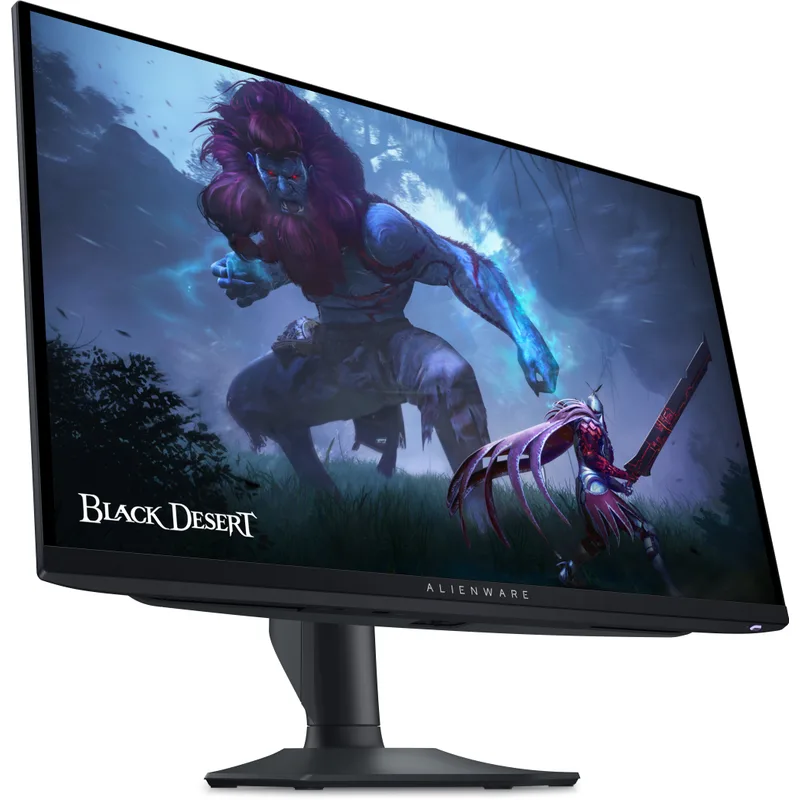
Alienware AW2725DF 27" 360Hz QD-OLED Gaming Monitor
Samsung’s QD-OLED technology — the same panel generation used in the AW2725DF — applies quantum dot color conversion over a blue OLED backplane, producing richer reds and greens than LG’s WOLED approach. The result is 99.3% DCI-P3 coverage and colors that read as saturated rather than merely bright. Side-by-side with the LG 27GX790A-B, the delta is subtle in gaming scenarios, but noticeably wider when comparing sRGB content or photo work where color accuracy is the point.
OLED’s absolute black depth means real-world contrast ratios in the millions-to-one. In a dark room, this is immediately visible: dimly lit environments in Cyberpunk 2077 or Alan Wake 2 reveal shadow detail that a local-dimming IPS panel suppresses behind a halo. SDR content benefits as well — the infinite contrast extends to everyday desktop use, not only HDR gaming.
Peak brightness sits around 250 nits for a full white screen, climbing to roughly 450 nits at a 10% window and approximately 1,000 nits for small highlights under 3% of the screen. For HDR gaming in a dark-to-moderate room, DisplayHDR 400 True Black certification delivers more punch than 400 nits implies on a local-dimming LED display. That said, if your room gets very bright, the AW2725DF won’t wash out highlights the way a budget monitor would — but its glossy surface will create reflections that compete with what you’re seeing on screen.
The glossy panel surface is the AW2725DF’s most practical limitation. Under overhead ceiling lights or with a window behind you, reflections are visible and persistent. For dark-room gaming or controlled environments, this is a non-issue. For bright home offices or desks facing windows, it’s a genuine ergonomic problem — one the Samsung G60SD’s matte coating directly addresses.
Gaming at 360Hz
For the 1440p competitive gaming use case, 360Hz lands above the ceiling most hardware combinations can consistently drive. Reaching frame rates above 360 FPS in CS2 at 1440p requires at minimum a Ryzen 7 9800X3D paired with an RTX 5080. In Valorant and other lower-overhead titles, hardware capable of sustaining 360 FPS is more accessible, and the visible motion clarity improvement over 240Hz is measurable in aim-intensive scenarios.
The 0.03ms GtG response time means no pixel-level motion blur from slow OLED transitions — a known issue with early OLED monitors before manufacturers optimized the driving circuitry. For comparison on how refresh rates compare across your existing setup, see our 144Hz vs 240Hz vs 360Hz monitor guide.
AMD FreeSync Premium Pro with G-Sync compatibility means VRR sync works with both AMD and Nvidia GPU platforms. The FreeSync range covers 48–360Hz, so frame pacing is smooth even in GPU-limited scenarios where frame rates dip below 360.
Alienware includes OLED Care features — pixel refresh cycles, logo luminance adjustment, and an automatic screen timeout. Based on owner reports across the two-plus years this panel has been available, burn-in risk under normal gaming and desktop use is low when these guidelines are followed. Static HUD elements left on screen for extended sessions carry more risk than typical game play does.
Design and Ergonomics
The AW2725DF uses a rectangular matte-black chassis without AlienFX RGB lighting — a sensible choice on a display this thin. The stand delivers 150mm of height adjustment, ±20° swivel, -5° to 21° tilt, and a 90° portrait pivot. That ergonomic range is broader than most competing OLED monitors at this price tier, and it means the included stand is functional enough that most users won’t need a monitor arm. The 100×100mm VESA mount is available if you prefer one.
Four USB 3.2 Gen 1 ports on the back of the monitor, plus USB-C, makes desk cable management easier than monitors without a hub. The USB-C implementation provides video passthrough and data, though it doesn’t deliver enough wattage for laptop charging at full load.
The Competition
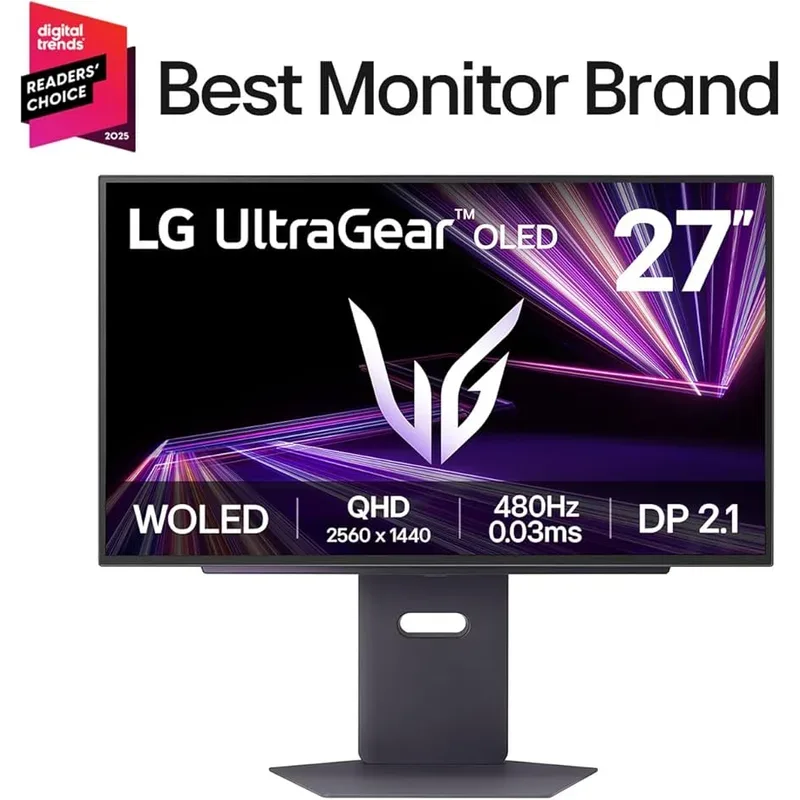
LG 27GX790A-B 27" 480Hz WOLED Gaming Monitor
The LG 27GX790A-B matches the AW2725DF at ~$699 street while offering 480Hz on LG’s WOLED panel — a 120Hz advantage at the same price point. For competitive gaming, that gap is meaningful: higher max refresh enables tighter frame pacing at extreme frame rates, and DisplayPort 2.1 handles full 480Hz over a single cable without the DSC compression that DP 1.4’s bandwidth limits impose.
LG’s WOLED produces slightly less color saturation — 98.5% DCI-P3 versus the AW2725DF’s 99.3%. In direct side-by-side comparison, Samsung’s reds and greens read as deeper. For a dedicated creative workflow, the AW2725DF maintains a color advantage. For competitive gaming where you’re likely running low-saturation competitive settings anyway, this distinction disappears. Both panels share glossy surfaces without a matte option.
If you primarily play fast-paced competitive titles and your hardware can sustain 400+ FPS in those games, the LG 27GX790A-B is the stronger buy at the same price. If your use case spans competitive gaming alongside content creation, photo editing, or video work, the AW2725DF’s QD-OLED color advantage and USB-C hub justify choosing it over the LG.
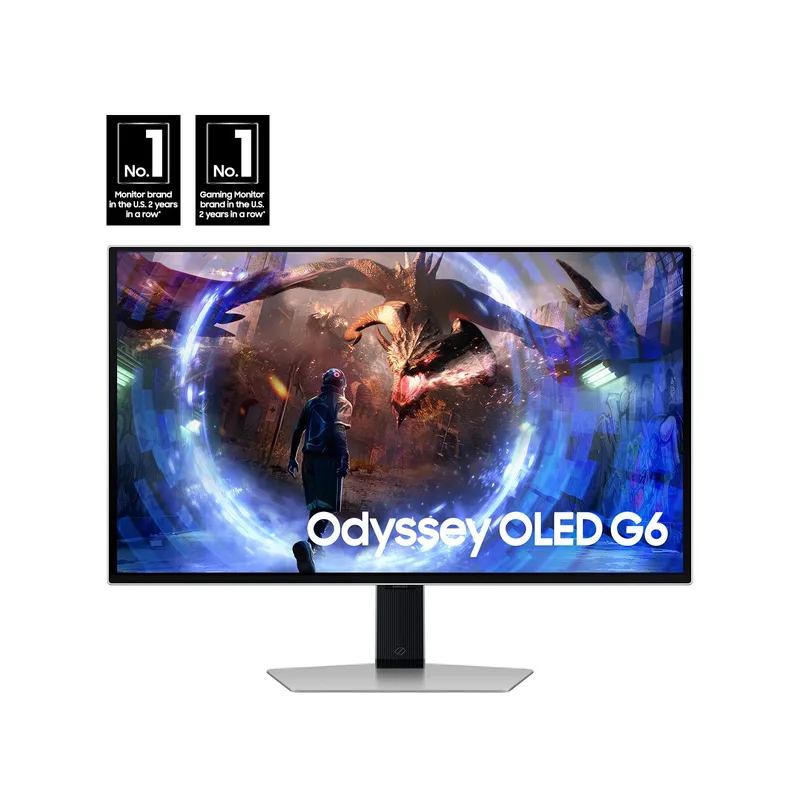
Samsung Odyssey OLED G6 G60SD 27" 360Hz QD-OLED
The Samsung Odyssey OLED G6 G60SD uses the same QD-OLED panel type as the AW2725DF at 360Hz with one differentiating feature: a matte anti-glare coating. In a bright room, the G60SD is a usable display where the AW2725DF becomes a mirror. Samsung’s Dynamic Cooling System with Pulsating Heat Pipe also reduces thermal throttling during extended HDR sessions, which helps sustain the higher brightness numbers for longer.
The trade-offs for that matte coating are real. Perceived color saturation and sharpness drop compared to the glossy AW2725DF — the matte surface scatters light slightly and reduces the “pop” that makes OLED visually striking in darker environments. For games, it’s a moderate reduction that most users adapt to quickly. For photography or color work, you’re accepting some visual softness in exchange for no reflections.
At $749, the G60SD costs $50 more than the AW2725DF without adding refresh rate or resolution. It also lacks a USB hub. The matte coating is the sole justification for that premium — and for users with a bright desk environment, it’s a legitimate justification. For broader QD-OLED comparisons, see our full OLED roundup.
Who Should Buy the AW2725DF
Buy the Alienware AW2725DF if:
- You game in a controlled or dark environment where glossy reflections aren’t a daily problem
- You want QD-OLED color accuracy for both gaming and casual creative work
- You need USB-C and an integrated USB hub without adding a separate dock
- Your game library is a mix of competitive titles and AAA games where 360Hz is sufficient
Choose the LG 27GX790A-B instead if:
- Your game library is primarily fast-paced competitive titles and your hardware can sustain 400+ FPS
- Refresh rate headroom matters more than color saturation
Choose the Samsung G60SD instead if:
- Your desk is in a bright room with windows or strong overhead lighting
- You want QD-OLED quality without the glossy surface reflections
FAQ
Is the AW2725DF good for productivity and creative work?
The 99.3% DCI-P3 coverage makes it viable for photo editing and casual video work. For sRGB-targeted design work, switch to the sRGB emulation mode — native mode oversaturates sRGB content at approximately 150% coverage. Professional color grading requiring DCI-P3 calibration benefits from the wide gamut.
What GPU do I need to run 360Hz at 1440p?
For competitive titles with lower graphical overhead (CS2, Valorant, Apex Legends), a mid-range GPU like an RX 9070 or RTX 5070 paired with a fast CPU reaches the 300–360 FPS range at 1440p with optimized settings. For GPU-heavy AAA titles at max settings, most hardware will run below 360 FPS — but FreeSync Premium Pro ensures VRR sync down to 48 FPS keeps the experience smooth even when not at peak refresh.
How does OLED burn-in risk compare to LCD in practice?
Based on owner reports from two-plus years of this panel being in use, burn-in risk under typical gaming sessions is low when Alienware’s OLED Care features are active. Static on-screen elements — desktop taskbars left displayed for hours, persistent HUD overlays in certain games — carry more risk than general gaming use. Enable the pixel refresh cycles, use the screen timeout, and vary your content, and the risk is manageable for normal use patterns.
Does the AW2725DF work at 360Hz over HDMI?
No. HDMI 2.1’s bandwidth caps the AW2725DF at 120Hz at 1440p. Achieving 360Hz requires DisplayPort. Use either of the two DP 1.4 inputs with a DisplayPort 1.4 cable for full 360Hz. For more context on which resolution and refresh rate combinations map to which cable standards, see our 1440p gaming monitor roundup.
The Bottom Line
The Alienware AW2725DF was an early 360Hz QD-OLED pioneer at $899.99. At ~$699 in August 2026, it’s now the most accessible entry into premium 27” QD-OLED gaming — delivering Samsung’s 99.3% DCI-P3, perfect OLED contrast, 0.03ms response, and a full ergonomic stand with USB-C connectivity.
The honest limitations are the glossy panel in bright environments and the 360Hz ceiling at a time when LG offers 480Hz for the same money. For dark-room builds combining competitive gaming with content creation, the AW2725DF wins on color and value. For dedicated competitive gaming focused purely on frame rates, the LG 27GX790A-B at $699 delivers more headroom at the same price. For bright-room setups where reflections are the deciding factor, the Samsung G60SD at $749 is the only matte QD-OLED in this tier.